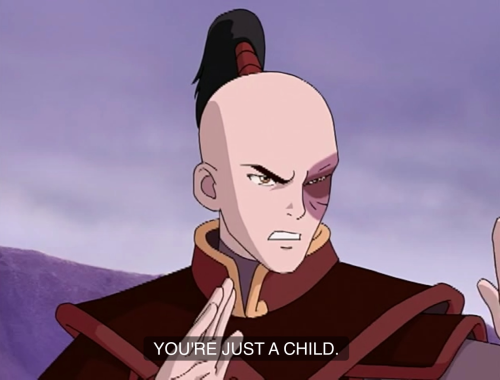
Sometimes I think about the fact that there is exactly one time that we hear someone express surprise at the fact that Aang–the Avatar– and his companions are children. And it’s in the second episode, from Zuko:
From an out-of-universe perspective, this makes sense. And it wasn’t something that surprised me when I was a ten-year-old in 2005 when A:tLA first aired. One of the tenants, I think, of adventure children’s television is that there is a degree of wish fulfillment. Children want to be taken seriously as agents, and so it makes sense from that vantage point, that everyone takes the Gaang seriously as agents except the person portrayed as an antagonist.
But, I think this also makes sense, heart-breakingly and unlike other children’s adventure television, from an in-universe perspective. This is a world ravaged by bloody, bloody war for a hundred years. A world in which child soldiers are commonplace. We see countless examples of this throughout the series:
When we meet Sokka–fifteen-years-old and in-charge of security for his village–he is training small children to be soldiers. This is played off as something of a laugh, but if Aang hadn’t returned in the second episode, I think we’re supposed to think that Sokka very much would have tried to lead these little boys into battle.
Jet and the Freedom Fighters, who practice guerrilla warfare (fairly successfully) and regularly raid Fire Nation outposts, are children. Jet, who I think we are supposed to assume is one of the eldest of the group, is sixteen when he dies (according to the Avatar wiki).
The Kyoshi Warriors are one of the elite-most fighting force in Avatar World, eventually taken seriously by the Earth Kingdom military and given military jobs. And the general of the Kyoshi Warriors, Suki, and the eldest member of the group (again according to the Avatar wiki) is fifteen. She can’t have always been the eldest member. I’m willing to bet the older women are sent off to war, and Suki becomes the eldest member and the leader by default. (Much like Sokka–probably why they connect so well).
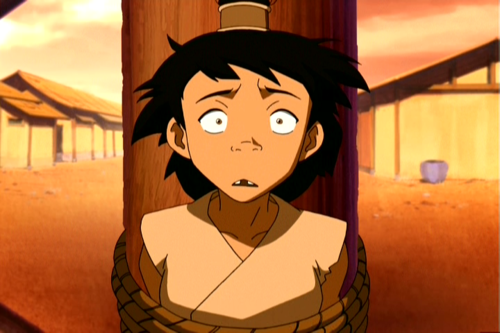
In Zuko, Alone, the soldiers in the village threaten to send Lee off to join the army at the front, and based on the mother’s reaction, and what we see of him when he’s tied up, this doesn’t seem like an empty threat, and it’s probably not the first time this has happened to children in the Earth Kingdom in villages like these.
I could go on.
So of course, after living in a world of child soldiers like these, no one is going to bat an eyelash to learn that the Avatar–perhaps the ultimate non-Fire Nation soldier–is twelve-years old, and his companions aren’t much older. When Aang starts to bring this up himself to Yue, for instance, Yue doesn’t seem to understand. He’s the Avatar, he has to save them, she insists. Who cares if he’s a child?
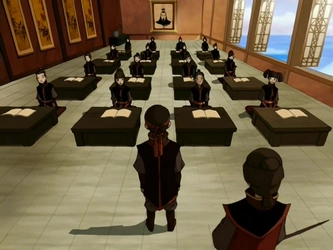
But the Fire Nation Army isn’t filled with child soldiers. It doesn’t need them. Fire Nation children are in school. It is adults that make up the Fire Nation Army.
And, (with the exception of Azula and her gang), when we do see a Fire Nation child attempting to take on the role of an adult member of the military, he isn’t taken seriously. (E.g. Zuko, and the way Zhao brushes him off.)
So of course it is only Zuko, who grew up in the absolute center of the Fire Nation, and, though he is banished, hasn’t really seen much of the reality of the war until he meets Aang, that looks at the Avatar and remarks in surprise that he is a child.
(If anyone is interested, I wrote a fic that deals with a lot of these themes. It can be found here.)
This is not only an excellent analysis but I think it also ties in to one of the greater themes of the show as a whole, namely these kids are entitled to a childhood even in a broken world:
“Normally we would have told you of your identity when you turned sixteen, but there are troubling signs. Storm clouds are gathering.”
“I fear that war may be upon us, young Avatar.”
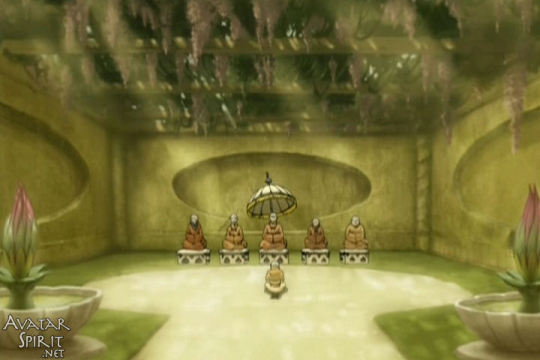
In their fear the Air Nomads were going to make Aang the first child soldier against the Fire Nation. In their rush to skip four years they lost a hundred. Aang rejects that role early on and constantly rejects it even as he accepts his responsibility as the Avatar.
He reminds Katara that she’s still a kid. When he connects to Zuko the first time it’s through the language of all the fun he used to have with his friends in the Fire Nation. Team Avatar takes the time they need for vacations and to make new friends. In doing this they start to heal the world person by person.
Aang most succeeds as Avatar when he finds balance between childish things and adult responsibilities. This rubs off on everyone. Sokka goes from desperate to be taken seriously to someone who sets himself up for a laugh, because he knows his own strength. Zuko spends season 1 as an imitation of Ozai, ends the show as someone who can lead a country and smile openly at a goofy drawing.
They are all still very young with too many responsibilities on their shoulders. But they’ve also carved out an important space where they can be children with each other. All things in balance.
things I have seen called pedophilia on this hellsite with my own two eyes
– a relationship between two adults with the youngest being 25
– a high school senior dating a high school junior
– a college senior being sexually interested in a college freshman
– size difference fetish art featuring two adult characters
– consenting adults engaging in kink with other consenting adults
– writing about 2 teenagers of similar ages having sex
– shipping characters with vaguely defined ages who are treated as adults in canon
–
telling kids that asexuality exists
– sex education
like, I shouldn’t have to ask myself if the person being accused of pedophilia is an actual child molester or if they reblog shippy vo|tron fanart
Antis: Why do people hate us for not liking pedophilia :////
Also Antis:*call out everything under the sun that isn’t pedophilia as pedophilia and then wonder why the fuck nobody takes pedophilia claims seriously anymore*
👆👆👆👆👆
I wrote this post on September 4th, 2017. It only took a month. (From that point on.)
False callout posts get hundreds if not thousands of notes (albeit at least half of them confused or rejecting the accusations), while posts trying to draw attention to individuals that might pose actual danger go ignored.
There’s something demonstrably harmful to minors and adults alike, especially to victims/survivors – it’s how much of a rhetorical nightmare shipping discourse is, and how much it actually desensitizes people to the subjects in question. You do not want people to become callous and dismissive, but the individuals continuously fabricating accusations, watering down definitions, making completely outrageous claims, and concentrating their opportunistic activism on ‘problematic content’ do everything possible to erode the patience, understanding, sympathy and empathy of the people around them.
Please, please stop trying to sell your ship wars as literally anything else. You’re doing more damage than any piece of fiction possibly could. This is how you are affecting reality, and the effect your actions have is unquestionably bad.
You have to start taking these subjects seriously again. You absolutely have to. When you’re not using certain terms correctly, you’re not respecting their meaning, and you don’t take what they stand for seriously enough, because in your mind the definition can be changed or applied to different things.
Shipping that deals with entirely fictional characters is inconsequential and amoral in every possible instance. This applies to drawn and written works, as well. Fictional characters aren’t real people. Real people law doesn’t apply to them. You need to understand this.
Here’s an example: Shipping entirely fictional characters -> creates no discomfort for the characters involved, because they are not real; the effect it has on you as a person is your responsibility
Creating/consuming explicit/mature content of entirely fictional characters -> creates no discomfort for the characters involved, because they are not real; the effect it has on you as a person is yourresponsibility
I’m talking about entirely fictional characters. This excludes the shipping of real people – actual living and breathing human people. Not historical figures. People that are alive today. A person. (We still know what a person is, right?) The shipping of real people is a different subject entirely, and it should be approached differently. Still not a crime. Just different.
The bottom line is: Stop treating fictional characters like real people. Stop implying that shipping ‘matters’. Stop involving serious subjects to give your anti-ship arguments more weight and meaning. It’s just a ship. Calm down. Stop claiming that fiction has a direct, constant, measurable effect on reality. (It has an effect, but not like you think it does.) Stop saying “This is abuse/incest/pedophilia/etc” when you really want to say “I don’t like it”.
hey so I have to hear about actual cases of child sexual abuse pretty often in my work and it tears at my heart and accusations of paedophilia over depictions of fictional characters infuriate me, especially if people take them so far that they waste law enforcement time and resources that could have been spent investigating actual crimes in which a real live human child was harmed.
False callout posts get hundreds if not thousands of notes (albeit at least half of them confused or rejecting the accusations), while posts trying to draw attention to individuals that might pose actual danger go ignored.
I’ve seen survivors writing and being told they “write like pedophiles” and be retraumatized by antis a hell of a lot more often than I’ve seen fictional ships actually hurt people.
Blacklist exists. Block your triggers. Block your squicks. Save your pitchforks for actual abusers and people who actually hurt children. There are plenty of valid targets out there. Save your high horse for the places you can actually do some good.
There are a ton of genres I don’t read, lots of tags I just skip. It’s okay to curate your own media consumption. You don’t have to finish everything you start.
I have literally walked away from fics that hit my squick spot two chapters in within the last 24 hours.
we’re literally floating on a tiny planet in fucking space why are we surrounded by hatred and misery. why can’t everyone just calm the fuck down and lay on some grass. the sun is a GIANT BURNING ORB why does money exist. fuck everything


































 just moving along like everyone else