Apparently now is the time for uncomfortable truths because I’ve just had it.
How many posts have I seen that talk about fanfiction ‘setting the bar higher’ or about how ‘unoriginal’ published fiction is? How many posts have I seen where someone’s saying “I wish someone would write about X thing that subverts some popular trope!’?
And nearly daily, I see fandom deride us like we’re somehow other. And look, I get it. In large part, I think a lot of the pushback is the inaccessibility of publishing in large houses, and the way that those large houses churn out the same tropes over and over again, while enforcing and maintaining the societal status quo. But hey, those are large presses. Those are The Big Four. There are so many smaller, younger, moreinclusive presses running around now, not even to mention self-publishing.
If I read a book that I absolutely love and I immediately develop a writer-crush on that author, 9 times out of 10 I say to myself “I wanna be friends” and then we become friends. It’s great. Authors have no chill about each other, none at all, I love it.
So when I finally caved and came to tumblr and started getting involved in fandom, it was like a bucket of cold water to the face when I found out, over and over, that fanfic writers and readers wanted nothing to do with me and my original fiction. I mention that I’ve finally been writing again, someone asks what pairing, I say it’s orig fic and the immediate disinterest is nearly palpable. There’s the continuous parade of posts talking about how no one ever writes about this, you never see books about that, I wish there was a book like this, with this, not with that, and every time I see those posts I become an incredible combination of sad and indignant.
Because these books do exist, these authors and publishing houses do exist. These editors and artists, they exist. I know because I’ve worked with them, I’ve emailed and tweeted them, I’ve published with them. These posts and this attitude are willfully ignoring and erasing the industry that’s closest to your own works. Do you think mainstream publishing and The Big Four, do you think they’d accept ABO? Do you think they’d accept triads with an ace member? Do you think they’d accept trans love stories? Sweeping epic fantasy where the main character being gay isn’t the driving force behind the plot? Or sweet and fluffy contemporary romance? No, they wouldn’t, because on the whole mainstream publishing, when it deigns to include us, is pretty much only interested in killing us.
Fandom needs to understand that there are queer spaces in publishing too, and we are not the enemy. It really sucks to try to fit in with the people you think will understand you best and have it made clear, time and time again, that you’re still too other for them.
And it is because of these explicitly queer spaces in publishing that the big New York houses are beginning to adjust and allow for more diversity in all aspects. We can make a difference, but we do it by reading and supporting what’s there, not denying it unless it comes from a pre-existing property.
“Shh, it’s alright,” the villain said. “You’re doing beautifully and I’m so proud of you. But that’s enough now. It was cruel of them to make you fight me – you could never have won. It’s not your fault.”
The ancient and powerful villain may have had a calm and gentle face as he spoke, but he was furious, not at the hero, but the gods for continually sending kids and teenagers to fight their battles.
Tears fell from the heroes eyes, staining their cheeks. “I don’t g-get it… You’re not supposed to be kind!” The words left the hero’s mouth breathless, strained, and disbelieving. The gods had said the cause was righteous, that they were destined for this; so why, then, had they failed? Why, then, was the villain looking so kindly at them? And why, then, were they so relieved to hear those words from his mouth?
The villain knelt. Gods, so far as the hero knew, did not kneel. They towered and gleamed and spoke in booming voices that seemed to shake the sky itself. They were beautiful, and powerful, and above the ken of mortals. They said their brother had fallen – but the hero’s thoughts could only blank, as they saw him not stumble, nor falter, but bring himself to their level of his own accord.
“What am I supposed to be?” he asked.
The hero swallowed. Was this a test? The gods had warned that the Trickster could be beguiling.
“You… you want to bring about the end,” they accused. Reminding themselves as much as anything.
The villain nodded.
“Yes,” he agreed. Admitted; confessed. The hero waited for him to gloat. They were so tired. The weapons that they had been given had been so heavy. The magic in their veins had burned. They had fought so hard to reach this lair, the Throne of the Fallen God… but now they cannot even see a throne. Just a place that looks like a prison, too-long lived in.
Seal him back in.
“I can’t…” they say. Can’t let you do that, is what they know they should be saying. But somehow it stops there. Everyone is counting on them. Counting on them to save the day, to stop the end of the world.
The villain reaches over, and rests a steadying hand on their shoulder.
“Shh,” he repeats. “I know. A dozen mortal years and a thousand divine gifts are not enough to thwart a hatred that has been building for centuries in the heart of a god. You were a good champion. Better than they deserve. But if I let another one of you win, it will only mean a different child is sent, in another hundred years. It is not fair. I should not have let this go on for so long. I am sorry, little one.”
The hero trembles in exhaustion. The corners of their eyes itch, as they meet the villain’s gaze. It must be a trick. It must be. But they do not have the strength to fight it. Hot tears track down their cheeks, as they slump in defeat.
The villain squeezes their shoulder.
“You did well,” he assures them. They should not take comfort in it. And yet, he sounds so convinced that they cannot help it. Weak, they think. To come so far and fall for all the tricks at the end, to falter in the last moment. They scrub at their cheeks. But they do not resist, as the villain scoops them up, and holds them with one arm. Like a parent carrying a child. Tall enough for the hero to remember being even smaller. He pats their back, and brings them with him to the dread altar in the center of the chamber.
“It is time for the end,” he says. “You do not have to watch.”
They should, they think. It would be brave to.
They close their eyes, and turn their face towards the villain’s shoulder instead. His voice rumbles as he finishes the incantation. Through closed eyelids they see something flash; but when they blink their eyes reflexively open, they find that a hand has moved to shield their gaze for them. The ground shakes. The air turns hot, and then cold. The strange objects arrayed around the villain’s layer tremble and clatter, like an earthquake.
This is it.
Sorry, Mama. Sorry, Papa.
I wasn’t strong enough.
They brace themselves as it all comes to an end.
Ha! You wish! Watch as I turn this serious and angsty thread into a bittersweet sugar fest! Muse, let’s hit it!
The ground shakes and trembles. A cry rips through the air
itself, cracks of thunder, gales of wind; the voices of hundreds of ancient
beings grasping desperately at the last straws that may keep them alive. That
may keep them here. That may keep them immortal.
Trembling, the hero curls in on themselves, hoping against
hope that it won’t hurt. That it will be swift and painless, just like people
said it was for their Mama and Papa when the lightning struck them down. Never
mind their screams, never mind that they still twitched and convulsed before
the ax man finished them off.
The cries reach their crescendo, each note seemingly trying
to tear the very fabric of existence apart. This is it. They curl up just a
little bit tighter and…
“You sure you’re allowed to be
here?” Johnny asks the Devil. It’s been a good few weeks since the bruises
faded but he can feel them suddenly, flaring into a string of sharp pains along
his jaw.
In the hard August sunlight,
there’s no hint of scales under the Devil’s skin. He looks like a man—a weak
chin, and pale as something grown in the dark. He’s leaned up against the side
of Johnny’s truck like he’s sunning himself. (Maybe he is. They say that in the
Garden, the Devil was a snake; Johnny wonders if he has fangs too.)
Johnny can feel him staring, even
through the mirrored sunglasses. “Why wouldn’t I be allowed?” the Devil asks,
as Johnny stops dead in front of him. Johnny’s palm is sweating, where he
clutches the handle of his fiddle case.
“Well, it’s holy ground, isn’t
it?”
The Devil scoffs. “Does the church
parking lot really count as holy ground?”
“As much as any graveyard.”
The Devil is watching him, behind
those mirrored shades of his. Johnny would stake his life on it. “Then what
business could you have here, Johnny?”
The sun is hot, and Johnny’s
shoulders ache—it’s been a while since he played so long, and the band had
barely taken any break between sets. It had been even hotter under the white
tent, every breath an inhale of warm coleslaw and human bodies sweating through
their Sunday finest. Johnny had only agreed to play the church social as a
favor to Nina, and he’d hated her more with every note of I Am The Man,
Thomas and Big Mama Brown, wishing he’d thought up some excuse instead, or
maybe just told Nina to fuck herself with a bow frog.
But the Devil is leaning up
against Johnny’s truck, and Johnny has the awful suspicion that if he mentions
all that, he might be offered another gift.
(The bruises along Johnny’s jaw
sing.)
“Why does any man get religion?”
Johnny says, and the Devil cocks his head curiously. Johnny grins. “Protection
against the wickedness and snares of the Devil.”
He has the pleasure of watching
the Devil throw back his head and laugh under the bright sky. The Devil’s got
hair the same white as ash, and a forked tongue; it’s strange to see him duck
his head back down, and wet his lower lip with it.
“You needn’t venture into His
country, Johnny,” the Devil says, and Johnny can hear the capitol letter there,
the specific Him. “If you wanted
something, you know I would have obliged.”
……..also while I firmly believe that T’Challa, Nakia, and W’Kabi went to the same schools that all children in the capital city attend (because Wakanda isn’t about to socially stratify its educational system—rich or poor, royalty or no, all children from all tribes attend the Wakandan schools) they also had a whole bunch of additional lessons. As royalty and de facto nobility, they were being raised with the expectation that they would one day rule, so they were stuck in lots of boring English/French/Mandarin lessons; lessons on the laws of Wakanda and the intricacies of the Council’s etiquette, etc.
And then, when they’re a little older they have combat and warcraft; statecraft lessons with the Dora-in-training, and this is when they meet Okoye. She’s a gawky teenager—taller than all of them, she had her growth spurt first—who scowls whenever they whisper or giggle in class. (She is not from the capital city, her Wakandan still accented; later they learn she traveled hundred of miles with nothing but her pack, just to come before the head of the Dora and throw herself on her knees, begging to be considered. She has sweat and bled for it, and she thinks they are not taking their duty to Wakanda seriously enough.)
Still, despite being stiff and disapproving, she’s smart, and fierce; the other Dora-in-training seem to look up to her and like her. (They also have gone disapproving and haughty when it comes to the Trio.) However, maybe a year into their lessons, the Dora-hopefuls play a hilarious prank on their Modern Politics instructor. It involved a jackfruit, a pun on the Wakandan word for colonialism, and their teacher’s inability to remember anyone’s names; it was extremely funny.
And T’Challa, Nakia and W’Kabi are floored when they discover it was Okoye who planned it—they didn’t think she had a sense of humor, or was capable of something like a prank, even if it was a hilarious and generally harmless.
They decide they like Okoye immensely, and she should be their friend. They put their heads together, and carefully plan charm offensive—behaving in class so she doesn’t glare at them, asking to sit with them and eat with them; inviting her to the market with them and encouraging her to tell stories. The Dora-hopefuls live in the barracks, so they cannot invite her to sleep in T’Challa’s rooms, the way W’Kabi and Nakia often do, but they would have her study with them there.
This, they think, is a good plan.
She looks spooked, the first time Nakia asks her to sit and eat with them in the gardens beyond the Dora training building. Okoye sits cross-legged and stiff, barely touches her food, her eyes darting around as though she is a trapped animal. When Nakia reaches out—just to indicate the tattoo on her shoulder, ask about its meaning, she was not going to touch her—Okoye flinches.
Your wife changes her hair color every season and her personality adjusts slightly. You’re secretly only in love with Autumn wife. She just came home sporting her Winter color.
it’s my fault. it’s just that when we met it was autumn; her red-orange hair and crackling laughter. there’s a little spooky in her, a lot of play. and what a better time for falling?
i didn’t realize it for the first few years – something shifting, something so subtle. the winter makes us all cold, the summer makes us all a little out of our minds. i just loved her, because she was incredible, and i was the luckiest person alive.
it’s just that i realized that spring came with sudden bursts of cold. it’s just that summer frequently raged in with fire sprouting from her lips. it’s just that winter was the worst of all, her eyes dead. it’s just that autumn loves me different; throws herself into it without the clingy sweat of summer. i used to love that summer girl, you know? i loved how wild she was, the way in summer she took every risk she could. but i carried her home drunk one too many times, cleaned up one too many of the messes she made for no reason than to enjoy the sensation of burning. and winter was worse; the shutdown, the isolation. how she became distant, a blizzard, caught up in her own head, unable to tell me what was wrong and unable to think i actually wanted to listen.
she comes home, her hair bleached white. a dark smile on her lips. the shadowy parts of her are back. they loom like icicles overhead. she kisses me with her body held at a distance, a peck on my cheek that feels like an iceberg. she makes polite conversation and we go to bed early, our bodies untouching.
it is a lonely season, i think on the ninth day of this. winter is cold. winter is known for the death of things. when i look at her, i see the girl i fell for, inhabited by an alien. she was the first women i loved so much i felt it would kill me. i can’t leave. when i wake her up with my crying, she tells me to shush and go back to sleep. she’s different like this, quiet, doesn’t eat.
three days later i stare at myself in the mirror. i wonder if it’s me. if the fat on my body or something in my face or the wrinkles and she doesn’t love me. i try prettier lingerie, lean cuisine, i try different hair, more makeup, try harder. it doesn’t work. she looks at me the same; that empty gaze that neither loves nor condemns my actions.
somewhere in februrary i lose it. we’re fighting again, from car to restaurant to car to home again. we fight about stupid things, small things; i tell her i feel she doesn’t love me, she says i’m not listening. the circle goes around and around, old pain peeling back, new pain unhealing. i sleep on the couch.
i wake up when i hear her crying, white hair around her all messed up. the kind of sobbing that only comes at two in the morning, heavy and thick and hurting. my winter girl. my heart is breaking. she looks up at me like i’m her anchor. “i’m sorry i’m like this,” she says. and i start saying, it’s okay i’m here we’re married, but she just shakes her head and says, “I know this isn’t the real me.”
i hold her cold hand. she stares at the blankets. “i am different in winter,” she whispers, “i know i am and i’m sorry.” she looks at me. “why do you think i dye my hair? cut it off? get rid of the old me?”
i tell her it’s okay. we’re together and it’s okay, and then she whispers, “i’m sorry you married four of me.”
we lay there like that, her head on my chest. she falls asleep. i stare at the ceiling, thinking of the way she sounded when she was crying. how i helped put her in that pain. how i promised in sickness and in health and everything in between.
the next day i spend at the library. there aren’t enough books on how to love someone with seasonal affective disorder so i make my own, notes and pages and little ideas on post-its. and i take a deep breath and make myself a promise.
she comes home to her favorite dinner and we kiss and she’s uneasy but that’s okay. the next day i bring home flowers and the next day she finds little love notes in her pockets. i love her quiet, the way winter demands, understand her sex drive is faltering; spend more time just cuddling. we drink wine and we kiss and some part of her starts relaxing.
the truth is there is no loving someone out of their mental illness. the truth is that you can love someone in despite of it; love them loud enough to give them an excuse to believe they can make their way out of it.
and i learn. i remember the rebirth of spring, when she starts thawing. we kiss and have picnics in pretty dresses. i remember her joy at little birds and her rain dancing. i fall in love with the flowers in her cheeks and the little bursts of cleaning. i fall in love with summer’s slow walks and milkshakes and shouting to music playing too loud on the speakers. i fall in love with her dancing, with the sunfire energy. and when winter comes; i am ready. i remember that snow used to look pretty. i fall in love with the hearth of her, with the holiday, with the slow smile that spreads across her face so shyly. i fall in love with how she looks in boots and mittens and every day i find another reason to love her the way she deserves – they way i always should have.
she comes home with her white hair and dark smile and a package in her hands. i ask to see what it is and that small shy grin comes creeping out. it’s a sunlamp packed in with medication. she looks at me with those wide eyes and that beautiful winter blush. “i’m trying to get better,” she whispers, “i promise.”
recovery doesn’t look immediate. sometimes it isn’t neat. i can’t say we never fight or that we’re suddenly complete. but each day, that tiny girl’s strength gives me another reason. i love her. i love her while she tames the roller coaster of spring; i love her for reigning in the summer storms; i love her for taking her winter and trying to be warm. it is hard, because everything worth it is hard. she spreads out her autumn leaves; mixes the best parts of her into everything. learns to take winter’s silence for a moment before yelling in summer. learns to take autumn’s spice and give it to spring. we are both learning.
one day she comes home and her hair is different, but it’s a style i don’t know. i kiss it and tell her that she’s beautiful and the inside of me swells like a flood. i’m so glad that she’s mine. every part of her. the whole. i am the luckiest person on earth. and i always have been. but she’s hugging me and saying, “thank you for helping me,” and i can’t explain why i’m crying.
this is what love is; not always an emotion but rather your actions. the choices we make when we realize our lives would be empty if the other was absent. this is what love is: letting them grow, helping them find their way in out of the cold. this is what love is: sometimes it takes work to see how the thing you planted together actually grows.
this is what love looks like in an autumn girl: it is winter and she glows.
I’m actually sobbing jesus christ
my heart is aching??? this is gorgeous
Wow. Worth the read, don’t scroll.
This is everything.
Everything about how to love.
I was not prepared
Nor was I.
“this is what love is; not always an emotion but rather your actions. the choices we make when we realize our lives would be empty if the other was absent. this is what love is: letting them grow, helping them find their way in out of the cold. this is what love is: sometimes it takes work to see how the thing you planted together actually grows.”
Honestly, if you scrolled… Go back up and read it.
I’ve read this again and again, and it just wrecks me every time.
This is beyond beautiful. Thanks for doing this prompt @inkskinned
Congratulations, genius. You convinced your best friend, the Protagonist, not to marry the story’s Love Interest, and instead go off and have awesome adventures with you forever. But in doing so, you pissed off the Author.
After the third bandit ambush, the Unnecessary Character waits until the Protagonist falls asleep to turn an accusing look at the sky.
“Hey,” the Unnecessary Character says, jabbing a finger stupidly at the non-sentient array of stars, “you quit it. You quit it right now.”
The Unnecessary Character, henceforth known as TUC so as not to waste too many letters on them, looks rather rough. Their hair is a tangled mess from the swallows who’d mistaken the horrendous strands as nesting material.
“I know that was you,” TUC hisses. “Swallows use mud and spit to make their nests, not twigs.”
TUC is unaware that they actually look like dirt, just terrible, smelly dirt.
“This is a lot of unnecessary anger,” TUC says to the sky. “You’re the one who thought Ally needed a friend and now you’re mad that I’m being a friend to her? Josiah was a creep, you know. Maybe you think he was charming, but he’s borderline abusive. No, scratch that. He was straight up abusive.”
TUC’s main weakness has always been the inability to see the big picture. They don’t know that the Love Interest would do anything for the Protagonist, up to and including battling the dragon that would inevitable be coming to the castle.
TUC pales until they begin to resemble watery porridge. “The what?!”
Their voice is shrill and stupid. The pitch of it nearly wakes the poor, exhausted Protagonist who’s had it rough these past few nights with TUC waylaying her with their idiocy.
“Let’s…let’s swing back to the dragon later,” TUC says. They pinch the bridge of their nose, trying to ease the headache thinking so hard has given them. “Look, Josiah wanted to keep Ally in the castle, okay? Like, all the time. She’s an adventurer, dude, not a stay-at-home wife. And have you already forgotten how Josiah locked her in the dungeons when those rebel forces tried to break in? And then just forgot about her in the aftermath until she broke out?”
It’s not surprising that TUC has misinterpreted that lovely and gallant action. Ally is a lady, forced to work hard all her life to support her mean family. She needs someone to take care of her so she can finally be happy.
“Her mean–they were poor!” TUC says, missing the point completely. They direct a hideous look at the sky. “No, I’m not missing the point! Everyone in her family was worked to the bone, not just her! They all had to work insane hours just to pay taxes! Taxes, may I remind you, that Josiah and his father set!”
TUC woke the next morning to a strange clicking sound. Or, it felt like the next morning; they had no idea how many mornings it hat been, since they locked themselves in dire combat with the cruel, twisted being who was the director and creator of their world. Time there had become strange. Had it merely been last night since they railed at the sky, at the ruthless, irrational being?
Ally was still fast asleep, her face untroubled for once. TUC felt both happiness and relief; she, at least, would always be safe.
Now it was quiet for a moment, before the clicking started again.
A silver deer materialized in the forest in front of them. They jumped, startled, knowing that deer had not lived in those woods for years, since Josiah and his father and uncles and other nobles has hunted them to extinction there. He was fairly certain this one was in dire danger, just being there.
But–the deer was wearing a blue ribbon around its neck, and carrying a rolled up piece of paper in its mouth. It came close enough to drop the paper, then moved off a little ways, still watching them.
TUC picked up the scroll, bewildered, and unrolled it.
In glowing, mercury-bright writing, it said: I believe you. I have always believed in you.
I am an Fanfic Author, and I am here to save you from your Canon.
(This is amazing, what a great addition!)
TUC frowns at the scroll, perhaps wishing they knew how to read. Unfortunately, such things were often below the capabilities of–
“You know I can read,” TUC says, their voice like fingernails on a chalkboard after their fitful night of sleep. “I would have slept great if it weren’t for you.” They roll up the scroll. “You didn’t write this, did you?”
TUC is hallucinating, a common affliction for those as embroiled in conspiracy as they. Their lips turn down into a frown, skin wrinkling unpleasantly as they look down.
“If you didn’t write this,” TUC says, the effort of thinking showing clearly on their face, “then that means you don’t have unilateral say in these events. Perhaps every moment you’ve designed exists concurrently with those moments provided by an outside source in your sphere. If that’s the case then–”
They break off as a whole flock of birds, seeing the terrible mess below, swoop down. Even when it is clear that TUC’s hair is not carrion, as they hoped, they continue to pelt towards their head with murderous purpose. They would have their revenge.
TUC, with far too much cruelty, drops the scroll and reaches for their bow in one motion. The first three arrows are lucky hits, scraping against the innocent creatures’ wings and sending them tragically plummeting to the ground. The rest of the flock, in fear, turn on an updraft and frantically fly away from the monstrous human.
“Nice,” TUC says, desperately attempting to appear they are not out of breath. They must be though–it must have taken great effort to ward off their fate. A hardly sustainable effort, one might say. TUC rolls their stupid eyes. “Birds aren’t going to do much, you know that. Don’t act like I just kicked a bunch of babies.”
TUC would kick a bunch of babies. They just hadn’t had the chance yet. Instead, they’re bending down to pick up the scroll which definitely doesn’t exist.
“But it does,” TUC says, muttering like a fool. “And since it does, it would seem that I–” they smile “I have an ally.”
TUC’s mom has an ally.
This is amazing. Definitely look behind the Read More.
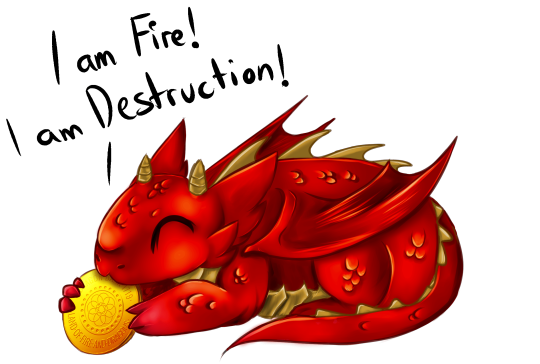
The world’s tiniest dragon must defend his hoard, a single gold coin, from those who would steal it.
Suggestion: The dragon’s definition of “steal” is somewhat loose. It still allows the coin to be used and bartered and change hands–but on one condition: the dragon must be with it at all times.
They become a familiar sight in the marketplace.
“Here’s your change, ma’am. One gold piece.” The merchant holds out a palm, on top of which rests a tiny, brilliantly colored creature clutching a single gold coin.
“That’s a dragon,” you say dumbly. “One piece… and a dragon.”
“Yes.”
You cautiously reach out and attempt to take your change. You tug. It holds. You tug harder. The dragon lets loose a tiny, protective growl.
“Ma’am–no, ma’am, you have to take the dragon, too.”
“Sorry?”
The seller notes your dubious expression. “Not from around here, are ya?” They shrug. “Them’s the rules. Take the coin, take the dragon.”
They wait expectantly. Wondering how the world has so suddenly gone mad, you slowly, slowly hold out your hand.
The dragon perks right up. It scampers from their palm to yours with the coin clamped in its jaws and scales your sleeve with sharp little claws.
“Have a nice day, ma’am,” the merchant says. “Spend him soon, now, you hear? At another booth, if you can. He likes to travel.”
From its perch upon your shoulder, the dragon lets out a happy trill.
Bonus: the coin eventually passes to the rogue in a group of travelling adventurers. The dragon becomes the mascot of the entire group, and they lay out a small pile of coins for him to sleep on every night, clutching his coin like a teddy bear.
In a world where puns are illegal, one man rises up in opposition.
“Sir, I was looking for you,” Howard said, staring at the back of the chief’s neck. “We got him.” He turned around slowly, eyes staring down at a manila folder in his hands. He was an intimidating man, even despite his enlarged belly and the countless wrinkles spiraling down his face, neck, and everywhere else. Tall, maybe 6’2’’, and still quite muscular—especially for a 63-year-old that refused to retire. He was bald now, but he’d had thick, black hair when Howard had first joined the department over a decade ago. Even after all that time, he still felt as if he were a child talking to an adult whenever he was around the chief.
“Him? Who is him?” Chief said, not looking up from the manila folder.
“Him,” Howard said, nodding toward the folder. “We got him.”
“Him? Al? You got Al?” Chief said, glancing up from the folder in his hand, then slowly closing the cover. A large, red “CONFIDENTIAL” was stamped across its front.
“We did, he was outside of an arboretum. We caught him red handed. No, red lipped. Red worded? We caught him in the act is what I’m trying to say.”
“The fuck is an arboretum?”
“Sir, it’s a garden with a large collection of trees instead of flowers. Kind of like a forest, except man made,” Howard said. “It’s basically a forest.”
“Where is there an arboretum in New York?”
“Central Park. Does it matter? We got him.”
“Where is he?” Chief said, glancing around the room. The veins on his neck, visible through his wrinkled, dried skin, popped out slightly as he swiveled his head.
“He’s in the interrogation room.” Howard nodded toward the big, metal door on his left.
“How do you know you got the right guy?” Chief asked.
“He was standing outside of the arboretum telling people they were barking up the wrong tree.” Howard paused. “You know, bark: like a tree has.”
“My god,” said Chief, lowering the folder down to the side of his left leg.
“That—that wasn’t all,” Howard said, stuttering slightly. “When I approached him, he told me to leaf him alone. Not leave, but leaf. To leaf him alone.”
Chief slowly walked to the wooden table in the corner of the room and lowered the manila folder onto the top of it. He placed both palms down and sighed.
“We got a real sicko on our hands, Howard. You did good getting him off the street. Has he confessed yet?”
“No, sir. We sent Chuck in earlier. He came out in tears, an absolute wreck. He didn’t even get a chance to turn on the recorder. Said he wouldn’t stop punning, that Al told him to spruce up the place. Said that it would help us branch out creatively. Chuck tried to play it off, tried to be the tough guy, but Al just didn’t let up.” Howard turned his head toward the metal door to his left. “Chuck told me Al claimed he had an idea for an escape that he maple off. Maple, not may pull. He made it clear that it was a pun.” Howard exhaled deeply and stared up at the ceiling. “He said Al called all of us saps, and that he wooden be surprised if he just walked out the front door. Wooden. Like wouldn’t.”
“Dear lord in heaven,” Chief said, lifting his palms off the table then smashing his fist down on top of the manila folder. “God damn this monster. I’m going to go in,” he said.
“Chief,” Howard pleaded, his voice higher than he had intended it.
“No, I have to do this. I can’t send any more of my men in. I need to be the one to face this maniac.”
Howard nodded and took a step back so that the door was clear. Chief slowly unbuttoned his sport coat, revealing a leather holster underneath. He unlatched it, the grip of his Glock now exposed, then re-fastened the top button on the jacket.
“Turn the recorder on by the window. If it gets too much, please leave the room. I will not hold it against you. Just make sure the recorder is running—we can’t let him go this time.”
Chief exhaled, brushing the side of his hand down the front of his jacket, then made his way toward the door, unlocking it and pulling it open before stepping inside. Howard walked around the wall to the one-way window, flipped on the old tape-deck recorder, and peered inside.
“Al?” Chief said, sliding a chair out from the metal table in the middle of the room. “I’m Dave Johnson, Chief of Police. Do you know why you’re in here?”
Al glanced up at the chief, but seemed to be looking toward the corner of the room.
“That,” Al said, pointing to a whiteboard in the back of the room, “over there.”
The chief turned around. “The whiteboard? What about it?”
“It’s remarkable.”
Howard involuntarily smashed his fist down on the table in front of the glass, but the chief seemed not to notice Al’s pun.
“Nothing remarkable about it.”
“The whiteboard,” Al repeated, “it’s remarkable. Re-markable.”
The chief squinted slightly, as if he were in pain. “Seems unremarkable to me. Now please answer the question. Do you know why you’re here?”
Al sighed. “Let me guess, is it because of the two pieces of string I ate?”
“What?” said the chief.
“The string, I ate two pieces of string. I shit you not.”
Chief’s face became visibly tense, a reddish hue slowly replacing his normal pale color. “You are here for your puns, Al. You’ve been on the pun,” Chief stopped, his eyes wide. “Run. You’ve been on the run for a long time, but we got you. And we have you recorded making these puns.”
Al stared down at the metal table and his eyes closed. “I know,” he said.
“So you admit it?”
“You think I like making puns? You think I like breaking the law?”
“If you don’t like it, then why do you do it?”
Al slowly lifted his head back up toward the chief.
“A long time ago, I was kidnapped and brutally tortured. My life was threatened and I was brought to the brink of death. Do you know what that’s like? Six men accosted me, beat me and chained me to a tree as I walked home. They said they’d tell me ten puns to dictate my future. If I survived, then I was free to go. They told me no one had ever lived through them, they assured me I would die. They laughed when they said that, stared straight in my eyes and pulled the chain tighter to keep me from squirming. Then they began. Each pun was said with hate, each one was meant to kill me. Yet in the end, no pun in ten did.”
The chief’s eyes rolled back in his head, his torso slumping forward onto the table in front of him. He began convulsing, seizing hard enough to knock the chair out from under him, his body plummeting to the floor behind the desk. Howard tried to reach for the alarm on the far right of the window, to hit the button and call for help, yet his limbs refused move. His mind refused to listen. The room turned black.
Howard awoke to a uniformed man standing over him, one of the new recruits he’d not yet learned the name of. He was towering over Howard, yelling for him to get up.
“Gone!” shouted the recruit.
“Huh,” Howard said, voice groggy and slow.
“He’s gone. He took the tapes and he’s gone.”
“Ch-chief,” Howard said, pulling himself up. His arms felt weak, as if he’d spent the past few hours lifting weights. “Where’s the chief.”
“He’s okay, we’ve got him in the office. He’s awake. You’re both going to be fine.”
“Al,” Howard said, remembering the barrage of puns. “Where did he go?”
“He’s gone,” said the recruit.
“Where did he go?” Howard repeated, now shouting.
“Gone, sir. He walked right out the front door.” The recruit paused, but Howard could tell he wasn’t yet done speaking. “We also have reason to believe the name we’ve been calling him is fake.”
“What? Why? We had him here, he responded to Al. All the background checks matched his name.”
“It’s just, his name. Mr. O’Bye. Al O’Bye.”
A stinging pain shot through Howard’s skull. Alibi. Why hadn’t he seen it before; that was why his history was so clean, why he had been so elusive. They were tracking a ghost.
“Fuck me,” Howard muttered, holding his left hand to his throbbing temple. He stared into the empty interrogation room.
“Sir, that’s not all,” said the recruit. He picked up a folded piece of paper from table and handed it to Howard. “He—well—he left you a note.”
Howard stared at the paper. “Detective,” it read in cursive on the front, hand written in blue ink. He flipped it open.
“You ask me why I do what I do, what makes me who I am. Yet you don’t even know who it is that I am. Perhaps I’m simply an unappreciated baker getting revenge on the world after suffering through long hours because I kneaded the dough. Maybe I’m a forlorn banker, doing this because I’ve finally lost interest. Or maybe I’m just a backwards poet, writing inverse and making no sense. Yet, in the end, you’re not much different than I. You stay up all night and day, searching for me, wondering who I am, waiting for the light that never comes. Only when I stayed out too late waiting for that sun to rise, it dawned on me.
It’s been my pleasure meeting you, perhaps I will see you around.
Sincerely,
Mae B. Layter”
Howard lowered the note, a warm sensation running down his face as if an insect were crawling on the flesh above his lip. He placed his left hand beneath his nose, rubbed it, and then glanced down at his fingers. They were covered in blood. Darkness again drowned out his vision.
Omg this is the greatest. As a pun enthusiast this is the greatest thing I have ever read.
 just moving along like everyone else