Bad books on writing tell you to “WRITE WHAT YOU KNOW”, a solemn and totally false adage that is the reason there exist so many mediocre novels about English professors contemplating adultery.
At fifteen, Kasamatsu was lanky,awkward, and way more angry at the world than he should. Honestly, he was doing well at school, played basketball, and successfully kept his younger brothers
from becoming arsonists, but he was a teenager, and he was angry. Because he had zits, because he couldn’t talk to girls,
because his band was never going to be famous, or even leave Moriyama’s garage,
for that matter. Hell, because his cereal turned too saggy one day while he
jerked off three times during one
shower – just because he was a teenager.
Mostly because he was two hundred
percent gay, though, and beginning to think he would die a virgin, since the
only guy whose gaydar seemed to be working, and steering him in Yukio’s general
direction was a thirteen-year-old with perfect skin, and the tendency to
embarrass him in public, by using the same cheap tricks on him as he did on all
the older girls that found him and his dubious seduction techniques so cute.
“Senpai, you look tired,” drawled
Kise, flashing a dazzling grin that even Kasamatsu recognized as a force to be
reckoned with.
He only rolled his eyes, too
exhausted after the basketball practice to even scold that brat for basically
stalking him after school, and tried to bypass Kise, who promptly followed.
“Probably because you’ve been
running through my mind all day,” he added flirtatiously, batting his
ridiculous eyelashes.
Kasamatsu thinks this is what dying feels like – you can’t breathe and can feel your brain collapsing on itself, the desperate rush of blood the only sound you can hear. His face feels hot, his palms are wet, and Kise is looking at him patiently and respectfully like Yukio doesn’t look like he’s choking on his own tongue at all.
He tries to calm down by reminding myself that this is it – the graduation, the last stop; they won’t see each other ever again, probably, not if Kasamatsu can help it, he’s going far away enough anyway. Kise rocks on the balls of his feet awkwardly, still aggravatingly patient, and Kasamatsu grits his teeth.
He fists his palm and presses it against Kise’s chest, a little bit more violently than he intended, making Kise stagger back slightly and frown in confusion. Yukio uncurls his fingers slowly and presses his hand flat against Kise’s heart, still unable not looking at him.
He lets go then and turns around to leave, hears a gasp escape Kise’s lips but he keeps going, he won’t turn back, he can’t face him. That’s the one challenge Kasamatsu Yukio has to back down from and he deserves the privilege of running away, he’s worked hard enough to earn it. He’s not a coward.
“You’re a coward, senpai!” Kise shouts, and Yukio falters in his steps.
THAT FIRST SITE IS EVERY WRITER’S DREAM DO YOU KNOW HOW MANY TIMES I’VE TRIED WRITING SOMETHING AND THOUGHT GOD DAMN IS THERE A SPECIFIC WORD FOR WHAT I’M USING TWO SENTENCES TO DESCRIBE AND JUST GETTING A BUNCH OF SHIT GOOGLE RESULTS
For those who want context surrounding the debate whether women should be allowed to continue reading or writing non-con erotica. Additional context is also provided regarding fandom harassment of abuse survivors who write or read non-con fiction.
An excellently written piece, if rather hard to swallow for the crowd which believes fannish expression that includes dark kinks / sexual fantasies should be constantly policed.
However, it should be noted that the expression ‘debate if women should be allowed to continue writing non-con erotica’ makes my hair stand on end and typifies what I can’t abide in this entire thing. I didn’t come into fandom to be allowed or disallowed to write something or other. I came into fandom do straight up do so, there was no concept in my mind of ever giving someone the power of disallowing me to write the thing. Fandom was never about control for me, it was about solace, about joy, about pleasure, about deconnecting temporarily from the drudgery of a difficult and often unpleasant life.
I already live my life, as a woman, under a constant stream of being told what I’m not ‘allowed’ to do. I’m not allowed to be too harsh, too sharp, too abrasive. I’m not allowed to say I’m childfree and mean it. I’m not allowed to get a buzzcut (I’ve straight-up had hair-dressers who refused me!) I’m not allowed to continue being interested in video-games at nearly thirty, whereas with my brother it’s ‘eh, boys mature much more slowly.’ I’m not allowed to criticize street-harassers and gropers without being insulted for it.
And now it’s ‘I’m not allowed to explore my darker fantasies in the safe, secure medium of writing, without potentially becoming a target for Purity Culture Wank.’ Fandom was my refuge from all the ‘not allowed’ nonsense and I’ll be damned if I ever let it become filled with it!
In the West, plot is commonly thought to revolve around conflict: a confrontation between two or more elements, in which one ultimately dominates the other. The standard three- and five-act plot structures–which permeate Western media–have conflict written into their very foundations. A “problem” appears near the end of the first act; and, in the second act, the conflict generated by this problem takes center stage. Conflict is used to create reader involvement even by many post-modern writers, whose work otherwise defies traditional structure.
The necessity of conflict is preached as a kind of dogma by contemporary writers’ workshops and Internet “guides” to writing. A plot without conflict is considered dull; some even go so far as to call it impossible. This has influenced not only fiction, but writing in general–arguably even philosophy. Yet, is there any truth to this belief? Does plot necessarily hinge on conflict? No. Such claims are a product of the West’s insularity. For countless centuries, Chinese and Japanese writers have used a plot structure that does not have conflict “built in”, so to speak. Rather, it relies on exposition and contrast to generate interest. This structure is known as kishōtenketsu.
When I send out my chapter to be read over by my beta readers, I always include a set of questions typed out at the bottom, grouped into different categories such as: plot, pacing, character, setting, etc.
You might want to tailor the questions depending on the genre or which chapter it is. For example, if it’s the first chapter you’ll want to ask them about how well your story managed to hook them, or if they managed to easily get an idea of the world you’ve introduced them to. If it’s the climax you might want to ask if the action scenes are fluid, and if the plot twist/s were predictable or surprising.
Here’s some example questions that you could use:
Opening Chapter:
What is your first impression of the main character? Do you find them likable? Annoying? Boring?
After reading it for the first time, what is your first impression? Was it cohesive and compelling? Boring and confusing?
Did the first sentence/paragraph/page efficiently grab your attention and hook you in?
If you were to read this chapter in a bookstore/library would you be convinced to buy it? Or would you need to read further before deciding? Why or why not?
Did you get oriented fairly quickly at the beginning as to whose story it is, what’s going on, and where and when it’s taking place? If not, what were you confused about at the beginning?
Does the first chapter establish the main character efficiently? Do they feel believable?
Characters:
Could you clearly imagine what the characters looked like? If not, who?
Who was your favourite character and why? Has your favourite character changed? (if this hasn’t changed feel free to skip this question)
Are there any characters that you do not like? Why do you not like them? (Boring, annoying, problematic, etc.)
Was there ever a moment when you found yourself annoyed or frustrated by a character?
Could you relate to the main character? Did you empathise with their motivation or find yourself indifferent?
Were the characters goals/motivations clear and understandable?
Did you get confused about who’s who? Are there too many characters to keep track of? Are any of the names or characters too similar?
Do the characters feel three-dimensional or like cardboard cutouts?
How familiar have you become with the main characters? Without cheating could you name the four main characters? Can you remember their appearance? Can you remember their goal or motivation?
Dialogue:
Did the dialogue seem natural to you?
Was there ever a moment where you didn’t know who was talking?
Setting/world-building:
Were you able to visualize where and when the story is taking place?
Is the setting realistic and believable?
How well do you remember the setting? Without cheating, can you name four important settings?
Genre:
Did anything about the story seem cliche or tired to you? How so?
Did anything you read (character, setting, etc.) remind you of any others works? (Books, movies, etc.)
Plot/pacing/scenes:
Do you feel there were any unnecessary scenes/moments that deserved to be deleted or cut back?
Do the scenes flow naturally and comprehensively at an appropriate pace? Did you ever feel like they were jumping around the place?
Was there ever a moment where you attention started to lag, or the chapter begun to drag? Particular paragraph numbers would be very helpful.
Did you ever come across a sentence that took you out of the moment, or you had to reread to understand fully?
Was the writing style fluid and easy to read? Stilted? Purple prose-y? Awkward?
Did you notice any discrepancies or inconsistencies in facts, places, character details, plot, etc.?
Additional questions:
What three things did you like? What three things did you not like?
Can you try predicting any upcoming plot twists or outcomes?
Was there ever a moment when your suspension of disbelief was tested?
Is there anything you’d personally change about the story?
Was the twist expected or surprising? Do you feel that the foreshadowing was almost nonexistent, or heavy handed?
Feel free to tailor these to your needs or ignore some of them if you don’t think they’re useful. Basically, your questions are about finding out the information about how others perceive your own writing and how you can improve your story.
“Dad, there’s a monster under my bed.”
“Yes, I know. That’s why I’ve trained you. Here, your sword.”
“But-“
“Be bold, my girl! Save us all!”
“Um,” she said, feeling very silly. “Still there?”
“Yes,” the monsters under the bed hissed.
“I’m moving, to uni. Um. Will you come?”
“Yes.”
“Where is he?!”
“Eaten.”
“You ate him?”
“We are monsters under the bed. We are your greatest fear.”
“I don’t fear you.”
“You feared him.”
“My son has monsters under his bed.”
“Yes.”
“Can you… chase them away?”
“Let him fight, like you fought us.”
“He can’t.”
“You can teach.”
“Monsters,” she whispered, “are you still there?”
“Yes.” A whisper from under her hospital bed.
“I fear death.”
“Join us?”
She slipped away.
The last four posted as a serial chain, but I was thinking of it as a sequel to the first, even if I didn’t reply to that. I posted that too long ago (January 13, 2015) to find in my client, but then I remembered I could find it here on Tumblr.
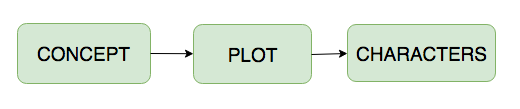
There’s no one way to start writing a book. For some people, it’s enough to just jump in and start writing to see where the story takes them. If you’re not too keen on that idea, then here is oneprocess (as in, not theonlyprocess) that might help you move beyond your concept.
Concept ≠ Plot
Many writers mistake concept for plot, but they’re actually two very different things. A world where everyone grows up with superpowers is a concept; the plot is what you decide to write about within that concept – the specific characters and what happens to those characters; who your antagonist is and what conflict arises when that antagonist goes after what they want. All of these things contribute to your plot.
So first, define what it is you actually have at this particular point. Do you just have a concept? If so, you’ll need to take the necessary steps to develop that concept into a plot.
Concept >>> Plot
If you’ve decided that all you really have is a concept, then how do you take it and turn it into a plot? You brainstorm. All brainstorming really amounts to is expanding your ideas. All you’re doing is asking questions about the concept and delving deep into the answers.
The most simplistic way to start this process, especially if you’re struggling, is to ask one of two questions (or both, if applicable). These two questions: What could go wrong? What could go right?
Going back to my example about a world where everyone grows up with superpowers. If I were to ask the question “what could go wrong,” I’d end up with a whole list of possibilities.
The powers suddenly disappear
People start abusing their powers
Someone figures out how to steal powers
A hierarchy of strong vs. weak powers develops, creating superiority/inferiority dynamics
Someone is born without a superpower
There are many more possibilities I didn’t even think of here, but any one (or more) of these could become a plot. Choose one that sounds interesting, and then ask yourself “and then what?”
Say I choose: Someone figures out how to steal powers. Then what does that person do? Do they recruit people to do the dirty work for them? Do they work alone? Do they hoard these powers and barter them for other goods? Do they attempt to enslave people? Do they attempt to take control of institutions? What do they do?
Your goal is to take your ideas and turn them into actions taken by characters. People doing things. And each piece you add will usually lead into another. If you went with the idea that this character is stealing powers and essentially selling them for other goods, you’d have to ask yourself follow-up questions. First, who are they selling to? Why would anyone buy a new superpower if they already have one? What uses would they have for additional ones? What is the key demographic that this person is trying to reach? Secondly, what are they selling them in exchange for? Money? Favors? Souls? What is this character getting in return?
Now that you’ve examined potential actions that the character takes, you’ve also exposed potential new characters.
People they’re stealing from
People they’re bargaining with
People that try to police these crimes
People that try to copy this character’s process
At the beginning of this section, I talked about using “what could go right” as another optional jumping off point. This is a good path to follow if your concept is already really negative. For a concept where someone is killing people for some pointed reason, you might ask “what could go right” and explore ideas where the killer is caught and brought to justice.
The point of all this is to think about change as a means of taking your idea from concept to plot. A concept is static – it doesn’t move, evolve, or change. By developing a plot, you’re forcing the concept to be challenged in some way. If you think about it that way, you’ll be able to formulate conflicts, and the people that orchestrate and fight against those conflicts.
On that note, I think we’re ready to move onto the third piece of my graphic above.
Plot = Character Actions and Consequences
At this point, you have sketches for characters. You’ve got this nameless, faceless person that is stealing the powers, and all these other nameless, faceless people that I listed above. In essence, we have character concepts. And just like we turned our initial concept into a plot, we have to turn these character concepts into actual characters.
The basics are the easiest way to start. You figure out their name, their gender identity, their age, their appearance, some brief backstory and personality traits. I personally prefer the simplest questionnaire that I put together back in the early days because it hits on the poignant pieces of a character without overwhelming you with 100s of questions.
Now that you’ve given your character concepts names and faces and potential behaviors, you start to consider how one character’s view of the world inspires them to take certain actions, and you then think about how those actions affect your entire story.
We already kind of talked about the motives of the power thief in our example, but definitely delve deep here. On the surface, this character seems bad – stealing from people and then selling what they steal. But depending on what it is they’re getting in return, could we not argue that this character is a supernatural Robin Hood? Maybe instead of selling, they’re giving, and maybe the characters they’re stealing powers from are people that abuse and misuse their powers. Character motives can take a plot and turn it on its head, forcing you to reconceptualize everything. And that’s okay! That’s part of the process.
But separate from that idea, if we have a character concept of someone whose powers were stolen, and after developing their basic backstory, we discover that person’s name is Rose, and she has an especially close relationship with her brother. So when her powers are stolen, how does this affect her life? Was she using her powers to keep her brother alive and protected? What she using them to keep a roof over their heads? Was she using them as part of her job, as a means of providing? What happens to her life when her powers are stolen? And what will Rose do about it? Whatever Rose does will impact the story. If she does nothing to get her powers back, how does she solve her problems and does that make for a good story? If she does decide to act, then you’ve moved onto a new plot point to dive deeper into.
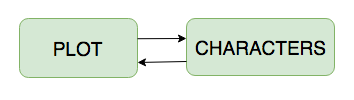
My point is, character concepts come from plots, but characters themselves often create plot, as their decisions and mistakes and successes create new outcomes. So if I could modify my original flow chart:
Before you develop something, you conceptualize it. You have a concept, then you make it a plot. You have concepts for characters, then you make them characters. And those characters end up driving your plot, to the point that this happens:
Plot inspires character. Character inspires plot. And it just keeps going around and around and around. Breaking it down into these pieces helps organize the process, but developing a story is rarely this neat and tidy. You’ll get ideas that don’t make sense, ideas that aren’t cohesive, characters you don’t need, characters that piss you off, problems you can’t solve, or plot points you’ve committed to that you no longer like…it will be messy. But it’s your mess, and the more you work on developing your own process, the more it’ll make sense to you. And it’ll become easier to know how to go about fixing it when something’s not right.
Have fun with this process! It’s supposed to be fun. When the pieces start to become clearer, you’re able to put them together in a rough outline. And once you have a rough outline, you can start writing, and really see it take shape.

 just moving along like everyone else