Don’t characterize a Black character as sassy or thuggish, especially when the character in question is can be described in literally ten thousand other ways..
Don’t describe Black characters as chocolate, coffee, or any sort of food item.
Don’t highlight the race of Black characters (ie, “the dark man” or “the brown woman”) if you don’t highlight the race of white characters.
Think very carefully about that antebellum slavery or Jim Crow AU fic as a backdrop for your romance.
If you’re not fluent with AAVE, don’t use it to try to look cool or edgy. You look corny as hell.
Don’t use Black characters as a prop for the non-Black characters you’re actually interested in.
Keep “unpopular opinions” about racism, Black Lives Matter, and other issues pertinent to Black folks out the mouths of Black characters. We know what the fuck you’re doing with that and need to stop.
Don’t assume a Black character likes or hates a certain food, music, or piece of pop culture.
Be extremely careful about insinuating that one or more of a Black character’s physical features are dirty, unclean, or ugly.
Feel free to add more.
Adding more…
Be wary of making Black characters seem animalistic, uncivilized, or subhuman in comparison to white characters. Watch out for: comparing us to monkeys, gorillas, chimpanzees, apes, and other animals.
Words like Negroid, colored/colured, Negro, and the n-word do not belong in the mouths of contemporary characters you want to portray as sympathetic.
Not all Black people are African American.
Africa is not a country but the second-largest continent on earth with some 54 different countries with thousands of ethnic groups and 1,500 to 3,000 languages and dialects.
Resist the urge to make a Black character seem uneducated and ignorant compared to white characters.
Capitalizing Black shows that you recognize that the word unifying people of African descent, particularly the diaspora, should be described using a proper noun.
Please, say “Black people,” not “blacks.”
Give Black characters the same psychological and moral complexity as white men are given by default.
Make sure that you don’t write a Black character as happily subservient to a white character.
Understand and show that you understand that Black characters don’t exist to be the caretakers of white characters.
And more…
Do your own homework instead of expecting, asking, or demanding Black fans to do it.
Before approaching that Black person you admire so much for being so articulate about race issues (this is sarcasm) to beta read your work: 1) make sure it’s something they’ve expressed interest in doing, and 2) you offer something in return for their time and expertise.
Be prepared for fans to have issues with what you came up with and open to suggestions.
Having only one Black character in a story that takes place in a huge city, country, or galaxy looks weird. Really, really weird. Scary weird.
Don’t use a Black character’s death to motivate a white character.
Portray Black characters with complex and multifaceted identities. We are more than just Black. We are also women, LGBT, Jewish, disabled, neurodivergent, immigrants, etc.
There is a huge chasm between hypersexual and desexualized.
Remember: what’s progressive for a white character is not necessarily progressive for a Black one.
So you want to make an OC?: A Masterpost of Ways to Create, Develop, and Make Good OCs!
i made this masterpost in hopes that it helps you in making your own OCs ah;; it can also apply to developing RP characters i suppose! if you’d like to add more resources then go for it sugar pea (´ヮ`)!
I’ve been trawling my way through the kindle unlimited mines, and there is a thing I am seeing that is uncomfortably common that I do not want to be common, and that thing is extremely poor and shallow handling of the aftermath of rape.
Here are some disclaimers: I am someone who has been raped. I do not speak for all people who have been raped, and some of them may disagree with me, and that is OK ™ because different viewpoints are valuable things. Mostly I just want people to think for more than, like, five seconds when they decide to invoke rape in a story. Here is one viewpoint in service of that.
While putting your favorite condiment on a sandwich, you accidentally make a magical occult symbol and summon a demon.
You silently take two more slices of bread out of the package and make another sandwich. You put it on a plate with a handful of potato chips and hand it to the demon. He takes the sandwich, smiles and vanishes in a puff of demonic smoke. The next day you get that job promotion you were after. There was no contract. No words spoken. You owe nothing. But every now and then, another demon pops in for lunch. Demons don’t often get homemade sandwiches.
Can I keep this going? I’m going to keep this going.
It would be a little annoying, if they weren’t so nice about it. You don’t know what you expected demons to be like, but you certainly didn’t expect them to be nice about it. There’s no demands, no voices like wailing babies, no blood on the walls (well, there was that one time, but Balthazak was very apologetic about the whole thing and cleaned it up right quick). Just the occasional demon stopping by for lunch. In fact, you could almost forget that they weren’t just ordinary people, the way they act. Nice people, too.
You start talking with them, as time goes on. In the beginning you carefully pick your words so they couldn’t be spun to even imply a contract or reference a soul, but when they seem politely eager to have a normal chat, your words become a bit looser. You even begin gossiping with them – turns out, demons have breakroom gossip just like anyone else. You listened to Rek’ththththtyr’s account of Drokyarix’s torrid affair with Irkilliz, and Ferkiyan didn’t even know what Drory was doing behind his back, poor dear, and you kept quiet and let Ferkiyan cry on your shoulder after Drokyarix finally broke up with him (the shirt was a bit of a loss, demon tears are ruinous to cloth, but Ferkiyan’s a good sort and you couldn’t just turn him away). You even managed to talk him down from going and starting a fight with Irkiliz, who didn’t even know that Drokyarix was in a relationship, and who was almost as horrified as
Rek’ththththtyr.
After that event in particular, you start to get a sort of a reputation as a place where a demon can come to relax, talk, and – of course – get a sandwich. Your sandwich-making skills have really improved since this whole thing began. Your luck seems to have improved too – you’re not sure if you can attribute the whole thing to the sandwiches and the reputation, but you don’t really want to know anyway.
One day, there’s a bright flash of light from your living room. Nothing unusual in itself – most of the younger demons haven’t quite got the style of their elders, and usually just go for a materialization in a flash of hellfire over your fireplace – except that it’s white instead of the usual red. You look up, and who do you see but an angel looking at you with a spear in his hand. Shrugging, you tell him to sit down and you’ll have a sandwich for him shortly, and meanwhile he can just tell you all about what’s on his mind. This clearly is not at all what he was expecting, but after a moment’s thought, he decides to take you up on your offer and starts talking. Apparently, he’d been dispatched to take care of some demon summoner in the neighborhood, and while he’d evidently got the wrong house the right one shouldn’t be hard to find – have you seen anyone practicing satanic rituals nearby? You laugh, a little, and tell him that you don’t really summon them, they just come on their own. They do like their sandwiches, and they’re quite nice folk.
The angel’s jaw drops, and you remind him to chew with his mouth closed.
And I’m going to take this even further. Here we go.
It took a bit of explaining with the first angel to arrive. Telling him about the first accidental summoning and then how the demons just started stopping by around lunch time on your days off. But once he understood what’s been going on (and finished his sandwich) he nodded solemnly and said he would get this all straightened out “upstairs.”
You eventually start getting more angels coming around for lunch. Sometimes they bring a small dessert for you to share after the sandwiches, and the dishes are always magically clean and back in the cupboard when they leave.
You lean that angels don’t have much of their own drama, but they do know all the truths about human tabloid drama and they’re more than willing to dish on what the Kardashians have been up to.
The first time an angel and a demon show up for lunch on the same day is a little tense. You tell them that ALL are welcome for lunch in your house and that you would prefer it to be a no-conflict zone. It takes a while for them to settle, but eventually they grow comfortable enough to start chatting. Which is when you learn that because demons are technically fallen angels, you’ve been having two sides of an estranged family over for lunch regularly.
Soon, you have an angel and a demon at every lunch. Old friends and estranged siblings meeting up to reconnect over a sandwich at your dinning room table. You help the ones who had a falling out reach an understanding, and you get to hear wild stories of what the “old realm” was like.
One day, as you’re pulling out the bread and cheese, a messenger demon appears. You greet him and tell him a sandwich will be ready soon, but he declines. He is here on behalf of Lucifer to ask if it’s alright by you for him to “enter your dwelling so as to meet with his brother Michael over sandwiches.”
A little stunned, you agree. The demon disappears and you prepare three sandwiches, setting them at the table.
When Lucifer (the actual devil!) appears in small puff of smoke, you welcome him and ask what he’d like to drink. As you’re fetching the apple juice, a blinding flash of light comes from the dinning room indicating Michael’s arrival. You grab a second cup and walk back in to find a tense stand off between the brothers. You set down the cups and juice while calmly reminding them that this is a conflict-free zone, and if they are going to fight, please take it to an alternate plane of existence.
They don’t fight. They sit and enjoy the sandwiches and talk about what happened. You learn a lot about why creation started, what the purpose of humanity was and what it’s grown to be. You only have to diffuse two arguments. And at the end when it’s time for them to leave, they hug each other, agreeing to meet up again somewhere else.
In the following weeks you have the usual assortment of demons and angels stopping by. The regulars ask how you’re mom is doing and if your friend is settling in to their new apartment nicely. At some point during each visit though, they ask if it’s true. Did Lucifer and Michael really come for lunch? You tell them yes, but won’t say what was talked about. They’re disappointed, everyone likes the gossip, but they understand. Before they leave, you ask each angel and demon about this idea you have for the summer, what if you had a barbecue on the back patio for everyone who wanted to come? They think it sounds like a fun idea.
I would pay good money for this to be a movie/tv show
By her very nature Hestia is not supposed to have favorites,
but Hades has always been hers.
She is the eldest sister, and he the eldest brother. She
wonders if that is perhaps why they somehow end up being the responsible ones.
“I like it down here,” she says, curled up in his throne.
“It’s quiet.”
He snorts, head bent over the reams of paper, endless lists
of the dead. Somehow, she never sees Zeus with paperwork. “It’s dark, and
cold.” She glances around. The only light comes from the softly glowing
moonstones, from the bioluminescent designs etched into the walls.
She extends a hand, “I can–”
A cheerful fire crackles to life in the center of the room,
warm and sweet and smelling of cedar even though there’s no smoke. “Sister!” he
snaps, “Return that to Olympus immediately!”
She pouts, holding the fire steady, “Why? It’s my fire, I am
its keeper, am I not? I can give it to whoever I choose.”
“Zeus has decreed it is a privilege of those that reside in
the heavens,” he glares, “I will not see his wrath turn upon you. Put it back.”
Hestia closes her palm, and the fire snuffs out, returning
to its home on Mount Olympus. “Little brother Zeus would do well to remember
his place.”
“I’m sure he would say the same of us,” Hades says wryly,
eyes dropping back down to his desk.
She is the keeper of the hearth, the bringer of fire, the
guardian of the home. The spirit of Mother Gaia pulses in her more clearly than
the others, no matter the claims Hera likes to make
Zeus is a little boy. A powerful little boy for sure, but a
child none the less. She and Hades grew in their father’s stomach together, his
was the hand she grasped through the years in their horrid prison.
She dislikes little boys telling her how to govern her realm
of hearth and home.
~
Prometheus was not a smart man, but he was a brave man, an
ambitious man.
So when a goddess appears in front of him, offering him an
opportunity for glory, he does not refuse. He grins with eyes too bright and
says, “Fire? The tool of gods back in mortal hands? We could do much with
that.”
“Yes,” the goddess agrees, “but it will not come free. If
you succeed you will be sent to Hades’s realm, of this I am certain, and when
you are – you must bring fire to him as well. That is the price of our
bargain.”
“Agreed,” he says instantly, and does not question why a god
needs a human to get him fire. His is not the place to question gods.
Myths will say that he was a Titan, a god among gods, but
that is not true.
He was a lone, ambitious man. The act of a single person can
often be mistaken for the work of a god.
~
Hestia’s throne sits unused on Olympus, more concerned with
tending her hearth fire than sitting high above mortals.
Any being which must assert their authority through status
symbols likely has very little authority to begin with. “You’re planning
trouble,” Hera accuses one day, her clothing purposefully plain next to her
husband’s and her hair piled atop her head in an exhaustingly elaborate
fashion.
Hera did not become wife of Zeus, Queen of the Gods, by
being stupid. She can be accused of many things, but stupidity is not among
them.
“Whatever do you mean, little sister?” Hestia asks, reaching
a hand into the fire and watching the flames dance harmlessly over her skin.
None of her other siblings would be so fortunate, should they try to touch her
fire.
Hera cross her arms, lower lip jutting out, and Hestia’s
mouth twitches. They are all so painfully young still, now. Hera is little more
than a girl, and Hestia thinks she would be fond of her if she were not so
clearly hiding fangs behind her pretty lips.
Loving your family never meant having to like them.
“You won’t get away with it, whatever it is,” Hera declares
before turning on her heel and striding off.
Hestia cups a ball of flame in her hand, the warmth of it
seeping down to her bones. “Whatever you say, little sister.”
~
The climb up Mount Olympus takes him weeks. He’s exhausted
and hungry by the time he reaches the top, having run out of food some days
ago. But he makes it – something that no other human can claim.
He follows the goddess’s instructions to the letter, waits
until the moon is high in the sky before creeping into the palace. He doesn’t
touch any of the statues, the tapestries, the golden goblets or silver plates.
He doesn’t even let his gaze linger on them, for he is after a prize far more
valuable than wealth.
Fame. Notoriety. His name written in the heavens, never to
be forgotten.
The hearth is in the center of the throne room, larger than
twice his size and more golden than red. He takes a trembling step forward,
eager and terrified all in one.
The goddess appears in front of him, more silhouette than
anything else. “This fire will burn you,” she warns, eyes fever bright and
sparking just like the inferno behind her, “It will kill you. It is only a
matter of when – not if.”
“I understand,” he says, because it doesn’t matter, death
does not matter. Death comes for all men. If he succeeds in returning fire to
humankind, he will be more than a man – he will be a legend.
“Very well.” She spicks up a globe of fire in her hand.
Prometheus reaches for it, but she does not hand it to him. Instead she opens
her mouth impossibly wide and places it on her tongue, lips closing around it
and her whole face turning red from the heat.
She grabs him by the front of his shirt and jerks him
forward, placing her mouth to his mouth and pushing the ball of celestial fire
onto his tongue.
“There,” she says, leaning back. “That will dampen it enough
for you to make it back to the land of mortal men, but you must not open your
mouth until you are ready – as soon as it’s exposed to the air it will consume
you. If you are not back in the mortal realm at that point, your death will be
for nothing.”
It burns, it’s complete agony. He can already feel the fire
eating its way through the soft, wet muscles of his cheeks. But he gives the
goddess one sharp nod and then he’s sprinting his way out of Olympus.
He doesn’t have much time.
~
Prometheus is long gone by the time Hera drags herself to
the throne room, sleeping robe askew and Zeus’s teeth marks on her collarbone.
She’s older than her husband but still so terribly young, and for a moment
Hestia pities her.
“What did you do?” Hera demands, voice coming out rough.
Hestia can’t see any bruising on her throat but that doesn’t mean there isn’t
any. “I know you did something!”
She knows the woman Hera will grow into, has seen many girls
become that same woman, and as the wife of Zeus it’s nearly inevitable. But
she’s not a woman yet, just a girl who’s gambled everything for a play at power
and hasn’t yet figured out if she’s won or lost.
“It’s cold in Zeus’s chambers,” Hestia pats the empty space
beside her, “Won’t you sit with me, little sister?”
Hera stares at her, mistrust heavy in the air and plain on
her face. She will learn to hide her thoughts better one day. “It’s not cold in
there.”
“Isn’t it?” she asks simply, and for a split second Hera’s
face crumples. “Come, little sister.”
Hera takes one hesitant step closer, then another,
eventually stumbling to her knees beside her and staring into the fire, Hestia
is sure, so she has an excuse for her eyes to water.
“None of that now,” she adjusts Hera’s robe and pulls her
hair from her face, the normally immaculate locks frizzy and tangled. She
summons a brush and runs it through her sister’s hair, careful and steady.
The tension leaves Hera’s body by degrees until she chokes
out, “It’s warm here.”
“As it always will be, when you are beside me,” she says,
because she can promise that at least. Whether Hera will choose to sit at her
side in the future is another matter entirely.
~
Burns have surfaced all across his body, blistering legions
turning into bloody caverns of ash where he once had flesh.
Most of his lower face is gone, his jaw open and gaping and
only bone. The ball of celestial fire is nestled at the bottom of his throat;
it’s burned through until only a thin layer of skin separating it from the open
air. He has to hurry. Every step is agony, he hasn’t been able to take a breath
for several minutes, and at this point death can only be a relief.
He will not die in vain.
Prometheus finally, finally steps upon mortal soil, but he
does not stop there. He runs home, to his city, to the center of the square.
People recognize him, even with half his face burned away, and there are
screams.
He collapses in the city square and reaches what’s left of
his hand into his throat. He pulls all but a spark of the celestial fire free,
and opens his hand.
He’s consumed in an instant, and his last sight is of fire
flying – into stoves, lighting hearths, candles twinkling to life.
They will carve his name into the skies for this. He dies
satisfied.
~
“How could this have happened?” Zeus rages, “How dare he
steal from the gods! I will have Hades destroy him in every possible manner!”
“Yes, my king,” Hestia murmurs. She doubts he’ll ever make
note of the contempt in her voice at his title.
King of the Gods. As if gods have ever cared for kings.
Hera remains remarkably, carefully silent at her husband’s
side, hair neatly coiled the exact circumference of Hestia’s fingers.
It wasn’t something Hestia asked of her, nor what she was
expecting. It is, however, a very pleasant surprise.
Maybe there’s hope for her yet.
~
Prometheus opens his eyes, which he wasn’t expecting.
Everything still feels like it’s burning, but his body is back in more or less
one piece.
He’s in a place both dark and cold, and when his sight
adjusts he realizes Hades, god of the dead, is standing before him.
“You’ve angered my brother greatly,” the god says, but he
doesn’t sound all that upset. “I’m to give you the worst punishment imaginable
for your transgressions.”
Prometheus opens his mouth, and out drops the smallest
flicker of a flame. “From the goddess,” he says, and the spark goes twirling,
dancing across torches and leaving them lit, passing by a hearth so it roars to
life.
Hades eyes widen as he watches the sparks progress, until it
disappears down the hallway to light the rest of his realm. “Foolish older
sister,” he says, softer and kinder than Prometheus thinks the god of the
underworld is supposed to look.
The whole place looks brighter with the fire, it goes from
ominous to nearly – homey, a place not only to arrive at but one to return to.
Hades slides his gaze back to him, “Those burns are from
celestial fire. I cannot heal them – you must live with them.”
“I understand,” Prometheus says, even though he doesn’t. If
he’s to be subjected to the worst punishment imaginable, what does it matter if
he’s burned or not?
The god smiles, as if he’s reading his thoughts, and says
“Very good.”
The next thing Prometheus knows, he’s back in the lands of
mortal men. Different, perhaps – but alive.
~
Fires are lit in her name, each home’s hearth dedicated to
her, and Hestia smiles.
write a story about how you became the world’s most powerfull person… by accident.
You learn about the butterfly effect in school. The concept is interesting, but not so interesting that you don’t fall asleep partway through the movie. You hear something distantly about a butterfly beating its wings and hurricanes. You think it will never apply to you.
You know now (not then) that power comes through and from favors.
If you had known that then you would probably not have done so many.
(This is where it starts.)
One.
There is a strange creature crossing the road behind the lecture hall. You stop on your bike and frown at it. It looks a little like a turtle, but it’s limbs are longer than any turtle you’ve ever seen. It’s stretched out on the hot asphalt, long, pale limbs clawing forward towards the small stream that runs on the other side.
You hop off your bike and gently pick the creature up, hands under the belly of the shell like you learned from the internet.
Imagine your surprise when the shell slides off the creature instead, dropping a tiny woman onto the asphalt.
“Water,” she croaks, tiny eyes screwed shut. Her eyelids are the size of yours which means they’re huge on her. “Please.”
(You will not know until later what exactly please means to the fae.)
You feel yourself move through your shock. You pick her up and take her to the water’s edge. She slips under the surface, pale skin flashing like the scales of a fish, and she’s gone.
You’d wonder if your roommate slipped you something this morning if she wasn’t back a moment later, pushing a small rock into your hands.
“A boon,” she says. Her eyes are large and black, suited for her underwater world. “For a favor.” She smiles, showing teeth jagged and sharp like a piranha.
When you blink, she’s gone.
You stare at the rock in your left hand. It’s smooth and worn from years in water, an interesting swirl of granite and quartz. “I wish I knew,” you tell it.
The rock ices over so fast that you don’t have time to drop it. The frost swirls across your skin, burning you where it touches, and you watch in horror as your skin turns a mottled black and blue.
You fall to your knees from the pain and choke on a scream as the stone sinks into you, touching your bones and sending more ice through your marrow. It climbs up your arm and touches your eye, changing you vision so now that you’re see double, a strange, blue world juxtaposed next to the one you know and love.
A good fight scene (and a good smut scene for that matter) always works in the service of the narrative. It works toward the cohesive big picture.
From an entertainment standpoint, violence is boring.
You need your audience invested in the characters participating in the violence, in the actions and events leading up to the fight, in the aftermath and how this will effect the character’s overall goals.
In a narrative context, if you’re bored during a fight scene or a sex scene it’s because the build up to that moment failed. The scene itself may also have failed. However, your foundation is what makes your story sing.
Think of a story like building blocks. You’re playing Jenga with your reader on a homemade house, they’re slowly pulling out the pieces and you’re betting you built your blocks well enough to withstand scrutiny. You’ve got to keep them interested long enough to get to the end before the whole thing comes tumbling down.
A fight sequence which works in concert with it’s narrative is enjoyable, doesn’t overstay it’s welcome, and ultimately works to build up the story it’s telling. Fighting isn’t fighting, you see. Combat is a form of problem solving, the fight itself is an expression of the character’s individuality. Everything we’ve been learning about them, their goals, and their behaviors are being put in a pressure cooker and dialed up.
You should be learning about the character as the fight progresses, the fight working on multiple levels in concert with its narrative to get the story where it needs to go. Often, a first fight is like an establishing shot in film. You get a feel for who this character is when under pressure, who they are. Peril can be a great way to get the audience invested, but its up to the author to prove why they should.
Poor fight sequences don’t tell you anything. They’re there to establish the character as capable of fighting but don’t even do that because their concept of combat is generic.
The combatants aren’t individuals expressing themselves, the fight isn’t proving anything except fighting, it doesn’t have meaning except for its attempts to prove the narrative’s poor concept of badassery. This often happens with no regard for the setting’s rules, the aftermath consequences, what the character’s actions will effect in the long run.
It doesn’t mean anything and, while violence is shocking and terrifying in real life, in fiction violence has to mean more than just an exchange of blows.
How many times have you read a book where several mooks show up to get their ass kicked by the protagonist? They limp off at the end and while they’re often in a perfect position to be seen again due to their connections, we never do.
In even just a moderately competent narrative, those same mooks are characters. We’ll see them again in bit roles. They’ll play a role, either to help or hurt later as an aftermath consequence of the protagonist’s earlier actions. These are callback characters we can use to remind the audience of what happened previously in the narrative, and offer up some catharsis.
In a really well written scene, these mooks serve an important purpose when it comes to establishing the protagonist’s character in a quick snapshot. Like the moderately competent character, they come back later to the aid or the detriment of the protagonist. The mooks’ response actions are a direct result of their encounter with the character, often acting as an inciting incident. The protagonist suffers direct consequences as a result of their actions, whether its injury, loss, or the attention of the villain which causes them to lose something. In these fight scenes, you can see the story’s trajectory because it acts as another way to get to know the hero, the secondary characters, the tertiary characters, and whoever else is participating. It’s working on five different levels.
What you often see in a good fight sequence, whether it’s in a written medium or film, is the culmination of a great deal of hard work on the part of the author. A smut sequence is a reward, it’s a way to pay off on the reader’s investment in the relationship between these two characters and the narrative’s investment in them. It doesn’t matter if that’s hardcore sex, or a Victorian hand touch, or a knockout blow to the jaw, the end result is the same. It’s entertaining, satisfying, and even cathartic.
A poor sex scene is just dolls bumping bits. A poor fight scene is just dolls trading blows. Nothing occurs, nothing happens, there’s none of the underlying satisfaction or catharsis in the outcome. You don’t have any investment, no consequences, it overstays its welcome and tells you nothing about the characters.
You’ve no reason to care, so you don’t.
As a reader, you don’t owe a writer attention when reading their work. They’ve got to earn it. If they aren’t, then it may be that the story isn’t for you and that’s okay. Take into account your tastes,
It takes practice to choreograph a fun fight scene. Writing sex and violence is mostly about learning to find your limits (i.e. what you’re comfortable with writing), and overcoming embarrassment. Determine the difference between need and want.
Are you avoiding writing these scenes because you’re scared of being bad at them or because they just don’t interest you?
These are two very different issues, and it’s easy to hide from the first behind the second. Be honest with yourself. If it is fear, then don’t give into it. The easy solution if you’re afraid of being bad at something is to practice. Start looking critically at the media you consume, when you start to get bored during a fight scene or a sex scene, when you want to skip ahead, ask yourself, “why?”. Check out the sequences and stories where this doesn’t happen, and try to figure out the differences between the two.
When it comes to the mechanics of both violence and sex, the more you learn the better off you’ll be at writing it. The more you practice writing violence/sex/romance then the better you’ll be. Like with everything, it’ll probably be pretty terrible in the beginning but the more you practice, the better you get. Writing itself is a skill, but its also a lot of sub-skills built in underneath the surface. Being good at dialogue doesn’t mean you’ll be good at action, having a knack for great characterization doesn’t mean you’ll be good at writing setting description. Putting together great characters doesn’t mean you’ll automatically be good at worldbuilding.
Don’t be too hard on yourself.
All it takes to figure out whether or not the time to fight is right is by listening to your gut.
Remember, the best scenes are based in narrative cohesion and emotional investment. They’re a pay off in and of themselves for your audience, dessert after dinner. They aren’t the meat and potatoes. If you set out to just write a fight scene or write a smut scene then it’ll get gratuitous. Then the focus is on the fight or the sex itself, hangs entirely on their shoulders, and you’ve just upped the ante for how entertaining you need to be.
It’s not “how do I write a fight scene”, it’s “how did my characters get to this point and why are they fighting”. If you start from a character place, it gets easier. The same is true with romance. “How do my characters participate in a romance (sex or not)”.
Make it about the individuals, that’s when it really gets fun.
And, if you get too stuck, try writing fight scenes with characters who don’t know much about how to fight. Sometimes, it’s easier to get into it when you begin at the beginning. There’s a lot less pressure convincing an audience with a character who knows nothing than one at the top of their field.
There’s a lot less stress about “is this right?” when you’re trying to get a feel for the flow if you’re dealing with a character who doesn’t know jack shit. Fight scenes with characters who know nothing can also be really, really, really fun. They’re wild, improvisational frenzies where all you have is the character sorting through their alternative, non-fighting skills trying to figure out how to survive.
Believe it or not, this will help you because you don’t get to cheat with the idea that your character already knows what they’re doing when you don’t. It’ll help you tap into the character, seeing scenarios from their perspectives, and writing to that instead of “generic fight scene”. When you’re unsure, characters who know nothing about the subject matter they’re engaging in but still have to engage are great. They teach you how to write from the standpoint and perspective of the individual. You need those skills just as much when writing characters who are professionals or at the top of their field.
If you don’t think you can write an interesting fight sequence with a neophyte, then that might be a part of the problem. A character doesn’t need to be good at something to be entertaining. A smut sequence where everyone’s fumbling, knocking into each other, embarrassed, stuck in their clothing, cheesy, corny, and laughing can be just as fun (if not more so and more honest) than the ones that generally get envisioned.
For me, good is entertaining and the entertainment is based in humanity but you need to define “good” for yourself in your own writing. Be honest with yourself about your fears and you’ll find a way to bridge yourself to the kind of writing you want to be doing.
Freeing yourself of your own internalized preconceived notions will help a lot, and produce stories that are way more fun.
When you are writing a story and refer to a character by a physical trait, occupation, age, or any other attribute, rather than that character’s name, you are bringing the reader’s attention to that particular attribute. That can be used quite effectively to help your reader to focus on key details with just a few words. However, if the fact that the character is “the blond,” the magician,” “the older woman,” etc. is not relevant to that moment in the story, this will only distract the reader from the purpose of the scene.
If your only reason for referring to a character this way is to avoid using his or her name or a pronoun too much, don’t do it. You’re fixing a problem that actually isn’t one. Just go ahead and use the name or pronoun again. It’ll be good.
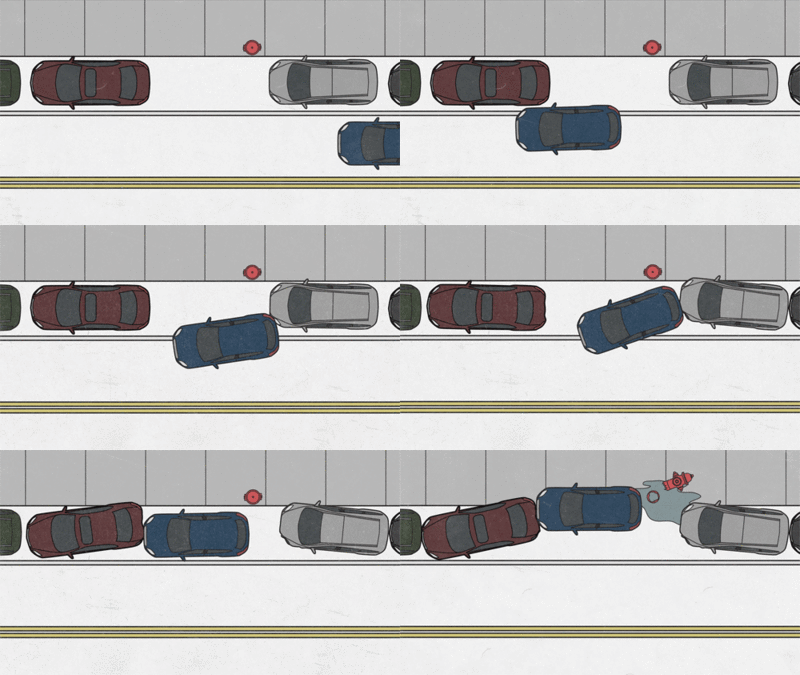
 just moving along like everyone else