A Genie offers you one wish, and you modestly wish to have a very productive 2017. The genie misunderstands, and for the rest of your life, every 20:17 you become impossibly productive for just 60 seconds.
“Well, it was a nice day.” You kiss your sweetheart gently on the forehead and sigh as the last remaining seconds of 20:16 tick away. “See you at 8:18,” you say.
Then it happens. Every ounce of fatigue or hunger leaves your body. The face of your beloved is perfectly still, their expression exactly the same. The ticking of the clock on the wall has stopped. Once again, it’s 20:17.
You stretch your arms and walk to the table with the homework for the three doctorates you’re working on. The work is mentally stimulating and enjoyable, but it’s finished far too quickly. You check your pocket watch and see that not even one hundredth of a second has passed.
You knew it was too soon to be able to see any movement on the watch, but you can never quite help yourself from looking early on every 20:17. Time to move on.
You clean your home, do your budget, then go outside and fix a noise that your car was making earlier that afternoon. (Oh how you already miss afternoons.) Then you go back inside, boot up your computer (which magically speeds up to keep pace with you as long as you’re in contact with it) and check for any new orders.
You’ve set up a website for the small business you started called “Magic Elf Services.” People in your area can pay a modest fee on your site to have different tasks and odd jobs done by “The Magic Elf” at 8:17pm every day. It was a little slow to get started, but word has spread and these days you have a steady stream of clients.
The money that comes in from the business is nice, but you’re mostly grateful that it gives you a clear list of things to do. You print off your updated list of clients, step outside, and start making your way through the neighborhood with your to-do list.
There’s the apartments down your street where several neighbors have hired you to tidy up, do the dishes, and mop the floors. You do the windows too, just to see if they notice. There’s the large house across town that paid the “Magic Elf” to clean out the gutters. After the first dozen jobs are done, you manage to stop looking at your pocket watch.
As near as you’ve been able to determine in the past, 20:17 seems to last for approximately one normal year. But it’s not exact. For one thing, it’s hard to keep track of “time” when everything but you has crawled to an almost total standstill. For another thing, time seems to move differently depending on how “productive” your behavior is. One time you tried to spend all of 20:17 sitting at home in your pajamas, but that was getting you nowhere, so you eventually gave up and got busy. (Though you defiantly stayed in your pajamas the whole time.)
During 20:17 your body doesn’t get tired, hungry, sick, or injured. You’re essentially tireless and immortal for the duration of the “minute.” So sleeping or eating away your boredom has never really worked for you.
One of the houses on your list forgot to follow the instructions and leave a key for you to get in. At first you figure you’ll just send them an email telling them to pay more attention and that you’ll do the job tomorrow. Then you decide to go home, get your locksmith tools, and come back.
After finishing up all the jobs on your list, you go into several other homes and small businesses in the area, performing tasks you hope they’ll find helpful, and leaving a hand-painted business card at each one. (The business cards don’t contain your real name just in case somebody thinks “The Magic Elf” should be subject to breaking and entering laws.)
Speaking of laws, you head down to the local police station to pick up your case file. You’ve been in contact with a detective who’s been investigating corruption within their department, and your ability to investigate unseen and get in almost anywhere between the ticks of the clock has proven invaluable. You see that they’ve also added five missing person cases to your file this evening, which certainly raises your interest in the job.
You make your way through town gathering evidence, and start making your way to the outskirts of town. Since you happen to be out that way (and you’ve already solved three of the five missing person cases) you decide to swing by the stone castle you’re building and do some more work there.
The castle walls stand about 20 feet right now, but you know they’ll be much higher when you’re done. You’re far from any roads and pretty safely tucked away, so for now it’s your little secret. You’ve been excavating and moving all the rock yourself, which has been much easier than you first expected since your body doesn’t get tired or sore. You’ve also got a nice system of tunnels going underneath the castle, and you dig and build more of that network for a while.
All that time spent underground has left you feeling rather lonely, so you walk back home to see the face of your sweetheart. Their facial expression has moved ever so slightly since you last saw them, which is a comfort to you. Looking at them gets your imagination going and makes you dream up a story you’d like to tell, so you sit on your couch, plug in your laptop, and write a book.
After you finish editing the last chapter for the third time, you finally allow yourself to look at your pocket watch again. Three seconds have officially passed so far.
It’s gonna be a long 20:17.
Wow, Dave. You managed to take a concept that seems nice on the exterior and make it into a real nightmare. This is some good stuff.
Which is EXACTLY why you should never trust a wish-granting djinn.
Yeah, that is a good question – why do some scifi twist endings fail?
As a teenager obsessed with Rod Serling and the Twilight Zone, I bought every single one of Rod Serling’s guides to writing. I wanted to know what he knew.
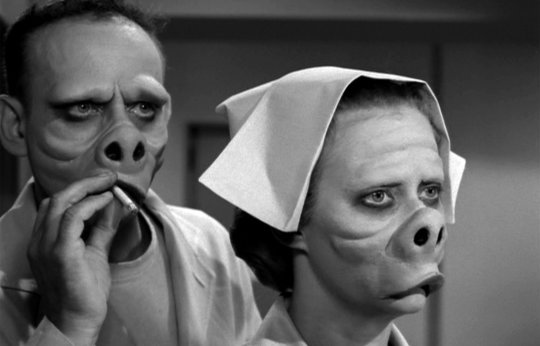
The reason that Rod Serling’s twist endings work is because they “answer the question” that the story raised in the first place. They are connected to the very clear reason to even tell the story at all. Rod’s story structures were all about starting off with a question, the way he did in his script for Planet of the Apes (yes, Rod Serling wrote the script for Planet of the Apes, which makes sense, since it feels like a Twilight Zone episode): “is mankind inherently violent and self-destructive?” The plot of Planet of the Apes argues the point back and forth, and finally, we get an answer to the question: the Planet of the Apes was earth, after we destroyed ourselves. The reason the ending has “oomph” is because it answers the question that the story asked.
According to Rod Serling, every story has three parts: proposal, argument, and conclusion. Proposal is where you express the idea the story will go over, like, “are humans violent and self destructive?” Argument is where the characters go back and forth on this, and conclusion is where you answer the question the story raised in a definitive and clear fashion.
The reason that a lot of twist endings like those of M. Night Shyamalan’s and a lot of the 1950s horror comics fail is that they’re just a thing that happens instead of being connected to the theme of the story.
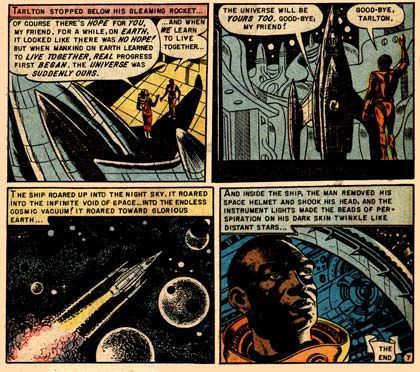
One of the most effective and memorable “final panels” in old scifi comics is EC Comics’ “Judgment Day,” where an astronaut from an enlightened earth visits a backward planet divided between orange and blue robots, where one group has more rights than the other. The point of the story is “is prejudice permanent, and will things ever get better?” And in the final panel, the astronaut from earth takes his helmet off and reveals he is a black man, answering the question the story raised.
IIRC “Judgment Day” was part of the inspiration for the excellent Star Trek: Deep Space Nine episode “Far Beyond the Stars.”
Mary was a beautiful baby, sweet and affectionate, but by the time she’s three she’s turned difficult and strange, with fey moods and a stubborn mouth that screams and bites but never says mama. But her mother’s well-used to hard work with little thanks, and when the village gossips wag their tongues she just shrugs, and pulls her difficult child away from their precious, perfect blossoms, before the bites draw blood. Mary’s mother doesn’t drown her in a bucket of saltwater, and she doesn’t take up the silver knife the wife of the village priest leaves out for her one Sunday brunch.
She gives her daughter yarn, instead, and instead of a rowan stake through her inhuman heart she gives her a child’s first loom, oak and ash. She lets her vicious, uncooperative fairy daughter entertain herself with games of her own devising, in as much peace and comfort as either of them can manage.
Mary grows up strangely, as a strange child would, learning everything in all the wrong order, and biting a great deal more than she should. But she also learns to weave, and takes to it with a grand passion. Soon enough she knows more than her mother–which isn’t all that much–and is striking out into unknown territory, turning out odd new knots and weaves, patterns as complex as spiderwebs and spellrings.
“Aren’t you clever,” her mother says, of her work, and leaves her to her wool and flax and whatnot. Mary’s not biting anymore, and she smiles more than she frowns, and that’s about as much, her mother figures, as anyone should hope for from their child.
Mary still cries sometimes, when the other girls reject her for her strange graces, her odd slow way of talking, her restless reaching fluttering hands that have learned to spin but never to settle. The other girls call her freak, witchblood, hobgoblin.
“I don’t remember girls being quite so stupid when I was that age,” her mother says, brushing Mary’s hair smooth and steady like they’ve both learned to enjoy, smooth as a skein of silk. “Time was, you knew not to insult anyone you might need to flatter later. ‘Specially when you don’t know if they’re going to grow wings or horns or whatnot. Serve ‘em all right if you ever figure out curses.”
“I want to go back,” Mary says. “I want to go home, to where I came from, where there’s people like me. If I’m a fairy’s child I should be in fairyland, and no one would call me a freak.”
“Aye, well, I’d miss you though,” her mother says. “And I expect there’s stupid folk everywhere, even in fairyland. Cruel folk, too. You just have to make the best of things where you are, being my child instead.”
Mary learns to read well enough, in between the weaving, especially when her mother tracks down the traveling booktraders and comes home with slim, precious manuals on dyes and stains and mordants, on pigments and patterns, diagrams too arcane for her own eyes but which make her daughter’s eyes shine.
“We need an herb garden,” her daughter says, hands busy, flipping from page to page, pulling on her hair, twisting in her skirt, itching for a project. “Yarrow, and madder, and woad and weld…”
“Well, start digging,” her mother says. “Won’t do you a harm to get out of the house now’n then.”
Mary doesn’t like dirt but she’s learned determination well enough from her mother. She digs and digs, and plants what she’s given, and the first year doesn’t turn out so well but the second’s better, and by the third a cauldron’s always simmering something over the fire, and Mary’s taking in orders from girls five years older or more, turning out vivid bolts and spools and skeins of red and gold and blue, restless fingers dancing like they’ve summoned down the rainbow. Her mother figures she probably has.
“Just as well you never got the hang of curses,” she says, admiring her bright new skirts. “I like this sort of trick a lot better.”
Mary smiles, rocking back and forth on her heels, fingers already fluttering to find the next project.
She finally grows up tall and fair, if a bit stooped and squinty, and time and age seem to calm her unhappy mouth about as well as it does for human children. Word gets around she never lies or breaks a bargain, and if the first seems odd for a fairy’s child then the second one seems fit enough. The undyed stacks of taken orders grow taller, the dyed lots of filled orders grow brighter, the loom in the corner for Mary’s own creations grows stranger and more complex. Mary’s hands callus just like her mother’s, become as strong and tough and smooth as the oak and ash of her needles and frames, though they never fall still.
“Do you ever wonder what your real daughter would be like?” the priest’s wife asks, once.
Mary’s mother snorts. “She wouldn’t be worth a damn at weaving,” she says. “Lord knows I never was. No, I’ll keep what I’ve been given and thank the givers kindly. It was a fair enough trade for me. Good day, ma’am.”
Mary brings her mother sweet chamomile tea, that night, and a warm shawl in all the colors of a garden, and a hairbrush. In the morning, the priest’s son comes round, with payment for his mother’s pretty new dress and a shy smile just for Mary. He thinks her hair is nice, and her hands are even nicer, vibrant in their strength and skill and endless motion.
writing advice: never italicize words to show emphasis! the busted-ass website you post your writing on will only display them like 40% of the time anyway!
1. Navigation. You can see all your chapters, scenes, character & setting planning at one glance and switch between them very easily – compared to scrolling up and down in one long word processing document. Every file can also be a folder, so you can have collapsible items underneath it.
2. Word count targets. The “Project Targets” are particularly useful for NaNoWriMo so you don’t have to keep looking back at the website to see how you’re doing for the day, but more so outside of it, when you want to keep yourself working to a target but don’t have Nano’s charts and daily word counts. It also gives you a nice ding when you hit your session target.
3. How many pages? I only recently discovered this, but it’s very nice to be able to see in Project Statistics approximately how big your manuscript would be in pages without worrying about formatting.
4. Outlining. Scrivener has two methods of outlining – one is Corkboard, which is exactly what it sounds like, a digital corkboard with notes pinned on it that represent your chapters/scenes with their summaries. The screenshot above is called ‘outliner’ and lists collapsible chapters/scenes with various statistics you can select as shown in the tick menu. Generally I prefer Corkboard, but Outliner is useful if you just want to see everything in a clear order.
5. Full screen. I get distracted very easily when writing, so the full-screen writing mode is wonderful for me to avoid that – but you can still choose certain windows from the normal Scrivener view to show up. I have my targets and my summary, so I can stick to my plan when I’m writing and also see what progress I’m making.
6. Notes. No screenshot, but it’s a simple post-it note style box to the side of every document (chapter, scene, character etc.) that allows you to add notes. This may sound very simple, but it’s far more useful than I’d expected. During NaNoWriMo when I’m not meant to be editing at all, but I know something needs fixing, I will jot down something in the side like ‘Take out the horse’ so that when I go through again to edit I know exactly the things to focus on immediately but which would have taken too much time before. It’s linked to the scene so I don’t just have a pile of notes in one document at the end and then have to work out where it needs fixing.
Overall
I downloaded Scrivener for the first time two years ago, and now I can’t imagine working without it. It’s so nice to have the planning and the writing all combined into one place where I can easily switch between the two. I haven’t yet got as far in a novel created in Scrivener to use the compile features so I can’t comment on those, but so far all my experiences of it have been good.
One thing to note is that if transferring project between a Windows and a Mac version of Scrivener, it’s generally best to zip the file first.
[Screenshots from my current novel Kindling Ashes using the Mac version of Scrivener – some features may not be available in Windows yet.]
I used to think tension and conflict were the same thing. I mean don’t they go together?
Well, a lot of the time they do, but it’s entirely possible to have one
without the other. They often go hand-in-hand, but they aren’t the same
thing. Conflict doesn’t necessarily equal tension, and tension doesn’t
equal conflict.
Lately I’ve been editing stories that seem to have so much conflict and
no tension! I don’t care about the conflicts. I don’t care about the
characters. Because there is no tension.
Tension isn’t the conflict.
A couple of months ago, I wrote this post on Mastering Stylistic Tension. In the comments, Becca Puglisi said:
I learned a long time ago that while conflict and tension are often
considered to be synonymous, they’re different. Tension is key for
winding up the character’s—and therefore the reader’s-emotions.
I admit that for some reason I read it as “Tension is the key for
winding up,” and my mind filled with an actual image of a key winding
something up. Tension winds up. Conflict is problems that collide.
Tension doesn’t need problems to collide, tension is often the promise or potential for
problems colliding. My oldest brother pointed out that there are action
movies that have conflict after conflict, but no tension. They are a
spectacle–blasts, explosions, fire. Then, he went on to say, there are
movies like Jaws that have scenes that work largely off tension.
I said in my Mastering Stylistic Tension post, “In some ways, it’s not the conflict itself that draws readers in, it’s the promise of conflicts,” which is often the tension.
Tension invests us personally in the story. We feel it. It’s
anticipation, it’s hope or dread for what will happen. It’s a tangible subtext or undercurrent for what could happen.
Tension is defined as a straining or stretching; intense suppressed emotions.
Conflict means “to come to a collision;” to fight or contend.
So tension may suggest a conflict, but it is not the conflict itself.
Conflict may be an object, but tension is the key winding it up.
Sometimes writers try so hard to put in so much conflict to make their
stories interesting when what their story needs is tension for the
conflicts they already have.
I’ll give an example from my own experience.
Last year I was working on a sequence of flashbacks for my novel. While
not the main purpose of the flashbacks, it was important that I
illustrate a romantic relationship in them, because the relationship
itself is important to a main character and what happens in the present
timeline. I was stuck trying to figure out how to communicate the
uniqueness and complexity of the relationship in such a short space. In
an old, old version of this story, I had planned to use a lot of
romantic gestures to convey the relationship, but in working on these
flashbacks, I realized that the romance and the conflict it brought
(which deals with “forbidden love”) wasn’t as powerful as the tension it could have.
I scrapped the idea of the characters touching and kissing, and instead focused on their powerful desires to touch and kiss when they weren’t allowed or able to; I gave one of
the characters a particular reason and a personal commitment to not give
the other affection.
The scene immediately became more interesting. The tension was palpable,
their desires electric, but because they could not give into their
desires, the tension couldn’t release, regardless of how much they or
the audience wanted it to.
The conflict is forbidden love, but the tension is held in the drawn out moments of a desire that can’t be manifested.
This is one of the reasons that sexual tension can be so powerful in
stories. It’s not the colliding problems that come with being with that
person, it’s the subtext and undercurrent of wanting to be with that
person, but not being with them. Once the couple is together, that
tension ends.
Likewise, some of the best dialogue comes from tension, not straight-up
conflict. It comes from subtext, from what’s not being directly said.
Once the dialogue becomes direct, the tension ends and the problems
collide in conflict. Tension often comes before direct conflict. And if
that isn’t happening much in your story, it should.
As Mindy Kaling once explained, sometimes the best tension comes from
the characters trying to avoid conflict, from them trying to stop it
from bubbling out into the open. The closer the conflict gets to the
open and the harder a character tries to stop it, the stronger the
tension gets. It winds up, tighter and tighter. We as an audience
anticipate its release.
That’s what draws a reader into the story.
So make sure that your story has tension and conflict, and not just one
or the other. If you have a story with a bunch of conflict, but your
readers aren’t interested, you may need more tension. If you only have
tension and no conflict, the reader may end the story feeling cheated.
Use both.
For a full and updated list of writing advice, click here. All advice is by Marina Montenegro and originally posted on Writing the Words blog. (This list is updated to include August’s Romance section)
I’ve been craving SickFic, so have some prompts and feel free to tag me here at @wordmage because I would love to see your takes on the prompts below. Feel free to add more, or use it for RP/art, whatever. I plan to try and fill them all out, myself.
99.9% Immunity – (character) never gets sick, right? Wrong.
Elephant in the Room – (character) is sick, but for some reason – rank, personality, etc – no one is talking about it
Heroes Don’t Take Sick Days – there’s no time to rest when you have to save the world, so (character) has to push themselves even when miserable
Insult to Injury – as if being injured wasn’t enough, (character) is getting sick too
Ill Timed – it’s the worst possible time for (character) to be sick, but their body didn’t get the memo
Irreplaceable – (character) is the leader/boss and isn’t able to take personal time off, even when they’re under the weather
It’s Nothing – (character) insists they’re fine, right up until they collapse
Medic Down – every group seems to have a primary caretaker. How do they handle it when (character) is the one sick?
Milking It – if (character) has to be sick, they’re at least going to get as much pampering out of others as they can
Not a Word – (character) said they don’t get sick, and isn’t in the mood for anyone to remind them while they recover
No Rest for the Wicked – the big bad (character) has more to worry about than the good guys
Open Secret – everyone knows (character) is sick, but they’re trying so hard no one has said anything
Persuasive Partners – (character) is sick, and refusing to stay put; their partner(s) give them a good reason to stay in bed
Stepping Up – boss/leader (character) is clearly miserable, so the others go out of their way to take as much of their workload as possible
Suffer in Silence – for whatever reason, (character) doesn’t want anyone to know they’re sick, and does everything they can to hide it
Take One Down… – (character) gets sick, and spreads it to the rest of the group
Team Mom/Dad – (character) is the one to always take care of others on the team
The Wolf Cries True – (character) has been known to exaggerate or even pretend they’re sick, only this time they’re telling the truth
This is Your Fault – (character A) was clingy while they were sick, and now (character B) has it
Why Didn’t You Say? – (character) hasn’t been feeling well, making for some uncharacteristic behavior, and their partner(s)/team/friends are much more understanding once they realize why
This is somehow one of my most popular posts (nearly 400 notes on it, mostly reblogs) which I am 110% behind and totally approve. So I’m also going to add more things. (Drop these in people’s askbox with characters or something! Mine, too!)
Behind Closed Doors – (character) has a solid public face, but in private they let themselves be taken care of when they’re not well
Bless You – (character) has a particularly sneezy cold, and may or may not be able to retreat from life to deal with it.
Don’t Speak – (character) has a horribly sore throat and is reduced to barely talking while they load up on hot drinks and soup to recover.
I’m Dying – (character) has a headcold and despite that not being anywhere near the worst they’ve ever been, they’re flailing about it to anyone who will listen
Judgement Call – (character) really isn’t feeling well, but has pressing obligations. Others could step up, but no one is as qualified. They choose to…
Painfully Polite – (character) has very strong feelings about how one should behave, and they are even more mindful when they’re not at their best, talking through a sore throat, trying not to cough, attempting to stifle sneezes, etc.
Misery Loves Company – (character) is under the weather and not up for much, but really appreciates having someone there. Even if that someone is sick too.
Stay With Me – (character A) rarely asks for help, but they’re feeling miserable enough to ask (character B) to keep them company a while.
With Kid Gloves On – it’s a known fact that (character) has trouble accepting help, even when they’re sick; the others have learned specific “acceptable” methods over time
You Heard Nothing – (character) is obviously coming down sick – sneezing, sniffling, coughing – and absolutely refusing to admit to it, let alone take things easy.
idea: selina kyle as a reverse archeologist. she steals from museums and private collections and returns things to the shrines and graves where they belong. she brings a clay jaguar to monte alban and now she can talk to cats. the whip is because she’s indiana jones. batman makes half-assed attempts to stop her but it’s not like she’s wrong so like ¯_(ツ)_/¯ he’s got violent crimes to deal with, what does he care if she’s stealing back smuggled relics from rich assholes. he met that guy at a party once and he was a huge asshole so fuck him. steal his toupee, too. it’s probably endangered. ‘oh no catwoman is escaping and there’s nothing we can do. robin sit back down. there’s nothing we can do. she’s taking that statue back to egypt and we have no possible recourse against this terrible nonviolent crime with a single dick victim. i am definitely really mad about this. i’ll fight her later, when you’re sleeping or at a friend’s house or something. you’ll understand when you’re older.’
so far this post has been reblogged by one single dude who was super offended by the idea of putting relics back where they came from, and a legitimately shocking number of hype archaeology majors who aspire to working primarily in repatriation.




 just moving along like everyone else