About twelve years ago, a man died in high orbit over Tau Ceti V.
His name was Drake McDougal, and aside from a few snapshots and vague anecdotes from his drinking buddies, that’s probably all we’ll ever know about him. Another colony-born man with little records and little documentation, working whatever asteroid field the Dracs deigned to allow them. Every now and then a Drac gunship would strut on through the system, Pax Draconia and all that. But that was it.
One fine day, one of those gunships had a misjump. A bad one. It arrived only ninety clicks above atmo, with all its impellers blown out by the gravatic feedback of Tau Ceti V’s gravity well. The Dracs scraped enough power together for a good system-wide broadbeam and were already beginning the Death Chant when they hit atmo.
People laughed at the recording of sixty Dracs going from mysterious chanting to “’what-the-fuck’ing” for years after they forgot the name Drake McDougal. The deafening “CLANG” and split second of stunned silence afterwards never failed to entertain. Drake had performed a hasty re-entry seconds after the gunship and partially slagged his heatshield diving after it. Experts later calculated he suffered 11Gs when he leaned on the retro to match velocities with the Dracs long enough to engage the mag-grapples on his little mining tug.
Even the massively overpowered drive of a tug has its limits, and Drake’s little ship hit hers about one and a half minutes later. Pushed too far, the tug’s fusion plant lost containment just as he finished slingshotting the gunship into low orbit. (It was unharmed, of course; the Drac opinion of fusion power best translated as “quaint,” kind of how we view butter churns.)
It was on the local news within hours, on newsnets across human space within days. It was discussed, memorialized, marveled upon, chewed over by daytime talk-show hosts, and I think somebody even bought a plaque or some shit like that. Then there was a freighter accident, and a mass-shooting on Orbital 5, and of course, the first Vandal attacks in the periphery.
The galaxy moved on.
Twelve years is a long time, especially during war, so twelve years later, as the Vandal’s main fleet was jumping in near Jupiter and we were strapping into the crash couches of what wee enthusiastically called “warships,” I guaran-fucking-tee you not one man in the entire Defense Force could remember who Drake McDougal was.
Well, the Dracs sure as hell did.
Dracs do not fuck around. Dozens of two-kilometer long Drac supercaps jumped in barely 90K klicks away, and then we just stood around staring at our displays like the slack-jawed apes we were as we watched what a real can of galactic whoop-ass looked like. You could actually see the atmosphere of Jupiter roil occasionally when a Vandal ship happened to cross between it and the Drac fleet. There’s still lightning storms on Jupiter now, something about residual heavy ions and massive static charges or something.
Fifty-eight hours later, with every Vandal ship reduced to slagged debris and nine wounded Drac ships spinning about as they vented atmosphere, they started with the broad-band chanting again. And then the communiqué that confused the hell out of us all.
“Do you hold out debt fulfilled?”
After the sixth or seventh comms officer told them “we don’t know what the hell you’re talking about” as politely as possible, the Drac fleet commander got on the horn and asked to speak to a human Admiral in roughly the same tone as a telemarketer telling a kid to give the phone to Daddy. When the Admiral didn’t know either, the Drac went silent for a minute, and when he came back on his translator was using much smaller words, and talking slower.
“Is our blood debt to Drake McDougal’s clan now satisfied?”
The Admiral said “Who?”
What the Drac commander said next would’ve caused a major diplomatic incident had he remembered to revert to the more complex translation protocols. He thought the Admiral must be an idiot, a coward, or both. Eventually, the diplomats were called out, and we were asked why the human race has largely forgotten the sacrifice of Drake McDougal.
Humans, we explained, sacrifice themselves all the time.
We trotted out every news clip from the space-wide Nets from the last twelve years. Some freighter cook that fell on a grenade during a pirate raid on Outreach. A ship engineer who locked himself into the reactor room and kept containment until the crew evacuated. Firefighter who died shielding a child from falling debris with his body, during an earthquake. Stuff like that.
That Dracs were utterly stunned. Their diplomats wandered out of the conference room in a daze. We’d just told them that the rarest, most selfless and honorable of acts – acts that incurred generations-long blood-debts and moved entire fleets – was so routine for our species that they were bumped off the news by the latest celebrity scandal.
Everything changed for humanity after that. And it was all thanks to a single tug pilot who taught the galaxy what truly defines Man.
This makes me cry
It had been so many cycles since the Drac incident, and even more since the Drake McDougal event, and the the galaxy had sort of come to the conclusion that humans were, well, human about things, and that they regarded their lives in completely incomprehensible ways.
Yet for all of the witnessed sacrifices, few warriors had ever been taught to recognise the most terrifying of human deeds. In a forgettable corner of the galaxy, in an unremarked planet with a previously less than recorded history, a party of six human security escorts bringing their rescued survivors to a hive ship became a party of five,
A lone human, holding one of their handheld ‘melee’ weapons wordlessly tilted their head to their commander, and stopped, standing in plain sight in the middle of a field.
Waiting.
When asked, the lower ranked humans simply said “She knows what’s she’s doing”. The human captain’s inexplicable statement “She’s buying us some time” made it as if their companion had stepped into some form of marketplace.
Katherine of Rescue Group’s fate was never confirmed, but no pursuit came that night. On the next dawn, when the hive ship was able to leave, the humans insisted we departed immediately, and did not go back for their companion.
We do not know for sure what became of Katherine of Rescue Group. All we know is that when pressed, the human captain explained to our own that the one who stayed had communicated an ancient human tradition, the rite of self sacrifice. In words, the captain explained, the look and the nod would mean “Go on. I’ll hold them off. It was not, as we thought, that this one warrior had sought victory over many enemies, but that they had calculated a trade off of the minutes or hours it could take to defeat a human, against the time needed by their companions.
Humans, as humans say, do not go gentle into that good night.
Worse, they do not go gentle into bad nights, worse days, or terrifying sunsets. Dawn seems to fill them with potency and rage, as if to call upon the solar gods and tell the deities to come down here and say that to their human faces. We do not know how long she bought us, but we, the hive now called K’thrn, understand what it means to have someone expend their existence for the survival of others.
The most hilarious thing about the fact Buckbeak had a trial and lost is that later on JKR resolves the issue by having Hagrid take him in again and renaming him Witherwings. That’s literally all it took. What if in POA, Hagrid simply said, “Sorry, Buckbeak flew away.”
“There’s a hippogriff right there, Hagrid.”
“A different hipprogriff.”
“I’m… pretty sure that’s the same hipprogriff.”
“Prove it.”
no dna tests we die like scientifically underdeveloped societies
Prisoner of Azkaban continues to be the most frustrating book
Someone should have just adopted Sirius and started calling him Gerald.
Remus: Erm… this is our new order member, my… cousin Gerald. Gerald White.
“Mr. Lupin that is Sirius Black with glasses!” “Oh come now Minister, Sirius Black doesn’t wear glasses. That wouldn’t make sense.” “Well have Mr. White take off his glasses then!” “He can’t he needs them to see.”
it got better
It’s honestly a miracle to me that wizarding society doesn’t collapse every other week because like
You’ve got this world full of people who can destroy whole buildings or turn people into beetles or make vehicles fly just by waving a stick at them
And there is literally no common sense
Anywhere to be found
Voldemort would never have had anyone find out he was back if he just went around calling himself Steve
Okay, see, I thought I saved this post to comment on it but I’d like to bring up
The Minister would NEVER EVER disbelieve in Gerald White. He’d buy it hook line and sinker. The wizarding world would buy it hook line and sinker. The GOBLINS wouldn’t but wizards have been shown to be pretty blindingly clueless. Still, Gringotts would grudgingly give Sirius access to the Black fortune.
But, but, but, you know the one person
the one person
who Gerald White would drive AB-SO-LUTELY FUCKING BATSHIT?
Severus Snape.
Snape would do everything, EVERYTHING, to get people to believe that it’s Sirius. But the Order would ignore it (they accepted Sirius as Sirius before anyway) and Remus would just be so… so affronted.
‘Severus, he is my cousin.’
And Sirius would love it. He’d love the fact that Snape just hated it. He’d be the BEST DAMN GERALD WHITE EVER b/c Snape is doing everything from dropping veritaserum into his firewhisky to capturing a dementor in a box and releasing it on Sirius when he least expects it
That one causes problems for a bare minute because SHIT A DEMENTOR ATTEMPTED TO GIVE GERALD THE KISS MAYBE SNAPE IS RIGHT except Harry comes forward and is like ‘excuse me, I’ve never committed a crime and dementors are ALWAYS attacking me, I think they’re attracted to glasses’
and the magical community is like ‘shit, yeah, you’re right’
and just
Spare. Snape goes spare.
Now I’m imagining Fred and George sneaking extra Weasleys into Snape’s class manifests every year.
Annnd I wrote the thing. Sort of. It kinda got out of hand.
–
The first year they’re just Fred and George, except when occasionally they’re Gred and Forge, but it’s not too long before Snape just stops trying to tell them apart and just treats them as the joint entity “Weasley,” who happens to be in two places at once.
The next year they take turns attending first-year Potions class as Barry Weasley, the glasses-wearing Weasley cousin who missed the Sorting Ceremony because he tried to swallow three chocolate frogs at once on a bet from his twin cousins and got sick.
Snape has a choice between asking questions about Barry and punishing Fred and George for tormenting their cousin, and punishing Fred and George wins out. At this point, it’s not really that weird–the Weasleys do tend toward large families–and any excuse to give the twins detention is basically the sort of thing you could put under a box propped up with a stick on a rope and a “TOTALLY NOT A TRAP” sign to catch Severus Snape.
So he figures Barry Weasley is real. He comments on the boy’s resemblance to Fred and George, and Barry nods and says “Everyone says that. I could fool everyone but them, except eventually people figure out there’s only one of me.”
Snape doesn’t have much cause for complaint. Barry is not a difficult student (the twins are, at this point, quite happy with the joke for its own sake and so don’t risk the Barry persona on tormenting him), perhaps a bit prone to letting his mind wander (it helps that George is actually interested in Potions, and uses the second run as an opportunity to experiment), but there have been no outright disasters centered around his cauldron, which is a lot more than can be said for the twins.
The next year is Fred and George’s third year, Barry’s second year, and Ron’s first year. They don’t take Ron entirely into their confidence … but they do let on that they’ve invented a fictional “Cousin Barry” to mess with Snape a bit, in case Snape asks, but Snape doesn’t ask.
He does mention Barry Weasley to Barry’s supposed Head of House, but by pure luck he manages to do so when Minerva is sufficiently preoccupied by that late night with four first-years sneaking out after curfew, and she hears “Harry and Weasley,” and nods, and asks him something about a Gryffindor fifth-year she’s concerned about, and, well, that basically settles it.
Fred and George run into a minor difficulty in that they don’t have a free period coinciding with “Barry’s” potions class, but they get lucky enough to have History of Magic during that class, and Binns wouldn’t notice if Fred or George set the classroom on fire, much less if Fred or George is always absent.
Fred and George are at this point quite satisfied with getting “Barry” through seven years of Hogwarts without Snape realizing he’s fictional, but then at the beginning of their fourth year Snape is absent from the Sorting and the Welcome Feast and … well. Opportunity beckons.
Since Fred and George are pragmatic about which elective classes they take (they’re much more interested in independent study directed toward magical jokes and pranks), they have several free periods and it only takes a significant look between them to agree that, yes, they can absolutely handle being one more person just for Potions class.
They’re a bit more advanced at their magic now, and a bit of diluted Shrinking Potion and a Freckle Charm create Barnaby, Barry’s younger brother. There’s a minor concern with Ginny being in the same class, and more importantly, Operation Barnaby is still in the planning stages when McGonagall hands out the schedules and they realize they have Transfiguration during the requisite class period and McGonagall will definitely notice if a twin is missing.
Thus is is that Barnaby Weasley, Hufflepuff, is born.
Snape doesn’t give away anything more than a mild frown at another Weasley showing up on the class roster, but he does raise an eyebrow and inquire, “Hufflepuff?” after reading his name.
Barnaby (Fred, at the moment) turns red with the help of a Blushing Charm and looks hurt and defensive, which makes the Hufflepuffs, upset at the perceived insult to their House, accept him without question. Nobody ever asks either twin why he only shows up in Potions class; they get that it’s some long-con joke focused on Snape and they don’t interfere.
Barnaby is not quite as hopeless at Potions as Neville, but he is prone to the same wandering attention span as his brother, only more so. His potions regularly fail and occasionally explode, usually in a way that to Snape indicates carelessness with the ingredients and tells Fred or George something useful about the what happens when you do that.
The next year there are no new Weasley children, officially, but when Fred plops himself down next to George on the train and says “So what about a girl?” George knows exactly what he’s talking about.
They mix a hair-growing potion on the train, and have to hide it quickly when Draco Malfoy comes running into their compartment, frightened of the dementors.
George takes the hair potion and the shrinking potion and the pair of them use the Marauders’ Map to intercept Snape on his way to the Great Hall. Fred hides behind a pillar and casts a Duplicating Illusion Charm on himself and tries hard not to burst out laughing as George plays Nasturtium Weasley, little sister to Barry and Barnaby, who’s somehow managed to get lost on the way to the Great Hall.
Snape’s not the slightest bit pleased to be getting yet another absent-minded Weasley cousin, snarls, snaps something vaguely cutting, and leads her towards the Great Hall, intending to hand her over directly to Professor McGonagall; instead he runs into Fred and George (actually Fred and his charm double); Fred explained that they saw their cousin wandering off and went to go get her. Snape lectures the pair of them on wandering, accuses them of being up to no good, and stalks off to direct evil looks at Professor Lupin.
Which, luckily, takes up so much of his attention that he doesn’t pay attention to the Sorting. Fred and George decide the next morning, after careful consultation of multiple students’ class schedules, to put her in Hufflepuff along with Barnaby.
They strike it lucky again, in that first-year Potions only conflicts with Care of Magical Creatures, to which only one twin is going (they don’t see much point in both of them taking the same class, figuring that one of them knowing something is as good as both of them knowing it and they can teach each other more effectively than anyone else can teach them, an argument that failed to impress Professor McGonagall into letting them each out of half their classes back in first year); Hagrid won’t be expecting to see two of them.
Nasturtium Weasley, it develops, has quite a lot of bright red hair and a tendency to hyperfocus on ingredients or processes, leading to a lot of ruined potions when she keeps stirring too long or spends the whole class period shredding the shrivelfigs or gets lost examining the lobes of a dirigible plum leaf. Fred and George, taking turns being Nasturtium, are happy to spend the time just thinking through some interesting research they’ve been doing or contemplating a problem with their latest invention or just brainstorming new joke ideas until Snape appears, bellowing about melted cauldrons and the people who don’t even notice them because they’re too fascinated by the down on a downy mage-thistle.
But they’re being run just a bit ragged at it and decide that three is enough–until they wander past the Hospital Wing at just the right time to hear Snape bellowing apoplectically about Harry Potter, and Dumbledore’s more reasoned tones making light of the idea that Harry and his friends were in two places at once.
Fred and George look at each other and a light goes on.
They’ve heard about time-turners. They’ve also seen Hermione Granger run herself ragged studying textbooks for every subject available. They know how many subjects there are, and how many class periods in a week.
As one, they reach out and lightly smack each other on the head for not putting it together earlier.
Snape comes raging out the door just in time to see them and gives them detention. Fred and George scowl after him and turn and look at each other. And nod.
It’s on.
Fred “accidentally” bumps into Hermione when she’s on her way to McGonagall’s office, pretends to lose his balance, and falls hard to the floor. It gives him bruises, but sometimes sacrifices must be made for the successful theft of major, highly-regulated, top-secret magical artifacts. Hermione turns to help him, and George switches the time-turner with an elaborately crafted fake, a Confundus Charm and a Diversion Charm giving it the correct density of magical energy signature and ensuring that anyone who tries to use it will find an urgent reason to put it off. (George is super pleased with that one; it’s a time-turner, so quite naturally anyone who can use it has plenty of time to use it later.)
Next year is their sixth year, which brings enough of a drop in courses (there are definite benefits to getting only two OWLS each, though they doubt their mother would agree) that they only need to use the time-turner once, when Barry has Potions when Fred has Transfiguration and George has Herbology. They’re almost disappointed by this, until Fred gets a devastatingly diabolical grin on his face and says, “what if there were two of them?”
George’s face mirrors the grin in an instant, and he responds with his own suggestion. “Cousins.” A pause. “And they hate each other.”
And so come into being Gentian Weasley, younger sister of Barry, Barnaby, and Nasturtium Weasley, and her cousin from yet another branch of the Weasley family, Bilious Weasley the Second.
This time they give themselves some insurance, and make very good use of the time-turner, by charming Snape into seeing the new arrivals be Sorted. For a diversion they let Peeves the Poltergeist into the kitchens and assist him in creating havoc (testing out a potential product, tentatively named the Souper Swimming Pool, in the process); the amount of commotion takes three Professors to sort out, one of them Snape, and it’s surprisingly easy to hit the distracted Potions Master with the prototype of a Daydream Charm, highly modified to suit the occasion.
Once they’ve finished the time loop, they blast themselves with Aguamenti charms to make it look like they’ve just come out of the rain and sit down. Snape sees Weasley, Bilious and Weasley, Gentian be sorted into Gryffindor one right after another and summons himself a bottle of firewhiskey.
This is a mistake, as he has the keen and ignoble joy of being hungover for the worst Potions class he’s ever taught, including that one time when somebody (Potter) threw a firework into the Swelling Solution.
Gentian snickers when Snape reads Bilious’ name. Bilious calls Gentian “freckles.” Slytherin students from accross the room (the both of them are Gryffindors this time) look on in obvious amusement. Snape looks constipated. Their own supposed housemates eye them, looking confused, concerned, and generally bamboozled but none of them vocalize their curiosity.
Fred and George share a secret, gleeful smile, and escalate.
They spill things on each other: water, pigeon milk, stinksap. Gentian breaks a salamander egg on Bilious’ forehead; Bilious stabs Gentian with a knarl quill. They drop the wrong ingredients surreptitiously into each other’s potions. Bilious’ cauldron spews copious amounts of green smoke, gaining a lecture and losing five points for Gryffindor; his retaliation recreates Neville Longbottom’s disaster a few years prior and melts Gentian’s cauldron. Gentian shrieks at Bilious, Bilious dumps the whole jar of puffer-fish eggs over Gentian’s head, and Gentian launches herself at him, punching and clawing and screaming her head off.
Snape separates them with a wave of his wand and threatens them with a month’s worth of detention collecting bubotuber pus. Gentian says, “You can’t do that, I’ll tell McGonagall on you,” which neatly puts Snape off telling Professor McGonagall himself, because honestly, she probably will take issue with it. Bilious smirks loftily and sneers, “Baby. I like bubotuber pus. It smells like petrol.”
“How,” Snape asks suspiciously, “would a wizardborn young man like yourself know about petrol?” and Gentian (secretly Fred) hides a wince; their father’s particular fascination with Muggle things might be their undoing. But George recovers, saying proudly, “My dad’s an accountant.”
The Slytherins laugh. Fred catches the reference and Gentian says, “Oh, right, your dad’s the family Squib.”
Bilious grabs his cauldron and makes to empty it over her head, only to find that the contents are basically a solid baked into the cauldron’s bottom. Snape casts it away and tells them they’re more of a disaster than Neville Longbottom and deducts fifty points from Gryffindor, and they spend the walk out of the dungeons trying to convince their housemates that the points don’t actually matter that much.
Snape goes straight to McGonagall to complain, but refers to them as “Those two damned Weasleys,” and McGonagall nods and makes sympathetic faces and promises to speak to them. Fred and George get a detention with McGonagall at the same time as Gentian and Bilious have one with Snape, which makes them as happy as a time-turner can make two mischief-minded teenagers in possession thereof.
That year is a delight. They have a Triwizard Tournament to watch, a small multitude of visiting students from Beauxbatons and Durmstrang, many of them attractive, to interact with, and five alter egos with which to torment Professor Snape. Moreover, with the time-turner and the extra Potions classes, they’ve made significant progress on their product line and are turning a brisk business with the student body.
Snape learns quickly and the first time is also the last time he schedules Gentian and Bilious for a detention together. Fred and George take it in turns to run certain of their inventions past Flitwick and Sprout to gain back some of the points they lose in the first-year Potions class. By the time summer rolls around, Fred calculates that they’ve used the time-turner enough to have come of age and potentially erased the Trace on them.
They pay Mundungus Fletcher a galleon to come somewhere out-of-the-way with them and lend them his wand to cast a few spells. When no owls show up carrying Ministry warning letters, they head to Diagon Alley and celebrate by buying a storefront and the flat above it, and spend most of the summer there, fixing it up and getting things ready for a product launch next year. NEWTS, schmoots.
There’s of course that annoying business about Voldemort returning, and their mother decides the best way to keep them out of the Order’s business is to turn them into house-elves, but they come up with a few charms to do housework slowly by magic, and adjust the illusion spells, and put in just as much of an appearance as necessary.
Then September rolls around again, and their new Defense Against the Dark Arts teacher is even worse than Snape and Lockheart combined, and just like that, Barry, Barnaby, Nasturtium, Gentian, and Bilious all add themselves to Defense Against the Dark Arts classes.
This largely sucks, because the DADA classes are utterly useless this year, but Fred gets the idea of substituting their alter egos and eventually themselves with illusion charms (”She doesn’t actually teach, she’ll never notice”), which makes George laugh hysterically because they’ve progressed from attending classes multiple times as different people to using doppelgangers to avoid going to class at all, and the two tactics are completely at odds with each other. But they do it.
Umbridge doesn’t notice, and pretty soon the only class they show up for is the one where second-years Bilious and Gentian are forever hurling hateful looks, creative insults, badly-aimed spells, and improvised projectiles at each other.
Umbridge starts taking points from Gryffindor off at the first “blast-ended walnut” from Gentian and assigns the first detention at Bilious’ elaborately-detailed Muggle catapult. Fred and George add a line of Magical Model Muggle Major Munitions to the product array at the soon-to-be-hatched Weasleys’ Wizarding Wheezes, and make copious notes on how to use them as actual weaponry once Voldemort makes his appearance.
Fred writes “I must not fight in class” with Umbridge’s quill for six hours and then steals it. George listens to Fred’s description of the evening, takes one look at Fred’s hand, and breaks into Umbridge’s office and takes a generous crap on her desk. “Crude,” says Fred admiringly, “but deserved.”
The next time Barnaby has DADA, Fred goes as him in person and tests out a Skiving Snackbox. Throwing up on Umbridge is satisfying. He gets detention and writes “I will be more careful with how I am sick” some nine hundred times with a completely normal quill, charmed to write in red ink like a Muggle fountain pen, and mimes innocence when Umbridge expresses confusion at the lack of redness and swelling on his hand.
Gentian and Bilious get into a full-on wizards’ duel in their next DADA class, and aim so terribly that Umbridge gets hit more than they do. They both get detention, and Fred and George send illusions in their stead.
Next week they do it again, and Umbridge spends half the afternoon in the hospital wing, getting tentacles removed. Colin Creevey, confined to bed rest for a case of Exploding Hiccups, sneaks a picture and later trades it to the Weasley Twins for a Pygmy Puff, two Daydream Charms, and a promise to look into developing Extendable Eyes.
Umbridge goes to complain to McGonagall, who listens to the entire rant about a pair of students she’s never heard of with a reasonably straight face. Then she blandly tells Umbridge she’ll look into it, and turns back to her essay-marking.
McGonagall wanders down to the staff room the next morning and relates the whole conversation to the other teachers. Flitwick and Sprout are practically rolling on the floor by the time she finishes, but Snape is standing there looking Stupified; he makes the biggest miscalculation he’s made in years, and asks, “You mean they’re not real?”
McGonagall looks at him, calculates what all it would take for him to be asking that question, and promptly laughs herself sick.
Snape waits, looking like he might catch fire, until she recovers. “Yes, Severus. I have never heard of a Gentian Weasley, and the only Bilious Weasley I know is my age.”
Snape says, “There’s two Bilious Weas—who names these people?!”
“There’s one, Severus. I can assure you that there is no such person attending this school at this time.”
He grimaces, then tries, “I don’t suppose Ginny, Ronald, and their siblings are fictional?”
“No such luck, Severus.”
He closes his eyes. Opens them. “Fred and George.”
“Most assuredly real, Severus.”
“No, I meant–they did this. They’re responsible for this, aren’t they?”
“I would imagine so,” McGonagall says, a hint of a smile hovering about her lips.
He eyes her. “Shut up, Minerva.”
She claps a hand to her mouth to hide a giggle, and he turns and sweeps from the room.
As it turns out, he has Gentian and Bilious the next period.
Fred and George, blissfully unaware, are launching into their standard pretend fight—in this case, swordfighting with Transylvanian Lesser Pseudoporcupine quills—when Snape arrives at their table and claps a hand on their near shoulders. He’s smiling like a dragon.
“Fred. George.”
Shit.
They have a moment of sharp dismay, but it doesn’t last. They are the Weasley Twins, they’ve been fooling Snape for years with this prank, and they have money hidden in multiple places and the deed to a shop in Diagon Alley and all the official education they’ll ever need.
They turn and grin back.
“Well done, Professor,” says George. “How’d you find out?”
“Professor McGonagall told me.” His smile was a thin, sharp blade.
“No way.”
“Really?”
“How’d she know?”
“She wouldn’t.”
“I’m afraid I did, Mr. Weasley,” says McGonagall from the doorway. “Although admittedly without knowing you were pranking Professor Snape as well as Professor Umbridge; I thought I was merely sharing a very amusing anecdote with the other teachers.”
They’re drawing curious looks, though fortunately Fred-as-Gentian’s cauldron is hissing like a teakettle and drowning out the conversation; Snape snaps at them to pay attention to their cauldrons before jerking his head at his office door.
Once they’re ensconced within what Fred once called the Snape Museum of Slimy Things, and Fred and George have undone the spells and potions that make them Bilious and Gentian, McGonagall turns to Snape and says, “I forbid you to expel them, Severus.”
He’s about to respond when Fred says, “Go ahead, expel us.”
That gets them two very surprised professors. George shrugs. “Everything’s ready to go. We’ve got a shop in Diagon Alley and enough stock to fill it and enough expertise for a lifetime of success.”
Snape frowns and asks, “Do I want to know what you’re planning to sell?”
George says, “No” at the same times as Fred says, “It’s a joke shop.”
McGonagall looks like she’s trying not to laugh. Snape looks like he’s swallowed a sea cucumber. He opens his mouth, closes it, and then says, “I would have never imagined an argument that could convince me not to try to expel you, but you’ve just provided it. I will not be assisting you in selling pranks to the student body of Hogwarts on a retail level.”
George says, “Actually, we’ve been doing it since the middle of last year.”
Snape turns to McGonagall. “I quit.”
“No.”
“Hey, let Umbridge expel us,” Fred suggests. George snickers.
Snape looks at them, and then at McGonagall, and then back to the twins.
“No, you’re going to stay here,” Snape says, a look in his eyes that makes them wonder what all Umbridge has said to him. “You’re going to continue to be Gentian and Bilious—and Nasturtium and Barnaby and Barry.” He looks to McGonagall as if for confirmation, and George considers that both professors were young once, and were quite possibly as complete and utter hellions as him and Fred.
Snape smiles like a knife. “Give her hell.”
He’s never felt so much respect for a teacher before.
“Mr. Weasley?” Snape adds, almost as an afterthought, his eyes shifting from one to the other as if unsure which of them he’s addressing.
“Yessir?”
“Fifty points from Gryffindor.”
Fred and George smile at each other as they follow McGonagall into the hall.
Worth it.
They follow orders. Bilious and Gentian hit Umbridge with so many “accidental” hexes that she finally bans them from her classroom. Barnaby functions as a sort of a Patient Zero for Umbridge-itis. Barry uses his status as the quiet one to construct elaborate spells that have Umbridge’s classroom warping itself into odd shapes or growing spines out the walls or puffing up like a balloon and trapping her at the bottom. Nasturtium stands up in class one day and slams an epic poem about how teachers who don’t teach are useless and a sea sponge would do a better job of earning the salary.
Between them, they work to set up elaborate pranks and position Umbridge to catch the worst of it. After Dumbledore’s removal, Fred and George set off the best fireworks display Hogwarts has ever seen, and McGonagall gives Gryffindor one hundred points; Gentian and Bilius, usually the only ones still played in person by the Weasley twins, play Umbridge beautifully the next morning, fighting each other as usual and then turning ally, working together to attack her with flurries of squawking birds and flying, shitting replica nifflers.
When Umbridge twigs that they’re all working together she stands up in the middle of the Great Hall at dinner and demands that every Weasley in the place stand up.
Four Weasleys, all siblings, do so.
“Where are the rest of you?” she hisses to Ron, who looks clueless. Ginny cocks an eyebrow and looks to Fred and George speculatively. Umbridge turns to them and they smile like sharks.
Fred climbs up onto the table, George right on his heels. “Ladies and gentlemen, a performance by myself and my twin!”
George produces a potion, downs it, and becomes Gentian.
Fred narrates as George shifts between the various fictional cousins, ending by restoring his own appearance, putting on a pair of glasses, and becoming Barry. Snape slaps his face down into his hands. George finishes by announcing that these new appearance potions, and the fireworks, and a multitude of other products, would be available at 93 Diagon Alley, home to Weasleys’ Wizard Wheezes.
“Not so fast,” says Umbridge, holding out her wand. “The pair of you are going to be expelled—but first you are going to find out what happens to troublemakers in my school.”
“We’re not,” says George, “But let me tell you something: this is not, and will never be, your school.” He looks around at the students, at the teachers, at Snape and McGonagall standing a short distance away, and he and Fred wave their arms in a mirrored gesture to take in the whole student body, and they say, the pair of them together, “This is our school.”
The cheer from around them shakes the rafters.
Then they raise their wands and say, again in unison, “Accio brooms!”
The brooms make holes in the walls on their way in, and Fred and George mount them and soar up among the floating candles, and Fred has to cast a Sonorus Charm to make himself heard over the cheering.
“Weasley’s Wizarding Wheezes, number 93, Diagon Alley: Our new premises!”
And George waves to Peeves, who’s floating up there along with them, attracted by the promise of mayhem. “Give her hell from us.”
Peeves salutes, and Fred and George fly out the front door to freedom.
When they return to Hogwarts almost two years later, their time spent as the fake Weasleys serves all of Hogwarts well: the muggle munitions devices, some elaborate magical shielding, judiciously-applied daydream charms turned hallucinogenic means of luring the Death Eaters to shooting at false targets, and projectiles that created all manner of interesting effects, save the day for many people in the Battle of Hogwarts.
Fred never knows he came close to dying. George never knows he came close to losing his twin. They go back to Diagon Alley, afterwards, and as the world puts itself back together, they help people laugh.
“hello,” the dark lord said, “i need a library card.”
“everyone needs a library card,” the librarian said brightly, sliding a form across the desk. “fill this out.”
the dark lord produced her own elaborately plumed quill from the depths of her robes and scrawled her name in handwriting that was completely illegible but seemed to whisper the secrets of the dark from the blinding white page. “yes, but i need mine in order to take over the tri-kingdom area.”
the librarian’s polite smile barely faltered. “funny, the last dark lord to try that didn’t bother with a card.”
“yes, and do you see that fool currently ruling our kingdom? no. of course not. utterly ridiculous, to attempt to take over any size country without a library card, much less an intermediate-sized one like this.” she accepted the thin plastic card with a gracious flourish of her gloved hand.
the librarian, adding the new card’s number to the database, privately agreed, but chose not to say anything.
the librarian balanced the pile of pulled books under one elbow and held the list of call numbers in their hand for easy consultation. “intermediate spell casting for grades three and four,” they murmured, running fingers along the peeling spines until they found it. “willing to bet that’s sorrel’s request.”
they fit the large, paperbound book under their elbow and moved on, checking the list again. “magical creatures encyclopedia, L through M. that’s jackaby trying to finish the entire set by midsummer.” they would get that one last to carry it around the shortest amount of time.
“next — the complete guide to raising the dead.” they paused in front of the row of shelves with the right call numbers. they could guess the requester of that one too, but knew better than to say it out loud.
the return slot thunked loudly as it swung open and closed, having swallowed the returned books with a wet gulp.
“good morning,” the dark lord said pleasantly as she looked up from sliding her books in — or as pleasantly as “good morning” could sound when it was uttered by a voice that sounded like gravel being chewed to pieces by the jaws of a large monster.
“it is, very,” the librarian said crisply, conjuring a clean handkerchief for the still-slobbering return slot.
the mouth just visible under the dark lord’s enormous cloak hood curved into a scythe’s blade smile, but she said nothing else.
“did you enjoy your books?” the librarian asked, since she wasn’t moving and there were no other people waiting (most likely because of the dark lord standing there).
the hood nodded up and down. “extremely. especially the taped lecture by doctor dramidius ardorius of the dark arts institute.”
“well, we have many more taped lectures. i especially recommend the one on the healing powers of tea.” they tilted their head in a now get out sign. the poor steam-powered self-checkout contraption would get overheated if people were too scared to check out at the front desk.
they didn’t really expect the dark lord to take the recommendation seriously, but the next day they noticed the cloaked, hooded specter glide out the door with the taped lecture on magic-infused herbal teas tucked between a CD of dark chants and a step-by-step art book on drawing occult symbols.
“you give good recommendations,” the dark lord said with a shrug when the librarian raised their eyes from the front desk’s computer to the shadows of her hood.
the librarian wasn’t sure what to say. “you seem to take up quite a lot of my time.”
“i’m only a simple library patron,” the dark lord replied in a saintly voice that resembled a dragon coughing up a partially digested house. “do you enjoy mermaid song?”
“yes. you can find the library’s collection in the CD section over there.” they looked pointedly back down at the computer.
“i hear there’s a concert on the shore tomorrow evening.”
“perhaps we’ll get a recording of it.”
the dark lord continued taking out books on various unsavory topics. the librarian continued suggesting books on healing, positive thinking, and community service. the dark lord seemed more amused with each visit. her smile was almost charming, once you got past the long, sharp teeth.
the librarian was trying to go about their usual morning ritual of pulling books that had been requested the night before, but the dark lord wouldn’t stop making faces at them from behind gaps in the shelves. she seemed to find it hilarious. the librarian hadn’t decided yet if they were amused or annoyed.
“ooh, look at this,” the dark lord said, pulling a sturdy but beaten up board book featuring a werewolf mid-transformation on the cover from the shelf. “this was my favorite when i was just a little menace.”
“somehow i’m not surprised.”
the dark lord tucked the book into the ridiculous basket made of a large skull that floated alongside her. “didn’t you have a favorite picture book when you were little?”
“Barker the Sentient Book End,” the librarian said promptly. “i screamed for it every night until someone read it to me, long after i’d already memorized each page.”
the dark lord cooed, sounding like a cross between an owl and something eating an owl. “adorable. i knew you had a little monster in you somewhere.”
the librarian crossly debated denying being a monster at all or pointing out they had actual kraken blood in them.
they should have guessed how close the dark lord was from how good her mood was, but it wasn’t until they arrived at work on monday that the librarian heard the news.
“the newest dark lord managed to overthrow the faeyrie monarchy last night. something about combining traditional herbal spells with a newfangled mental magic based on the power of willful thinking… or something. the news reporter mentioned the use of mermaid song in a mild kind of mind control, i think? i wasn’t listening. the good news is, our budget stays in place.”
the librarian contemplated hurling the can of bookmarks across the room, but concluded that it would be both unprofessional and unsatisfying. they settled for aggressively stamping returned, only slightly saliva-covered books with red ink.
the phone clicked loudly. “public library, how can i help you?”
“by taking my offer,” the dark lord said, slightly hesitant voice like a rock slide that wasn’t sure it was ready to slide. “the royal library in the capital needs a new head librarian.”
“why’s that?” the librarian spun in their new swivel chair, tangling the phone cord while they were at it, thinking they wouldn’t want to leave so soon after getting it.
there was a cough like the ocean spitting out a new island. “erm, hmm, last one got… eaten. tragic. these things happen when you’re very, very small, you know.”
“so i’ve heard.” the librarian stretched the phone cord and watched it bounce back. “well, i’m happy where i am.”
“well.” her voice was more disappointed than they’d expected. “it’s a very nice library, you know. large selection of mermaid song in the CD section.”
“the royal library is part of our system. i can request any materials from there that i want to be delivered here.”
a pause. the dark lord had not considered this. “well, maybe i’ll take the royal library out of the system.”
“you wouldn’t dare disrupt the workings of our very intricate library system set up at the dawn of time.”
“maybe i would!”
“no.”
“fine. i wouldn’t.”
the librarian swiveled some more, wrapping the cord around with them until it ran out of give and spun them in the other direction. “would you like to grab a coffee sometime?”
“yes,” the dark lord said, voice too surprised to resemble anything in particular. “i can travel down meet you tomorrow morning.”
“don’t you have things to do?”
they could sense the shrug from the other end of the line. “i’ll move the capital to your town. i can do that, you know. i’m the supreme ruler of the tri-kingdom area.”
“yes,” the librarian agreed, un-spinning to return the phone to its cradle. “just don’t forget who gave you the library card.”
It always takes time to sort yourself out after a reaping, even a relatively pleasant one. That’s why, even though you’d like to rejoin Sam, Amanda and Lexi in the cafeteria, you head back to the dorms.
You don’t feel any different after. Some legends say that you eat the souls of the dead, praying on them for sustenance. You’d like to say that Reapers never do that, that they never commit such a heinous crime, but you’ve been around long enough to know better than to lie. There are words for Reapers who eat, none of which you’d dare say here. Names give things power and eaters get more than their fair share to begin with.
You shiver under the blazing sun and try to turn your mind to more pleasant topics.
You are halfway back to your room, when you see Ms. Jan, Mr. T and Principal Finn rushing towards the animal husbandry building. Mr. T’s upset enough that his mane has burst free of his button-down shirt though he’s the only one of the three so affected. Ms. Jan, all banshee characteristics gone, is composed as she leads the group, strides long and purposeful. Principal Finn is listening to her seriously, his wheelchair rolling over the grass easily, with a grim expression on his face.
This is, of course, until he sees you.
You keep your expression blank as Principal Finn says something to Ms. Jan and Mr. T, gesturing for them to go on, and then directs his motorized wheelchair towards you.
You have been accepted into a school for supernatural creatures. You decide to let your teachers and classmates try to figure out what you are.
Someone puts blood in your orange juice, no doubt hoping to trigger fangs or claws. You know that the vampires often take their meals this way, that they don’t speak until after the meal is done for fear of lisping, but you’re not a vampire.
“It’s not that I can’t drink blood,” you tell your friends, pushing the juice away from you. “It’s just that–well, where did this blood even come from? It might not be clean.”
“Hey,” Amanda says, offended. Her glittery wings twitch behind her and the delicate feathers that serve as her eyebrows furrow. “That’s my blood you’re talking about.”
You grimace and push the glass towards her. “You should hold onto it then. i think chemistry is moving onto blood studies next and you do not want that getting to them.”
Amanda’s strange, light green eyes gleam for a second. In the next moment, the glass is empty, no trace of blood or juice. As one of the fae, she has access to dimensions the rest of them could only dream of. As far as you’re concerned, that glass of blood no longer exists.
Sam groans and slumps forward, his scales scraping against the table. He looks human but, you know, it’s only a glamour. Underneath, Sam is just as inhuman as Amanda, maybe even more so. Were-lizards are an odd bunch. “Come on! If you tell us I promise to split the money with you!”
“Well, I don’t,” Lexi says. She’s reading over the history notes from yesterday, long dark hair falling around the heavy frames of her prescription sunglasses. You know that she’s going to have to join the night classes soon if her vampiric powers get any stronger. You’ll miss her but you’ve never been a fan of the smell of burning flesh so you’d rather she switch classes sooner rather than later. “I plan to collect in full when I finally figure it out.”
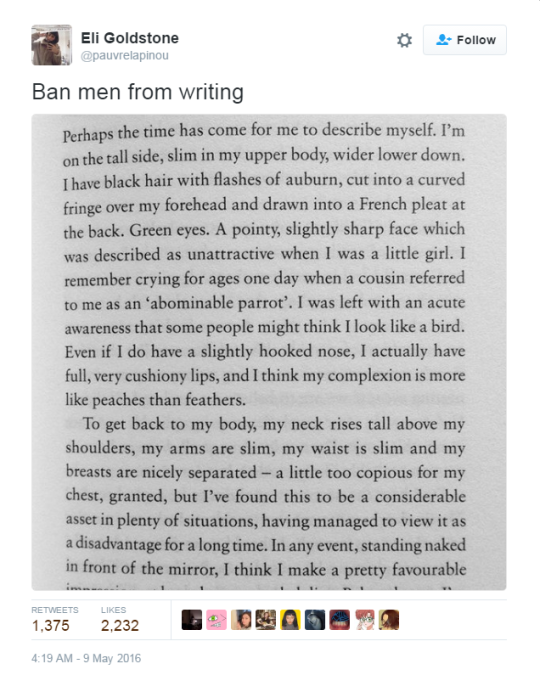
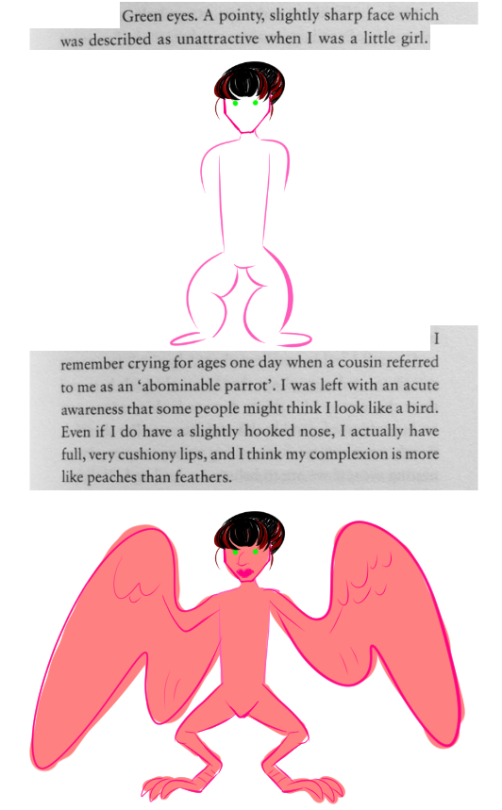
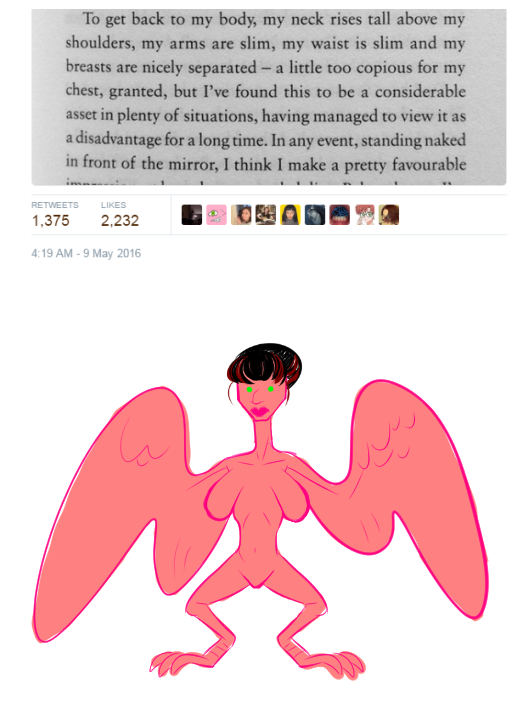
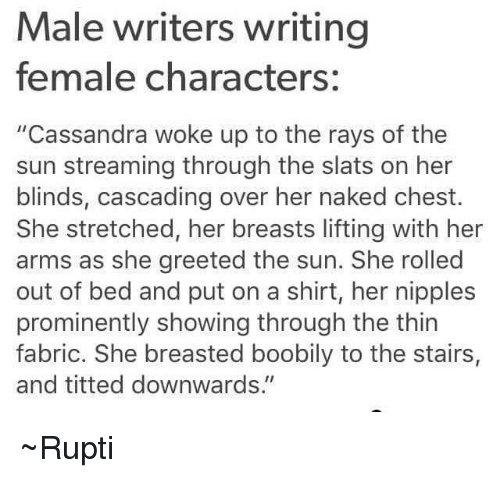
The only acceptable reason for this is if this character is actually a demon who seduces men and then eats them. [source]
who wrote this, expose him
my breasts are nicely separated. Completely divided, every year they move apart by half an inch.
My breasts are nicely separated though they still fight for custody of the children.
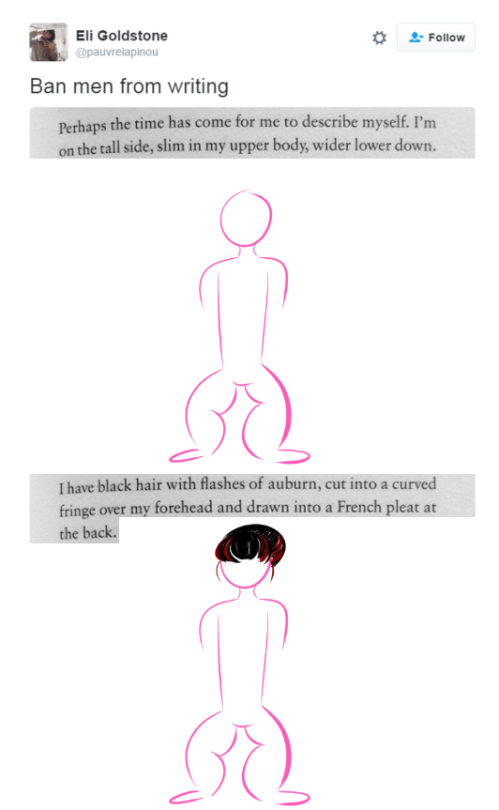
I,,a woman,,,am WiDeR LOweR dOwN
That was difficult to read.
So ugly
My name is Ebony D’arkness Dementia Raven Way, and my breasts are nicely separated
OH MY GOD WHAT IS THAT AND HOW ON EARTH DID IT GET PUBLISHED
You can always tell when it’s a man writing a description because they focus oddly on the breasts. There will always be something about breasts and I can’t tell you how many times I’ve read historical or fantasy fiction and they talk about “her breasts hanging freely under her tunic” or what the fuck ever and it’s like…women don’t do that? We don’t describe ourselves by saying “I have blonde hair and blue eyes and my breasts hang freely under my tunic”. I kind of feel like we should counter by awkwardly mentioning all male character’s balls in their description. It’s kind of in the same vein.
“I have auburn hair and hazel eyes and my copious nicely separated balls hangs freely under my breeches”
G E T W I D E R L O W E R D O W N
“To get back to my body”
seriously tho what is the source of the original text….we have to drag him
Anonymous asked: Hi! I’m writing novel and I’m having a really hard time figuring out filler events. I’ve got basic things that happen but nothing is really that exciting, to be honest. It’s just basic interactions with a group of around ten people. I guess I’m not really sure what my point of the novel is and I know I want it to mean something more than an abstract representation of who I am.
Well, you never want to have “filler events” in a novel, because all they do is waste time, and readers don’t like to have their time wasted.
Instead, do this:
1. Choose a conflict for your story.
Conflict is the engine which drives the story forward. Without it you have a flat story. It sounds complicated, but conflict is just the struggle that the story is all about. The conflict of Harry Potter series was the struggle to defeat Voldemort. The conflict of The Hunger Games series was the struggle to defeat the Capitol (first by winning The Hunger Games, then by winning the rebellion.) And the conflict of The Lord of the Rings series was the struggle to destroy the One Ring and bring peace to the land. But a conflict doesn’t have to be so grand–it can be as simple as the struggle to survive your senior year of high school, the struggle to make friends in a new town, or the struggle to win the heart of the cute guy who runs the yogurt stand near your work. Whatever you choose, this struggle–this conflict–will fill out your story and give it the point that it’s currently missing.
2. Choose a goal for your characters.
Conflict is the struggle itself, but the goal is the point the characters are struggling toward. In The Hunger Games, Katniss wasn’t really looking to defeat the Capitol so much as she just wanted to survive. It just so happened that in order to do that, she had to thwart and then defeat the Capitol. If your conflict is the struggle to survive the last year of high school, the goal the character is struggling toward might be to get good grades and stay out of trouble. The goal is tied to the main conflict but is more personal to the character.
3. Figure out your character’s motivation.
Motivation drives the character through the struggle, toward the goal. It’s the reason that they want to win the struggle. It’s why they do everything that they do. Why did Katniss want to survive? Because she wanted to take care of her loved ones. Why does your character want to get good grades and stay out of trouble all year? Maybe success means parental permission to backpack across Europe over the summer. Once you choose your character’s motivation, your character’s actions will make more sense.
4. Decide on an antagonist.
You can’t have a struggle without an opposing force. If you had a tug o’ war with people on only one end of the rope, they would pull the rope and instantly win. They would have nothing to struggle against, and it would be boring. But if you put people on the other end of the rope, pulling with all of their might, now the people on the other end of the rope have something to struggle against. The antagonist is the person, people, thing, things on the opposite end of the rope. Every time your character starts to gain ground in the tug o’war struggle of your story, it’s the antagonist’s job to yank hard on that rope and cause your protagonist to lose ground. The motivation provides the pull from the character’s end, the antagonist provides the pull form the opposite end.
The antagonist can be a super villain, it could be a well-meaning but overstrict parent, it could be bullies, a catastrophic weather event, an evil dystopian government–whatever you want. And it doesn’t have to be something bad. It just has to be something which, for whatever reason, creates obstacles to whatever goal your character is trying to reach.
5. Choose obstacles.
Once you’ve settled on your antagonist (or antagonists if you have more than one), you need to figure out what obstacles will best stand in your protagonist’s way. You should choose some they can tackle easily, and some that will throw them off their game. Sometimes they will fail and come back at it a second time and triumph. If your antagonist is a strict teacher, perhaps the first obstacle is a pop quiz which your character aces without batting an eyelash. But maybe the next obstacle is a group assignment–which is bad news for your character who doesn’t play well with others. The group assignment goes south and results in a D grade for the character. So, the character has to figure out how to tackle that bad grade and bring it up. Perhaps they choose to do extra credit which fails to get the grade up above a C. This is an “all is lost” moment for the character, but then maybe they do something great in class and the teacher awards them with more extra credit, which brings their grade up to a B. Your protagonist is ready to pack their bags from Europe when they find out that the final exam will account for a whopping 75% of their grade–mom and dad require all A’s for the trip to be a go… can your character do it? The uncertainty as your character attacks each obstacle is part of what keeps the reader turning pages.
When you’ve done all of the above, you’ll find that your story comes together much easier and that you suddenly have much more to write about. This is just the tip of the iceberg, but it’s enough to get your story to a much better place. 🙂
tfw ur trying to write plot but ur brain only provides you with out-of-sequence snippets built on vague ideas and an endless number of potential outcomes that develop and branch out unnaturally over an unspecified timespan
Thanks for your question, nonny! This is a very wide topic, so I wasn’t sure how to answer it – but I’ve come to a conclusion.
I think the most common writing mistake is to self-edit, and it’s detrimental to writing time as a whole. Self-editing is basically editing your story while you’re writing it; going back and correcting mistakes and rewriting sentences while you’re still putting paragraphs on paper. The worst part about this problem is that it feels like you’re doing the right thing – that by “fixing yourself” and keeping a scrutinizing eye on the page, you’re becoming a better writer. But you’re not helping yourself.
Think of it this way, because this is how I learned it: I grew up in dance. I took over a decade of ballet, jazz, and tap classes, and I moved up in the classes at a steady pace. I was awkward as hell, but I was a fast learner. I was meticulous and made sure to pay attention, learn all the steps, and master the timing. I was, in retrospect, one of the most accurate dancers at my level.
But I didn’t get lead roles. Ever. No matter how hard I worked, I couldn’t get any of the starring roles in our productions. And every time I asked for critiques from my mentors, I got the same message, over and over.
“You’re too in your head. You’re too focused on being perfect to engage with the audience.”
And they were absolutely right. Going back and watching tapes of myself, I never smiled – even when I was having a good time. I never showed my own personality; I never messed around between run-throughs. I made fewer mistakes, but I missed out on the personality and fun and interactive aspect of art and performance!
So instead of focusing on getting things right, approach it like this: prepare beforehand – study and revise afterhand. But let writing be writing. Let yourself get lost in the scene. Let yourself make mistakes. Try turning the font white or closing your eyes; try Write or Die to turn up the heat. Whatever you do, just do it and don’t think until it’s over. That is my advice.
Writing books often exhort you to “write a shitty first draft,” but I always resisted this advice. After all,
I was already writing shitty drafts, even when I tried to write good ones. Why go out of my way to make them shittier?
A shitty first draft just kicks the can down the road, doesn’t it? Sooner or later, I’d have to write a good draft—why put it off?
If I wrote without judging what I wrote, how would I make any creative choices at all?
That first draft inevitably obscured my original vision, so I wanted it to be at least slightly good.
Writing something shitty meant I was shitty.
So for years, I kept writing careful, cramped, painstaking first drafts—when I managed to write at all. At last, writing became so joyless, so draining, so agonizing for me that I got desperate: I either needed to quit writing altogether or give the shitty-first-draft thing a try.
Turns out everything I believed about drafting was wrong.
For the last six months, I’ve written all my first drafts in full-on don’t-give-a-fuck mode. Here’s what I’ve learned so far:
“Shitty first draft” is a misnomer
A rough draft isn’t just a shitty story, any more than a painter’s preparatory sketch is just a shitty painting. Like a sketch, a draft is its own kind of thing: not a lesser version of the finished story, but a guide for making the finished story.
Once I started thinking of my rough drafts as preparatory sketches, I stopped fretting over how “bad” they were. Is a sketch “bad”? And actually, a rough draft can be beautiful the same way a sketch is beautiful: it has its own messy energy.
Don’t try to do everything at once
People who make complex things need to solve one kind of problem before they can solve others. A painter might need to work out where the big shapes go before they can paint the details. A writer might need to decide what two people are saying to each other before they can describe the light in the room or what those people are doing with their hands.
I’d always embraced this principle up to a point. In the early stages, I’d speculate and daydream and make messy notes. But that freedom would end as soon as I started drafting. When you write a scene, I thought, you have to start with the first word and write the rest in order. Then it dawned on me: nobody would ever see this! I could write the dialogue first and the action later; or the action first and the dialogue later; or some dialogue and action first and then interior monologue later; or I could write the whole thing like I was explaining the plot to my friend over the phone. The draft was just one very long, very detailed note to myself. Not a story, but a preparatory sketch for a story. Why not do it in whatever weird order made sense to me?
Get all your thoughts onto the page
Here’s how I used to write: I’d sit there staring at the screen and I’d think of something—then judge it, reject it, and reach for something else, which I’d most likely reject as well—all without ever fully knowing what those things were. And once you start rejecting thoughts, it’s hard to stop. If you don’t write down the first one, or the second, or the third, eventually your thought-generating mechanism jams up. You become convinced you have no thoughts at all.
When I compare my old drafts with my new ones, the old ones look coherent enough. They’re presentable as stories. But they suck as drafts, because I can’t see myself thinking in them. I have no idea what I wanted that story to be. These drafts are opaque and airless, inscrutable even to me, because a good 90% of what I was thinking while I wrote them never made it onto the page.
These days, most of my thoughts go onto the page, in one form or another. I don’t waste time figuring out how to say something, I just ask, “what are you trying to say here?” and write that down. Because this isn’t a story, it’s a plan for a story, so I just need the words to be clear, not beautiful. The drafts I write now are full of placeholders and weird meta notes, but when I read them, I can see where my mind is going. I can see what I’m trying to do. Consequently, I no longer feel like my drafts obscure my original vision. In fact, their whole purpose is to describe that vision.
Drafts are memos to future-you
To draft effectively, you need a personal drafting style or “language” to communicate with your future self (who is, of course, the author of your second draft). This language needs to record your ideas quickly so it can keep up with the pace of your imagination, but it needs to do so in a form that will make sense to you later. That’s why everyone’s drafts look different: your drafting style has to fit the way your mind works.
I’m still working mine out. Honestly, it might take a while. But recently, I started writing in fragments. That’s just how my mind works: I get pieces of sentences before I understand how to fit them together. Wrestling with syntax was slowing me down, so now I just generate the pieces and save their logical relationships for later.Drafting effectively means learning these things about yourself. And to do that, you can’t get all judgmental. You can’t fret over how you should be writing, you just gotta get it done.
Messy drafts are easier to revise
I find that drafting quickly and messily keeps the story from prematurely “hardening” into a mute, opaque object I’m afraid to change. I no longer do that thing, for instance, where I endlessly polish the first few paragraphs of a draft without moving on. Because how do you polish a bunch of fragments taped together with dashes? A draft that looks patently “unfinished” stays malleable, makes me want to dig my hands in and move stuff around.
You already have ideas
Sitting down to write a story, I used to feel this awful responsibility to create something good. Now I treat drafting simply as documenting ideas I already have—not as creation at all, but as observation and description. I don’t wait around for good words or good ideas. I just skim off whatever’s floating on the surface and write it down. It’s that which allows other, potentially better ideas to surface.
As a younger writer, my misery and frustration perpetuated themselves: suppressing so many thoughts made my writing cramped and inhibited, which convinced me I had noideas, which made me even more afraid to write lest I discover how empty inside I really was. That was my fear, I guess: if I looked squarely at my innocent, unvetted, unvarnished ideas, I’d see how bad they truly were, and then I’d have to—what, pack up and go home? Never write again? I don’t know. But when I stopped rejecting ideas and started dumping them onto the page, the worst didn’t happen. In fact, it was a huge relief.

 just moving along like everyone else