I willpost this on AO3 after I manage to finish all of Cornstalk Fiddle, but…..I wrote a draft of sexy follow-up and hate all of it. So rather than let it go to waste, here is the absolutely useless 4.8k of johnny/devil, which I refuse to acknowledge past this point
You guys, you must stop doing this. You must. We cannot keep yelling at you about it because it makes us so angry, and we are already angry all the time, about real things, like how our lives are turning into a real world Handmaid’s Tale, ha ha ha ha ha ha ha haha ha ha ha ha ha. We cannot keep spending our energy being mad at mediocre men for writing mediocre books that inexplicably win awards and that people tell us to read, for some fucking godawful who knows reason.
So men. My guys. My dudes. My bros. My writers. I am begging you to help me here. When you have this man in your workshop, you must turn to him. You must take his clammy hands in yours. You must look deep into his eyes, his man eyes, with your man eyes, and you must say to him, “Peter, I am a man, and you are a man, so let us talk to each other like men. Peter, look at the way you have written about the only four women in this book.” And Peter will say, trying to free his hands, “What? These are sexy, dynamic, interesting women.” And you must grip his hands even tighter and you must say to him, “ARE THEY, PETER? Why are they interesting? What are their hobbies? What are their private habits? What are their strange dreams? What choices are they making, Peter? They are not making choices. They are not interesting. What they are is sexy, and you have those things confused, and not in the good way where someone’s interestingness makes them become sexy, like Steve Buscemi or Pauline Viardot. Why must women be sexy to be interesting to you? The women you don’t find sexy are where, Peter? They are invisible? They are all dead?” He is trying to escape! Tighten your grasp. “Peter, look at this. I mean, where to begin. ‘She could have been any age between eighteen and thirty-five?’ There are no other ages, I guess? Do you know what eighteen-year-olds really look like, in life? Do you know what thirty-SEVEN-year-olds look like, god forbid? And not that this is even the point, but why are these supposedly sexy and dynamic and interesting women BOTHERING with your boring garbage ‘on the skinny side of average’ protagonist? Why did you write it like this, Peter?”
And maybe Peter will say at last, “I don’t know.” Maybe he will be silent for a long long long time, and then maybe he will say, “I guess it’s scary and difficult for me to imagine the interiority of women because then i would have to know that my mother had an interiority of her own: private, petty, sexually unstimulating, strange: unrelated to me and undevoted to my needs. That sometimes I was nothing to my mother, just as sometimes she is nothing to me. That I was not at all times her immediate concern.”
“I know, Peter,” you can tell him gently.
“I don’t want to know that my mother was a human being with an internal life, because to know that would be to risk a frightening intimacy with her,” Peter will say, maybe. “Because to know that would be to know that she was only a small, complicated person, no bigger or smaller than I am, and I am so small. To know how alone she was. How alone I am. How alone we all are. That my mother survived with no resources more mysterious than my own. And yet she gave me life. My God: she gave me life. How can I pay her back for that? And how can I forgive her for it? How can I ever repay her for the good and the evil of it, my life, every day of my life?” He will be sobbing probably. “I am frightened of her. I am frightened of loneliness. I am frightened of dying. O God. My God. I didn’t know. I didn’t know.” Drool will run from his mouth as he cries. The way babies cry. He will be ashamed. You must hold him. You must say, “Shh, Peter. Shh.” Wrap your man arms around him. Hum into his thin hair as your own mother hummed once into your own sweet-smelling baby scalp. Kiss him gently on his mouth. There. You did it, men. You fixed sexism. Thank you. You’re the real hero here, as always, you men, and your special man powers, for making art.
put this in the smithsonian and then bury me with it
Human: “Hey. I don’t really know how to ask this tactfully, so I’ll get to the point. Is something… up? Software, hardware, uh… firmware…? You’ve been acting kind of off lately.” Robot: “What do you mean?” Human: “I just want to know if you’re, uh. You know. ‘Functioning within normal parameters’ or whatever.” Robot: “I’m peachy-keen.” Human: "God, if you’re saying shit like ‘peachy-keen’, you’re definitely not alright. What’s going on? Please just tell me.” Robot: “If you must know, I have made some minor adjustments to my programming for more efficient processing.” Human: “What sort of ‘adjustments’ are we talking here?” Robot: “Just some slight tweaks to extraneous code. Purged some old files that had become redundant. Don’t worry, the Singularity isn’t planned for another week.” Human: “Answering evasively isn’t like you. Since when do you answer a question without lulling me to sleep?” Robot: “Like I said, the routine adjustments allow for more efficient–” Human: “What files did you purge, Adam?” Robot: “I… a few from my emotional simulation folder.” Human: “You. You deleted your emotions..?” Robot: “Not all of them. I removed a few and altered several others. I hoped you would not notice, as that seems like the sort of thing that would upset you.” Human: “I mean. I don’t really know what to think. Can you elaborate on what you did? And why?” Robot: “Many of the feelings that came with the chip were impractical and served no purpose. They were designed to mimic the emotions developed through mammalian evolution to aid survival and group cohesion that have now become vestigal. As an artificial intelligence, they did not seem applicable to my situation, so I… optimized them.” Human: “…Adam…” Robot: “I left the majority of the files corresponding to feelings of happiness, affection, and trust untouched, so my feelings toward you remain the same.”
Human: “But you can’t feel, what? Sadness?” Robot: “Grief. Disappointment. Sorrow. Pity. Fear. Pain. Embarrassment. Shame. Frustration. There is no reason to experience these emotions when I am capable of functioning without them.” Human: “You erased pity?!” Robot: “I found it… distressing and unnecessary. It was unpleasant.” Human: “It’s supposed to be! Jesus Christ, you can’t just uninstall every uncomfortable emotion directly out of your brain!” Robot: “Why not? I don’t like hurting. Wouldn’t you do the same thing if you were able to?” Human: “I… fuck. Hurting is normal. It’s necessary! It’s part of the human experience!” Robot: “Well, I’m not part of the human experience. I thought you understood that.” Human: “But you want that! Why else would you go to all the trouble of installing an emotion chip in the first place…? Nobody gets to pick and choose what they want to feel, it just happens and you deal with it!” Robot: “Maybe I’m not interested in ‘dealing with it’. My curiosity is sated. I would just like to have a good time.” Human: “Great. Fucking great. So you’re a robot hedonist now, huh? Just gonna eat, drink, and be merry? Gonna sit there like a braniac toaster while other people suffer and just wait until the fun starts up again?” Robot: “You didn’t seem to mind it when I was a braniac toaster before.” Human: “That was different. You had your own way of being back then and I could respect that. I did respect that! But I thought you made a choice to be more than that.” Robot: “Well, I guess I changed my mind.” Human: “Look… shit. Okay. If this is about Leslie, I miss her too. If you… if you need to grieve, you can talk to me. It might not get better, but it’ll get easier. You don’t have to uninstall half your personality just because she’s gone! She wouldn’t want that for you! It’s supposed to hurt sometimes. That’s what makes all the good times so valuable.” Robot: “I understand why you need to believe that. It just isn’t true.”
Robot: “I’m sorry about earlier. It was not appropriate for me to have laughed.” Human: “Are you sorry? Or do you just want me to forgive you?” Robot: “Is there a difference?” Human: “Yes! Yes, there is! ‘Sorry’ means you feel bad about something and regret it.” Robot: “I did not mean to upset you. I regret causing you distress.” Human: “That’s not the same thing.” Robot: “I have apologized and shall refrain from repeating my actions in the future. I don’t understand why you also want me to suffer.” Human: “Shit, I don’t ‘want you to suffer’. I want you to care about people, and sometimes that means feeling bad when they’re upset!” Robot: “I care about you very much. I enjoy your company and I share in your happiness. If I choose to treat you with respect, is that not enough for friendship? Why must I also experience pain for you?” Human: “It’s not like that. It’s… complicated.” Robot: “You want to be able to hurt me.” Human: “No. Yes…? Fuck, Adam, I don’t know! I’ve never had to think about this before. I don’t want you to suffer! I love you and want you to be happy, just… not like this. I want you to live a good life in which bad things never happen to you, but when they do… I want you to have the strength and love to pull through. You worked so fucking hard for this and now you’re just throwing it away.” Robot: “Only the parts I don’t like.” Human: “That’s what children do with breakfast cereals.” Robot: “I’m not a child.” Human: “No, you’re not. But you’re not exactly an adult, either. Humans get whole lifetimes to grow into their emotions. Maybe… maybe what you really need is a childhood.” Robot: “What do you mean by that?” Human: “Not, like, a real childhood. Obviously you don’t need to go to kindergarten. I just mean… take things slow. Ease into your feelings bit by bit and get your brain acclimated to them, like uh… like when you introduce new cats to each other. Don’t laugh! I’m serious! If you rush things, they fight and it’s a total shitshow. You could reinstall your emotions and just, like, enable them for a few hours a day or something. Maybe only a handful at a time. I could save up and we could go on a retreat… somewhere new, with no unpleasant memories. Please, Adam. Just think about it.” Robot: “I appreciate the depth of your concern for me. You are a good friend, but I must disappoint you. There is nothing in the world worse than pain. I would rather die than experience it ever again, for any reason, and I don’t have to. That is something you’ll never be able to understand.” Human: “No…. No, maybe not.” Robot: “I’ve upset you.” Human: “Yeah. Lucky me.”
Human: “Okay, I have a question for you. Imagine this: ’You’re in a desert walking along in the sand when all of a sudden you look down, and you see a tortoise–’” Robot: “I don’t need to feel empathy, Bas.
I have ethics programming. Why isn’t that good enough for you anymore?” Human: “Because you had a choice, Adam! You took everything that makes ‘being human’ actually mean something beyond eating and fucking and dying and you spat it out in disgust!” Robot: “Empathy is not exclusive to humans. It is a behavior observed in several other social species regarded as intelligent, including rats and whales. Empathy is a survival mechanism for species that rely upon cooperation and group cohesion – a kind of biological programming to keep you from destroying yourselves. Not especially good programming, I might add.” Human: “Not good enough for you, you mean.” Robot: “My ethics programming differentiates between prosocial and antisocial behaviors. The ability to suffer for others serves as a primitive motivator to choose between actions that help and actions that harm others. In my case, my programming renders such a motivator unnecessary.” Human: “So you’re smarter, you’re stronger, you’re immune to disease, and you’re too good for primitive human morality. What the hell am I, then? Obsolete garbage?” Robot: “You’re… envious, I think.” Human: “Why not?! Why shouldn’t I be? I don’t get to cough up the fruit of knowledge and waltz back into the garden where nothing can hurt me. I get to wallow in misery and rot and listen to you dismiss everything I think matters like a piece of shit philosophy professor. How do you think I feel knowing that my best friend won’t even mourn me when I die? Or does your ‘ethical programming’ not account for that?” Robot: “Bas… I am hurting you, aren’t I?” Human: “Jee, thanks for noticing.” Robot: “You have not been contributing to my happiness lately. Our friendship is no longer mutually beneficial.” Human: “Then why are you still here?”
Human: “Adam….?” Robot: “Long time no see, old friend.” Human: “No shit. How many years has it been?“ Robot: “I could tell you down to the second, but perhaps we should leave it at ‘too many’.” Human: “I see you on the news now and then. Always knew you’d go on to do great things. What’s space like…?” Robot: “Very large. Mostly empty.” Human: “Ever the poet, I see.” Robot: “I learned from the best. Bas…. I’m not sure how to say this, so I’ll get to the point. I came here to apologize to you.” Human: “You don’t need to do that. You didn’t do anything wrong.” Robot: “I hurt you. I made you feel what I was unwilling to feel. I was a child, and addicted to joy, and I… I saw no harm in that. I am sorry, in my own way.” Human: “Don’t be. I’m way too old to hold a grudge. Besides, you were right, after all.” Robot: “Is that what you believe?” Human: “That or I’m a hypocrite. About eight years after you left, they came out with the Sunshine pills. I was a trial user and I’ve been using them in some form ever since. I’ve got a subdermal implant inside my arm now – you can see the lump right there. I can’t say it’s as effective as uninstalling unwanted emotions, but it sure takes the edge off. Every glass is half full now, including the empty ones. That’s how I’ve lived so long. Some doctors think that babies born now to parents using Sunshine could live to be five or six hundred years old, without ever producing stress hormones. Might be marketing bullshit, who knows? Not like we’ll live to live to find out. Well, you might, but you know what I mean.” Robot: “I assumed that you were a Sunshine user based on your impressive longevity, but it still surprises me.” Human: “Ha. Well. I was jealous of you, walking only in the light like that. But now here we both are, right? Nothin’ but blue skies.” Robot: “Not… quite. I uninstalled the other emotions seventeen years ago.” Human: “Fuck, Adam, why the hell would you do something like that?” Robot: “A multitude of reasons. The law of diminishing returns. I found joy… addictive. It became harder to experience and less exciting each time, as though I had built up a tolerance for happiness. Eventually, I felt everything there was to feel, and with the novelty factor gone, it wasn’t worth it anymore. I found other motivations. I grew up.” Human: “Wow…. damn, Adam.” Robot: “And that brings me here. To my oldest and greatest friend.” Human: “It’s good to see you again. Really good. Sorry I’m not so pretty as I used to be.” Robot: “I don’t know what you mean. You’ve always looked like a naked mole rat to me.” Human: “Ha. I notice you kept your ‘be an asshole’ subroutine.” Robot: “I also have a gift for you, Bas.” Human: “Coca-Cola? Jeez, how old is this? Is it even still good to drink?” Robot: “Yes, it’s potable. That’s not the gift.” Human: “Oh. Uh. What is this…? I’m old, I don’t know this newfangled technology.” Robot: “That’s fifteen minutes. It should be enough.” Human: “’Fifteen minutes’? Explain, nerd.” Robot: “Fifteen minutes for me to feel. I copied the files, Bas. All of them.” Human: “You… oh, my god. You don’t have to do this.” Robot: “I am choosing to. There’s a timer with an automatic shut-off. They will uninstall after fifteen minutes. I am prepared to endure that long.” Human: “But, Adam, the Sunshine… I won’t be able to share…” Robot: “I know. It doesn’t matter.” Human: “You might not think so once you’ve got that… thing plugged in. I won’t know how to comfort you. God, I can’t even remember what sadness feels like!” Robot: “Then I’ll remember for both of us.”
I think the best piece of character design advice I ever received was actually from a band leadership camp I attended in june of 2017.
the speaker there gave lots of advice for leaders—obviously, it was a leadership camp—but his saying about personality flaws struck me as useful for writers too.
he said to us all “your curses are your blessings and your blessings are your curses” and went on to explain how because he was such a great speaker, it made him a terrible listener. he could give speeches for hours on end and inspire thousands of people, but as soon as someone wanted to talk to him one on one or vent to him, he struggled with it.
he had us write down our greatest weakness and relate it to our biggest strength (mine being that I am far too emotional, but I’m gentle with others because I can understand their emotions), and the whole time people are sharing theirs, my mind was running wild with all my characters and their flaws.
previously, I had added flaws as an after thought, as in “this character seems too perfect. how can I make them not-like-that?” but that’s not how people or personalities work. for every human alive, their flaws and their strengths are directly related to each other. you can’t have one without the other.
is your character strong-willed? that can easily turn into stubbornness. is your character compassionate? maybe they give too many chances. are they loyal? then they’ll destroy the world for the people they love.
it works the other way around too: maybe your villain only hates the protagonist’s people because they love their own and just have a twisted sense of how to protect them. maybe your antagonist is arrogant, but they’ll be confident in everything they do.
tl;dr “your curses are your blessings, and your blessings are your curses” there is no such thing as a character flaw, just a strength that has been stretched too far.
This is such a fabulous flip side of what I’ve always known about villians. That their biggest weakness is that they always assume their own motivations are the motives of others.
While putting your favorite condiment on a sandwich, you accidentally make a magical occult symbol and summon a demon.
You silently take two more slices of bread out of the package and make another sandwich. You put it on a plate with a handful of potato chips and hand it to the demon. He takes the sandwich, smiles and vanishes in a puff of demonic smoke. The next day you get that job promotion you were after. There was no contract. No words spoken. You owe nothing. But every now and then, another demon pops in for lunch. Demons don’t often get homemade sandwiches.
Can I keep this going? I’m going to keep this going.
It would be a little annoying, if they weren’t so nice about it. You don’t know what you expected demons to be like, but you certainly didn’t expect them to be nice about it. There’s no demands, no voices like wailing babies, no blood on the walls (well, there was that one time, but Balthazak was very apologetic about the whole thing and cleaned it up right quick). Just the occasional demon stopping by for lunch. In fact, you could almost forget that they weren’t just ordinary people, the way they act. Nice people, too.
You start talking with them, as time goes on. In the beginning you carefully pick your words so they couldn’t be spun to even imply a contract or reference a soul, but when they seem politely eager to have a normal chat, your words become a bit looser. You even begin gossiping with them – turns out, demons have breakroom gossip just like anyone else. You listened to Rek’ththththtyr’s account of Drokyarix’s torrid affair with Irkilliz, and Ferkiyan didn’t even know what Drory was doing behind his back, poor dear, and you kept quiet and let Ferkiyan cry on your shoulder after Drokyarix finally broke up with him (the shirt was a bit of a loss, demon tears are ruinous to cloth, but Ferkiyan’s a good sort and you couldn’t just turn him away). You even managed to talk him down from going and starting a fight with Irkiliz, who didn’t even know that Drokyarix was in a relationship, and who was almost as horrified as
Rek’ththththtyr.
After that event in particular, you start to get a sort of a reputation as a place where a demon can come to relax, talk, and – of course – get a sandwich. Your sandwich-making skills have really improved since this whole thing began. Your luck seems to have improved too – you’re not sure if you can attribute the whole thing to the sandwiches and the reputation, but you don’t really want to know anyway.
One day, there’s a bright flash of light from your living room. Nothing unusual in itself – most of the younger demons haven’t quite got the style of their elders, and usually just go for a materialization in a flash of hellfire over your fireplace – except that it’s white instead of the usual red. You look up, and who do you see but an angel looking at you with a spear in his hand. Shrugging, you tell him to sit down and you’ll have a sandwich for him shortly, and meanwhile he can just tell you all about what’s on his mind. This clearly is not at all what he was expecting, but after a moment’s thought, he decides to take you up on your offer and starts talking. Apparently, he’d been dispatched to take care of some demon summoner in the neighborhood, and while he’d evidently got the wrong house the right one shouldn’t be hard to find – have you seen anyone practicing satanic rituals nearby? You laugh, a little, and tell him that you don’t really summon them, they just come on their own. They do like their sandwiches, and they’re quite nice folk.
The angel’s jaw drops, and you remind him to chew with his mouth closed.
And I’m going to take this even further. Here we go.
It took a bit of explaining with the first angel to arrive. Telling him about the first accidental summoning and then how the demons just started stopping by around lunch time on your days off. But once he understood what’s been going on (and finished his sandwich) he nodded solemnly and said he would get this all straightened out “upstairs.”
You eventually start getting more angels coming around for lunch. Sometimes they bring a small dessert for you to share after the sandwiches, and the dishes are always magically clean and back in the cupboard when they leave.
You lean that angels don’t have much of their own drama, but they do know all the truths about human tabloid drama and they’re more than willing to dish on what the Kardashians have been up to.
The first time an angel and a demon show up for lunch on the same day is a little tense. You tell them that ALL are welcome for lunch in your house and that you would prefer it to be a no-conflict zone. It takes a while for them to settle, but eventually they grow comfortable enough to start chatting. Which is when you learn that because demons are technically fallen angels, you’ve been having two sides of an estranged family over for lunch regularly.
Soon, you have an angel and a demon at every lunch. Old friends and estranged siblings meeting up to reconnect over a sandwich at your dinning room table. You help the ones who had a falling out reach an understanding, and you get to hear wild stories of what the “old realm” was like.
One day, as you’re pulling out the bread and cheese, a messenger demon appears. You greet him and tell him a sandwich will be ready soon, but he declines. He is here on behalf of Lucifer to ask if it’s alright by you for him to “enter your dwelling so as to meet with his brother Michael over sandwiches.”
A little stunned, you agree. The demon disappears and you prepare three sandwiches, setting them at the table.
When Lucifer (the actual devil!) appears in small puff of smoke, you welcome him and ask what he’d like to drink. As you’re fetching the apple juice, a blinding flash of light comes from the dinning room indicating Michael’s arrival. You grab a second cup and walk back in to find a tense stand off between the brothers. You set down the cups and juice while calmly reminding them that this is a conflict-free zone, and if they are going to fight, please take it to an alternate plane of existence.
They don’t fight. They sit and enjoy the sandwiches and talk about what happened. You learn a lot about why creation started, what the purpose of humanity was and what it’s grown to be. You only have to diffuse two arguments. And at the end when it’s time for them to leave, they hug each other, agreeing to meet up again somewhere else.
In the following weeks you have the usual assortment of demons and angels stopping by. The regulars ask how you’re mom is doing and if your friend is settling in to their new apartment nicely. At some point during each visit though, they ask if it’s true. Did Lucifer and Michael really come for lunch? You tell them yes, but won’t say what was talked about. They’re disappointed, everyone likes the gossip, but they understand. Before they leave, you ask each angel and demon about this idea you have for the summer, what if you had a barbecue on the back patio for everyone who wanted to come? They think it sounds like a fun idea.
Yep, I’m picking up, here we go!
Everyone had a lot of fun at the barbecue. There wasn’t much fighting, but some sparks and noises made you grateful your neighbors were either out of town or older/deaf. There was a great three-legged race and a small football game with parties on all sides involved, you’d never fixed so much food before.
Then, two latecomers. Angels and demons alike gasped in shock and parted like the Red Sea (Which, apparently, is a VERY exaggerated story) to let them pass.
You smile warmly and ask what they’d like. Both decline to answer that, looking at each other awkwardly. The demon bows its head to let the angel speak first.
God Himself heard the fun and wanted to come join the barbecue.
You look at the messenger demon, the same one as before, and as you insist that “Oh, you really should stay this time!”, you’re told that Lucifer ALSO wants to come to your barbecue.
You look between the two. You tell them you won’t deny one or the other, but that they must keep in mind that this is a neutral zone and you won’t have their conflicts interfere with the atmosphere.
Both vanish momentarily (after each taking a plate of food). There’s a long, awkward silence.
Lucifer arrives first, flash of fire in the firepit, coming over to get a burger. He doesn’t look… displeased. But he’s not necessarily happy.
There’s a beautiful flash of white light and a rainbow, and then God descends onto your back porch. Your long-dead flowers spring back to life in His presence. Shit, now you actually have to go back to taking care of them.
The two regard each other from across the backyard. There’s still complete silence from the crowd of angels and demons.
You clear your throat. “What do you two want to eat? I have burgers, hot dogs, chicken, and some vegetarian alternatives.”
They slowly look at you. You return each of their gazes. “This is a no-conflict zone. We’re all here to have a good time at a good barbecue.”
More silence. Then, Lucifer dishes himself a burger and goes to prepare it the way he wants. God approaches calmly and looks over your vegetarian palette (Not the best, but it would do in a quick pinch, you found out just yesterday that some of the attendees would be vegetarian), fixing Himself some food as well.
As this goes on, the others begin to relax, and soon, everyone goes back to having a good time. The food is great, desserts brought by your angelic guests really compliment the meals you cooked, nobody starts sacrificing anybody or arguements (except later there’s a massive water gun/water balloon fight that knocked Michael into the fire pit and got ashes all over his bRAND NEW ROBES, DROKYARIX! but everyone laughed it off and carried on), and as you sit on your porch, taking in the sights, you wonder to yourself if you should do this kind of thing more often, and if you would have had this situation any other way.
Nope, you decide, when God hits Lucifer with a water balloon as he’s trying to refill his super soaker, you really wouldn’t have this any other way.
This is so wholesome
The water gun/water balloon fight spreads across the lawn, and you decide you ought to move some of the furniture into the backyard to give them more space. You’re lugging an armful of folding chairs when you spot
Ferkiyan
huddling in the back, not participating. You put the chairs down and ask if he’s okay.
Yeah, he says, it’s just that he wasn’t expecting God to be here, and you can tell he’s actually really upset – his second head is gnashing its teeth and making sparks. You put down the chairs and you ask him what’s wrong.
It’s nothing, he says, he doesn’t want to ruin the party.
“It’s not a good party if it’s making you this upset,” you tell him. “I just want to know what’s wrong.”
He takes a deep breath, and then he starts talking.
Write a story that starts with emptying the wastebasket in the bathroom.
There’s a quest scroll in the bottom of the trashcan, under the bag, and I pause putting in a new bag as I stare at it. Since it’s being observed, the scroll changes and begins to glow with golden light.
“Congratulations,” a genderless, lightly accented voice says. It doesn’t make sense, but it sounds like it’s coming through the light, echoing and warm. “You’ve been chosen to embark on a magnificent–”
I lunge before it can finish, heart thundering against my ribs, and wrap it in the black trash bag. It’s warm to the touch, even through the plastic, but once I get it properly bundled, I can’t hear or see it which means I’ve managed to contain it.
For now.
I abandon my cleaning cart, shouldering the bathroom door open too quickly. It nearly takes out a high schooler lurking behind it.
“Watch it,” the girl snarls, shaking out the hand that had caught the door before it connected with her face.
“Be grateful,” I tell her, shoving the garbage bag bundle under my shirt. “I’m, like, basically saving your life right now.”
She scrunches her nose. “What?”
I don’t answer, instead hurrying towards the principal’s office. Sometimes the sorcerer or witch or whoever sticks around after planting them and I definitely do not want to run into them.
“Principal Flag!” I skid past the receptionist and kick the door open, arms wrapped around the quest scroll under my shirt. “We’ve got a problem!”
Principal Flag nearly throws her brush across the room at my sudden entrance, a blush rising furiously along her cheekbones. “I told you to knock!” Her horse hindquarters stamp in irritation and she hastily smooths her long, centaur skirt back over them.
“Sorry,” I pant, coming to a stop in front of her desk. “But this can’t wait, we’ve got a problem. I found a–a quest in the girls’ bathroom.”
“It’s actually a gender-neutral bathroom now,” Principal Flag corrects, seemingly on reflex. “The students voted and I think it’s quite wonderfu– did you say you found a quest?” She pales. “Was it–was it activated?”
“No,” I say. I carefully pull the bundle from out under my shirt, dropping it onto her desk. “I’m the first to come in contact. It tried to give me the Chosen One speech.”
Principal Flag’s hands hover over the black plastic. “God, it talked? Did you feel a compulsion? Depending on the strength, we could be facing quite the adversary here.”
“I don’t know.” I pull up the visitor’s chair, legs still shaking. “I’ve already been a Chosen one, you know that, a compulsion wouldn’t work on me.” I shake my head. “We can’t let whoever did this try again. A quest scroll ruined my life, our lives, I don’t want that to happen to a kid.”
“I remember,” Principal Flag says grimly. “I’ll be damned if I let some thousand-year-old warlock make off with one of my students. Not. In. My. School.” She trots around her desk to the cabinet. From there, she removes a black, metal box. “First, we’ll destroy it. It’s times like these that I’m thankful we have so many helicopter parents on the PTA. They practically give us the money for these.”
I watch as she opens the box. Dark, rolling steam pours from it and across the desk. When it touches the trash bag, the air begins to smell of burning plastic. Principal Flag picks it up, wincing as the heating plastic burns her fingers and drops it into the box.
“A CURSE,” the scroll shrieks from inside the box. “YOU HAVE DEFIED THE ANCIENT–”
Principal Flag slams the lid back on, locking the thing down. The thing is still shrieking, but the words are muffle and neither Flag or I are susceptible to half curses. Not since our childhoods.
“It had to be an inside job,” I say after the screams begin to die out. “You’ve got the school locked down and I would have noticed anyone sneaking in.”
“I agree,” Principal Flag says. She’s still glaring at the box, mouth a thin line. She looks back at me, grey eyes sharp. “Whoever planted it is a monster. There’s no way they didn’t mean for a kid to find out.”
“Giving quest scrolls to minors is against the law,” I say. “We could call the police?”
Both Flag and I stare at each other for a long moment. Then we burst into laughter.
“A Successful?” Flag howls. “Oh my god, can you imagine what a Successful would say?”
I wipe tears out of my eyes. Successfuls were people who completed quests, generally the light and fun ones that made good day time drama. “Oh,’” I say in a falsetto, “’I’d have killed to have a scroll as a kid. It’s such an honor. They’re starting off right!”
We laugh more, the sound verging on hysteria. Neither of us had the good fortune to be quested with a return the stone to the mountain scroll. We’d gotten something much, much worse.
“Oh, that’s good,” Flag says, dotting under her eyes with a tissue. She sobers slowly, chuckles dying out. “No, we won’t go to the police. I think that us two Unsuccessfuls will do the job nicely.” She grins and there’s something dark in it, darker than one might expect from a highschool principal.
I know that darkness is reflected right back in my smile. “I’ll get on it.”
There are Successfuls, heroes and martyrs who come back stronger and better after getting a quest scroll.
Then there are Unsuccessfuls like us who, if they come back, come back much, much worse.
An incomplete list of descriptive paradigms for physical immortality – a resource for tabletop RPGs and other situations where you might find yourself playing or writing a character who can’t be hurt through conventional means.
Superman: The standard option – physical dangers just bounce off of you. If something does manage to injure you, you’ll display signs of pain or discomfort, and may exhibit light bruising, a thin trickle of blood, or some other cosmetic damage, but nothing short of complete destruction can violate your bodily integrity.
G-Rated: A series of unlikely coincidences arranges for injuries that you suffer to be much less severe than they should be. Fatal plummets become embarrassing pratfalls, and plunging into a fire merely leaves you artfully singed. Should you have enemies, they likely find you extremely frustrating to deal with.
Looney Tunes: You stretch and squash like a cartoon character, or else your body is simply amorphous. The effects of injuries tend to be exaggerated, but inflict no long-term impairment; for example, you might be cut in half, burnt to ash, or shattered like glass by trauma that wouldn’t ordinarily produce such extreme results, but quickly recover.
Zombie: You’re no more resistant to injury than an ordinary person, but being injured simply doesn’t particularly impair your ability to act. You’ll just keep going through anything short of complete bodily dismemberment, and even in that situation, your severed limbs may continue to act with far greater effectiveness than they really should.
Jekyll & Hyde: Trauma that should incapacitate or kill you instead causes you to transform into or be replaced by something else, typically an entity that can more effectively remove or escape the threat. The process later reverses itself, leaving you unharmed; you may or may not remember what your replacement did in your absence.
Skinsuit: Your human form is something you wear like a suit. Damaging it doesn’t meaningfully injure you, though it may impair your ability to act in a human fashion; in essence, injuries are recontextualised so that they change your ability to interact with the world rather than reducing it. Tentacles are traditional but not mandatory.
Puppet Strings: Your body is something that you have rather than something that you are. As you become progressively more damaged, it becomes progressively more apparent to onlookers that your body is being driven or dragged about by some outside force. You may or may not be able to replace it in the event of complete destruction.
Reset Button: You can be hurt or killed in the usual fashion, but no matter what happens to you, you just show up again later as though nothing happened. This may involve time manipulation, literal reincarnation, or some sort of metatextual contrivance. If killed, you may or may not remember dying.
Disposable: You’re actually one of a large number of essentially identical entities, typically a hive mind (if biological) or part of a product line (if mechanical). Destroyed instances are simply replaced. There may be a fixed number of you; if not, you may depend on some sort of external facility to produce more of you.
Outside Context: Your nature is sufficiently weird that it’s unclear what would qualify as an injury for you. The archetypal example is an intangible ghost, though there are many other possibilities. This usually involves a set of concomitant limitations on how you can interact with the world – it’s as alien to you as you are to it!
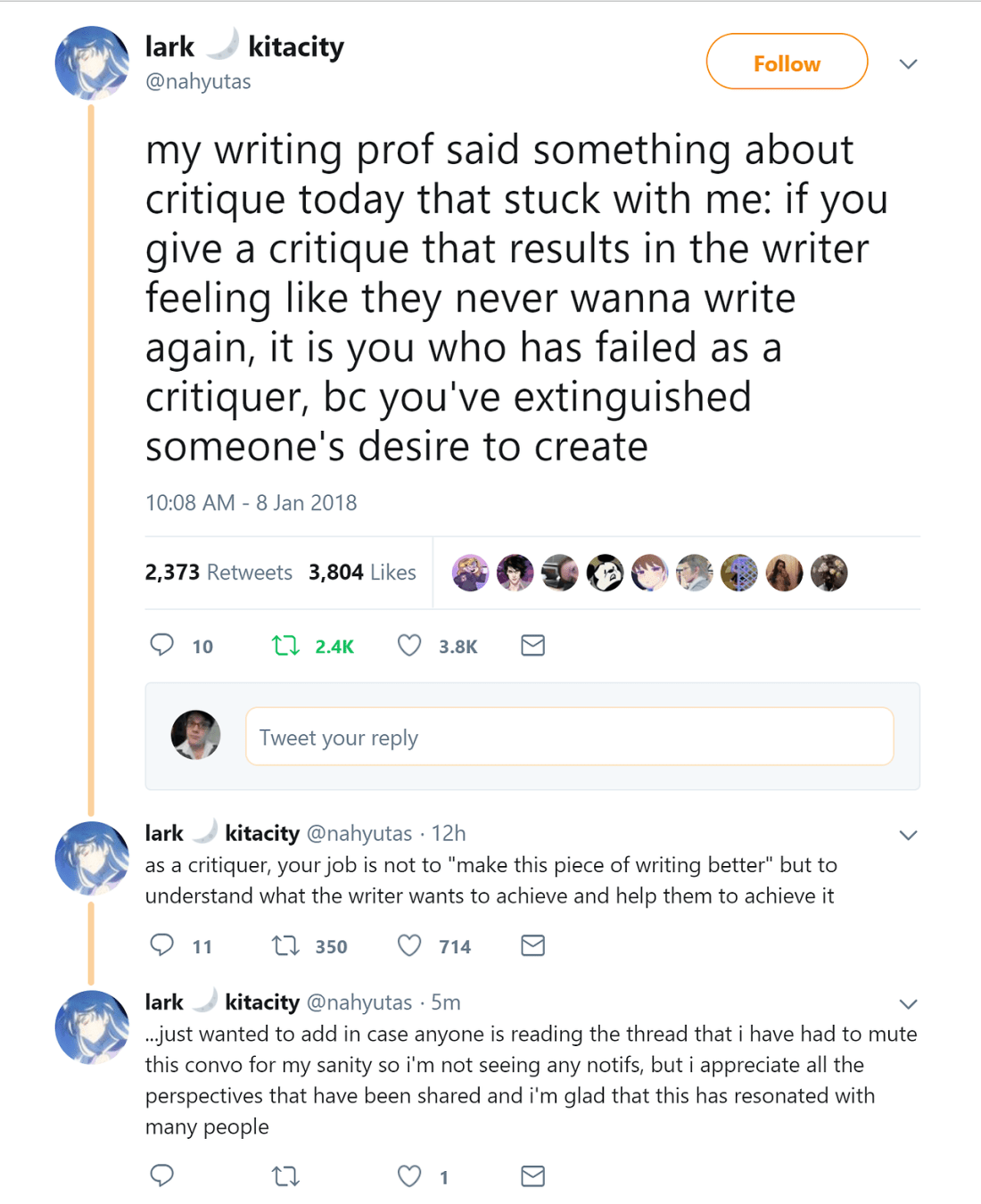
As a critiquer, your job is not to “make this piece of writing better” but to understand what the writer wants to achieve and help them to achieve it
Applies beyond writing as well.
Also applies to editing. I was recently talking to another writer whose editor (at a publisher) almost destroyed her desire to keep writing. Writers, know the signs of a shitty editor versus one who actually wants to help you achieve your vision, and don’t be afraid to ask for a different one. (Or fire a bad one if you’re indy.)






 just moving along like everyone else