Taken from Adult Children of Emotionally Immature Parents by Lindsay C. Gibson, Psy.D. A summary of the tips the book hands you on how to recognize emotionally healthy people.
They’re realistic and reliable
They work with reality rather than fighting it. They see problems and try to fix them, instead of overreacting with a fixation on how things should be.
They can feel and think at the same time. The ability to think even when upset makes an emotionally mature person someone you can reason with. They don’t lose their ability to see another perspective just because they aren’t getting what they want.
Their consistency makes them reliable. Because they have an integrated sense of self, they usually won’t surprise you with unexpected inconsistencies.
They don’t take everything personally. They can laugh at themselves and their foibles. They’re realistic enough to not feel unloved just because you made a mistake.
They’re respectful and reciprocal
They respect your boundaries. They’re looking for connection and closeness, not intrusion, control or enmeshment. They respect your individuality and that others have the final say on what their motivations are. They may tell you how they feel about what you did, but they don’t pretend to know you better than you know yourself.
They give back. They don’t like taking advantage of people, nor do they like the feeling of being used.
They are flexible and compromise well. Because collaborative, mature people don’t have an agenda to win at all costs, you won’t feel like you’re being taken advantage of. Compromise doesn’t mean mutual sacrifice; it means a mutual balancing of desires. They care about how you feel and don’t want to leave you feeling unsatisfied.
They’re even-tempered. They don’t sulk or pout for long periods of time or make you walk on eggshells.
When angered, they will usually tell you what’s wrong and ask you to do things differently. They’re willing to take the initiative to bring conflict to a close.
They are willing to be influenced. They don’t feel threatened when other people see things differently, nor are they afraid of seeming weak if they don’t know something. They may not agree, but they’ll try to understand your point of view.
They’re truthful. They understand why you’re upset if they lie or give you a false impression.
They apologize and make amends. They want to be responsible for their own behavior and are willing to apologize when needed.
They’re responsive
Their empathy makes you feel safe. Along with self-awareness, empathy is the soul of emotional intelligence.
They make you feel seen and understood. Their behavior reflects their desire to really get to know you, rather than looking for you to mirror them. They aren’t afraid of your emotions and don’t tell you that you should be feeling some other way.
They like to comfort and be comforted. They are sympathetic and know how crucial friendly support can be.
They reflect on their actions and try to change. They clearly understand how people affect each other emotionally. They take you seriously if you tell them about a behavior of theirs that makes you uncomfortable. They’ll remain aware of the issue and demonstrate follow-through in their attempts to change.
They can laugh and be playful. Laughter is a form of egalitarian play between people and reflects an ability to relinquish control and follow someone else’s lead.
They’re enjoyable to be around. They aren’t always happy, but for the most part they seem able to generate their own good feelings and enjoy life.
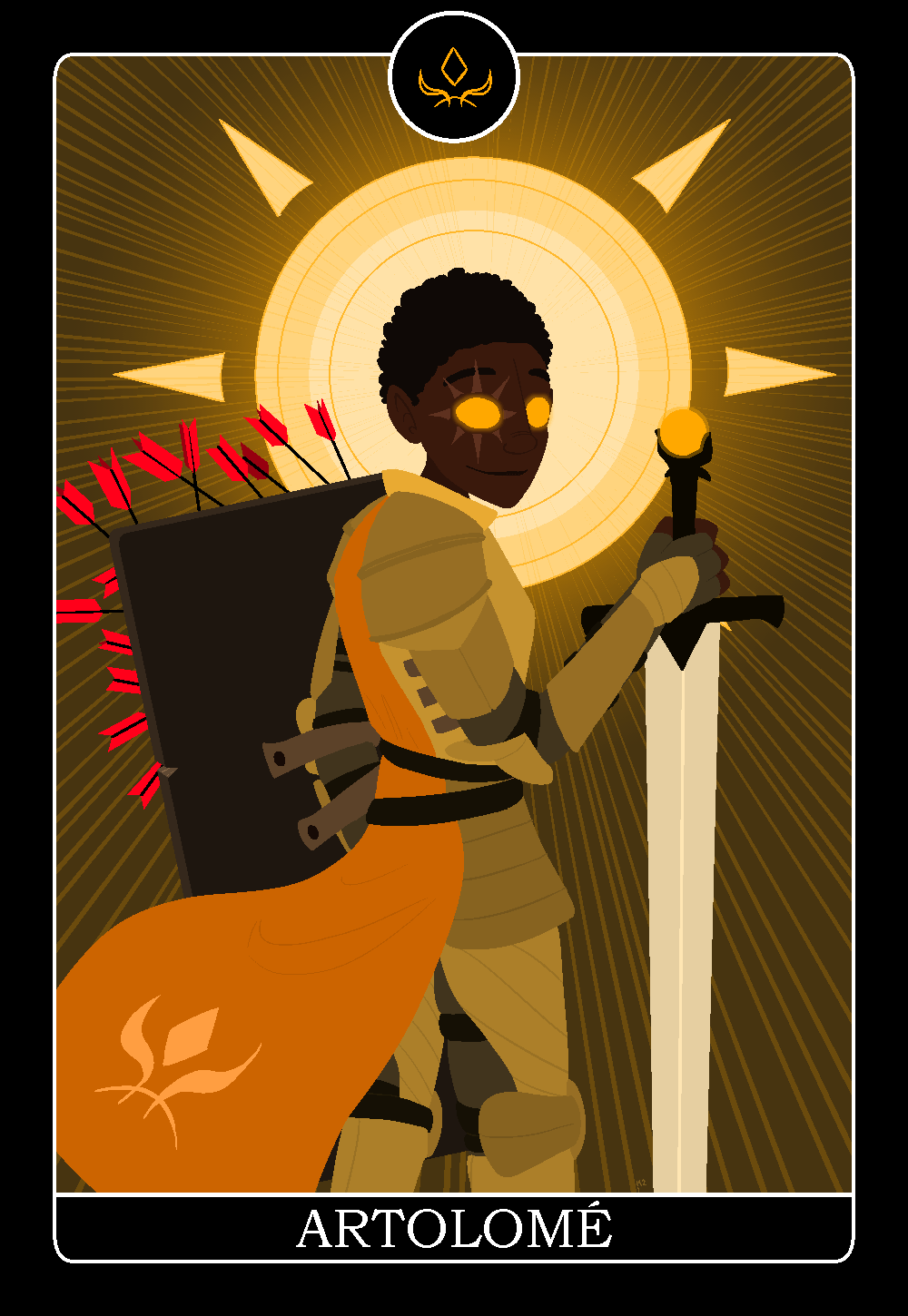
Artolomé, Our Lady Of Valour. It is in her nature to be just, to protect those who cannot protect themselves, and to be the blazing light of truth, who holds the sun in her palms. She was, it is said, once a mortal, and attended in the court of the previous god of Law and Good after her first death, before ascending upon the abdication of her predecessor.
There are many gods of my Pathfinder setting, and here is the first to be fully illustrated. This is Artolomé, the LG goddess of truth, justice and so forth. She’s pretty nice, if a bit overly-pedantic.
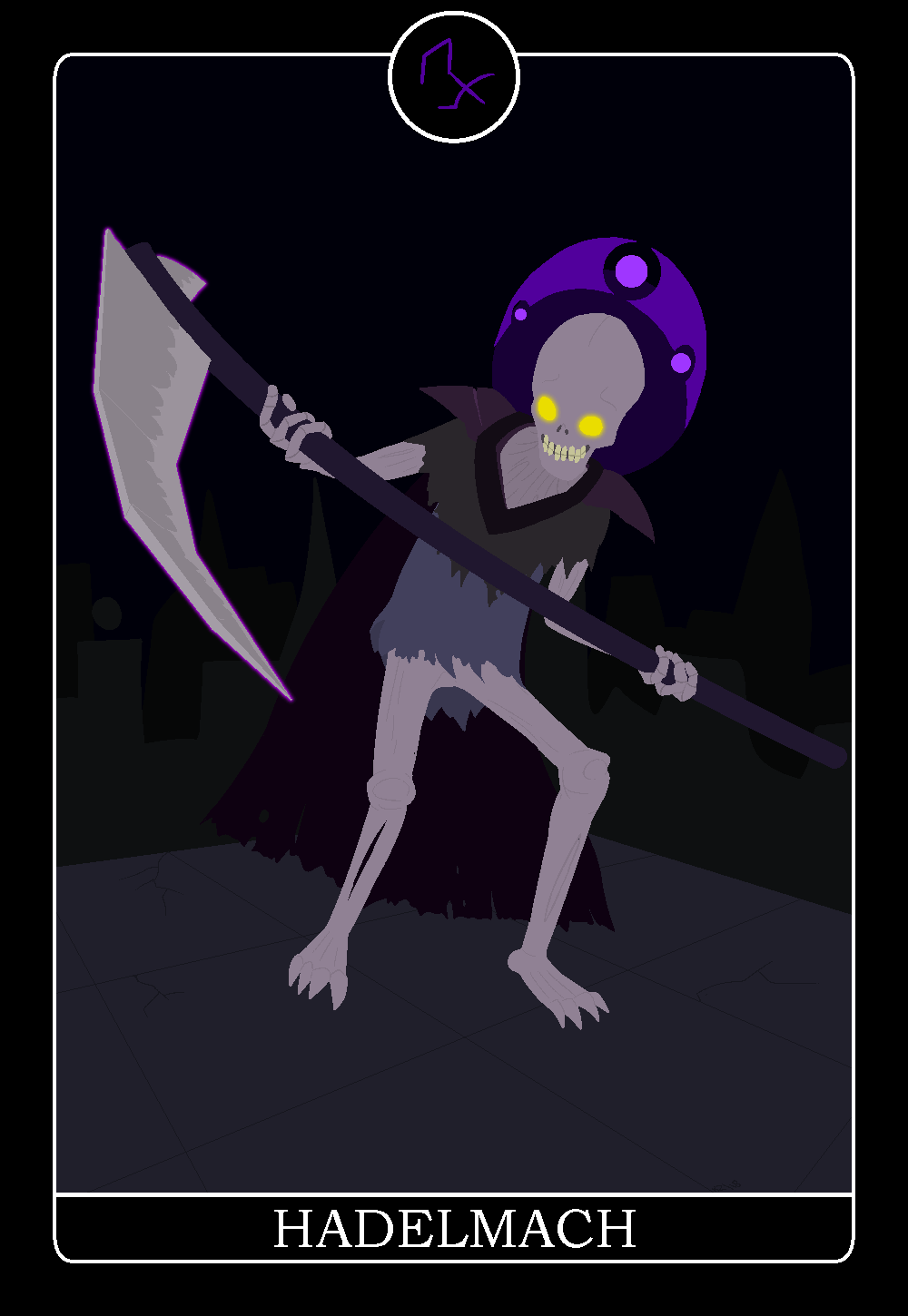
Hadelmach, The Twisted. It is in her nature to labour unceasingly, to reap what she has sown, and to dwell in pristine darkness. She is the patron deity of the Sunless Isles, a society of Gaunts that, despite their worship of an evil god, threw off the rule of their God-Emperors (distantly descended from Hadelmach herself) in revolution, and now are far friendlier to outsiders than they used to be. Hadelmach’s more ‘positive’ influences and rituals have become preeminent among the cold, rain-soaked cities of the Isles, and what effect that will have upon the goddess over the centuries remains to be seen.
The Sunless Isles are a very interesting and friendly place.
An incomplete list of descriptive paradigms for physical immortality – a resource for tabletop RPGs and other situations where you might find yourself playing or writing a character who can’t be hurt through conventional means.
Superman: The standard option – physical dangers just bounce off of you. If something does manage to injure you, you’ll display signs of pain or discomfort, and may exhibit light bruising, a thin trickle of blood, or some other cosmetic damage, but nothing short of complete destruction can violate your bodily integrity.
G-Rated: A series of unlikely coincidences arranges for injuries that you suffer to be much less severe than they should be. Fatal plummets become embarrassing pratfalls, and plunging into a fire merely leaves you artfully singed. Should you have enemies, they likely find you extremely frustrating to deal with.
Looney Tunes: You stretch and squash like a cartoon character, or else your body is simply amorphous. The effects of injuries tend to be exaggerated, but inflict no long-term impairment; for example, you might be cut in half, burnt to ash, or shattered like glass by trauma that wouldn’t ordinarily produce such extreme results, but quickly recover.
Zombie: You’re no more resistant to injury than an ordinary person, but being injured simply doesn’t particularly impair your ability to act. You’ll just keep going through anything short of complete bodily dismemberment, and even in that situation, your severed limbs may continue to act with far greater effectiveness than they really should.
Jekyll & Hyde: Trauma that should incapacitate or kill you instead causes you to transform into or be replaced by something else, typically an entity that can more effectively remove or escape the threat. The process later reverses itself, leaving you unharmed; you may or may not remember what your replacement did in your absence.
Skinsuit: Your human form is something you wear like a suit. Damaging it doesn’t meaningfully injure you, though it may impair your ability to act in a human fashion; in essence, injuries are recontextualised so that they change your ability to interact with the world rather than reducing it. Tentacles are traditional but not mandatory.
Puppet Strings: Your body is something that you have rather than something that you are. As you become progressively more damaged, it becomes progressively more apparent to onlookers that your body is being driven or dragged about by some outside force. You may or may not be able to replace it in the event of complete destruction.
Reset Button: You can be hurt or killed in the usual fashion, but no matter what happens to you, you just show up again later as though nothing happened. This may involve time manipulation, literal reincarnation, or some sort of metatextual contrivance. If killed, you may or may not remember dying.
Disposable: You’re actually one of a large number of essentially identical entities, typically a hive mind (if biological) or part of a product line (if mechanical). Destroyed instances are simply replaced. There may be a fixed number of you; if not, you may depend on some sort of external facility to produce more of you.
Outside Context: Your nature is sufficiently weird that it’s unclear what would qualify as an injury for you. The archetypal example is an intangible ghost, though there are many other possibilities. This usually involves a set of concomitant limitations on how you can interact with the world – it’s as alien to you as you are to it!
God forgot to give sins to the angels and thumbs to the goats, so that angels have more thumbs than they can handle, and goats have more sins. To this day goats and angels both adore and resent humankind for having BOTH thumbs AND a capacity to sin, in balanced and wieldy amounts. That’s a fact about the creation of the universe
……i can’t tell if this is shitposting or talmudic midrash
I just had this hyper-realistic dream and like. I don’t even know what to make of this lmao
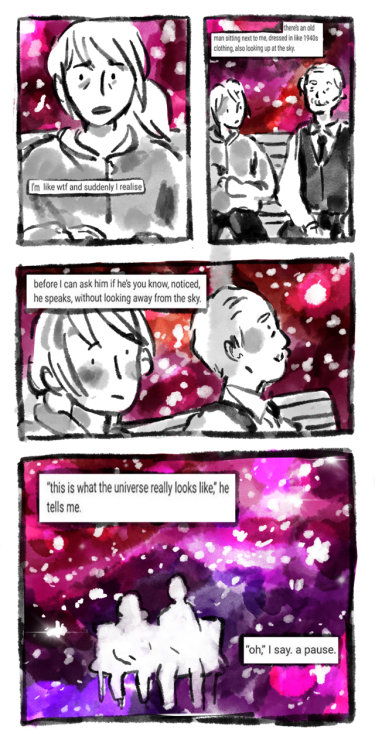
I was sitting in this park, on a bench, looking up at the night sky and all the stars and stuff, and I blinked and suddenly the entire sky was different. I’m talking different constellations, the sky absolutely packed with billions more stars, some so close they’re massive. I’m like wtf and suddenly I realise there’s an old man sitting next to me, dressed in like 1940s clothing, also looking up at the sky.
before I can ask him if he’s you know, noticed, he speaks, without looking away from the sky.
“this is what the universe really looks like,” he tells me.
“oh,” I say. a pause. “…can you put it back?”
he smiles and nods. I look up. the sky has gone back to normal.
“what do I do with this information?” I ask, looking at him again.
he turns his head and, smiling, looks me dead in the face. "be careful.“
20+ years ago, a friend of mine was doing research on “collaborative filtering”, the technology that underlies things like Netflix showing you movies you’ll probably-like. There was discussion of a project applying this technology to Usenet (a discussion medium) or internet forums or things like that, and one of the people, I think a faculty adviser, rejected it completely and said “no, this would be evil”. Because if you filter out all the posts you don’t like, you live in a bubble of people who agree with you.
Facebook proved him right.
I think this is a key thing to understand about all this “do we talk politely to people who disagree with us” discourse: 90% of the people supporting any given evil thing are not strongly committed to it. They’re just going along with what the people around them believe and say. If any people around them believe and say differently, that will have a significant impact on them.
Convincing people on things like this isn’t some kind of incredible one-in-a-million chance. If you just talk to them on a regular basis and go about your business, just existing, but occasionally mentioning conflicting views, that will convince a lot of them that the extremist things they are picking up are possibly-bullshit. Just being queer near people who are default-homophobic can, and does, get many of them to gradually change their minds.
There’s plenty of research on the polarizing impact of things like facebook’s default sorting of things so you see people who agree with you more and people who disagree with you less.
Failure to distinguish between genuine militants and people who are supporting crazy bullshit because no one they know personally is suggesting there’s a problem means further radicalizing the latter.
I know this is anecdotal, but in my 31 years of life, I have never convinced anyone to let go of some toxic or cruel attitude or practice. No amount of calling attention to it or explaining why it’s bad ever made a difference. No amount of just “being there” made any positive influence whatsoever.
People don’t change their minds, and they don’t consider anything beyond what they heard when they were five years old.
Convincing people on things is not a “one-in-a-million chance” like you say, but that’s only because you think it would actually work one time.
It doesn’t.
Even me saying this isn’t going to change anyone’s minds. No one is going to read what either of these posts say and reconsider their stance on anything.
Talking to other human beings is a pointless, frustrating waste of time and energy that could be better spent jerking off.
@despicableplankton I think this is a valuable perspective, and I have some questions, because if you’ve covered all the bases I can think of to cover in your efforts to convince people and still saw no success, it would warrant a significant update on my perspective on the matter.
As a starting point for what my perspective is, I can summarize it as follows: We don’t convince people by explaining how wrong they are. We convince people by trying to understand how right they are, and if they feel that we’re genuinely engaging with their ideas they’ll realize their errors themselves along the way as they try to explain them to you.
So what I normally do – unless I see a good reason for doing otherwise – is any time my mind raises a disagreement, I try to find some way to formulate it as a “I want to understand what I’m missing” sort of question. Incidentally, for me this aligns perfectly with me actual desire to learn anything that I might be missing.
So with that said, I’d actually like to know, if you don’t mind taking the time: have you tried the above, if so, could you go into details as to how those interactions went, and in what ways has it failed you?
TL;DR: I don’t think it matters what mental strategy you have, or how you present an argument, or even what you use to back up your beliefs. People decide ahead of time they don’t want to change, so they don’t. People have learned to throw out whatever information they don’t want to believe. Your pitch and your presentation is pointless if they’re not buying what you’re selling.
VERY LONG, RAMBLING, DEPRESSED RESPONSE BELOW THE BREAK:
One thing to remember is that you won’t always know if you’ve changed someone else’s mind.
I have had vehement arguments with people where I dug in and didn’t give an inch, didn’t even show the slightest appreciation for their viewpoint – only to change my mind later, long after the conversation was over, based in part on things they told me.
I have also had times where I’ve watched two other people argue, in one of those arguments that goes absolutely nowhere, and shifted from agreeing with person A to agreeing with person B without ever actually involving myself in their conversation.
If you regularly argue about things you’re passionate about, and use good argument strategies, it’s quite likely that you have changed some minds without even knowing that you have. Especially if those conversations were in a public forum, and therefore likely to involve many silent bystanders who choose to observe without contributing.
I agree with the one above me. I’ve been in lots of arguments, and I’ve never once changed my mind during the argument. But I have charged my mind, sometimes months or years later, due to things that people argued at me.
I’ve persuaded literally dozens of people to change their minds on contentious issues, that I know of, and sometimes I find out later about people I didn’t realize I’d convinced.
If you don’t think people can be persuaded, git gud.
Most people change their minds many many times in life. Even fanatics. What you don’t get, as merely one single outside participant in another human being’s life, is awareness and control over the timing or results of the change process, or credit for the results. this is not a bad thing.
i would encourage skeptics to consult exmormon.org and observe large groups of “hopeless” fundies undergoing massive ideological healing in real-time. Look at their stories. Count the people who were saved from lifelong mental prisons by the words of strangers.
Just because you can’t tell you’re winning doesn’t mean the other guy is a lost cause. That kind of surrender just indicates you got some stuff to work on yourself.
Lately I’ve been doing this thing where when men give me shit at my job, I choose to instead speak to their wives/girlfriends/female counterpart. I had a dude today try to yell at me and I ignored him and instead spoke in a very level voice to his wife instead. He literally stomped his feet like a fucking toddler and said “stop ignoring me! I’m talking!” And his wife said “George, please use a quieter voice. You’re embarrassing me.”
You are a genius and I’m using this
Lol I learned it from my mom. She does this all the time and eventually the guy either sulks off somewhere or adjusts his behaviour and THEN she’ll address him. I did this with my friends puppies when I was training them and it works the same tbh
This is the kind of behavior you use on little kids, which I find both hilarious, disturbing and very telling of how little we expect men to GROW THE FUCK UP
Controversial opinion, but ur allowed to like things that suck
Like, sometimes there are just shows or books that are so goddamn awful for any number of reasons… But ya still like ‘em somehow, and that’s fine
It’s not required to write a 20+ page essay defending why you enjoy something shitty, you can just… Enjoy shitty things
Not all content is made equally and you’re allowed to like things that are far from perfect
Like, just, “This show sucks, but I like it anyway” is a totally valid response
another controversial opinion: you don’t actually have to agree with people that the thing you like sucks. like yeah lots of things suck and the thing you like might suck too. taste is subjective. what sucks for some people might be just fine for you. if someone demands that you acknowledge that they think the thing you like sucks, you can just straight up ignore the fuck out of them.
‘i like it’ is a complete sentence. it doesn’t need an ‘anyway’ at the end or a ‘but’ at the start. and you’re not on the hook for anyone else’s bad time, either.




 just moving along like everyone else