SO. IF YOU KNOW YOUR FANDOM HISTORY, YOU CAN SEE THE WRITING ON THE WALL RIGHT NOW.
AND IN CASE YOU DON’T, I will tell you a story.
I don’t know if Yahoo as a corporate entity hates fandom, or if it LOVES fandom in the way a flame longs to wrap its embrace around a forest. Or maybe it’s just that fandom is an enticingly big and active userbase; but just by the nature of our enterprise, we are extremely difficult to monetize.
It doesn’t matter.
Once upon a time – in the era before anyone had heard of google – if you wanted to post fandom (or really, ANY) content, you made your own webpage out of nested frames and midi files. And you hosted it on GeoCities.
GeoCities was free and… there. If the internet of today is facebook and tumblr and twitter, the internet of the late 90s WAS GeoCities.
And then Yahoo bought GeoCities for way too much money and immediately made some, let’s say, User Outreach Errors. And anyway, the internet was getting more varied all the time, fandom mostly moved on – it wasn’t painful. GeoCities was free hosting, not a community space – but the 90s/early 00s internet was still there, preserved as if in amber, at GeoCities.com.
Until 2009, when Yahoo killed it. 15 years of early-internet history – a monument to humanity’s masses first testing the potential of the internet, and realizing they could build anything they wanted… And what they wanted to build was shines to Angel from BtVS with 20 pages of pictures that were too big to wait for on a 56k modem, interspersed with MS Word clipart and paragraphs of REALLY BIG flashing fushia letters that scrolled L to R across the page. And also your cursor would become a different MS Word clipart, with sparkles.
(So basically nothing has changed, except you don’t have to personally hardcode every entry in your tumblr anymore. Progress!)
And it was all wiped out, just like that. Gone. (except on the wayback machine, an important project, but they didn’t get everything) The weight of that loss still hurts. The sheer magnitude…
Imagine a library stocked with hundreds of thousands of personal journals, letters, family photographs, eulogies, novels, etc. dated from a revolutionary period in history, and each one its only copy. And then one day, its librarians become tired of maintaining it, so they set the library and all its contents on fire.
And watch as the flames take everything.
Brush the ash from their hands.
Walk away.
Once upon a time – in the era after everyone had heard of google, but still mostly believed them about “Don’t be evil” – fandom had a pretty great collective memory. If someone posted a good fic, or meta, or art, or conversation relevant to your interests? Anywhere? (This was before the AO3, after all.) You could know p much as soon – or as many years late – as you wanted to.
Because there was a tagging site – del.icio.us – that fandom-as-a-whole used; it was simple, functional, free, and there. Yahoo bought it in 2005. Yahoo announced they were closing it in 2010.
They ended up selling it instead, but not all the data went with it – many users didn’t opt to the migration. And even then, the new version was busted. Basically unusable for fannish searching or tagging purposes. This is the lure and the danger of centralization, I guess.
It is like fandom suffered – collectively – a brain injury. Memories are irrevocably lost, or else they are not retrievable without struggle. New ones aren’t getting formed. There is no consensus replacement.
We have never yet recovered.
Once upon a time… Yahoo bought tumblr.
I don’t know how you celebrated the event, but I spent it backing up as much as I could, because Yahoo’s hobby is collecting the platforms that fandom relies on and destroying them.
I do not think Yahoo is “bad” – I am criticizing them on their own site, after all, and I don’t expect any retribution. I genuinely hope they sort out their difficulties.
But they are, historically, bad for US.
And right now is a good time to look at what you’ve accumulated during your career on this platform, and start deciding what you want to pack and what can be left behind to become ruins. And ash.
…On a cheerier note, wherever we settle next will probably be much better! This was never a good place to build a city.
i forgot that yahoo was the one that destroyed both de.li.cious and geocities too, dang. But yes – tumblr is a loss and the writing is on the wall. Yahoo won’t run this site purely for charity reasons, so unless something wildly changes, tumblr’s days are numbered.
(Maybe now is a good time to check out pillowfort.io …)
I have been involved in online fandom since AOL was new, and yes, I witnessed the destruction when Geocities went dark. It was a real loss. The Wayback Machine saved some pages, but not all.
But I think it’s wrong to blame Yahoo. They weren’t the only ones. And they won’t be the last. It might seem like Facebook, Tumblr, and Twitter are here to stay, but that once seemed true of AOL, Geocities, MySpace, etc. If it stops being profitable, it goes away…or becomes a useless shadow of what it used to be.
AOL still exists as a company, but the fannish message boards, filled with discussion and fanfic, are gone forever. So are all the personal webpages where fans used to archive their stories. Free mailing lists at Yahoogroups, Onelist, and Egroups were once the heart of fandom – where people posted discussion and fanfic, and expected them to be archived forever. Yahoogroups ended up absorbing the rest, then put Draconian limits on posting and archiving that basically made the mailing lists useless for fannish purposes.
Usenet is still around, but the archiving services (Remarq, DejaNews, etc.) mostly went away. Because of the nature of Usenet, it was pretty useless without multiple archives (posts tended to get lost, they were only available for a couple of weeks, and you couldn’t depend on one ISP or one archive to get them all – a pain if you were trying to read a 30-part story).
So, I am wondering how long Tumblr will be a viable platform for fandom. Yahoo recently sold off Flickr, and the new owner is making huge changes. You used to get 1 terabyte of space for photos; now you only get 1,000 photos, no matter what size they are. If you don’t buy a membership for $50/year, they will start deleting your photos until you are under the limit, oldest first. If they decide to sell Tumblr as well, who knows what the new rules will be.
Many Flickr users are upset at the changes. They expected their photos to be archived there forever. Now that won’t be the case, even if they pay – since once you die and stop paying the fee, your photos will be deleted.
I fear that applies to fannish works as well. Switching to Pillowfort.io or Dreamwidth isn’t really a solution. They are likely to face the same pressures Yahoo, etc. faced. Any commercial service can’t be relied on.
I’m reminded of something a biographer of Steve Jobs said. He writes a lot of biographies, and said Jobs was difficult, because his early journals were on magnetic tape and other obsolete media, written with software that is no longer readily available. Leonardo da Vinci was easier, because his handwritten notebooks can still be read. I guess there’s something to be said for dead-tree fanzines.
A good post to revive!
I don’t think it’s the commercial nature of a site by itself that’s the issue. DW never really took off like a lot of us hoped and never created that second era of LJ-style fandom, but it has been chugging happily along ever since. Its ambitions were modest and its business plan sound.
The problem is that most commercial sites are venture capital startup nonsense that does not have a clear business plan that will be sustainable in the long run. The aim is to drive users to the site in such numbers that they feel unable to abandon it, then inflict advertising or new fees on them after they’re stuck. “We’ll figure it out later” is a key feature of all of these, but the assumption that lots of users mean lots of ways to monetize isn’t always valid.
Squidge-style sites also don’t usually have good long-term plans. (IDK about Squidge in particular though.) The ones that last are the ones run by fans with deep pockets and good offline fannish support networks. Many others die when the owner forgets to renew the domain name or gets tired of paying or can’t pay any longer.
Look at the Smallville Slash Archive: it was one of many fannish sites that Minotaur hosted. When he died unexpectedly, his many fannish friends stepped in to save his work. SSA ultimately got imported to AO3 to preserve it. This worked because he had plenty of actual friends in fandom–people he saw offline at cons too–and not just casual acquaintances who followed him on social media. It’s true that donation drives can be signal boosted on social media, but all of the liking and goodwill in the world won’t do jack if nobody has access to the hosting/business side of a site to use those donations to keep it open.
This is one reason a lot of older fans I know have started talking about fannish estate planning. All those paper zines are a better archival format than any computer drive, but they also often get thrown in the trash by clueless relatives. Out of an original print run of a couple hundred, how many are extant?
AO3 is distinctive in that it has an entire organization in place to make sure it continues. (So while nothing is forever, AO3 is about as solid as it gets.) But I’d probably trust DW second most, and I’d trust it over many single-owner not-for-profit fannish spaces.
Not to hijack the thread, but this is Walter from Squidge.org. Yes, we’re still out here, though we’re such a small part of fandom now as opposed to the early 90s when we started. Squidge has a future, I think, and I’m looking at replacing several of current sites (Peja’s WWOMB, NCISFiction.com, and a couple more eFiction sites) with a single AO3-based archive.
And as for the future, yes, we’re all getting older. I have a will that bequeaths Squidge.org fandom sites to the OTW (the folks that run AO3). My husband has instructions, and OTW has been told of my wishes.
Great to hear you’re around! I used to read WWOMB so often–and again whenever I get into a new-to-me old fandom. There are so many fics on older archives that aren’t crossposted anywhere else.
“don’t support nestle!” shouts the liberal on the computer made from parts manufactured at foxconn
consumer activism is a lie, see you in hell or in communism
lmao try boycotting a brand in monopoly capitalism
This. This is a large part of what “there’s no ethical consumption under late capitalism” means. On top of everything else, when the same company owns both the product you’re boycotting *and* the “organic, free range, fair trade, no prison labor” version of that product, your choice is literally meaningless. Even before you factor in the strong possibility that those labels are lies, you’re still just choosing one prong of a two prong marketing strategy meant to capture 100% of the market. Your objections to their cheaper, less ethical brand are being used to wring more money out of you, money that all goes to the same place. Your morality is being used to exploit you, and they still win.
My girlfriend Marna has been a queer activist since the late 80s. She’s told me about the incredible deliberation and debates LGBTQ+ activists had, in the late 90s and early 00s as the community began to see past the AIDS crisis and immediate goals of “surviving a plague” and “burying our dead.” There were a lot of things we wanted to achieve, but we had to decide how to allocate our scarce reserves of money, labour, publicity, and public goodwiil. Those were the discussions that decided the next big goals we’d pursue were same-sex marriage equality and legal recognition of medical gender transition.
From hearing her tell it, it seems like it was actually a wrenching decision, because it absolutely left a lot of people in the dust. A lot of people, her included, had broad agendas based on sexual freedom and the rights of people to do whatever they wanted with their bodies and consenting partners—and they agreed to put their broader concerns aside and drill down, very specifically, onto the rights of cis gays and lesbians to marry, and the ability to legally change your sex and gender.
As a political tactic it was terrifically effective. In less than two decades, public opinion in many countries has totally reversed on gay marriage, and we’ve won some truly enormous legal landmarks. Gender transition has entered public consciousness and the first landmark battles allowing people to define their own gender have been won. Marriage equality means that husbands and wives are protected from being banned from their dying spouse’s bedside, being forcibly separated from their children, or not being recognized as an important part of their spouse’s life.
The LGBTQ+ community knew they were taking a gamble, focusing so exclusively on marriage equality, and trans activists knew that they wouldn’t be able to achieve anything else until they’d gotten basic medical transition recognized. By and large, prioritizing things this way paid off. But they knew going in that there would be costs—and we’re reaping them.
Activists of 20 years ago chose to sideline and diminish efforts to blur and abolish the gender binary. Efforts to promote alternative family structures, including polyamorous families and non-sexual bonds between non-related adults. Efforts to fight the Christian cultural message that sex is dirty, sinful, bad, and in need of containment. Efforts to promote sexual pleasure as a positive good.
Those efforts have been going on for the last 20 years, but they’re marginalized—activists who had to decide where their finite time, money, publicity, and social capital went literally sat in committee meetings and said, “Marriage equality is our top priority. Legal gender transition is our top priority. Everything else will have to wait.”
This happened especially because sex education, sex positivity, and youth outreach were incredibly dangerous areas. Our enemies have been saying for years that all LGBTQ+ people are pedophiles, perverts, seeking to corrupt and recruit children to our cause; anyone trying to teach children basic facts about how to avoid disease, what’s happening to their own bodies, or what possibilities they have for identity and orientation, risks having their name, career, and life ruined. As a sex educator in the 90s, Marna had to tell teenagers, “I can’t answer your questions about safe sex now. Come back when you turn 18.”
So kids who grew up being told that girls and boys are different and ought to lead different lives, and sex is dangerous and sinful and gross, and you definitely shouldn’t want sex UNTIL you get married to your One True Love, only had that message tweaked a little bit. Now you can cross the floor from the Girl Side to the Boy Side or vice-versa. Now your One True Love doesn’t have to be a different gender from you. But those kids could survive with the rest of their worldview relatively intact. And I think that’s what we’re seeing in fandom, with an emphasis on “pure” OTP ships, on only including LGBT+ identities that use crisp, clear gender binaries and result in nuclear family life. The rest of those cultural messages about sex and love remain: men’s and women’s worlds are and should be different, “impure” sex degrades and defiles you, sexual urges that do not contribute to your One True Love and family life should be repressed, shamed, or destroyed, and sexual thoughts are every bit as bad as acting on them.
This isn’t because kids today are bad or stupid. It’s because as a community, we had to decide where our effort was going, and now we need to pay down the debt we’ve racked up over years of prioritizing marriage equality and legal trans recognition over sex positivity, sex education, and deconstructing gender.
TERFs, SWERFs, exclusionists, and transmedicalists have stolen a march over liberal queers because they’re doing the work to educate youth. While liberal queers have been staging protests and lobbying politicians, half a dozen of my undergraduate professors were radical feminists. Communities of exclusionists and anti-sex activists have honed their expertise at engaging teenagers with their ideas and theories. They’re the ones writing the FAQs, answering the asks, and doing the groundwork of saying, “Here is a basic framework of sexual ethics for you to follow.”
If we want to win back the culture wars, we have to step up our own efforts. Go back to the sex educators and gender activists whose good work has been ignored or underfunded for all this time and support them. Let major LGBTQ+ activist organizations know that their work so far is very nice, but it’s time to renew our focus on youth outreach and mentoring young activists. Brainstorm a way to help angry, isolated, disenfranchised young people form communities based around positive action and a sense of belonging. Get into mentorship or education yourself. Help us pivot as a community, to reach out to the kids who have obviously been underserved.
This is a delightful post and I’m delighted you linked it over on Dreamwidth, which is where I saw it. I’m sitting here and chewing it over and integrating it into my personal experience of being, y’know, a twenty-eight-year old who reaped many of both the victories–Coffee wouldn’t be right here, living with me, without DOMA going down; wouldn’t have health insurance without Obergefell; wouldn’t feel safe if anything happened to me without legal recognition of our relationship–and also someone who came from a really different microculture.
God, I feel like the “HI I AM BRINGING THE ACE PERSPECTIVE TO BROADER HISTORY” person these days, but here’s a thing that strikes me: my communities, growing up, were also out there having sidestepped the marriage discussion and instead having chosen to focus on youth outreach, education, and engagement. I mean, for a decade the central ace-spec community out there was AVEN, which literally chose to call itself the Asexual Visibility and Education Network.
And the thing is, the same community was also quietly but heavily influenced by a lot of those ideas about blurred gender binaries and new family structures. There have always been quiet but powerful sex-positive currents in ace communities, to the point that in 2011 there were quite a lot of us going “Hang on, hang on, why the hell are we the standard-bearers of how great sex is?” in frustration. Ace communities are such a haven for nonbinary folks that in 2011 fully 40% of the surveyed community for one widely published study found that people ticked their gender identity as something other than “male” or “female.” (This is counting folks who put down identifications along the lines of “male-ish” or “female-ish”, which was a viable option.) And anyone who has looked at an ace community for five minutes or listened to ace folks talk about fantasies of family has seen how much focus these communities place on alternative family styles.
A lot of that sort of burst back all over mainstream queer communities again circa 2010-2012ish, as AVEN shattered and ace communities sprang up without necessarily referencing it. But those discussions and those currents and those feelings go right back to the roots of what AVEN was, and more to the point they go back to the roots of those older activism strains that were deliberately unfed by many “mainstream” queer activists: for example, asexual folks probably didn’t come up with romantic orientation wholesale–I ran into it described as “affectional” orientation often enough in ~2005ish that I’m pretty sure it was picked up from bisexual communities and dialogues. But it was indisputably asexual culture that burst out around 2011 and repopularized the concept within younger queer communities, to the point that I’ve run into a lot of allo folks asking if it’s appropriation to pick up the concept and borrow it for themselves.
Or–I’d ask @coffee-mage-sans-caffeine for more input than me on early nonbinary/genderqueer communities, because they know more about those spaces than me by a country mile, or maybe @xenoqueer has thoughts. But for a while there, when I met any given person who didn’t identify as male or female I could often work out whether they were coming from an ace-influenced or a non-ace-influenced background just by seeing if they used the word “nonbinary” or “genderqueer.” I’m pretty sure I wrote something about it at the time, but I haven’t got the time to go digging right now.
So I’m sitting here tilting my head and wondering: because while mainstream LGBTQ activists, for lack of a better turn, might have given this fight up wholesale while putting their muscle and their blood and sweat and tears into marriage equality, I don’t think TERFs et al. were the only pockets of queer community who were going out and focusing very specifically on youth engagement. I actually think that ace communities–and maybe the non-ace nonbinary communities of trans folks–might have been picking up and incubating many of these ideals and engaging in outreach all on their own.
It’s an interesting thought, thinking about AVEN as the vanguard of all of these older, tactically silenced priorities for queer liberation. And it makes a certain amount of sense in the context of the inclusionist/exclusionist wars c. 2003-2004 within ace communities outside of AVEN, too.
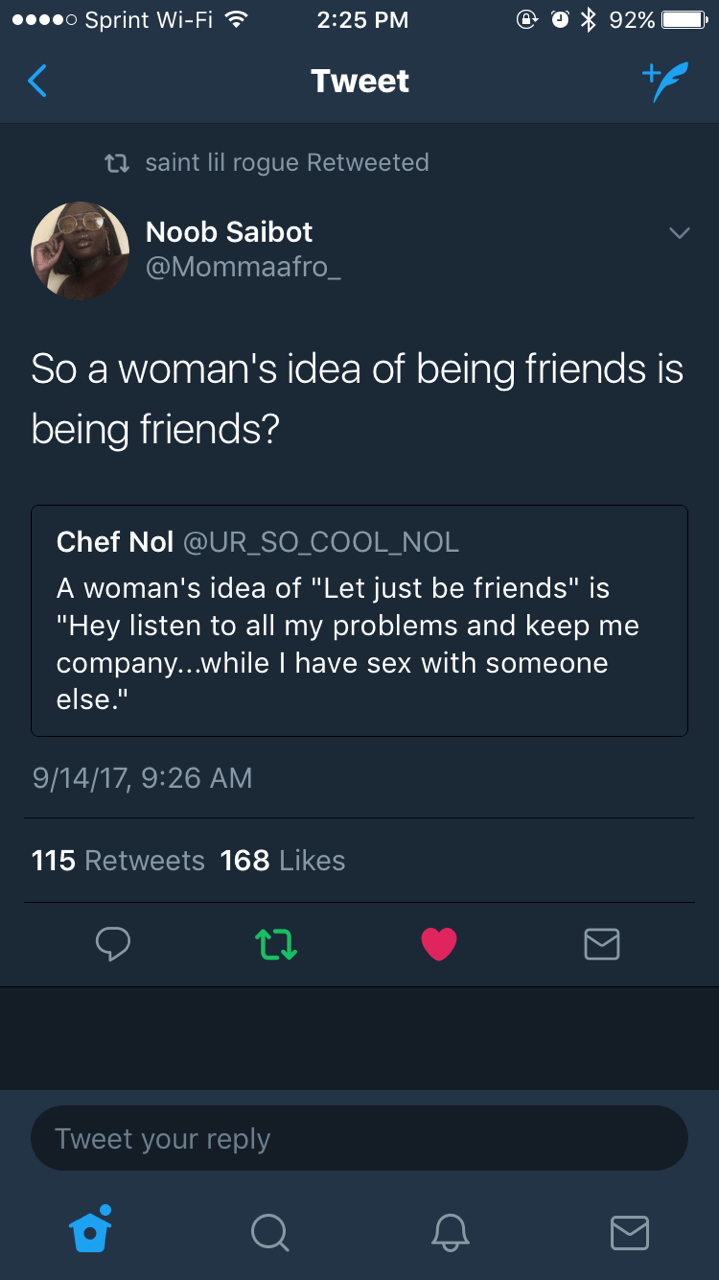
So there’s a known thing in the study of human psychology/sociology/what-have-you where men are known to, on average, rely entirely on their female romantic partner for emotional support. Bonding with other men is done at a more superficial level involving fun group activities and conversations about general subjects but rarely involves actually leaning on other men or being really honest about emotional problems. Men use alcohol to be able to lower their inhibitions enough to expose themselves emotionally to other men, but if you can’t get emotional support unless you’re drunk, you have a problem.
So men need to have a woman in their lives to have anyone they can share their emotional needs and vulnerabilities with. However, since women are not socialized to fear sharing these things, women’s friendships with other women are heavily based on emotional support. If you can’t lean on her when you’re weak, she’s not your friend. To women, what friendship is is someone who listens to all your problems and keeps you company.
So this disconnect men are suffering from is that they think that only a person who is having sex with you will share their emotions and expect support. That’s what a romantic partner does. But women think that’s what a friend does. So women do it for their romantic partners and their friends and expect a male friend to do it for them the same as a female friend would. This fools the male friend into thinking there must be something romantic there when there is not.
This here is an example of patriarchy hurting everyone. Women have a much healthier approach to emotional support – they don’t die when widowed at nearly the rate that widowers die and they don’t suffer emotionally from divorce nearly as much even though they suffer much more financially, and this is because women don’t put all their emotional needs on one person. Women have a support network of other women. But men are trained to never share their emotions except with their wife or girlfriend, because that isn’t manly. So when she dies or leaves them, they have no one to turn to to help with the grief, causing higher rates of death, depression, alcoholism and general awfulness upon losing a romantic partner.
So men suffer terribly from being trained in this way. But women suffer in that they can’t reach out to male friends for basic friendship. I am not sure any man can comprehend how heartbreaking it is to realize that a guy you thought was your friend was really just trying to get into your pants. Friendship is real. It’s emotional, it’s important to us. We lean on our friends. Knowing that your friend was secretly seething with resentment when you were opening up to him and sharing your problems because he felt like he shouldn’t have to do that kind of emotional work for anyone not having sex with him, and he felt used by you for that reason, is horrible. And the fact that men can’t share emotional needs with other men means that lots of men who can’t get a girlfriend end up turning into horrible misogynistic people who think the world owes them the love of a woman, like it’s a commodity… because no one will die without sex. Masturbation exists. But people will die or suffer deep emotional trauma from having no one they can lean on emotionally. And men who are suffering deep emotional trauma, and have been trained to channel their personal trauma into rage because they can’t share it, become mass shooters, or rapists, or simply horrible misogynists.
The only way to fix this is to teach boys it’s okay to love your friends. It’s okay to share your needs and your problems with your friends. It’s okay to lean on your friends, to hug your friends, to be weak with your friends. Only if this is okay for boys to do with their male friends can this problem be resolved… so men, this one’s on you. Women can’t fix this for you; you don’t listen to us about matters of what it means to be a man. Fix your own shit and teach your brothers and sons and friends that this is okay, or everyone suffers.
The next time a guy says, “What? You don’t want to be my friend?” I’ll text him this and then ask if he really wants to be friends or just have another potential girlfriend.
y’all I am living for these analyses where the new way to fight the patriarchy is to teach men to love each other and themselves
Im a communication student and can confirm the above is absolutely 100% accurate and it’s called agentic vs communal friendship theorized by Steven McCornack
Laziness: I’d rather sit here than pick up those clothes
Executive Dysfunction: I need to pick up those clothes I need to pick up those clothes why am I still watching this thing on Netflix while sitting down c’mon stand up I need to pick up those clothes I need to pick up those clothes I need to-
The Kind Of Actual Pathology-of-Motivation Associated With Major Depressive Disorder*: I know I need to pick up those clothes, and if I don’t pick up those clothes my quality of life will continue to decline, and theoretically the consequences of picking up those clothes are ones I don’t want, and if I don’t pick up those clothes they will get wrinkled and dirty again and I won’t have clean clothes to wear, but my life is an undifferentiated mass of grey and despite knowing all of these things I cannot actually make myself fucking care I will just stay here and stare at the clothes while Netflix plays until it stops. And tell myself how fucking lazy, stupid and useless I am because if I weren’t I would realize that I need to pick up those clothes and make myself do it. This is totally fine.
[yes, this is actually separate from executive dysfunction; it’s also a symptom of illness, a potentially really serious one, and tends to spring from complications due to anhedonia, or lack of the ability to experience positive stimuli] [it is also often COMORBID – that is, happening at the same time – with executive dysfunction]
Can you expand on how “i just can’t care” is different from “lazy”? Is it the internal ability to care, that it’s just lacking, whereas with laziness you have the capacity to do the thing, you just choose not to. I’m having trouble with cementing the actual explanation. Laziness is a values thing and the rest is a base-functionality thing?
In terms of what I meant, the crux there is cannot make myself.
Say I’m being lazy with my afternoon, and someone I know comes in and says, “You need to stop being lazy and do the thing, or Bad Consequence will happen.” And the consequence is genuinely bad.
For instance, say I’m Not Cleaning the Kitchen and someone comes to me and says, “You need to clean the kitchen or you’re going to get ants”. And they’re even right.
If I’m being lazy, and I agree that now that I think about it, ants aren’t good, I don’t want ants, I kick my own ass, get up and clean the kitchen. This is based on the ability of my brain to literally experience a Reward, a Positive State, from having a cleaner kitchen and not having ants.
If I’m having catastrophic anhedonic motivation failure? That doesn’t work. It’s not that I want to stay on the couch more than I don’t want to have ants. It’s that I can’t make myself care about EITHER state because it’s all fucking horrible. Nothing gets better. I might as well fucking have ants. I deserve ants. Look at me I can’t even fucking keep my kitchen clean I don’t even WANT my kitchen clean obviously since I’m still lying here so fuck it, I’ll just lie here and have ants. Oh look now I have ants. Isn’t that fantastic proof of how fucking awful I am.
Of course the entire thing is usually not that articulated in the brain, you know? This whole thing is an example. Usually it’s more like:
Laziness: … meh put away clothes later. Executive Dysfunction: *want to put away clothes* *constantly stall on the initial cognitive step of How To Put Away Clothes* *get more and more distressed/stressed about not putting away clothes* *keep stalling* *cry* Anhedonic Lack of Motivation: *lie there. stare at clothes. know clothes should probably go away. can even think of whole set of steps to put away clothes.* *cannot fucking feel anything about putting away clothes* *stalls out forever in pit of ‘why do i even fucking bother i should lie here and rot’* *uses fact that clothes have not been put away as evidence*
But the original form is pithier and has better rhythm.
So, it looks the same to a third party, but it feels/behaves differently on the inside
Well yes. They ALL look the same to a third party, at least casually – that’s the point.
If you know the person it’s pretty easy to see the difference (the general aura of misery and disinterest in anything else in the universe is a big hint).
This is something I wish was more widely understood. Executive dysfunction has become known about in my irl circles and while there’s definitely one or two for which this a problem most of the rest seem to use it as an explanation for the symptoms of unmanaged depression. As a society we are really bad at recognising the flat, empty, grey gaping maw that eats time and quietly lets us ruin our lives through neglectful apathy. Because that’s laziness, right? So I can understand wanting an explanation that doesn’t relegate blame. The problem is the most easily accessible, without further stigma (eg. depression as a moral failing) is an incorrect one, and genuinely unhelpful. Not the same strategies to address, plus depression can use more brain broken to feed to ifs narrative of I Hate You.
I mean: executive dysfunction is also a symptom of depression, and like I noted they’re often very much comorbid. I have had whole periods where what made my life fall apart was the total demise of my executive function.
But yes, executive dysfunction and anhedonic lack of motivation are actually different things, and they also require different things to fix.
And gods yeah, I think that the way that anhedonia – the actual impairment or destruction of your ability to experience positive emotions and stimulus – is something that needs way, way more attention, w/r/t how it works and how it affects your ability to function.
i wonder if theres such a thing as a disconnect between the action and the reward–as in you do feel a reward from doing something, it’s just that while you’re not doing it you sort of can’t believe in or don’t care about the reward? and so it doesn’t seem worth doing, but then if you do somehow get forced or just do it in a random fit of motivation the reward does happen, it’s not gone.
Fuck yeah! The brain reward system is a major problem in most disorders of motivation and executive function. Sciency links:
I have a lot of thoughts about this but they’re all very speculative; be appropriately skeptical.
There are people who I really disagree with, but fundamentally respect. I understand where their understanding of the world diverges from mine, and I get what they’re trying to do, and I might hope that they never get political power but on a personal level I trust them and like them, and enjoy debating and discussing things with them, and I know that they feel the same way about me. And I want my communities to be ones in which they are welcome (and my friendships with them are not discouraged or treated as evidence against my commitment and trustworthiness).
This is sort of the Peak Liberal take on how to handle profound political disagreement, and by that I mean something more than “it’s something liberals say a lot and leftists think is really stupid”. Liberalism is a collection of social technologies which developed to try to sustain societies where people had deeply felt political, cultural and religious (mostly religious) disagreements. Lots and lots of the norms of liberalism are norms for maintaining societies in which these profound disagreements exist. “I don’t agree with what you have to say, but I’ll defend your right to say it” is a core liberal norm; “we can respect each other without agreeing with each other” is liberalism; “we should treat each other compassionately and thoughtfully and lawfully even when we believe each others’ beliefs to be evil” is liberalism.
Leftists have a lot of critiques of this! Some of them are good critiques! For example:
In practice, no community is inclusive of everyone. Communities that are aiming for ‘inclusive of everyone’ end up being inclusive of the people with the most social power, because they’re most resilient to the inclusion of people who really hate them and like to hurt them. Norms that try to make everyone get along therefore end up being norms that make things comfortable for powerful people and Not For You at vulnerable people.
Divorcing peoples’ politics from their character like that isn’t very principled. If I think someone is a rapist, I shouldn’t ‘like them as a person but disagree with them about rape’. If I think someone supports mass murder in the form of foreign wars, I shouldn’t ‘like them as a person but disagree with them about mass murder’. Doing this requires some weird doublethink where you forget the actual consequences of peoples’ political behavior, which hurts real people, so you can relegate it to the realm where “they’re wrong about the best flavor of ice cream” and “they’re wrong about what temperature to keep their house” go.
But the core thing here is not a specific critique. Leftists, even when the specific critiques don’t apply, are deeply suspicious of “we disagree profoundly but we can respect each other”. They recognize it as the Core Liberal Thing and they are very much opposed to the core liberal thing. So leftists, when talking with people who they disagree with politically, tend to go out of their way not to do the Core Liberal Thing. They often take pride in not having respectful, positive relationships with people who they profoundly disagree with. They are often mean to people who they disagree with. They often ridicule the idea that we should be establishing common ground or agreeing to let some disagreements lie for the sake of common interests elsewhere.
And, yeah, they often are delighted about hurting liberals’ feelings. It’s an extension of the critique of collaborative-disagreement as a important core norm, and while I think some parts of the critique have merit, I’ve never seen anything productive come of a discussion between people who abandoned effort at kind and thoughtful disagreement in favor of trying to hurt their enemies’ feelings. And so I think you need it, at least a little bit sometimes on your own terms, even if you are opposed to it as a framework for how society should work.
oh shit, suddenly i understand why i’m seeing tumblr leftists talk about ‘liberals’ as The Enemy, when just last year ‘liberal’ was the opposite of ‘conservative’, and ‘conservative’ meant right-wing.
it’s because ‘conservative’ doesn’t actually mean right-wing, it just tends to coincide with it. conservative really means dogmatic and judgmental.
hot take: the capitalist cultural construction of “humans are naturally greedy and self-centered” is just an attenuated version of the feudal christian construction of “humans are inherently sinful”; both are designed to make people internalize cultural problems and externalize morality.
building off that hot take: western individualism (the American Dream, meritocracy, “pull yourself up by your bootstraps” mentality) is actually a hopelessly sentimental cultural fantasy that stems from this toxic capitalist conceit, and it’s high time we start admitting in our personal lives and in our public policy that humans actually live in dynamic and overlapping webs of inter-dependency
it’s this capitalist mindset that makes my struggling with disabilities ten times worse.
“you’re a parasite for needing assistance, why don’t you just work harder? you don’t deserve help.”
“People work backwards from identity to policy positions” is an essential truth that shows why so much political analysis falls flat. I’ve heard multiple ex-Republicans say that the main reason conservatives deny climate change is because liberals care about it. It’s an issue pushed by effete Hollywood leftists and college hippies, so they’re against it because it makes you a real American to be against those people.
(x) Oh wow. Tbh I don’t think there’s a single thing I wouldn’t apply to antis? Amazing.
I wanted to c/p the text and discuss it, but springhole won’t allow me to that so, sorry.
Honestly I would recommend this entire page as a must-read for anyone. It’s entirely possible for any group to become this toxic and you could end up swallowing extremist ideologies without even realizing that it’s happening.
I know this isn’t an exact answer to the questions you’re still waiting on from me, but I think this website is definitely directly addressing some of your thoughts on how to identify your community as being abusive in the first place.
Here’s the text of the section being discussed above:
The group fosters and nurtures irrational hatred and fear of anyone or any outgroup (often by creating an atmosphere where negative generalizations are the norm).
The group fosters and nurtures the belief that it is inherently superior to any outgroups, and that members of outgroups are inferior by default.
The group justifies actions that in any other circumstances would be considered morally wrong or abusive.
The group ignores or minimizes flaws within its own members and ideology that would be harshly criticized if they came from anyone or anything else.
The group’s narrative and ideology are more important than facts, truth, and logic; and they demonize anyone, inside or outside of the group, that questions it.
The group thinks little to nothing of exploiting people to achieve its goals – eg, by defrauding them, by overworking them, or by pressuring them into giving up absurd amounts of money and assets “for the good of the cause.”
The group takes a “shoot first, ask questions later” or “guilty until proven innocent” attitude, especially toward dissenters and outsiders.
The group doesn’t consider it possible to go too far in what they do to spread their beliefs or agendas, or they have no concept of what would constitute unethical means of spreading their beliefs or agendas.
The group doesn’t consider it possible to go too far in what they do against their opponents, or they have no concept of what would constitute a crime or wrong against their opponents.


 just moving along like everyone else