My favorite thing is that Europe is spooky because it’s old and America is spooky because it’s big
“The difference between America and England is that Americans think 100 years is a long time, while the English think 100 miles is a long way.” –Earle Hitchner
A fave of mine was always the american tales where people freaked out because ‘someone died in this house’ and all the europeans would go ‘…Yes? That would be pretty much every house over 40 years old.’
‘…My school is older than your entire town.’
‘Sorry, you think *how far* is okay to travel for a shopping trip?’
*American looks up at the beams in a country pub* ‘Uh, this place has woodworm, isn’t that a bit unsafe?’ ‘Eh, the woodworm’s 400 years old, it’s holding those beams together.’
A few years ago when I was in college I did a summer program at Cambridge aimed specifically at Americans and Canadians, and my year it was all Americans and one Australian. We ended the program with a week in Wessex, and on the last day as we all piled onto the bus in Salisbury (or Bath? I can’t remember), the professors went to the front to warn us that we wouldn’t be making any stops unless absolutely necessary. We’re headed to Heathrow to drop off anyone flying off the same day, then back to Cambridge.
“All right, it’s going to be a long bus ride, so make sure you’re prepared for that.”
We all brace ourselves. A long bus ride? How long? We’re Americans; a long bus ride for us is a minimum of six hours with the double digits perfectly plausible. We can handle a twelve hour bus ride as long as we get a bathroom break.
The answer. “Two hours.”
Oh.
English people trying to travel around Australia and wildly underestimating distance are my favourite thing
a tour guide in France told my school group that a particular cathedral wouldn’t interest us much because “it’s not very old; only from the early 1600s”
to which we had to respond that it was still older than the oldest surviving European-style buildings in our country
China is both old and big. I had some Chinese colleagues over; we were discussing whether they wanted to see the Vasa ship (hugely expensive war ship which sank on it’s maiden voyage after 12 min). They asked if it was old, I said “not THAT old” (bearing in mind they were Chinese) “it’s from the 1500s.” To my surprise they still looked impressed, nodding enthusiatically. Then I realised I’d forgotten something: “…I mean it’s from the 1500s AFTER the birth of Christ” and they went “oh, AFTER…”.
My dad’s favorite quote from various tours in Italy was “Pay no attention to the tower – it was a [scornful tone] tenth century addition.”
My last boss was Chinese, and she said when her parents came to visit her from Beijing they pronounced Chicago “A very nice village.”
My favorite thing is that Europe is spooky because it’s old and America is spooky because it’s big
“The difference between America and England is that Americans think 100 years is a long time, while the English think 100 miles is a long way.” –Earle Hitchner
We don’t know yet if Mueller has the goods — documentary or testimonial proof of explicit collusion — or if he can get them, so we have no idea how this is ultimately going to play out.
But we are disturbingly close to the following scenario:
Say Mueller reveals hard proof that the Trump campaign knowingly colluded with Russia, strategically using leaked emails to hurt Clinton’s campaign. Say the president — backed by the Wall Street Journal editorial page, Fox News, Breitbart, most of the US Cabinet, half the panelists on CNN, most of the radio talk show hosts in the country, and an enormous network of Russian-paid hackers and volunteer shitposters working through social media — rejects the evidence.
They might say Mueller is compromised. It’s a Hillary/Deep State plot. There’s nothing wrong with colluding with Russia in this particular way. Dems did it first. All of the above. Whatever.
Say the entire right-wing media machine kicks to life and dismisses the whole thing as a scam — and conservatives believe them. The conservative base remains committed to Trump, politicians remain scared to cross the base, and US politics remains stuck in partisan paralysis, unable to act on what Mueller discovers.
In short, what if Mueller proves the case and it’s not enough? What if there is no longer any evidentiary standard that could overcome the influence of right-wing media?…
Epistemology is the branch of philosophy having to do with how we know things and what it means for something to be true or false, accurate or inaccurate. (Episteme, or ἐπιστήμη, is ancient Greek for knowledge/science/understanding.)
The US is experiencing a deep epistemic breach, a split not just in what we value or want, but in who we trust, how we come to know things, and what we believe we know — what we believe exists, is true, has happened and is happening.
The primary source of this breach, to make a long story short, is the US conservative movement’s rejection of the mainstream institutions devoted to gathering and disseminating knowledge (journalism, science, the academy) — the ones society has appointed as referees in matters of factual dispute.
In their place, the right has created its own parallel set of institutions, most notably its own media ecosystem.
But the right’s institutions are not of the same kind as the ones they seek to displace. Mainstream scientists and journalists see themselves as beholden to values and standards that transcend party or faction. They try to separate truth from tribal interests and have developed various guild rules and procedures to help do that. They see themselves as neutral arbiters, even if they do not always uphold that ideal in practice.
The pretense for the conservative revolution was that mainstream institutions had failed in their role as neutral arbiters — that they had been taken over by the left, become agents of the left in referee’s clothing, as it were.
But the right did not want better neutral arbiters. The institutions it built scarcely made any pretense of transcending faction; they are of and for the right. There is nominal separation of conservative media from conservative politicians, think tanks, and lobbyists, but in practice, they are all part of the conservative movement. They are prosecuting its interests; that is the ur-goal.
Indeed, the far right rejects the very idea of neutral, binding arbiters; there is only Us and Them, only a zero-sum contest for resources. That mindset leads to what I call “tribal epistemology” — the systematic conflation of what is true with what is good for the tribe.
There’s always been a conspiratorial and xenophobic fringe on the right, but it was (fitfully) held in place by gatekeepers through the early decades of America’s post-war prosperity. The explosion of right-wing media in the 1990s and 2000s swept those gatekeepers away, giving the loudest voice, the most exposure, and the most power to the most extreme elements on the right. The right-wing media ecosystem became a bubble from which fewer and fewer inhabitants ever ventured.
As the massive post-election study of online media from Harvard (which got far too little attention) showed, media is not symmetrical any more than broader polarization is. “Prominent media on the left are well distributed across the center, center-left, and left,” the researchers found. “On the right, prominent media are highly partisan.”
When mapping out sources of online news, researchers found that the two basic poles were the center-left and the far-right.
The center of gravity of the overall landscape is the center-left. Partisan media sources on the left are integrated into this landscape and are of lesser importance than the major media outlets of the center-left. The center of attention and influence for conservative media is on the far right. The center-right is of minor importance and is the least represented portion of the media spectrum.
In short, they conclude, “conservative media is more partisan and more insular than the left.”
That insular partisan far-right media is also full of nonsense like Pizzagate that leaves the base continuously pumped up — outraged, infuriated, terrified, and misled. At this point, as the stories above show, the conservative base will believe anything. And they are pissed about all of it.
As Brian Beutler wrote in a scathing piece recently, the mainstream media has never learned to deal with the right-wing bubble — it has not learned how not to take bad-faith lies seriously. And now we will all reap the consequences…
Say he pardons everyone. People will argue on cable TV about whether he should have. One side will say up, the other will say down. Trump may have done this, but what about when Obama did that? What about Hillary’s emails? Whatabout this, whatabout that, whatabout whatabout whatabout?
There is no longer any settling such arguments. The only way to settle any argument is for both sides to be committed, at least to some degree, to shared standards of evidence and accuracy, and to place a measure of shared trust in institutions meant to vouchsafe evidence and accuracy. Without that basic agreement, without common arbiters, there can be no end to dispute.
If one side rejects the epistemic authority of society’s core institutions and practices, there’s just nothing left to be done. Truth cannot speak for itself, like the voice of God from above. It can only speak through human institutions and practices.
The subject of climate change offers a crystalline example here. If climate science does its thing, checks and rechecks its work, and then the Republican Party simply refuses to accept it … what then?
That’s what US elites are truly afraid to confront: What if facts and persuasion just don’t matter anymore?
…I think we all know already that it’s going to go this way.
Once this tax-cut plan goes down in flames, which it looks like it will
currently(remember, they wanted to get this passed the first week of
Sept or some crazy thing like that, so it’s already been massively delayed and the opposition to it is huge), then it’s possible the Rs will
decide Donny’s a liability and cut him loose.
I find this less likely
than some do, though, given how committed the Rs have been to the Infallibility of Republican Presidents since Nixon.
It’s not just the chorus of “Nixon did nothing Wrong” they’ve been warbling, faux-emotional, since his resignation, either; the Republican party basically responded to an RPres being forced out of office for committing serious crimes that threatened our very democracy itself by… doubling down on presidential criminality. Every Republican president since Nixon, with the possible exception of Bush1(haven’t looked him up in awhile so I’m shakier on his term), has committed impeachable crimes. None of them faced any punishment at all for them; hardly anyone in their administrations did. There was never even any serious attempt by Congress or through the Courts to punish them. The Republicans really are the party of “Faction Before Country” and have been for decades now, so the possibility of them choosing to ignore further evidence of Donald’s criminality(there’s already plenty out there unrelated to Russia, campaign finance fraud, and providing aid and comfort to an enemy of the Union that they’re choosing to do nothing about) is very real.
I wonder from where so many Americans get the idea that voting is supposed to be some expression of your deepest, most beloved values and virtues rather than a pragmatic, political move meant to shift your country as much closer to your ideal as possible. This strikes me as another example of extreme individualism. Voting isn’t about *you*. It’s about your city, state, and/or country. It doesn’t have to feel transcendently good deep down in your bones. It just has to *do* as much good as you can do, in this particular moment in time.
Because of the Fifth Amendment, no one in the U.S. may legally be forced to testify against himself, and because of the Fourth Amendment, no one’s records or belongings may legally be searched or seized without just cause. However, American police are trained to use methods of deception, intimidation and manipulation to circumvent these restrictions. In other words, cops routinely break the law—in letter and in spirit—in the name of enforcing the law. Several examples of this are widely known, if not widely understood.
1) “Do you know why I stopped you?” Cops ask this, not because they want to have a friendly chat, but because they want you to incriminate yourself. They are hoping you will “voluntarily” confess to having broken the law, whether it was something they had already noticed or not. You may think you are apologizing, or explaining, or even making excuses, but from the cop’s perspective, you are confessing. He is not there to serve you; he is there fishing for an excuse to fine or arrest you. In asking you the familiar question, he is essentially asking you what crime you just committed. And he will do this without giving you any “Miranda” warning, in an effort to trick you into testifying against yourself.
2) “Do you have something to hide?” Police often talk as if you need a good reason for not answering whatever questions they ask, or for not consenting to a warrantless search of your person, your car, or even your home. The ridiculous implication is that if you haven’t committed a crime, you should be happy to be subjected to random interrogations and searches. This turns the concept of due process on its head, as the cop tries to put the burden on you to prove your innocence, while implying that your failure to “cooperate” with random harassment must be evidence of guilt.
3) “Cooperating will make things easier on you.” The logical converse of this statement implies that refusing to answer questions and refusing to consent to a search will make things more difficult for you. In other words, you will be punished if you exercise your rights. Of course, if they coerce you into giving them a reason to fine or arrest you, they will claim that you “voluntarily” answered questions and “consented” to a search, and will pretend there was no veiled threat of what they might do to you if you did not willingly “cooperate.” (Such tactics are also used by prosecutors and judges via the procedure of “plea-bargaining,” whereby someone accused of a crime is essentially told that if he confesses guilt—thus relieving the government of having to present evidence or prove anything—then his suffering will be reduced. In fact, “plea bargaining” is illegal in many countries precisely because it basically constitutes coerced confessions.)
4) “We’ll just get a warrant.” Cops may try to persuade you to “consent” to a search by claiming that they could easily just go get a warrant if you don’t consent. This is just another ploy to intimidate people into surrendering their rights, with the implication again being that whoever inconveniences the police by requiring them to go through the process of getting a warrant will receive worse treatment than one who “cooperates.” But by definition, one who is threatened or intimidated into “consenting” has not truly consented to anything.
5.) We have someone who will testify against you Police “informants” are often individuals whose own legal troubles have put them in a position where they can be used by the police to circumvent and undermine the constitutional rights of others. For example, once the police have something to hold over one individual, they can then bully that individual into giving false, anonymous testimony which can be used to obtain search warrants to use against others. Even if the informant gets caught lying, the police can say they didn’t know, making this tactic cowardly and illegal, but also very effective at getting around constitutional restrictions.
6) “We can hold you for 72 hours without charging you.” Based only on claimed suspicion, even without enough evidence or other probable cause to charge you with a crime, the police can kidnap you—or threaten to kidnap you—and use that to persuade you to confess to some relatively minor offense. Using this tactic, which borders on being torture, police can obtain confessions they know to be false, from people whose only concern, then and there, is to be released.
7) “I’m going to search you for my own safety.” Using so-called “Terry frisks” (named after the Supreme Court case of Terry v. Ohio, 392 U.S. 1), police can carry out certain limited searches, without any warrant or probable cause to believe that a crime has been committed, under the guise of checking for weapons. By simply asserting that someone might have a weapon, police can disregard and circumvent the Fourth Amendment prohibition on unreasonable searches.
U.S. courts have gone back and forth in deciding how often, and in what circumstances, tactics like those mentioned above are acceptable. And of course, police continually go far beyond anything the courts have declared to be “legal” anyway. But aside from nitpicking legal technicalities, both coerced confessions and unreasonable searches are still unconstitutional, and therefore “illegal,” regardless of the rationale or excuses used to try to justify them. Yet, all too often, cops show that to them, the Fourth and Fifth Amendments—and any other restrictions on their power—are simply technical inconveniences for them to try to get around. In other words, they will break the law whenever they can get away with it if it serves their own agenda and power, and they will ironically insist that they need to do that in order to catch “law-breakers” (the kind who don’t wear badges).
Of course, if the above tactics fail, police can simply bully people into confessing—falsely or truthfully—and/or carry out unconstitutional searches, knowing that the likelihood of cops having to face any punishment for doing so is extremely low. Usually all that happens, even when a search was unquestionably and obviously illegal, or when a confession was clearly coerced, is that any evidence obtained from the illegal search or forced confession is excluded from being allowed at trial. Of course, if there is no trial—either because the person plea-bargains or because there was no evidence and no crime—the “exclusionary rule” creates no deterrent at all. The police can, and do, routinely break the law and violate individual rights, knowing that there will be no adverse repercussions for them having done so.
Likewise, the police can lie under oath, plant evidence, falsely charge people with “resisting arrest” or “assaulting an officer,” and commit other blatantly illegal acts, knowing full well that their fellow gang members—officers, prosecutors and judges—will almost never hold them accountable for their crimes. Even much of the general public still presumes innocence when it comes to cops accused of wrong-doing, while presuming guilt when the cops accuse someone else of wrong-doing. But this is gradually changing, as the amount of video evidence showing the true nature of the “Street Gang in Blue” becomes too much even for many police-apologists to ignore.
One of the biggest realizations with dealing with cops for me was the fact that they CAN lie, they are 100% legally entitled to lie, and they WILL whether you’re a victim of crime, accused of committing a crime or anything else
Everyone needs to reblog this, it could save a life.
i have this short book called “the cia’s greatest hits” and its like a compilation of a bunch of evil shit the cia has done, 2 pages each per operation and i cant find a pdf anywhere but its worth reading and i wish i could link it bc the cia is fucking vile and they should be more widely hated and more americans should know about all of the disgusting and horrific stuff theyve been responsible for
i still cant find the whole pdf but here is the text version of a lot of the chapters in the book if youre interested. and heres a timeline of atrocities committed by the cia too
A reminder that it’s illegal in the USA to collect or sell the feathers of wild birds (and their eggs, bodies, and nests) even if you find them lying on the ground, unless you have a permit to do so. As in, actually illegal, not “outdated law everyone has forgotten about and is no longer enforced”. Eagle parts are extra illegal.
How about bones?? Not like bird specifically just animal bones in general. Also why is it illegal?? There so many birds ergo so many feathers no ones gonna miss em
The specifics depend on your state, the situation, and whether the species is a game animal, but usually, it’s illegal unless you are licensed (ex for educational purposes).
There really aren’t “so many birds”. The populations of many species are rapidly declining due to habitat loss and pollution. I’ve seen birds of prey autopsied and their insides are often coated in plastics. Pesticides and rodenticides wipe out truly horrifying numbers of larger birds – please only ever use mechanical traps for mice and rats, not poisons.
The Migratory Bird Treaty Act of 1918 was passed four years after the last passenger pigeon died. It discourages the personal and commercial collection of bird parts for very good reason.
Oh, Ship! Tag me in on this one, I’m ready!
So, the history of Wildlife law in the United States goes way back, actually, to the history of wildlife law in Great Britain.
See, in Ye Olden Days, the King was in charge of deciding who was and wasn’t legally allowed to hunt. This was a Big Deal, because many people needed to hunt to feed and clothe themselves and their families. If the King said “you can’t hunt anywhere near where you live because those are My Deer,” you were, well, fucked.
Eventually, this power of wildlife ownership was technically redelegated to parliment, but hunting often remained super inaccessible to anyone but the wealthy, privileged few.
So when people started coming here from there, it was a total free-for-all. You could hunt anywhere, anything! There were things to shoot in the US that had been extinct in the British aisles for centuries, even!
So not only were people hunting for food, clothing, to drive out unwanted animals (see: wolves), but also for the hell of it because they were allowed!
For a while though, hunting was still very much an “I need to eat” business. Can’t fault ‘em for eating, ya know?
But once Europeans became really established here, with cities and leisure time and fashion, things got way out of hand.
There were pretty much No laws dictating how many animals a person could take, or when and from where they could take them.
What’s more is, suddenly, it wasn’t just for food, it was for MASS PRODUCTION! You know what women REALLY wanted? Hats With Feathers. Lots Of Feathers.
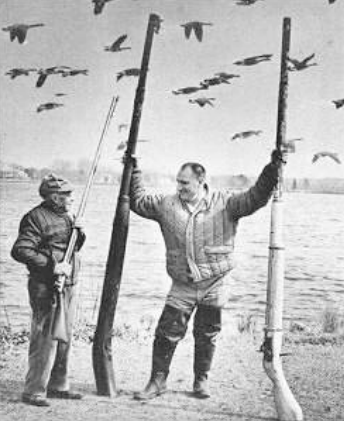
People were already killing Many Birds, but not Enough. “We need to kill WAY MORE BIRDS and FASTER,” they said. So they made These Big Guns.
They were made for mounting on boats, and who gave a damn about ammo? ANYTHING that could presumably maim a duck was a go. They loaded them with pieces of tin, metal, shards of broken glass, ya know. The usual.
Then, at night, during Mating season, they’d go out onto the water, shine a light so that all the ducks raised their heads to investigate, fire the gun, and instantly decapitate hundreds of ducks a shot. It was wild.
So this was happening
And the REASON this was happening was there was a demand for these ducks, feathers, mainly. Meat second.
The demand is what’s imperative here. It didn’t matter if you had the means to kill 100 or 1000 birds in a night. If you shot ‘em, someone would pay for ‘em.
You can see where this started going wrong, however. Eventually, there were like, uh, no birds left to shoot.
So now everyone’s starting to say, “well, what the hell…it seems that shooting All Of The Birds At Once has somehow wiped them out. Maybe we should do something about this.”
NOW, that was NOT a popular move. People were really loving the whole “I can kill anything any time I want” thing going on. They argued that limiting their take would violate their rights and freedoms (never mind the hypocrisy of claiming any rights to the wildlife of this land that had been taken from the indigenous peoples they’d killed and driven out).
But responsible hunters knew that wildlife and hunting laws were imperative to the continued existence of wildlife.
This wasn’t a new concept, mind you. Responsible Wildlife laws are even in the damn Old Testament:
“If you come across a bird’s nest in any tree or on the ground, with young ones or eggs and the mother sitting on the young or on the eggs, you shall not take the mother with the young.” Deuteronomy 22:6
Makes sense, right? Eat the eggs but make sure the mother remains to lay more.
And more than a century before, John Quincey Adams is quoted in reference to the issue:
“I went with my gun down upon the marshes, but had no sport. Game laws are said to be directly opposed to the liberties of the subject; I am well persuaded that they may be carried to far, and that they really are in most parts of Europe. But it is equally certain that where there are none, there is never any game; so that the difference between the country where laws of this kind exist and …where they are unknown must be that in the former very few individuals will enjoy the privilege of hunting and eating venison, and in the latter this privilege will be enjoyed by nobody.”
ANYWAY. Point was, people were realizing that if things didn’t change fast, there’d be nothing left to hunt, to eat, or to use for Fancy Hats.
So we got the Lacey Act of 1900, the first federal wildlife law.
“I have always been a lover of birds, and I always been a hunter as well, for today there is no friend that the birds have like a sportsman-the man who enjoys legitimate sport. He protects them out of season; he kills them with moderation in season.” John Lacey.
It limited market-hunting and commercial wildlife trafficking. People with Super Duck Guns were especially unhappy about this. However, if ducks understood federal laws, they would’ve been thrilled.
The problem was, there was still a HUGE demand for feathers, for meat, and absurdly, for specimen for people’s private collections. “I don’t CARE if that’s the last known living Auk. I want it.”
So they had it.
What we needed to do was to destroy the demand for bird products. And to destroy the demand, we had to stop products from being made. If no one is walking down the street wearing a Fancy Bird Hat, no one else is going to say “oh! I want one too,” and no one is going to pay a Fancy Hat Maker to pay a Big Duck Gun owner to shoot 1,000 birds.
So we got the Migratory Bird Treat of 1918, which made it almost totally across the board illegal to own Any bird parts (excluding legal game birds, but laws about when and how many you could hunt were forming to protect them).
There is a misnomer that taking something off the legal market will increase demand because people love what they can’t have. That’s proven untrue in this case. Very few people are actually willing to break Actual Federal Law in order to own a hat they can’t wear in public. The issue was larger society and for the most part law-abiding citizens who wore this stuff while it was legal but moved on once it wasn’t.
The reason it still exists is to keep the demand for bird parts non-existent, and it’s WHY you can’t legally collect feathers even when they fall off a bird naturally.
Because hey, YOU may live in an area with a healthy golden eagle population. Or a Blue Jay population. Or Red headed woodpeckers. YOU find their feathers all the time! They just fall off, no harm done.
So you pick them up, make them into cool jewelry and art, and post them on your etsy and pinterest.
They’re super popular! People love them!
Now I want in on that business!
But there aren’t many golden eagles, blue jays, or woodpeckers around me, so I don’t find their feathers often. But you know what’s way easier than looking for one, fallen feather? Shooting a bird and getting a lot at once.
And thus an innocent market has once again created an unsustainable demand that will threaten bird populations.
And that’s why it’s just flat out against Federal US law to own, collect, or sell almost any wild bird parts!
And MAKE NO MISTAKE! This law is Very Enforced. Wildlife officers Do pay attention to people talking about collected bird parts, and they Will throw the book at you. The fines are wild. Don’t risk it.
Alaska, Arizona, California, Colorado, honorable mention to Maryland it looks insane but at least you tried, New Mexico, honorable mention to Ohio for thinking outside the box, honorable mention to Oregon for being indecisive, Wyoming, that’s it
Maryland flag best flag
And Hawaii deserves an honorable mention at least.
uh, excuse you, the Texas flag is great? it is like the US flag but Actually Good
here fine full listing of US flags because I apparently have a bunch of Opinions on them
image for reference:
Alabama: it succeeds at being a flag. the designers clearly understood what a flag is supposed to be like. not, like, creative, but it has the essential qualities of a flag. acceptable work, 5/10
Arizona: going for the opposite aesthetic from alaska but doing an excellent job of it. bold, gorgeous, definitely in the style of a flag without just copying from somewhere else. 10/10
Arkansas: flags should not have writing on them. and this isn’t even, like, a motto or something, it is literally the name of your state, in case you forgot. here’s a pro tip: the point of a flag is to stand for the state; that means you don’t have to include the name of the state, the flag serves that purpose already. did not read the assignment, 0/10
California: has the name of the state on it, see arkansas. but one point for putting “california republic” like they’re their own country, b/c that’s fantastic, and one point for the bear. 2/10
Colorado: they’ve got the right spirit, they’re following the principles, they’ve put in the work; it’s just that somehow they ended up with something that looks like a corporate logo. 6/10
DC: this is good, solid work! they understand what they’re going for, and they’ve ended up with something flaglike and original and pretty. it’s not inspired the way, say, alaska is, but it is still A work, if not A+. 9/10
Connecticut: again with the text. you can have one point for having the self-respect to at least put it in latin. 1/10
Delaware: text and a date? you’ve got to be kidding me. next thing you know you’re going to be putting a full MLA citation on your flag. 0/10
Florida: that is not a flag. that is your seal. did not read the assignment, 0/10
Georgia: tons of tiny text??? we asked for a flag not an essay. 0/10
Hawaii: ow. look, you turned in something that actually fulfilled the assignment, at this point i appreciate that, but still. also you put in the union jack. we fought a war to get rid of that, you know. 3/10
Idaho: again, this is not a flag, this is your seal. 0/10
Illinois: text, date, name of state, and it’s your seal, this is like a tour de force of What Not To Do. but the eagle is badass. 1/10
Indiana: augh this was so close to being a really solid flag and then you had to go scrawl your name across it! next time why not just spray-paint indiana was here across it?? 1/10
Iowa: text text text. 0/10
Kansas: again with the seals. 0/10
Kentucky: seal, 0/10
Louisiana: text, but the pelican stabbing itself with its beak is p cool. 1/10
Maine: no, that’s still not a flag, that’s your coat of arms. one point for latin, 1/10
Maryland: uh. wow. well, I appreciate the enthusiasm? and, hey, no text. i will give this a resounding 6/10
Massachusetts: seal. i’d give you one point for latin, but actually this is the one state where having your name in english would have been helpful, b/c seriously, who can spell that? 0/10
Michigan: coat of arms. seriously, what is with this? why did so many states phone this in? did they put off their flag designs until the night before it was due? 0/10
Minnesota: that is, once again, your seal. 0/10
Mississippi: on the one hand, you understand what a flag is. on the other, you have terrible design sense. and what is with the narrow white border around the canton? you don’t need to do that. 3/10
Missouri: look, this would have been a five-out-of-ten flag if you had just stopped when you had a flag instead of adding your seal. and if you’re gonna do latin, commit. 0/10
Montana: thanks for reminding us of your name. 0/10
Nebraska: not only is that your seal, it literally says “seal” right there on it. now your flag says that it’s a seal, right there for everyone to see. how are you not ashamed of yourself? -5/10
Nevada: yep, that’s your name. next time at least center it, jeez. 0/10
New Hampshire: THAT IS YOUR SEAL. IT SAYS SO RIGHT THERE. -5/10
New Jersey: coat of arms. 0/10
New Mexico: YES THANK YOU THIS IS A FLAG. excellent design work! original! very distinctively new mexican! 10/10
New York: coat of arms. one point for latin. 1/10
North Carolina: this would have been a perfectly good flag without your initials and the date. this is not a school assignment you do not need to put those on. 0/10
North Dakota: that’s your name. one point for latin. 1/10
Ohio: you’re thinking outside the box. i can respect that. i’m not sure it’s working for you, but i respect it. and you know what? despite the weird shape, i can still tell it’s a flag, because it’s made like one. not sure this is the one you want to stick with, but i look forward to seeing future work. 7/10
Oklahoma: name, 0/10
Oregon: you … your flag is … two-sided? i … no. no. but, what the hell, i’ll give you one point for sheer audacity. 1/10
Pennsylvania: coat of arms, 0/10
Rhode Island: aww, man, it was going so well until you put on a random “hope”. look, buddy, the point of a flag is you symbolize concepts like hope with imagery and colors. using words is for your state motto. but they are tiny and i feel bad for them, and if i take out “hope” it’s a decent flag. 4/10
South Carolina: okay, so you avoided the obvious pitfalls. no text, no name, no date, no seal, no coat of arms. points for that. but you have two problems. first, images on a flag should be simple. stylized. something you can draw perfectly from memory. that is, like, the least stylized palm tree i have ever seen. second, your flag is butt ugly. 4/10
South Dakota: that is your seal, it says so, and you put your name on twice. seriously. -10/10
Tennessee: you’re in the same boat as colorado, here. you have clearly read the instructions and tried to follow them. it’s just that you ended up with something that looks like the logo for a chain restaurant. 6/10
Texas: okay so i’m biased. but, look, this is A Flag. it is not the work of art that, say, alaska is, but it is practically the platonic example of flagness. there is no text, there is no coat of arms, it is distinctive and has good brand recognition, and it is simple. you can draw it from memory. this is what a flag should be like. this is what the US flag should be like. i mean, fifty stars, really? thirteen stripes? it’s supposed to be an emblem, not a high-resolution photograph. texas has it down. we have had six flags, we have figured this out. i’m not gonna award a perfect score here – much as it pains me, i really do think that alaska and arizona and new mexico have made artistic leaps that texas hasn’t – but it’s only just shy of that. 9/10
Utah: aaand we’re back to seals. the beehive is cute, why couldn’t you use that, it would stylize nicely. 0/10
Vermont: coat of arms. also, your text arrangement is deeply questionable, it looks like it says “freedom vermont and unity.” this would be kinda cool if it were the intention but i am p sure it is not. 0/10
Virginia: seal. one point for latin, two points for being frickin’ badass. 3/10
Washington: dear god why. this is your seal, it says it’s your seal, and not only that, it is a picture of washington. hot tip: portraits: do not go on flags. and not only that, it is a TERRIBLE picture of washington. that is, like, the WORST PICTURE OF WASHINGTON I HAVE SEEN IN MY LIFE. and my mother has a four-foot-high gilt-framed portrait of washington she hung over the dinner table. what were you THINKING. -100/10
West Virginia: that is a seal. also, the border thing looks dumb. 0/10
Wisconsin: name, coat of arms, i would give a point for latin but i am rescinding it for the sheer dumbness of “forward” on the banner there. like, seriously. 0/10
Wyoming: oh for pete’s sake. look, if you’d just stuck with the buffalo, this would be almost a cool flag. but nooo. you had to add your seal. which says seal. and doesn’t even really fit. this is such a trainwreck. -10/10
it looks like we have nearly identical aesthetic criteria for flags, so in consideration of the sheer amount of work you’ve put into this I will allow Texas onto the list, despite the fact that their flag looks like a small child tried to draw the US flag and got bored
Growing up in Maryland (with parents from Ohio), I never caught on to just how many states had “we put our seal on a blue background and called it a day” flags.
The MD flag is from English heraldry – it’s the banner of the first Lord Baltimore. The gold-and-black is the coat of arms from his father’s side; the red-and-white is his mother’s. You would think other states, especially the ones established by European colonists, could’ve dug up something with that level of historical interest.
Have you guys listened to the 99% Invisible episode about flag design? They do the municipal version of “0/10 this is a seal” a whole bunch. It’s fun though, I like Roman Mars


 just moving along like everyone else