Okay, so we’re often led to believe that spiders = the Dark Lords, especially in LOTR, where its like “lol yea spiders just hang around Mordor” and in lore for the Hobbit, too, where its like “lol Necromancer’s land is riddled with em”
but… does he even fuckin’ like the spiders???
We never see him use them. They’re just AROUND. In the shadows. Trailing him, picking on his Orcs as much as anyone else. I mean, he seems to like Shelob? But that doesn’t necessarily mean he likes all the others… Or is this just like… Him being all “fuck it I’m tired of existence, I’ll align myself to the spiders, too… cause you knnow what they threw my master in the Void and drowned me”
I’ve always assumed that since Ungoliant isn’t a creation of Melkor, her brood aren’t even really allies of the Dark Forces. I’ve always seen them as their own faction.
… Spiders keep wanting to be friends with the Dark Forces, and the Dark Forces keep going “EEEW why do you have so many LEGS,” and getting a broom.
Back in the day I think Mr. Melkor-Arachnophobe-Bauglir swore off spiders but realized that little could be done about them and he certainly wasn’t going to try. It’s an interesting implication that the spiders in Middle-Earth are Ungoliant’s spawn- all spiders? were there regular tiny spiders or is every single spider a descendant of Ungoliant that just kept shrinking through time (as is a pattern in ME, sort of everything settling from the Ainulindale aka Big Bang and the universe going from high energy to low energy) until we get modern day lil spiders that are mostly harmless but still hold a tiny bit of TIMELESS VOID ETERNAL DARKNESS in them lmao
Mairon, while more ambitious on that front than Melkor, having not had a near-death experience with one fifty times bigger than your body, still didn’t want to oppose them. It seemed he bartered with Shelob, who canonically was living in Mordor long before Mairon settled there. He managed to strike a deal and keep her happy, and good thing because he wasn’t really in any position to tell her no. How’s about, you do your thing and I do my thing, and if it suits you maybe eat any intruders? Try not to eat my orcs? No? You’ll eat what you want? O-ok, s-sure, that sounds good. Great talk.
While it’s not a coincidence evil spiders and dark lords are found in close proximity, do not mistake correlation for causation! The spiders like the darkness the dark lords made, and occasionally just by doing what they do, prove an asset to Sauron. But no alliances were formed. It’s an uneasy coexistence.
I find it funny that even the dark sides of fantasy don’t like spiders
I think this is how the the sides of Lotr are
The “good” side :Dwarves, Elves, Man, Ents, and Hobbits (and valar)
The “bad” side :Orcs, Morgoth, Sauron, Balrogs, Vampires, Goblins, Ogres, Trolls, Werewolves, monstrous etc. creatures no longer around
The Spider side :Ungoliant, Shelob, all spiders (eat everyone and everything)
the thing about lotr that the movies don’t convey so fully is how the story is set in an age heavily overshadowed by all the ages before. they’re constantly traveling through ruins, discussing the glory of days gone by, the empires of men are much diminished, the elves (especially galadriel) are described as seeming incongruent, frozen in time….some of the imagery is even near-apocalyptic, like the ruins of moria and of course the landscape surrounding mordor
this is a strange thought to me, somehow: that the archetypal “high fantasy” story is set at the point where the…fantasy…used to be much higher? this is not the golden age; this is a remnant
LotR is Mad Max: Beyond Thunderdome of the elves.
i want to emphasize that people have added excerpts of their theses in reply to this post but this is still my favorite reblog
It is the way of my people to use light words at such times and say less than they mean. We fear to say too much. It robs us of the right words when a jest is out of place.
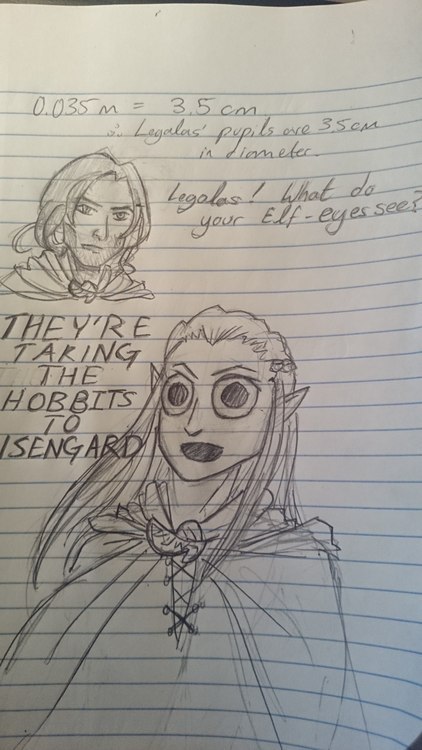
Update: Legolas’ pupils are about 3.5 cm wide each. Now drawing kawaii Legolas on physics assignment.
And they told you science was no fun.
Science!
I’m going to do it. I’m going to hand it in.
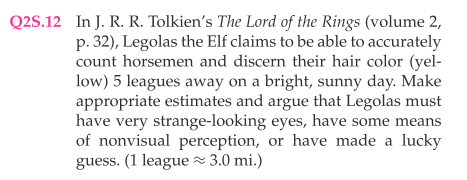
Legolas’s pupil size isn’t the problem here, though. 5 leagues is 17.262 miles. The curvature of the Earth means that for a person of average height, the visual horizon is less than three miles away. Even if your vision is telescopic and the atmosphere is perfectly clear, you can’t see around the planet. If they were standing on a hill, it would have to be at LEAST 198 feet above sea level in order to see the horizon at 17.2 miles away, with nothing tall in between. Which, knowing Rohan, isn’t impossible.
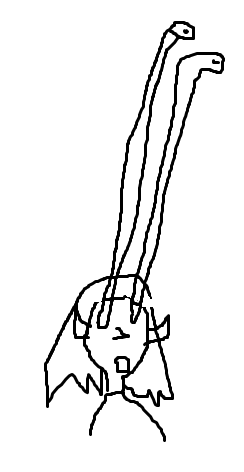
But consider: Elven satellite eyeballs.
you mean like
@sidereanuncia it’s back, the post that I can only imagine haunts your nightmares
I shall never find peace.
Also, for what it’s worth, there’s absolutely no reason to believe that the curvature of Middle Earth is the same as that of Earth.
There’s no evidence that Middle Earth curves.
Yeah there is. The Silmarillion states that the world was curved after the fall of Numenor (I believe), preventing access to Valinor. But Elves (among others) can travel the straight path across it.
So middle earth is round, but not for Elves because magic.
So wait, the reason he can see that far is because Elves just have the ability to ignore the curve of the earth? That’s awesome. It also means that no matter how good your optics got, you would always want elf eyes manning the spyglass because they can see arbitrarily far while everybody else is limited by this ‘horizon’ bullshit.
Oh thank God, my poor elf prince has seen too much in this post
tbh nothing is weirder to me than manly grimdark dudebro lord of the rings bc it’s just??? the epitome of light and love to me???? no narrative embodies hope and gentleness and healing like lotr does why must you insist on talking to me about badass aragorn vs. useless frodo. that’s not the point brad
I feel like this is also why so many of the post-LOTR Tolkien ripoffs are so terrible! It’s people pulling from Tolkien when they fundamentally don’t understand what makes Tolkien work. You get all these stories written by people who don’t think Frodo was worthy of his plotline and so they give it to their Aragorn expy instead, and it’s dull and boring and totally lacks the themes and the heart that make LOTR an important, enduring story.
hey @LEGO take some fucking notes next time you make a halfassed grey and brown adaptation of a beloved franchise that people have been asking for years
I really like @greyacedipperpines tagcomment here; I mean all the comments are good, but the bit about beauty is one I think some people miss. One of the most persistent complaints I see about LotR and the Hobbit is all the ink Tolkien spends describing the world, food/the feeling of eating, objects, ect. What those complaints don’t get is that those descriptions of all the beauty and simple joy to be found in the world, even in the midst of hardship and strife, are central to the story’s message.
It sure is convenient that all these songs that ostensibly weren’t written in English all rhyme when translated into English, isn’t it, Mr. Tolkien?
yknow what really bothered me for some reason?? he used ‘loud as a train’ or smth similar to describe the balrog’s roar. like, no ok so y’know if this is supposed to have been ‘translated’ like you tell us, then wouldn’t it have been smth other than a train, like a waterfall? idk it just really bothers me
Clearly he was talking about the train of Glorfindel’s robes which as everyone knows are covered in bells and jingle
1. I mean, he invented the languages he was going to translate, so if a rhyme didn’t work he could change the whole language if he wanted to. But actually, it’s not uncommon for translations (particularly older translations) to try to preserve or at least recreate rhyme schemes. For example, Tolkien translated “Pearl” into rhyming Modern English.
2. The train thing! It’s actually related to how Tolkien presents the hobbits as essentially “modern” characters who then go out and have adventures in the old heroic culture of myth and legend. As Tolkien says, “[The Shire] is in fact more or less a Warwickshire village of about the period of the Diamond Jubilee…” (Letters, 230, #178). It’s very deliberately a part of the language. Think of all the modern, non-medieval things the hobbits have. It’s always a contrast between Modern English (Shire) and Old English (rest of Middle Earth). Even though Tolkien changed some foreign names to make them seem English, the hobbits still have
tobacco (pipeweed), a New World crop
drink tea in the modern English way
potatoes, another New World crop, made more English-sounding as “taters”
rabbits/coneys, which were imported to England in the 13th century
a regular postal service
mantelpiece clocks!
It was a deliberate choice that gave readers us a group of characters who can serve as tour guides to a mythical medieval adventure. Tom Shippey explains it better than I ever could:
…There is one very evident obstacle to recreating the ancient world
of heroic legend for modern readers, and that lies in the nature of
heroes. These are not acceptable any more, and tend very strongly to be
treated with irony: the modern view of Beowulf is John Gardner’s novel Grendel (1971). Tolkien did not want to be ironic about heroes, and yet he
could not eliminate modern reactions. His response to the difficulty is
Bilbo Baggins, the hobbit, the anachronism, a character whose initial
role at least is very strongly that of mediator. He represents and often
voices modern opinions, modern incapacities: he has no impulses towards
revenge or self-conscious heroism, cannot ‘hoot twice like a barn-owl
and once like a screech-owl’ as the dwarves suggest, knows almost
nothing about Wilderland and cannot even skin a rabbit, being used to
having his meat ‘delivered by the butcher ready to cook’. Yet he has a
place in the ancient world too, and there is a hint that (just like us)
all his efforts cannot keep him entirely separate from the past.
…
Bilbo’s behaviour is solidly anachronistic, for he is wearing a jacket, relying on a written contract, drawing a careful distinction between gain and profit, and proposing a compromise which would see Bard’s claim as running expenses (almost tax deductible). Where Bard and Thorin used archaic words (‘Hail!’, ‘foes’, ‘hoard’, ‘kindred’, ‘slain’), he uses modern ones: ‘profit’, never used in English until 1604, and then only in Aberdeen; ‘deduct’, recorded in 1524 but then indistinguishable from ‘subtract’ and not given its commercial sense till much later; ‘total’, not used as here till 1557; ‘claim’, ‘interest’, ‘affair’, ‘matter’, all French or Latin imports not adopted fully into English till well after the Norman Conquest. It is fair to say that no character from epic or saga could even begin to think or talk like Bilbo.
Basically, if Tolkien does a thing with words, there’s always a very good chance that the professor was having fun with language, and doing it very consciously (see: Mount Doom, name of).
And furthermore, the entire conceit behind the books is that they’re translated into English from the “original” Westron of the Red Book, meaning that a ‘modern’ translator could do whatever he wanted with the language to make it work for the equally modern audience while preserving the same feel/meaning. Heck, even the characters aren’t named what you think they are (Merry, for instance).
LotR is actually the story of Maura Labingi, Banazîr Galbasi, Ranazur Tûk and Kalimac Brandagamba. Maura lived at Laban-nec, but left Haubyltalan and Sûza altogether, first aiming for a hill-town just outside Sûza but eventually for Karnigul (or, in Elvish, Imladris). Maura’s older cousin and dearest friend (in one person) Bilba Labingi lived in Karnigul at that point.
The extent to which Tolkien goes to present LotR as an edited mediaeval text is actually DELIGHTFUL and also ABSURDLY GREAT; the prologue is actually a provenance and edition litany, explaining which recension of The Red Book he was working from in order to explain its likely oddities and inclusions (or exclusions).
I have often actually wanted an edition with all known or reasonably extrapolated Westron put back in, because I’m really curious how it would read.
It’s actually very cool how things were translated into what modern Anglophonic readers would parse as “normal” fantasy-names as opposed to like. Aragorn, or Thranduil, or Ecthelion, or Elbereth Gilthoniel. The untranslated names of the Hobbits fit much more neatly into the phonetic flavor of the Adûnaic that becomes the ‘Common Speech’ or ‘Westron’ in the Third Age (and which gives us names like ‘Tar-Minyatur’ and ‘Ar-Pharazôn’ and ‘Akallabêth’), but those names would be tonally jarring in an otherwise translated text.
That’s also why the Dwarves have names like ‘Dwalin’ and the Rohirrim… have… pretty much any names at all. Since the Professor was translating the affect of the Hobbit names into modern English and was also a linguistics nerd, he preserved the linguistic relationship between Westron, Dalish, and Rohirric by translating them as the equally-ish related Modern English, Old Norse, and Old English (not that literally anyone but him would probably actually notice, but.)
 just moving along like everyone else