Anyone who knows me could tell you I’m no kind of artist. However, as a professional project manager, I frequently work with artists, and one of the most frequent challenges we end up dealing with is lost work due to technical issues, unforeseen circumstances, or just plain carelessness. I’ve seen projects that have lost dozens, in some cases literally hundreds of hours due to lost or damaged artwork needing to be redone – which isn’t great news for either a budget or a timeline!
Of course, this is an even bigger issue for artists who are working solo, since you typically won’t have anything to fall back on when things go south. Lost or damaged art may set back a big project’s timeline, but when you’re working for yourself, it can be an absolute show-stopper; most solo projects that suffer significant lost work never recover at all. So here’s a basic disaster mitigation and recovery plan that anybody with a working computer can set up:
1. Sign up for a Google account if you don’t already have one. The free version gets you 15GB of storage, which should be more than enough for your current projects unless you’re working with ungodly huge files; if you are, the 100GB version is only like twenty bucks a year.
2. Download and install the Google Drive sync client – I believe they’re calling it “Drive Everywhere” these days.
3. Set up a special folder on your hard drive that you’re going to keep all of your working files in, and point the sync client at that folder.
4. Configure your art program to autosave every 20 minutes or so. How exactly you do this will vary depending on the program you’re using – you can Google for instructions easily enough.
Blam. Now you have continuously updated offsite backups; hard drive crashes, lost media, or even – heaven forfend – stolen equipment will no longer wipe out your work in progress.
Plus, go into the web console for your Google Drive and right-click a file. See that menu option that says “Manage Versions”? That’s right: Google Drive keeps separate copies of every individual version of the file that’s ever existed (or for the past 30 days, if you’re using the free version). Unwittingly saved over your lineart two hours ago? Working file irrecoverably corrupted because your questionably legal copy of Photoshop barfed? No problem: just walk backwards through your version history until you find a version that’s still good.
Now, this is by no stretch of the imagination a particularly robust offsite backup and version management scheme – I’d certainly recommend additional measures for anyone who’s doing digital art as their regular paying gig – but it’s better than nothing, and it has the benefits that a. it requires no particular expertise to set up, and b. it’s free.
you’re allowed to say “no”. you’re allowed to say “i’m not comfortable with this”. you’re allowed to say “please leave”. you’re allowed to say “no, i don’t want to talk to you”. anyone who acts like they’re entitled to your body, time or attention thinks they somehow own you. and they really don’t.
When you are writing a story and refer to a character by a physical trait, occupation, age, or any other attribute, rather than that character’s name, you are bringing the reader’s attention to that particular attribute. That can be used quite effectively to help your reader to focus on key details with just a few words. However, if the fact that the character is “the blond,” the magician,” “the older woman,” etc. is not relevant to that moment in the story, this will only distract the reader from the purpose of the scene.
If your only reason for referring to a character this way is to avoid using his or her name or a pronoun too much, don’t do it. You’re fixing a problem that actually isn’t one. Just go ahead and use the name or pronoun again. It’ll be good.
honestly i couldn’t care less about wether or not my ships become canon i just ship whatever i want cause i wanna. i don’t need “evidence” or “subtext” maybe i just think jarjar binks and jabba the hut would have good chemistry together i ain’t gonna write an essay defending it let me have a good time leave me be
Albert grunted. “Do you know what happens to lads who ask too many questions?”
Mort thought for a moment.
“No,” he said eventually, “what?”
There was silence.
Then Albert straightened up and said, “Damned if I know. Probably they get answers, and serve ‘em right.
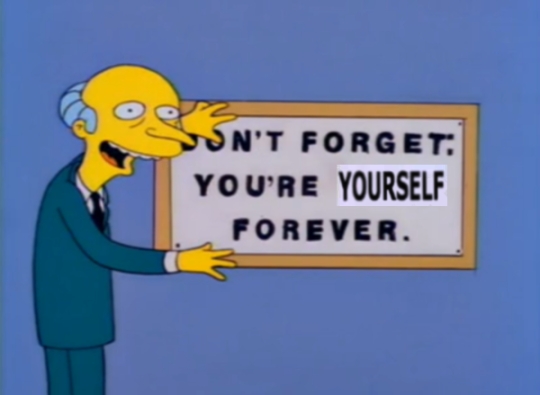
It’s okay to draw fanart and write fanfiction that appeals to you, and you alone.
You’re allowed to ship whatever you want. Let me repeat this for emphasis: YOU ARE ALLOWED TO SHIP WHATEVER YOU WANT PERIOD.
Your own enjoyment and entertainment are valid reasons to write, draw, or consume something.
If this enjoyment takes the form of sexual gratification, that’s also a valid reason to writer, draw, or consume something.
Fiction does not have to be morally pure. Fiction allows us to explore things that we wouldn’t want to experience in real life, things like violence, sexual violence, drug abuse, sexual taboos, or kinks: all kinds of weird or disturbingt things, and that’s okay.
No, the narrative does not have to condemn these things explicitly.
You don’t owe other fans an explanation or apology for the things you enjoy in fiction
If someone asks you to reveal personal information, it’s okay to tell them to fuck off.
There’s no such thing as a fandom police. Whoever claims to have the authority to tell you what is or isn’t acceptable for you to enjoy, is just arrogating that right. Their strategy only works if you let them have this power, so don’t.
It’s up to each person individually to create a “safe space” for themselves.
Other people’s mental health is not your responsibilty.
Not wanting to hear about anyone’s personal trauma does not make you a bad person.
it is admirable to want to help people with your work, but you’re allowed to do work that only benefits yourself. in fact, a certain amount of self-serving activity is necessary for your mental health. write what you like, because you like it.
Why does everyone say that they played someone ‘like a fiddle’? Fiddles are actually pretty difficult to play? Why not say ‘I played him like a recorder’? ‘Like a xylophone’? ‘Like a triangle’?
I think it’s got to do with detail and subtlety. If you play someone like a fiddle, that’s like, Iago or some shit. If you play someone like a triangle, you just told them there was free food somewhere when there wasn’t.
I’ve once read the following exchange:
“You played me!”
“Like the cheap kazoo you are.”
Which in my books is a pretty epic burn if we’re going to be making musical comparisons.