Yeah, that is a good question – why do some scifi twist endings fail?
As a teenager obsessed with Rod Serling and the Twilight Zone, I bought every single one of Rod Serling’s guides to writing. I wanted to know what he knew.
The reason that Rod Serling’s twist endings work is because they “answer the question” that the story raised in the first place. They are connected to the very clear reason to even tell the story at all. Rod’s story structures were all about starting off with a question, the way he did in his script for Planet of the Apes (yes, Rod Serling wrote the script for Planet of the Apes, which makes sense, since it feels like a Twilight Zone episode): “is mankind inherently violent and self-destructive?” The plot of Planet of the Apes argues the point back and forth, and finally, we get an answer to the question: the Planet of the Apes was earth, after we destroyed ourselves. The reason the ending has “oomph” is because it answers the question that the story asked.
According to Rod Serling, every story has three parts: proposal, argument, and conclusion. Proposal is where you express the idea the story will go over, like, “are humans violent and self destructive?” Argument is where the characters go back and forth on this, and conclusion is where you answer the question the story raised in a definitive and clear fashion.
The reason that a lot of twist endings like those of M. Night Shyamalan’s and a lot of the 1950s horror comics fail is that they’re just a thing that happens instead of being connected to the theme of the story.
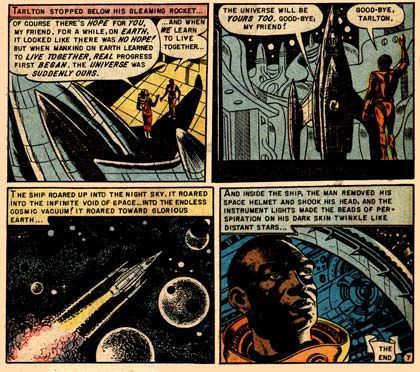
One of the most effective and memorable “final panels” in old scifi comics is EC Comics’ “Judgment Day,” where an astronaut from an enlightened earth visits a backward planet divided between orange and blue robots, where one group has more rights than the other. The point of the story is “is prejudice permanent, and will things ever get better?” And in the final panel, the astronaut from earth takes his helmet off and reveals he is a black man, answering the question the story raised.
IIRC “Judgment Day” was part of the inspiration for the excellent Star Trek: Deep Space Nine episode “Far Beyond the Stars.”
It’s fine if you want to avoid certain content, it’s fine if you don’t want to consume content that makes you uncomfortable, it’s fine if you blacklist the content and/or dont follow people who post it.
But what ain’t okay is telling other people they cannot consume it because it makes you uncomfortable. It isn’t okay to tell other people that they cannot create that type of content because you don’t want to see it.
Okay but OP, is this about actually generally “nonharmful” stuff – e.g. rarepairs – or about stuff like incest, pedophilia, abuse, rape, and so on?
I keep seeing posts like this and they keep being about the latter and I refuse to uncritically reblog them.
This is about any type of manner of fiction.
re: your tags, the only things that hurt real people are actions that are taken out on real people. If I stab a real person obviously the action is harmful because it hurts a real person directly and a real person is suffering consequences of an action that I directly forced upon them.
In fiction, a character being stabbed doesn’t hurt anyone because the character is not real. They’re fictional. Lines on paper, ink on paper, etc. they have no bearing, no rights, etc. in the world full of real people. They are tools meant and used for creation and content.
The idea that fiction is on the same level as real people is harmful because then people start caring more about the lives of characters than they do real people. There have already been incidents recorded of parents forgetting to feed their infants because they were too busy caring for a virtual baby or playing video games.
If someone wants to write a story that contains rape, they’re free to right that because it is fiction.
If you don’t want to read that story, you’re free to blacklist, not read, and avoid it.
I used to think tension and conflict were the same thing. I mean don’t they go together?
Well, a lot of the time they do, but it’s entirely possible to have one
without the other. They often go hand-in-hand, but they aren’t the same
thing. Conflict doesn’t necessarily equal tension, and tension doesn’t
equal conflict.
Lately I’ve been editing stories that seem to have so much conflict and
no tension! I don’t care about the conflicts. I don’t care about the
characters. Because there is no tension.
Tension isn’t the conflict.
A couple of months ago, I wrote this post on Mastering Stylistic Tension. In the comments, Becca Puglisi said:
I learned a long time ago that while conflict and tension are often
considered to be synonymous, they’re different. Tension is key for
winding up the character’s—and therefore the reader’s-emotions.
I admit that for some reason I read it as “Tension is the key for
winding up,” and my mind filled with an actual image of a key winding
something up. Tension winds up. Conflict is problems that collide.
Tension doesn’t need problems to collide, tension is often the promise or potential for
problems colliding. My oldest brother pointed out that there are action
movies that have conflict after conflict, but no tension. They are a
spectacle–blasts, explosions, fire. Then, he went on to say, there are
movies like Jaws that have scenes that work largely off tension.
I said in my Mastering Stylistic Tension post, “In some ways, it’s not the conflict itself that draws readers in, it’s the promise of conflicts,” which is often the tension.
Tension invests us personally in the story. We feel it. It’s
anticipation, it’s hope or dread for what will happen. It’s a tangible subtext or undercurrent for what could happen.
Tension is defined as a straining or stretching; intense suppressed emotions.
Conflict means “to come to a collision;” to fight or contend.
So tension may suggest a conflict, but it is not the conflict itself.
Conflict may be an object, but tension is the key winding it up.
Sometimes writers try so hard to put in so much conflict to make their
stories interesting when what their story needs is tension for the
conflicts they already have.
I’ll give an example from my own experience.
Last year I was working on a sequence of flashbacks for my novel. While
not the main purpose of the flashbacks, it was important that I
illustrate a romantic relationship in them, because the relationship
itself is important to a main character and what happens in the present
timeline. I was stuck trying to figure out how to communicate the
uniqueness and complexity of the relationship in such a short space. In
an old, old version of this story, I had planned to use a lot of
romantic gestures to convey the relationship, but in working on these
flashbacks, I realized that the romance and the conflict it brought
(which deals with “forbidden love”) wasn’t as powerful as the tension it could have.
I scrapped the idea of the characters touching and kissing, and instead focused on their powerful desires to touch and kiss when they weren’t allowed or able to; I gave one of
the characters a particular reason and a personal commitment to not give
the other affection.
The scene immediately became more interesting. The tension was palpable,
their desires electric, but because they could not give into their
desires, the tension couldn’t release, regardless of how much they or
the audience wanted it to.
The conflict is forbidden love, but the tension is held in the drawn out moments of a desire that can’t be manifested.
This is one of the reasons that sexual tension can be so powerful in
stories. It’s not the colliding problems that come with being with that
person, it’s the subtext and undercurrent of wanting to be with that
person, but not being with them. Once the couple is together, that
tension ends.
Likewise, some of the best dialogue comes from tension, not straight-up
conflict. It comes from subtext, from what’s not being directly said.
Once the dialogue becomes direct, the tension ends and the problems
collide in conflict. Tension often comes before direct conflict. And if
that isn’t happening much in your story, it should.
As Mindy Kaling once explained, sometimes the best tension comes from
the characters trying to avoid conflict, from them trying to stop it
from bubbling out into the open. The closer the conflict gets to the
open and the harder a character tries to stop it, the stronger the
tension gets. It winds up, tighter and tighter. We as an audience
anticipate its release.
That’s what draws a reader into the story.
So make sure that your story has tension and conflict, and not just one
or the other. If you have a story with a bunch of conflict, but your
readers aren’t interested, you may need more tension. If you only have
tension and no conflict, the reader may end the story feeling cheated.
Use both.
1. Seeing success as being determined by external factors. (So if I fail it’s circumstances or someone else’s fault.) This takes away my sense of power and keeps me stuck in failure and helplessness.
2. Personal blind spots. Sometimes we keep failing but we’re blind to the fact that there’s something we’re doing that is causing us to fail. That could be related to our communication style, our attitudes, lack of knowledge and ability, pursuing something that doesn’t suit our gifts and talents, and so on.
3. Self sabotage. Sometimes we don’t feel we deserve to succeed so unconsciously we do something that causes us to fail. This includes meditating on self-limiting thoughts (Eg, “I could never …; I don’t deserve …”).
4. Feeling ambivalent about the goals you’ve set. We often set a goal that is someone else’s goal so we’re not really sure if it’s what we want ourselves. That affects our motivation, and our will to succeed.
5. Fear of change. All successes bring some change – and that can feel quite threatening. And we’re often comfortable with our life as it is now – and so we wonder if success will really make us happier.
6. Pressure from others who don’t want you to succeed. It’s very common for our peers to be threatened by success, and we know they’ll be sarcastic or mean if we succeed. Hence, we don’t try our hardest as we recognise the cost will be social isolation, or rejection by our friends.
“When you meet me don’t be ill at ease. It will help both of us if you remember these simple points of courtesy:
I’m an ordinary person, just blind. You don’t need to raise your voice or address me as if I were a child. Don’t ask my spouse what I want–“Cream in the coffee?”–ask me.
I may use a long white cane or a guide dog to walk independently; or I may ask to take your arm. Let me decide, and please don’t grab my arm; let me take yours. I’ll keep a half-step behind to anticipate curbs and steps.
I want to know who’s in the room with me. Speak when you enter. Introduce me to the others including children, and tell me if there’s a cat or dog.
The door to a room or cabinet or to a car that is left partially open is a hazard to me.
At dinner I will not have trouble with ordinary table skills.
Don’t avoid words like “see.” I use them too. I’m always glad to see you.
I don’t want pity, but don’t talk about the “wonderful compensations” of blindness. My sense of smell, taste, touch or hearing did not improve when I became blind, I rely on them more and, therefore, may get more information through those senses than you do–that’s all.
If I’m your houseguest, show me the bathroom, closet, dresser, window–the light switch too. I like to know whether the lights are on or off.
I’ll discuss blindness with you if you’re curious, but it’s an old story to me. I have as many other interests as you do.
Don’t think of me as just a blind person. I’m just a person who happens to be blind.
You don’t need to remember some “politically correct” term, “visually impaired”, “sight challenged” etc. Keep it simple and honest, just say blind.
In all 50 states the law requires drivers to yield the right of way when they see my extended white cane. Only the blind may carry white canes. You see more blind persons today walking alone, not because there are more of us, but because we have learned to make our own way.”
I never thought about it before, but this is a reason to hate the light switches where there’s two switches, and the light’s state will depend on both.
And yes, be aware that about 90% of the usage of “see” in English is metaphorical and people will understand this, in general.
“if somebody becomes panicked when you accuse them of lying theyre obviously not telling the truth” shut up ugly im a survivor who got punished for shit i never did all the time of fucking course im gonna panic when im blamed for something i didnt do
since this post is actually getting attention rn i really want to emphasize this-
many of the “tells” of lying are traits commonly found in abuse survivors and mentally ill/disabled people.
stuttering, averting eye contact, panicking, raising your volume, fidgeting, and other similar traits are actions performed commonly by these groups, especially in situations of heavy stress- such as being accused of doing something we didnt do, especially if we are afraid of being punished for doing nothing.
im honestly begging people to think critically when accusing somebody of lying for small traits like these.
Also I don’t know how common it is in autistic adults or if its just me but avoiding eye contact is supposed to be a tell. Or muttering or trailing off. But like??? I will personally just never look people in the eye. It makes me uncomfortable and there’s nothing about looking in a person’s eyes that really holds my attention. Like all this shit youre supposed to see in a person’s eyes I just don’t see. And I trail off and jump around in what I say and stutter and just my speech patterns are very sporadic and a lot of people will ask me if I’m lying if I change how I talk? But that’s really just me being strange. Don’t know if this happens to other people though
i experience this exact thing and its so frustrating when people say im lying because of it
There’s also a lot of cultures where it’s rude to look people in the eye. I’ve known a few students from Sudan that would avoid looking teachers in the eye and the teachers would always assume they were up to something and blame them on things they obviously had no part in. Just because someone avoids eye contact or anything else that seems rude or guilty to YOU doesn’t mean they are.
^^^^ this too!!
It’s also a CPTSD thing. If you were punished as a kid for “looking at people funny”, not appearing submissive enough, etc., submissively averting your eyes becomes a learned habit that’s hard to break. Especially when dealing with authority figures or otherwise under pressure.
As an undiagnosed dyslexic in school, I can attest that authority figures terrify me because it didn’t matter how much I tried to do what was asked of me, I always tripped up in some way.
I scored perfectly on a text once, and was marked down 20% for poor handwriting.
There was always a sword of Damocles hanging over my head just waiting to fall, and that mindset hasn’t changed today. Whenever dealing with authority figures I’m always waiting for that sword that I can’t see, to fall.
When I pass a speed camera, I’d like to go 5 miles under the limit because what if the speedometer is wrong? It should be correct but experience has taught me that “should be” means shit. But going that slowly pisses drivers behind me off, so the balance I strike upsetting the police and upsetting other drivers is to do 2.5 miles under the speed limit.
and those ‘lie tests’ never take into account that habitual liars are good at lying. you can learn how to sound sincere and convincing: you answer things in a calm, confident tone while looking straight at your questioner, or maybe you sound just a bit surprised, like you don’t know why you’re being questioned about such a silly thing. or you sound careless. or you sound interested in helping someone figure out the truth, and helpfully suggest that someone else should get in trouble. if you need more time to think up a lie, you just casually ask them to help you jog your memory. you can get questioners to help you craft your lie, and they’ll be even more convinced because they know the parts they contributed are true. there’s a ton of ways to get away with lying.
people who freak out, stammer, avoid eyecontact, could be scared and guilty for a ton of reasons. but it’s almost definitely not because they’re liars. liars are smooth.
A lot of the advice I got about learning to enforce my boundaries was framed as an adversarial thing. Like, ‘yes, it might upset and disappoint the people around you, but you have to learn to tell them ‘no’ anyway.’ At best, ‘good people will still like you if you enforce your boundaries’.
What I wish I’d been told is that good people will think it’s awesome that you enforce your boundaries, that there are people who will respect the hell out of you for it, that there are people who will admire you not despite you telling them no, but because of it. That most people don’t want to make you do something you don’t enjoy,and so they’ll actively be happier and more relaxed around you if they know they can trust you to decline to do things you don’t enjoy and to ask them to stop things that bother you.
It helped me a lot, personally, to stop thinking of ‘enforcing my boundaries’ as something I did for me and more as something I did to empower the people I was close with, to build a situation where they and I felt sure everything that was going on was something we all wanted.
Most advice isn’t good for everyone and this advice seems maybe bad for people in abusive situations, because sometimes you do need to learn to enforce boundaries against people who will try to violate them. But if there are other brains like me out there: your partner will be really happy you can say no to them. your friend will be really happy you change the subject when you hate it. your roommate will really appreciate that you tell them to turn down the music. most people will feel safer and more comfortable around you if they know you’ll reliably express your needs, AND they’ll feel better about voicing theirs.
Tru fax.
I had a friend tell me that they really admired me for going “hey, I love you guys, but I need to go sit in a room by myself and read for an hour”. So yes, don’t be afraid of setting your boundaries!
And for people like me, who are very very VERY bad with things like unspoken clues to the fact that someone wants me to do/not do something or whatever? It is such a relief not to have to be constantly worried that I’ll do something that will make them not want to hang out with me anymore.
I’ve lost friends because they never tried to enforce their boundaries and as a result I had no idea I was trampling right over them until they got to a point where they couldn’t handle it anymore, and it is an AWFUL SHITTY FEELING knowing you’ve done that to someone.
Please please please enforce your boundaries with me. I promise I will love you for it.
This is so, so, SO important, people.
I am both bad at enforcing my boundaries and constantly scared of stomping over other peoples. It makes me feel safer if I know you can say No to me. I don’t know why it never occurred to me that others would feel safer if they knew I could say No as well.
i CONSTANTLY present suggestions to new friends as ‘you can say yes or no, it’s fine’ until i’m sure they’re the kind of person who isn’t scared to say no. only then i can relax around them and know i’m not gonna mess them up on accident! let your friends know how to take care of you, they’ll appreciate it.
another way to think of it is making yourself more trustworthy – i sometimes find it hard to trust what people say until they demonstrate they won’t lie and say they’re okay with something when they’re not
According to the CDC, in 10 percent of those drownings, the adult will actually watch the child do it, having no idea it is happening. Drowning does not look like drowning—Dr. Pia, in an article in the Coast Guard’s On Scene magazine, described the Instinctive Drowning Response like this:
“Except in rare circumstances, drowning people are physiologically unable to call out for help. The respiratory system was designed for breathing. Speech is the secondary or overlaid function. Breathing must be fulfilled before speech occurs.
Drowning people’s mouths alternately sink below and reappear above the surface of the water. The mouths of drowning people are not above the surface of the water long enough for them to exhale, inhale, and call out for help. When the drowning people’s mouths are above the surface, they exhale and inhale quickly as their mouths start to sink below the surface of the water.
Drowning people cannot wave for help. Nature instinctively forces them to extend their arms laterally and press down on the water’s surface. Pressing down on the surface of the water permits drowning people to leverage their bodies so they can lift their mouths out of the water to breathe.
Throughout the Instinctive Drowning Response, drowning people cannot voluntarily control their arm movements. Physiologically, drowning people who are struggling on the surface of the water cannot stop drowning and perform voluntary movements such as waving for help, moving toward a rescuer, or reaching out for a piece of rescue equipment.
From beginning to end of the Instinctive Drowning Response people’s bodies remain upright in the water, with no evidence of a supporting kick. Unless rescued by a trained lifeguard, these drowning people can only struggle on the surface of the water from 20 to 60 seconds before submersion occurs.”
This doesn’t mean that a person that is yelling for help and thrashing isn’t in real trouble—they are experiencing aquatic distress. Not always present before the Instinctive Drowning Response, aquatic distress doesn’t last long—but unlike true drowning, these victims can still assist in their own rescue. They can grab lifelines, throw rings, etc.
Look for these other signs of drowning when persons are in the water:
Head low in the water, mouth at water level
Head tilted back with mouth open
Eyes glassy and empty, unable to focus
Eyes closed
Hair over forehead or eyes
Not using legs—vertical
Hyperventilating or gasping
Trying to swim in a particular direction but not making headway
Trying to roll over on the back
Appear to be climbing an invisible ladder
So if a crew member falls overboard and everything looks OK—don’t be too sure. Sometimes the most common indication that someone is drowning is that they don’t look like they’re drowning. They may just look like they are treading water and looking up at the deck. One way to be sure? Ask them, “Are you all right?” If they can answer at all—they probably are. If they return a blank stare, you may have less than 30 seconds to get to them. And parents—children playing in the water make noise. When they get quiet, you get to them and find out why.
Can I just say thank you to OP for putting such a detailed description on this?
I’ve been a lifeguard for 6 years now and of all the saves I’ve done, maybe two or three had people drowning in the stereotypical thrashing style. And even those, like the save I made last weekend, it was exactly like OP describes where the person’s head is going in and out of the water but it isn’t long enough to get any air. Mostly you recognize drowning by the look on someone’s face. If someone looks wide eyed and terrified or confused, chances are they’re drowning. That look of “oh shit” is pretty easily recognizable. And even if you can’t tell for sure: GO AFTER THEM ANYWAY. I’ve done “saves” where a kid was pretending to drown and I mistook it for real drowning, but that’s preferable to a kid ACTUALLY drowning.
Also please remember that even strong swimmers can drown if they have a medical emergency, get cramps, or get too tired. If your friend knows how to swim but they’re acting funny get them to land. And even if someone can respond when you ask them if they need help, if they say they do need help? GO HELP THEM.
However . If the victim is a stranger, I can’t recommend trying to get them. Lifeguards literally train to escape “attacks,” because people who are drowning can freak the fuck out and grab you and make YOU drown as well. If you do go in after someone, take hold of them from the back and talk to them the whole time. IF YOU ARE GRABBED: duck down into the water as low as you can get. The person is panicking and won’t want to go under water and should release you. Shove up at their hands and push them away from you as you duck under. Don’t die trying to save someone else.
Please guys, read and memorize this post. Not all places have lifeguards. Being able to recognize drowning is such an important skill to have and you can save someone’s life.
Okay, but…..do you want a friend? Are you worried about not having any friends because you’re feeling isolated and lonely, and aren’t sure how to make connections outside of high school/college? Or because Friends and How I Met Your Mother paint your early 20s as an era where you basically live out of someone else’s apartment?
I mean—look, am a big proponent of having the social life you want. For me, I really don’t need that much social interaction. I have my colleagues at law school or at work, my family, and then a couple close friends from college who I mostly talk with by phone. That more than covers my bases. More social interaction than that and I am exhausted and cranky and have to curl up and be alone for a few days. I have to talk myself up to networking, and I tend to make very shallow friendships.
On the other hand, my best friend is a consummate networker—she’s always happy to meet new people, get together with them for various reasons, do little things with them. (She once offered to go grocery shopping with me. Not because she needed anything, just because I was going grocery shopping and we could spend time together. I swear, I stared at her like she’d offered to perform a tracheotomy with a rusty spoon.)
Both of us would be miserable if we had to switch places.
I just mention this because you didn’t actually say whether you genuinely want friends, if you’re interesting in putting in the work it takes to actually find new people and spend time with them. “I feel like I should have more/deeper friendships,” when you’re content with the relationships you have isn’t actually a good reason. And if you are content, then there’s your answer—you’re not in a place where you’re going to develop deep friendships right now.
Kids. Teenagers. As someone staring 40 in the face lemme tell you a thing.
You are going to be horrified and embarrassed at some point by the shit you are doing now.
And you are going to wish with all your might you’d done more of it.
You’re gonna wish you had more selfies, more photos, more videos being dumb with your friends. You’re going to wish you’d had your hair even higher or your shoes even sparklier.
Go. Document the shit out of your ridiculous life. Fuck trends but if you wanna be trendy, go all in. Fuck in-groups and subcultures but if one sings to you, do it all. Be exactly as cool or punk rock or goth or fandom or country or hardcore or hip hop or whatever, and don’t let anyone tell you differently.
Just don’t hurt people. That’s the only thing you’ll ever genuinely live to regret.
yep. what they said.
i’m 44 now, and i’ve lived a hell of a life. lived it full-tilt, balls to the wall, pedal to the metal. made a lot of noise. things i regret:
not wearing my knee braces religiously after i tore up my knees playing soccer, so the damage became permanent
not taking a gap year before college
being kind of a dick to some people i dated
not being more involved in my little brother’s life as he became independent
things i don’t for one second regret:
being noisy
taking up space
experimenting
traveling
wearing weird shit
making friends with every rando
going to rock shows even when i was broke
generally being a human explosion
one big reason why i’m so contented with my life now, being the mellow local bear dad in my cozy small town world, is because i kicked out the jams when i was young and held nothing back. i kinda feel like i’ve earned my chill.




 just moving along like everyone else