Okay, folks. So. Tumblr’s jumped the shark in a big way, and I’m not even just talking about indiscriminately blocking all “adult” content on a platform that IS, in fact, primarily 18+.
Many blogs, like the wonderful @blackkatmagic , that are not especially NSFW have vanished.
(And I for one LIKE being able to go to curated porn blogs run by actual people and have a chance of finding stuff to my taste, it was one of the things that kept me on this hellsite, but that’s another issue entirely.)
I know lots of people are talking about migrating, but none of us are sure to where yet. Pillowfort seems to be an option, some people are talking about Twitter. But for now, it’s a mess, and even if we knew where we were going, it’s often a huge process, and a lot of us have stuff on tumblr that ONLY exists there.
One possible quick solution to save your blogs, both NSFW and personal, is to import it to WordPress. I found this solution through from frantic googling on how to save an entire blog, text posts an all. There are several apps for downloading all the pictures from a tumblr, (Plently for Windows, but only a few paid ones for mac, of which Tumbelog Picture Downloader is working for me so far) but this is the only solution I’ve seen so far that allows you to save EVERYTHING. I downloaded my NSFW blog in like 10 min. My regular blog, which is significantly larger, is in the process of importing, but I don’t anticipate any problems. I will, of course, update you if I have any.
This tutorial I found worked really easily. http://quickguide (.) tumblr (.) com/post/39780378703/backing-up-your-tumblr-blog-to-wordpress
I put parenthesis around the .’s like we’re back in FF-Hell, just in case tumblr’s new thing about outgoing links kicks in. You know what to do.
To break it down, just in case:
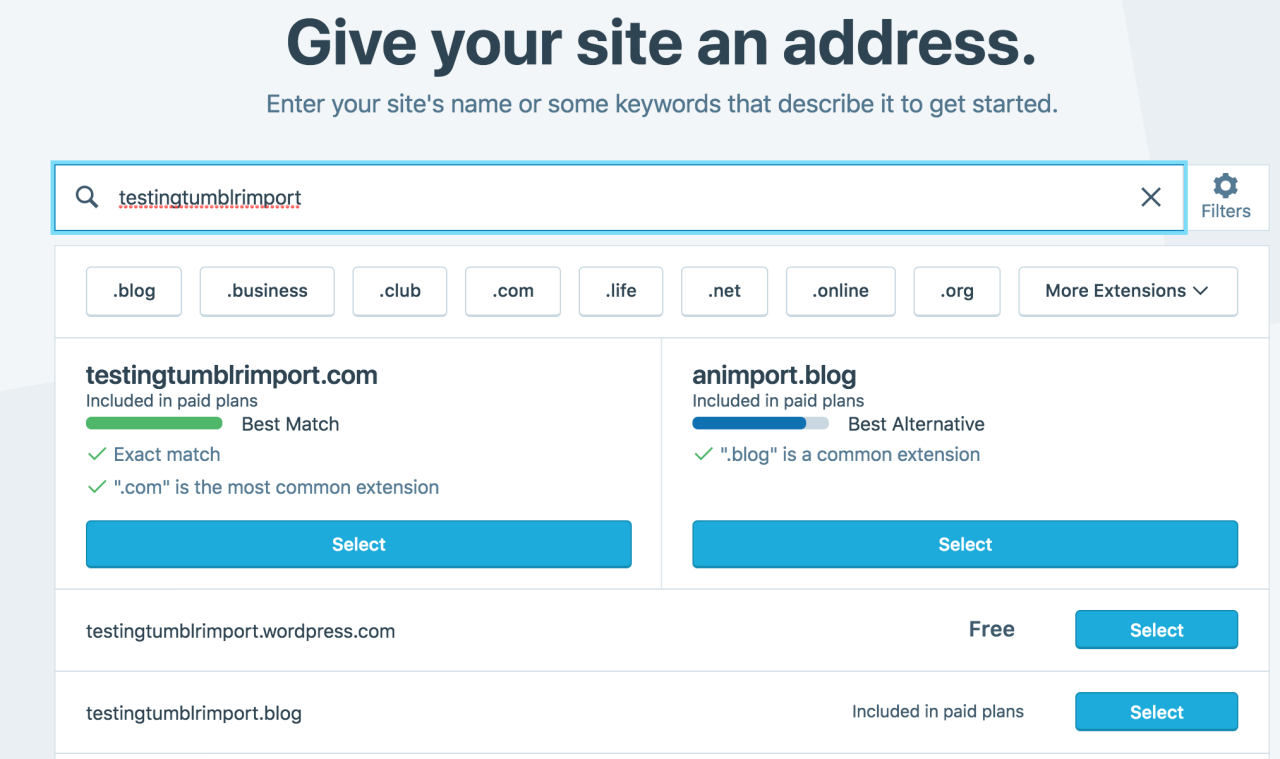
Sign up for a WordPress.com account at wordpress (.) com/start
You’ll have to create an account, with your email, a username, and a password. They should send you a confirmation email immediately, check it, activate it, and you’re good to go.
On the site, it will ask you for a site name. That page asks you a bunch of other information too, but you only have to fill out the site name.
Then you have to give your site a URL. If you’re lucky, your tumblr URL is still available, if not you’ll have to come up with another one, sorry.
It will tell you if that option is still available for free.
Then it will ask you to pick a plan. Free is really good enough, I swear.
Now you’re set up! You can import your tumblr!
The only differences from the linked tutorial are that the Import button is now on the first level menu, not in tools.
Hit Import, then you have to follow the link for “other importers” at the bottom, to find the option for Tumblr.
Then you’ll have to sign in with tumblr, using your normal tumblr credentials. You’ll be redirected there automatically.
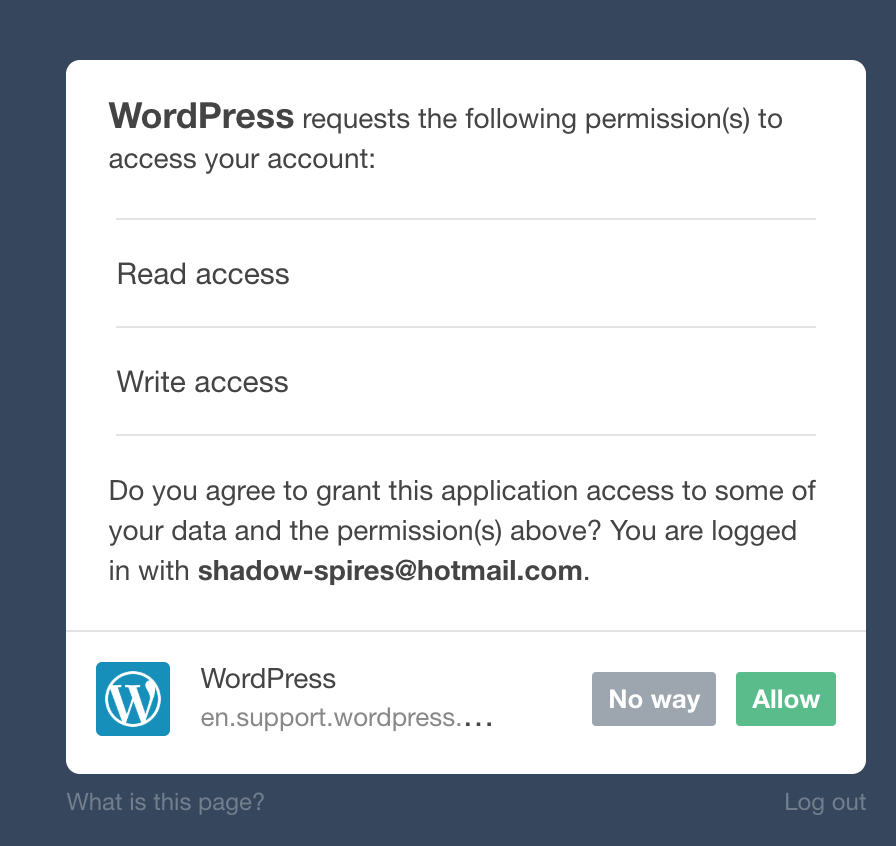
You’ll have to allow WordPress permissions on your blog.
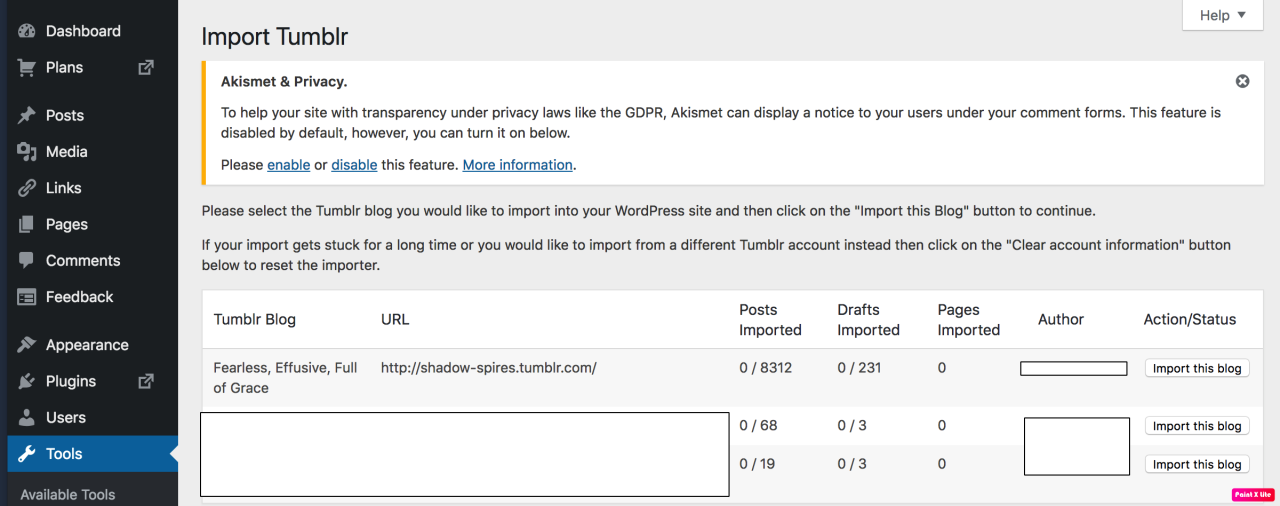
Then your blogs, including all your sideblogs, will show up in wordpress.
Hit import, wait a WHILE depending on the size of your blog, and you’re done!
ALSO!!
I made my NSFW blog private for now, since I don’t know WP’s policy on NSFW.
This means that to access it, someone has to have an account and request access. But hey, part of our problem on this hellsite has been people going places they aren’t wanted, so I don’t personally see this as a bad thing. They can send a request from the landing site on your blog, you get an email, click a link in the email, and PRESTO, they have access.
To make it private, go to Settings > Reading > Site Visibility. Go back and check, it took me changing the setting twice for it to actually stick.
tl;dr, you can import your entire blog to wordpress in just a few steps.
I’m going to tag the hell out of this, in no particular order. PLEASE reblog this and spread the word so people know it’s an option. If you’re having trouble, PM me, and I’m happy to help.
There are a whole bunch more, but that’s a start. Please reblog the hell out of this, so people are aware of this one simple option.
For people asking how to backup thier blog
Since the algorithms are flagging tons of stuff that don’t break the new guidelines anyway (twitter is on fire right now with screenshots of wrongly flagged art), here’s an option to back up your blog.
This is fascinating. I did a backup using tumblr-utils, it came out to about 3.6GB, it completed ever. This is not compressed, it’s just a bunch of HTML and images.
Tumblr’s exporter produced a zip file which is >5GB, and still running.
Comparing a blog exported by tumblr’s exporter to one exported by tumblr-utils, they are producing very similar results, with some images slightly different between them. Like, of three images on one blog, two were apparently identical, one changed size and I don’t know why.
What’s weird is that it’s not at all obvious why the export of this blog is over 5GB using tumblr’s exporter. Is it including more stuff? We can’t tell, because there’s no way to look at any part of the file unless the whole file makes it down, because zip files don’t have their primary table of contents until the end of the archive. But people are reporting corrupt zips. But intuitively, it shouldn’t be larger than the uncompressed data, right? Well, who knows. This is tumblr.
What is Tumblr-utlis and where can I find it, considering the fresh hell this blue nonsense is putting people through?
Python script to grab things. Grabbed my blog in ~24 minutes, contrast with it taking something like an hour for tumblr to decide it had created a file, and another hour to actually download it. Seems significantly cleaner, although honestly I suspect tumblr used the code from this one because of similarities in the generated output. So I think they used it and then modified it and broke it a bit.
Taken from Adult Children of Emotionally Immature Parents by Lindsay C. Gibson, Psy.D. A summary of the tips the book hands you on how to recognize emotionally healthy people.
They’re realistic and reliable
They work with reality rather than fighting it. They see problems and try to fix them, instead of overreacting with a fixation on how things should be.
They can feel and think at the same time. The ability to think even when upset makes an emotionally mature person someone you can reason with. They don’t lose their ability to see another perspective just because they aren’t getting what they want.
Their consistency makes them reliable. Because they have an integrated sense of self, they usually won’t surprise you with unexpected inconsistencies.
They don’t take everything personally. They can laugh at themselves and their foibles. They’re realistic enough to not feel unloved just because you made a mistake.
They’re respectful and reciprocal
They respect your boundaries. They’re looking for connection and closeness, not intrusion, control or enmeshment. They respect your individuality and that others have the final say on what their motivations are. They may tell you how they feel about what you did, but they don’t pretend to know you better than you know yourself.
They give back. They don’t like taking advantage of people, nor do they like the feeling of being used.
They are flexible and compromise well. Because collaborative, mature people don’t have an agenda to win at all costs, you won’t feel like you’re being taken advantage of. Compromise doesn’t mean mutual sacrifice; it means a mutual balancing of desires. They care about how you feel and don’t want to leave you feeling unsatisfied.
They’re even-tempered. They don’t sulk or pout for long periods of time or make you walk on eggshells.
When angered, they will usually tell you what’s wrong and ask you to do things differently. They’re willing to take the initiative to bring conflict to a close.
They are willing to be influenced. They don’t feel threatened when other people see things differently, nor are they afraid of seeming weak if they don’t know something. They may not agree, but they’ll try to understand your point of view.
They’re truthful. They understand why you’re upset if they lie or give you a false impression.
They apologize and make amends. They want to be responsible for their own behavior and are willing to apologize when needed.
They’re responsive
Their empathy makes you feel safe. Along with self-awareness, empathy is the soul of emotional intelligence.
They make you feel seen and understood. Their behavior reflects their desire to really get to know you, rather than looking for you to mirror them. They aren’t afraid of your emotions and don’t tell you that you should be feeling some other way.
They like to comfort and be comforted. They are sympathetic and know how crucial friendly support can be.
They reflect on their actions and try to change. They clearly understand how people affect each other emotionally. They take you seriously if you tell them about a behavior of theirs that makes you uncomfortable. They’ll remain aware of the issue and demonstrate follow-through in their attempts to change.
They can laugh and be playful. Laughter is a form of egalitarian play between people and reflects an ability to relinquish control and follow someone else’s lead.
They’re enjoyable to be around. They aren’t always happy, but for the most part they seem able to generate their own good feelings and enjoy life.
i feel like all i do is take care of myself, my plants, my friends and family, manage my depression and sometimes do laundry. one of my supervisors says i am “working for peace and good in this world”, that i am “helping the helpers”. a therapist-friend today said that was true and that once we are out of training and can choose our clients more ourselves that will be true even more so. most days i can see it. what do you think about it? thank you for your blog!
I have… three thoughts on this, I think.
Part of the definition of treason is giving “aid and comfort” to the enemy. Aid and comfort are no little things.
For me, posting cat pictures is a form of activism. I use the term “doughnut dolly of the revolution” a bit jokingly, because like Doughnut Dollies used to feel about themselves, I sometimes feel a bit inessential and useless. On the other hand. Most of the hardcore activists I know–the ones who negotiate and form coalitions and go out on picket lines and protest and testify to legislative committees and run nonprofits–are so burned out you can smell the smoke coming out from under their hoods. And have been for years. My girlfriend hasn’t totally recovered from the work she did against GWB’s war in Iraq.
So I do, in fact, aim to be a source of comfort, refuge, and resupply for people who go out and fight on the front lines of social justice. I blog the way I do in reaction to the intense level of media overload people got in 2015 and 16, where they couldn’t even check their fannish social media without getting overwhelmed by world events. So on days when something terrible is happening, I don’t think I can meaningfully contribute commentary or spreading awareness with any more skill or insight than 100,000 people are already doing–but I can reblog cat pictures from a source that’s fundamentally friendly.
One major issue I have with leftist activism is that it chronically undervalues work of nurturing, tending, cleaning, and maintaining. Who runs your bake sales? Who tends your wounds? Who cleans your clothes? Who makes food? Who cleans up after? That is a massive amount of work that’s taken absolutely for granted.
How we choose to work can be massively political. I had a professor, during grad school, who insisted that we could not let clients focus on the systemic problems they faced. If we let them blame anyone else for their problems, he said, they would never improve. (He worked for the US Army, convincing servicemembers that their children’s misbehaviour wasn’t due to having been moved around all the time, their spouse’s anxiety wasn’t related them being redeployed to Iraq for their fifth tour, their own bad moods weren’t related to traumatic brain injury; they just needed to take personal responsibility)
And one of the most formative clients for me during my own training was a Black university student who described how everyone in her class called her “sassy” and copied anything she said or did that seemed a little outside the norm, even though she felt that she wasn’t any weirder or louder than anyone else–or was she? Was there really something wrong with her? Was she ridiculous, worth being mocked? She drew in on herself like a setting sun, a star losing lustre, as she questioned herself.
I was still feeling my way, as a white girl reading a bunch of work by Black feminists and womanists, but even I knew about Black women being called too loud, too aggressive, too sassy. I very tentatively said, “It’s so upsetting, being picked on in this way that feels unfair and… honestly sounds kind of racist.”
“It does, doesn’t it,” she said, and dropped her head into her hands, knees drawn together. “Oh my god! It’s so racist! It’s so fucking racist!” And then she screamed quietly into her palms and did a little dance in her chair, and lifted up her head, and listed off all the things they’d said that they were racist–all the Black professionals and experts in her field they didn’t know when she mentioned them–how frustrating it was–how she’d dealt with racism in the past–how her family dealt with racism in the past–how much she missed her family–the festival she was going to in two weeks to reconnect with her Caribbean relatives.
I didn’t have to do anything for the rest of the session, just nod and make encouraging noises. That one little bit of validation linked her back into an entire system of resistance and community that gave her the strength to resist the pressures on her and renew her sense of pride and joy in who she was.
I think there’s a role therapists could have, and often do not have, in leftist movements. I keep thinking about it, but I don’t know how to make it fit.
Circling back to “every activist I know has burnout”: The way modern activism is done is very psychologically costly. We have discussions about “mental health and self-care” that kind of look like “BURN CARE WHILE LEAPING OVER LAVA: Remember that the lava is hot! Take frequent breaks to let your feet cool off!” Like, what if we did not have to leap over lava. What if an ordinary person’s activism didn’t have to involve large amounts of outrage, terror, and helplessness to fuel their work. What if we put resources into mental health as well.
And like I said, I don’t know what to do with this thought. Should I offer activist group members discount rates? Volunteer with an org as a counsellor? Suggest ways groups could make their members’ mental health better? Take my skills as a mediator into union disputes between nonprofit workers and management? Write articles about how somebody ought to address something about this problem? I’m not actually drowning in good ideas here.
I feel like there could be very targeted and effective work that we could do, that often gets ignored or discounted because the Left has a very ascetic bread-and-water, sacrifice-everything-for-the-revolution view of what activism should look like. And maybe we should start talking about it.
I’m pretending all the time to be, kinder, stronger, funnier, more sociable than I am. I guess we’re all like that but it just feels so inadequate.
What’s the difference?
I know it sounds flippant but… certain things are fundamentally performative. And other things are so close as makes no difference.
Kindness is performative. Actions are kind, and people are kind by performing those actions. You can’t “pretend” to be kinder than you are, you can only perform kindness or not perform kindness, and choosing to perform kindness is always worthwhile, no matter how much you may second-guess your motivations.
Strength is so many things. It takes strength to pretend a strength you don’t feel. And the way to achieve strength is to exercise it, so long as you do it in enough moderation to not strain or break anything. Being able to affect strength when necessary while being able to put it down again when that in turn is necessary is healthy. Everyone starts weight training with the littlest weights. It’s not fake or pretending to do what you gotta do in any given situation.
Funniness lives in the interlocutor, not in the speaker. It doesn’t matter how funny you think you are (or think you are pretending to be) – that’s not how it’s measured. At what point are you “pretending” to be a musician if the music still gets made? And often what it’s tempting to describe in first person as “pretending” is more accurately described in the third person as “practicing” – which is of course the way you cause things to Be.
Sociability is also performative. Pretending to be sociable is just…being sociable, despite a disinclination towards it. It’s making an effort towards something you value. So long as the effort is not so great that it backfires into resentment, there’s no practical difference.
Qualities or activities or whatever are no less worthy because you have to actively choose to perform them. If anything, the worthiness lies in the act of choosing. It’s not “pretending” – it’s agency.
tl;dr: ain’t nothing wrong with “fake it till you make it.” A plastic spoon* holds just as much soup as a “real” one
* I keep wanting to talk about semantic domains! Artifacts are defined by their utility, whereas living things are defined by their identity. So plastic forks are still forks, but plastic flowers aren’t flowers. So there’s two pep-talk messages to take away from this: (1) for certain things, the distinction between “fake” and “real” isn’t a relevant one so long as they still get the job done, and (2) the purpose of a living thing is to be the thing that it is. The idea of a “useless person” is as semantically nonsensical as the idea of “pretend kindness” (or fake cutlery).
ive been reading a book that basically explains how so-called “brain differences” between the genders is the result of gendered socialization and not the cause of it. i honestly expected the book to be very cis-centric but its actually the opposite, the author stresses that testimony from trans ppl is actually indispensable because we’ve, in a sense, “lived both experiences”
more cis feminists should have this mindset
one of the first examples that she uses to introduce her point about how perception by others can shape a person’s performance actually uses a trans woman. it explains that as a certain trans woman became to be seen as a woman more and more frequently, the ppl arond her eventually started viewing her as being ill equipped for tasks that they did not bother her about pre-transition. eventually she even found herself underperforming in these tasks herself.
I knew it was this book before I’d finished reading the first two lines. Honestly this book is indispensible if you want to debunk any gender determinism people claim is science. I can’t recommend it enough.
(Bonus bonus: I am myself a neuroscientist, and the old white men mentioned above – who are not – could not have missed the point harder if they’d actively tried. Which. Maybe?)
you know what’s wild is that all these crazy standards we hold ourselves to are things that we don’t even value in another person? like i’ve never been like “wow I love that this friend of mine is too proud to ask for help and never complains about their feelings” or “my favorite quality about this friend is that they get straight A’s and never get overwhelmed and has never told me about a problem” or “i love that this friend has never been wrong about anything or slipped up and said something embarrassing once in their life” and yet here we are, pushing ourselves past our limits for and beating ourselves up over slipups of things that our friends probably wouldn’t even rank in the top 50 reasons they like us
Neko Atsume, but with fish/reptiles/dinosaurs/pigeons/chickens instead? Where are these games? Am I going to have to learn to make games now?
(&:) Tiny Bird Garden is like Neko Atsume but with assorted birds, and Gecko Garden is basically the same but with leopard geckos.
(I would love things like dinosaurs, more reptile varieties, chickens, and especially small friendly cryptids. 😀 But I’m too lasy to make them myself. :/)
I’m going to check those two out ASAP. Thank you a million times for helping to feed my unending hunger to collect small good digital animals.
I’ve heard good things about Tap Tap Fish!
Tap Tap Fish is indeed pretty dang awesome. They came out with a little freshwater section too, so you can tap for guppies and goldfish and bettas and turtles and stuff now as well as various saltwater critters.




















 just moving along like everyone else