SPACE LESBIANS GONNA COLONISE MARS, MAKE IT A BEAUTIFUL SAPPHIC UTOPIA ❤
its actualy really fascinating, the reason they are considering making the mission to mars all female ACTUALLY doesnt have to do with “impure sexual thoughts” or anyhing it has to do with a multitude of factors, for example (cis) women astronauts tend to be smaller and require less food, nasa also did a series of studies showing that in groups, all woman groups showed better cooperation and teamwork than mixed or all men groups, and also probably the most interesting reason is that (cis) mens eyesight is damaged in space travel for reasons we dont even understand yet, for some strange reason the vast majority of men who have been into space have suffered damage to their eyesight and yet almost no women have had this issue, and scientists are still trying to figure out why but in the meantime sending men into space for long periods of time is a huge concern because they may go blind over time … just thought that that headline was a little reductionist and sensationalist so i had to comment, that being said tho…
HELL YEAH SPACE LESBIANS
I propose we call the landing site Themyscira Base
I do feel bad for plants in general. Like, I know they are often as vicious as animals in many ways, just slower. But, I mean, they just show up and they’re like, “I Think I Will Evolve To Eat The Sun And Also Make Oxygen And How Now Is All This.” And, like, everything fucking dies at first (totally not plants fault, btw. okay maybe it was but they didn’t mean to) but then new things evolve. And they’re like, “Fuck it, eating each other suuuucks. Let’s eat the plants which give us life.” And so we start doing that. And plants are all, “Oh Dear No, I Do Not Care At All For Being Eaten. I Will Make Myself Into Poison Sometimes.” But, y’know, stuff kept eating plants anyway so plants, ever the bro, came up with a new idea. “I Have Made A Decision About Being Eaten And You May Eat Me Friends And Here Is An Especially Tasty Bit Packed All Full of Delicious Sugars Which I Have Produced At Great Cost (What They Do Not Know Is That My Seeds Are Within And Shall Be Propagated Near And Far By Their Dung)“ But that’s not good enough for animals, no, not at all. We love the fuck out of some pomegranates but also alliums which are like, “I Have Not Decided To Go In For This Being Eaten Business. I Shall Be Very Foul Tasting And Also A Poison.” But no, sorry, onions, you fucked up. You accidentally wound up with a species that just doesn’t give up or fully comprehend the idea of things tasting “”‘bad’“’ or other concepts like not eating poison. (Sorry, plants, later we turn some of you who are not poison into a poison we consume recreationally. We really enjoy eating poison.) Legit, alliums are deadly to, like, every other species. And we call them aromatics and throw them in everything. Peppers are the best, though. They completely got on the being eaten train. BUT ONLY BIRDS Peppers are like, “You May Eat Me, Fair Avian, For You Are Sure To Spread Me A Great Distance. But, Mammal, Take HEED. Should You Eat Me Then I Will Burn You Most Terribly.” And we were all about that. “The FUCK, burning? I love pain,” said humans, presumably. “You know, peppers, you and evolution have done a good job at burning us but I am pretty sure we could make your chemical agony even more potent. Come hang with us,” humans added to a very confused pepper just before creating the ghost chili.
In 2010, the RIKEN institute in Japan created mutant cherry blossom trees by firing ion beams at them in a particle accelerator. The mutated trees now bloom four times a year and produce more flowers.
a wise use of science powers
ok so i’m not saying this is the most japanese thing ever, but I’m not saying it’s not
“we have a ray gun that creates mutants” anime level 8/10
“we used it to make super cherry blossoms” japan level 10/10
“so are they like firebreathing carnivorous flowers or” “no they just make more flowers, more often” aesthetic level 11/10
“well done, this is exactly what we hoped would happen when we paid a zillion dollars to build a particle accelerator” —the project backers
Particle physics is fucking magic
Some wizards took a magic box into the woods and fucked up some trees. I love this shit
“ok so should we mutate like a super army or-” “no. this sakura tree.” “but why” “hanami four times a year instead of once. imagine”
most vegetables are just different kinds of broccoli
Explain
broccoli, cabbage, kohlrabi, kale, brussel sprouts, collard greens, savoy, and cauliflower are all the same species of plant, Brassica oleracea
most veggies is the same
But wait, there’s more!
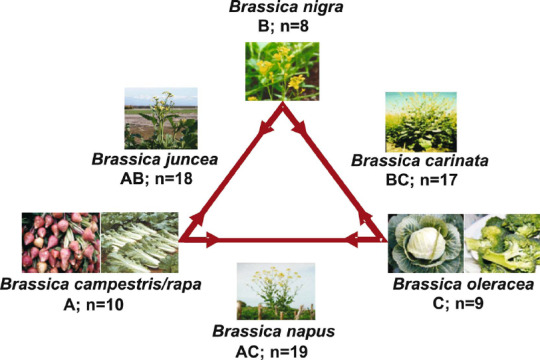
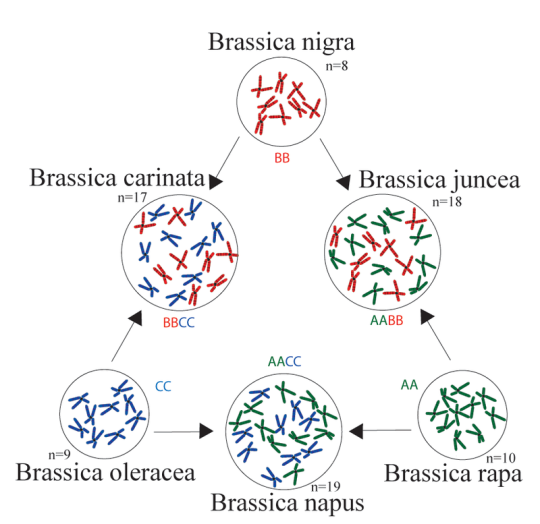
Brassical oleracea, cabbage and so on, hybridizes with B. rapa, turnip and Chinese cabbage, to make B. napus, rutabaga and rapeseed. It also hybridizes with B. nigra, black mustard, to form B. carinata, Ethiopian mustard. And B. rapa and B. nigra hybridize together to form B. juncea, Indian mustard.
Together these relationships make up the fantastic Triangle of U!
And why it it called the Triangle of U? Because of this awesome guy, botanist
Working in Japan in the 1930s and using his Japanized name of
U Nagaharu, he analyzed the evolutionary history of the six species through careful breeding techniques. “Woo made synthetic hybrids between the diploid and tetraploid species and examined how the chromosomes paired in the resulting triploids” (Wikipedia). This theory of hybrid origin, named the Triangle of U in his honor, has since been confirmed by genetic analysis.
If you set out to create every-which-way hybrids out of three congeneric species, and make sure that they were still all tasty, they would call you mad! Mad! But Woo proved that nature is even more of a mad scientist than a human could ever be.
So listen up y’all, nothing drives me crazier as both a writer and a scientist than seeing alien diseases that make no fuckin’ sense in a human body.
If you’re talking about alien diseases in a non-human character, you can ignore all this.
But as far as alien diseases in humans go, please remember:
DISEASE SYMPTOMS ARE AN IMMUNE RESPONSE.
Fever? A response to help your immune cells function faster and more efficiently to destroy invaders.
Sore/scratchy throat? An immune response. Diseases that latch onto the epithelium of the throat (the common cold, the flu) replicate there, and your body is like “uh no fuckin’ thanks” and starts to slough off those cells in order to stop the replication of new virus in its tracks. So when it feels like your throat is dying? guess what it literally is. And the white spots you see with more severe bacterial infections are pus accumulation, which is basically dead white blood cells, and the pus is a nice and disgusting way of getting that shit outta here.
(No one really knows why soreness and malaise happens, but some scientists guess that it’s a byproduct of immune response, and others suspect that it’s your body’s way of telling you to take it easy)
headache? usually sinus pressure (or dehydration, which isn’t an immune response but causes headaches by reducing blood volume and causing a general ruckus in your body, can be an unfortunate side effect of a fever) caused by mucous which is an immune response to flush that nasty viral shit outta your face.
Rashes? an inflammatory response. Your lymphocytes see a thing they don’t like and they’re like “hEY NOW” and release a bunch of chemicals that tell the cells that are supposed to kill it to come do that. Those chemicals cause inflammation, which causes redness, heat, and swelling. They itch because histamine is a bitch.
fatigue? your body is doing a lot–give it a break!
here is a fact:
during the Spanish 1918 Plague, a very strange age group succumbed to the illness. The very young and very old were fine, but people who were seemingly healthy and in the prime of life (young adults) did not survive. This is because that virus triggered an immune response called a cytokine storm, which basically killed everything in sight and caused horrific symptoms like tissue death, vasodilation and bleeding–basically a MASSIVE inflammatory response that lead to organ damage and death. Those with the strongest immune systems took the worst beating by their own immune responses, while those with weaker immune systems were fine.
So when you’re thinking of an alien disease, think through the immune response.
Where does this virus attack? Look up viruses that also attack there and understand what the immune system would do about it.
Understand symptoms that usually travel together–joint pain and fever, for example.
So please, please: no purple and green spotted diseases. No diseases that cause glamorous fainting spells and nothing else. No mystical eye-color/hair-color changing diseases. If you want these things to happen, use magic or some shit or alien physiology, but when it’s humans, it doesn’t make any fuckin’ sense.
This has been a rant and I apologize for that.
As a microbiologist, I think the main advice here is to take into account real diseases and conditions before you make up a fictional disease or condition.
Some bacteria have physical effects on the body that cause symptoms (EHEC varitype of E. coli ruptures cells at the site of infection, which is usually the large intestine, hence, you have bloody stools from it). If your alien or “made-up” bacteria or virus causes a certain symptom, find a real bacteria or virus that causes the same symptom. They need to behave in a similar fashion and have similar physical traits. Bacteria and viruses do not evolve functions because they’re cool. They evolve them because they’re useful.
There are also dietary issues, medications and chronic diseases that cause physical changes–copper toxicity can cause an orange ring around the iris, an eyelash lengthening “medicine” causes darkening and/or color change of the iris, hemochromatosis (sometimes known as “Bronze Diabetes”) causes darkening of the skin etc. If you want to use this sort of thing, again, find something real that causes it and work through things logically.
Play your cards right, do your research and you will have hordes of readers in the scientific and/or biological community cheering, screaming and crying because they love your work.
@biologyweeps, this feels up your speculative alley – anything to add?
Ohhh.
I’d like to add that the same goes for parasitic infections, more or less. If you want a certain trait for a diseases, cross reference with existing parasites to see what’s happening, and also make sure you check what happens if you put a parasite in a host it’s not meant for. We can sensibly assume that alien parasites that encounter a human would be ‘wtf’ and potentially cause complications that would never happen in the native species. Maybe in the native species it causes a cold like reaction at worst, but in a human the parasites may attempt to nest in a totally different tissue. Maybe that causes widespread tissue damage by the parasite itself as it tries to borrow in? Again, check existing cases to see what horrific things could happen.
While we’re on it, also check how your disease is communicated. One of the things that annoy me so much with zombie movies is that ‘biting’ is supposed to be a very effective way to spread it. It’s not. Anything that requires such intimate contact is actually kind of hard to communicate. Airborne things? Now there we are at potential ‘oh shit’ territory. So if you want your disease to sweep the country/planet/ship, pick something that’s easily communicable.
Also consider the incubation period. How long until someone shows symptoms? Are they already infectious to other people before showing symptoms or still after they stopped? As mentioned above, illness symptoms are in most part immune responses and the immune system needs time to get up and run. Give it that time.
And while we’re at it… there are symptoms that aren’t immune responses. For example the cramps that accompany tetanus are caused by a toxin the bacterium produces that damages/destroys nerve cells. Viruses can cause tissue damage when they insert in cells, replicate in there and destroy the cell on exit. Think of how HIV can wreak havoc on the human immune system by killing of a specific kind of cell. Depending on where your viruses likes to replicate it can massively impact the look of it. Something that destroys liver cells will look different (and if survived may come with different long term damage) than something that prefers skin or muscle cells. If it’s alien also consider how it might behave differently in its original host.
Fantastic post, I can relate to OP 100%. More points:
Nothing makes me groan harder than a made-up plague which gives anyone X diseases within seconds to MINUTES. I’m looking at you, most zombie movies. And if your alien/synthetic/sci-fi pathogen is at all like a virus (read: no metabolism of its own, just genetic material of some kind which it uses to reprogram host cells), then the rate at which it mupltiplies is limited to what normal human cells can do. Now, viruses can multiply pretty damn fast. But give you symptoms within MINUTES? Nope.
So long as we’re on the subject of epidemiology, and speed:
"Oh no, patient died less than a day after being infected! We’re all doomed!“ Wrong. While that SOUNDS scary, a plague that kills that quickly would not actually be that dangerous, and would be unlikely to have evolved to begin with. A disease needs to pass itself on to at least one other person, on average, before it kills its host, or it’s doomed to extinction. Any virus that kills its host before it has a decent chance of being passed on will basically quarantine itself. (Of course, you CAN do this if you handwave its origins as being made in a lab or whatever, just know it won’t realistically pose a truly terrifying threat on a population level.)
Mmore ideas for a realistically scary made-up plague:
– Long incubation period (say, a couple of weeks), making quarantine much more difficult, disruptive to everyday life, and unlikely to succeed.
– Infectious period != symptomatic period, i.e. someone can spread the disease before they appear sick. (Note: if this condition is met, then dying very rapidly after *manifesting symptoms* becomes plausible again, more plausible than dying quickly after being infected.)
– The possibility or relative prevalence of healthy carriers – think Typhoid Mary. I.e. rare people who skip the symptoms part entirely but are still infectious.
– The disease is transmitted through an animal that is hard to keep out, the definition of “hard to keep out” would depend on the setting here. Poor water sanitation means waterborne bacteria and microscopic parasites would be a huge danger. Insect or arachnid (e.g. tick) bites could be a danger in almost any setting..
– As an alternative to above point: the bacterial/viral/parasite/whatever can form spores that are fucking EVERYWHERE. (Read: the reason for both tetanus and botulinum poisoning.)
– The pathogen is both dangerous and impossible to fully exterminate through vaccination because it has a huge population of reservoir hosts. (Reservoir hosts are entire SPECIES that can carry and propagate the disease without being affected much by it.) Same way the Black Plague is still out there because a shitton of rodent species passively carry it.
And many more things if you do some research for inspiration! Pathogens are scary, fascinating things, and I really wish we had more realistic fictional representation of them than “virus which causes zombie behaviour in 3 seconds flat” (looking at you, 28 Days Later) and “virus which can MIND-CONTROL people who view the main carrier through a COMPUTER SCREEN” (wtf???) (looking at you, Jessica Jones).
Hollow trees are often more stable than before their cores rotted! “The removal of the tree’s dead heart brings yet another advantage. The change of form from solid pillar to hollow cylinder alters the way in which the trunk reacts to mechanical stress. It is much more resilient and stable. The removal of many tons of timber also reduces the strain on the tree’s elderly and doubtless somewhat decayed root system. The result is that an old hollow tree is often able to withstand a gale better than a younger undecayed one. In the ancient hunting parks of England such as Windsor, where trees stand out in the open, unprotected by others from the wind, it is by no means rare after a storm to discover that hollow oaks, four or five hundred years old, remain upright when younger ones, a quarter their age, have been blown over.” https://asknature.org/strategy/relationship-provides-nutrients-stability/
Suzanne Sadedin, Ph.D. in evolutionary biology from Monash University
I’m so glad you asked. Seriously. The answer to this question is one of the most illuminating and disturbing stories in human evolutionary biology, and almost nobody knows about it. And so, O my friends, gather close, and hear the extraordinary tale of:
HOW THE WOMAN GOT HER PERIOD
Contrary to popular belief, most mammals do not menstruate. In fact, it’s a feature exclusive to the higher primates and certain bats*. What’s more, modern women menstruate vastly more than any other animal. And it’s bloody stupid (sorry). A shameful waste of nutrients, disabling, and a dead giveaway to any nearby predators. To understand why we do it, you must first understand that you have been lied to, throughout your life, about the most intimate relationship you will ever experience: the mother-fetus bond.
Isn’t pregnancy beautiful? Look at any book about it. There’s the future mother, one hand resting gently on her belly. Her eyes misty with love and wonder. You sense she will do anything to nurture and protect this baby. And when you flip open the book, you read about more about this glorious symbiosis, the absolute altruism of female physiology designing a perfect environment for the growth of her child.
If you’ve actually been pregnant, you might know that the real story has some wrinkles. Those moments of sheer unadulterated altruism exist, but they’re interspersed with weeks or months of overwhelming nausea, exhaustion, crippling backache, incontinence, blood pressure issues and anxiety that you’ll be among the 15% of women who experience life-threatening complications.
From the perspective of most mammals, this is just crazy. Most mammals sail through pregnancy quite cheerfully, dodging predators and catching prey, even if they’re delivering litters of 12. So what makes us so special? The answer lies in our bizarre placenta. In most mammals, the placenta, which is part of the fetus, just interfaces with the surface of the mother’s blood vessels, allowing nutrients to cross to the little darling. Marsupials don’t even let their fetuses get to the blood: they merely secrete a sort of milk through the uterine wall. Only a few mammalian groups, including primates and mice, have evolved what is known as a “hemochorial” placenta, and ours is possibly the nastiest of all.
Inside the uterus we have a thick layer of endometrial tissue, which contains only tiny blood vessels. The endometrium seals off our main blood supply from the newly implanted embryo. The growing placenta literally burrows through this layer, rips into arterial walls and re-wires them to channel blood straight to the hungry embryo. It delves deep into the surrounding tissues, razes them and pumps the arteries full of hormones so they expand into the space created. It paralyzes these arteries so the mother cannot even constrict them.
What this means is that the growing fetus now has direct, unrestricted access to its mother’s blood supply. It can manufacture hormones and use them to manipulate her. It can, for instance, increase her blood sugar, dilate her arteries, and inflate her blood pressure to provide itself with more nutrients. And it does. Some fetal cells find their way through the placenta and into the mother’s bloodstream. They will grow in her blood and organs, and even in her brain, for the rest of her life, making her a genetic chimera**.
This might seem rather disrespectful. In fact, it’s sibling rivalry at its evolutionary best. You see, mother and fetus have quite distinct evolutionary interests. The mother ‘wants’ to dedicate approximately equal resources to all her surviving children, including possible future children, and none to those who will die. The fetus ‘wants’ to survive, and take as much as it can get. (The quotes are to indicate that this isn’t about what they consciously want, but about what evolution tends to optimize.)
There’s also a third player here – the father, whose interests align still less with the mother’s because her other offspring may not be his. Through a process called genomic imprinting, certain fetal genes inherited from the father can activate in the placenta. These genes ruthlessly promote the welfare of the offspring at the mother’s expense.
How did we come to acquire this ravenous hemochorial placenta which gives our fetuses and their fathers such unusual power? Whilst we can see some trend toward increasingly invasive placentae within primates, the full answer is lost in the mists of time. Uteri do not fossilize well.
The consequences, however, are clear. Normal mammalian pregnancy is a well-ordered affair because the mother is a despot. Her offspring live or die at her will; she controls their nutrient supply, and she can expel or reabsorb them any time. Human pregnancy, on the other hand, is run by committee – and not just any committee, but one whose members often have very different, competing interests and share only partial information. It’s a tug-of-war that not infrequently deteriorates to a tussle and, occasionally, to outright warfare. Many potentially lethal disorders, such as ectopic pregnancy, gestational diabetes, and pre-eclampsia can be traced to mis-steps in this intimate game.
What does all this have to do with menstruation? We’re getting there.
From a female perspective, pregnancy is always a huge investment. Even more so if her species has a hemochorial placenta. Once that placenta is in place, she not only loses full control of her own hormones, she also risks hemorrhage when it comes out. So it makes sense that females want to screen embryos very, very carefully. Going through pregnancy with a weak, inviable or even sub-par fetus isn’t worth it.
That’s where the endometrium comes in. You’ve probably read about how the endometrium is this snuggly, welcoming environment just waiting to enfold the delicate young embryo in its nurturing embrace. In fact, it’s quite the reverse. Researchers, bless their curious little hearts, have tried to implant embryos all over the bodies of mice. The single most difficult place for them to grow was – the endometrium.
Far from offering a nurturing embrace, the endometrium is a lethal testing-ground which only the toughest embryos survive. The longer the female can delay that placenta reaching her bloodstream, the longer she has to decide if she wants to dispose of this embryo without significant cost. The embryo, in contrast, wants to implant its placenta as quickly as possible, both to obtain access to its mother’s rich blood, and to increase her stake in its survival. For this reason, the endometrium got thicker and tougher – and the fetal placenta got correspondingly more aggressive.
But this development posed a further problem: what to do when the embryo died or was stuck half-alive in the uterus? The blood supply to the endometrial surface must be restricted, or the embryo would simply attach the placenta there. But restricting the blood supply makes the tissue weakly responsive to hormonal signals from the mother – and potentially more responsive to signals from nearby embryos, who naturally would like to persuade the endometrium to be more friendly. In addition, this makes it vulnerable to infection, especially when it already contains dead and dying tissues.
The solution, for higher primates, was to slough off the whole superficial endometrium – dying embryos and all – after every ovulation that didn’t result in a healthy pregnancy. It’s not exactly brilliant, but it works, and most importantly, it’s easily achieved by making some alterations to a chemical pathway normally used by the fetus during pregnancy. In other words, it’s just the kind of effect natural selection is renowned for: odd, hackish solutions that work to solve proximate problems. It’s not quite as bad as it seems, because in nature, women would experience periods quite rarely – probably no more than a few tens of times in their lives between lactational amenorrhea and pregnancies***.
We don’t really know how our hyper-aggressive placenta is linked to the other traits that combine to make humanity unique. But these traits did emerge together somehow, and that means in some sense the ancients were perhaps right. When we metaphorically ‘ate the fruit of knowledge’ – when we began our journey toward science and technology that would separate us from innocent animals and also lead to our peculiar sense of sexual morality – perhaps that was the same time the unique suffering of menstruation, pregnancy and childbirth was inflicted on women. All thanks to the evolution of the hemochorial placenta.
the next time you think you’re lonely, just remember you have about 25 billion white blood cells in your body protecting your sorry little ass with their life. you have 25 billion friends who would die for you. no need for tears.
thank you osmosis jones
My immune system tried to kill me though.
Jordan just remember you had twenty five billion enemies trying to kill you and you’ve survived them all
Take THAT you tiny goddamn sons of bitches.
i have 25 billion confused citizens fighting amongst themselves over whether or not to smash the state, and it makes me feel uncertain
jesse you’re such a punk rebel even your cells want to smash the system
this is actually a small sub branch of botany thats been growing and gaining some recognition in the past 5 years or so called plant cognition! we’ve been thinking about if plants can possibly be intelligent to any degree for centuries, but the main paper that started up this huge discussion in the modern era was one called Experience Teaches Plants to Learn Faster and Forget Slower in Environments Where It Matters by Monica Gagliano, a plant researcher in Australia who specializes in it. because the results indicated that plants were possible of learning and retaining information in a kind of memory in response to environmental changes, it received a lot of backlash and denial- generally in science, that kind of intelligent reaction to an organism’s environment is a good indicator of cognitive behavior in the organism. it got rejected by 10 different journals before being published in 2014.
the experiment worked like this. i’ve talked before about mimosa pudica, a tropical plant that curls its leaves back when touched (they go back to normal in a few minutes):
this is to help deter predators among other things. but in this experiment, Gagliano used it as an indicator of stimulus and to test cognitive function. It’s well known that pudica has a rudimentary nervous system that can even be temporarily inhibited using anesthetics (just like ours can!). she hooked up a ton of these plants in pots to identical rail systems that allowed them to be lightly dropped in an identical way, juuuuust heavy enough to trigger the stimulus so all the leaves drop down when they hit the bottom (a piece of foam so they wouldn’t actually hurt the plants). every time the plants would be dropped, they would close up.
but after the plants were dropped about 60 times each, they stopped responding to the drop.
they remembered that no harm was coming from this actionand decided that it was against their best interests to keep expending energy closing their leaves. they 200% learned to stop.
she decided to test it further. she put some of the plants in a shaker and let them receive a more jarring response; the plants closed up as usual. then, she put them back in the droppers and dropped them again. they didn’t close up. they had remembered that response. this dispels the obvious rebuttal to this experiment of the plants just being tired; they still closed up when stimulated differently.
they just chose not to close up when they hit a stimulus they remembered.
it turns out that not only could they remember to keep their leaves open when dropped on the apparatus, but they remembered after28 days when she kept testing it!! apparently by the end of the experiment, all the plants had decided to keep their leaves open when dropped!!!!
how do they do this?? we literally dont know. they have no central brain, only a basic nervous system. can other plants do this???
well, adding onto that, venus fly traps can count! like. they have three hairs inside their traps, and all three must be touched within 20 seconds for the trap to close. once closed, those three trigger hairs must continue to be stimulated by thrashing prey, or the trap will reopen.
so yeah like. basically ‘are they sentient’: apparently to an extent???? we dont know exactly why or how but they are??? maybe???? sort of????? at least some of them are?? but they dont have a brain so everyones like????????????????????? maybe its through a signaling network????????????????? but like how would that even work?????????
plant consciousness is still new enough to be dismissed as crazy by a lot of biologists but like. the evidence is there. we don’t know a whole lot and its clearly a radically different kind of intelligence than we know in animals, but it’s there and we 200% dont know how it works yet or even the full extent of how plants use this intelligence (for example: does a redwood have the same intelligence as a venus fly trap?? how does it learn things and use that knowledge???)
national geographic wrote an awesome article visualizing the experiment here if you want to read more!
This isn’t even touching on the fact that plants exchange nutrients with other plants through their root networks and engage in constant “bartering,” sometimes withholding resources until they get something extra. This is all performed with the aid of fungi, and the fungi in turn seem to weigh options and make decisions that will best benefit both themselves and their plant symbiotes. Sometimes two plants even get territorial and try to poison one another, and the fungal network steps in to put a stop to it.




 just moving along like everyone else