A good fight scene (and a good smut scene for that matter) always works in the service of the narrative. It works toward the cohesive big picture.
From an entertainment standpoint, violence is boring.
You need your audience invested in the characters participating in the violence, in the actions and events leading up to the fight, in the aftermath and how this will effect the character’s overall goals.
In a narrative context, if you’re bored during a fight scene or a sex scene it’s because the build up to that moment failed. The scene itself may also have failed. However, your foundation is what makes your story sing.
Think of a story like building blocks. You’re playing Jenga with your reader on a homemade house, they’re slowly pulling out the pieces and you’re betting you built your blocks well enough to withstand scrutiny. You’ve got to keep them interested long enough to get to the end before the whole thing comes tumbling down.
A fight sequence which works in concert with it’s narrative is enjoyable, doesn’t overstay it’s welcome, and ultimately works to build up the story it’s telling. Fighting isn’t fighting, you see. Combat is a form of problem solving, the fight itself is an expression of the character’s individuality. Everything we’ve been learning about them, their goals, and their behaviors are being put in a pressure cooker and dialed up.
You should be learning about the character as the fight progresses, the fight working on multiple levels in concert with its narrative to get the story where it needs to go. Often, a first fight is like an establishing shot in film. You get a feel for who this character is when under pressure, who they are. Peril can be a great way to get the audience invested, but its up to the author to prove why they should.
Poor fight sequences don’t tell you anything. They’re there to establish the character as capable of fighting but don’t even do that because their concept of combat is generic.
The combatants aren’t individuals expressing themselves, the fight isn’t proving anything except fighting, it doesn’t have meaning except for its attempts to prove the narrative’s poor concept of badassery. This often happens with no regard for the setting’s rules, the aftermath consequences, what the character’s actions will effect in the long run.
It doesn’t mean anything and, while violence is shocking and terrifying in real life, in fiction violence has to mean more than just an exchange of blows.
How many times have you read a book where several mooks show up to get their ass kicked by the protagonist? They limp off at the end and while they’re often in a perfect position to be seen again due to their connections, we never do.
In even just a moderately competent narrative, those same mooks are characters. We’ll see them again in bit roles. They’ll play a role, either to help or hurt later as an aftermath consequence of the protagonist’s earlier actions. These are callback characters we can use to remind the audience of what happened previously in the narrative, and offer up some catharsis.
In a really well written scene, these mooks serve an important purpose when it comes to establishing the protagonist’s character in a quick snapshot. Like the moderately competent character, they come back later to the aid or the detriment of the protagonist. The mooks’ response actions are a direct result of their encounter with the character, often acting as an inciting incident. The protagonist suffers direct consequences as a result of their actions, whether its injury, loss, or the attention of the villain which causes them to lose something. In these fight scenes, you can see the story’s trajectory because it acts as another way to get to know the hero, the secondary characters, the tertiary characters, and whoever else is participating. It’s working on five different levels.
What you often see in a good fight sequence, whether it’s in a written medium or film, is the culmination of a great deal of hard work on the part of the author. A smut sequence is a reward, it’s a way to pay off on the reader’s investment in the relationship between these two characters and the narrative’s investment in them. It doesn’t matter if that’s hardcore sex, or a Victorian hand touch, or a knockout blow to the jaw, the end result is the same. It’s entertaining, satisfying, and even cathartic.
A poor sex scene is just dolls bumping bits. A poor fight scene is just dolls trading blows. Nothing occurs, nothing happens, there’s none of the underlying satisfaction or catharsis in the outcome. You don’t have any investment, no consequences, it overstays its welcome and tells you nothing about the characters.
You’ve no reason to care, so you don’t.
As a reader, you don’t owe a writer attention when reading their work. They’ve got to earn it. If they aren’t, then it may be that the story isn’t for you and that’s okay. Take into account your tastes,
It takes practice to choreograph a fun fight scene. Writing sex and violence is mostly about learning to find your limits (i.e. what you’re comfortable with writing), and overcoming embarrassment. Determine the difference between need and want.
Are you avoiding writing these scenes because you’re scared of being bad at them or because they just don’t interest you?
These are two very different issues, and it’s easy to hide from the first behind the second. Be honest with yourself. If it is fear, then don’t give into it. The easy solution if you’re afraid of being bad at something is to practice. Start looking critically at the media you consume, when you start to get bored during a fight scene or a sex scene, when you want to skip ahead, ask yourself, “why?”. Check out the sequences and stories where this doesn’t happen, and try to figure out the differences between the two.
When it comes to the mechanics of both violence and sex, the more you learn the better off you’ll be at writing it. The more you practice writing violence/sex/romance then the better you’ll be. Like with everything, it’ll probably be pretty terrible in the beginning but the more you practice, the better you get. Writing itself is a skill, but its also a lot of sub-skills built in underneath the surface. Being good at dialogue doesn’t mean you’ll be good at action, having a knack for great characterization doesn’t mean you’ll be good at writing setting description. Putting together great characters doesn’t mean you’ll automatically be good at worldbuilding.
Don’t be too hard on yourself.
All it takes to figure out whether or not the time to fight is right is by listening to your gut.
Remember, the best scenes are based in narrative cohesion and emotional investment. They’re a pay off in and of themselves for your audience, dessert after dinner. They aren’t the meat and potatoes. If you set out to just write a fight scene or write a smut scene then it’ll get gratuitous. Then the focus is on the fight or the sex itself, hangs entirely on their shoulders, and you’ve just upped the ante for how entertaining you need to be.
It’s not “how do I write a fight scene”, it’s “how did my characters get to this point and why are they fighting”. If you start from a character place, it gets easier. The same is true with romance. “How do my characters participate in a romance (sex or not)”.
Make it about the individuals, that’s when it really gets fun.
And, if you get too stuck, try writing fight scenes with characters who don’t know much about how to fight. Sometimes, it’s easier to get into it when you begin at the beginning. There’s a lot less pressure convincing an audience with a character who knows nothing than one at the top of their field.
There’s a lot less stress about “is this right?” when you’re trying to get a feel for the flow if you’re dealing with a character who doesn’t know jack shit. Fight scenes with characters who know nothing can also be really, really, really fun. They’re wild, improvisational frenzies where all you have is the character sorting through their alternative, non-fighting skills trying to figure out how to survive.
Believe it or not, this will help you because you don’t get to cheat with the idea that your character already knows what they’re doing when you don’t. It’ll help you tap into the character, seeing scenarios from their perspectives, and writing to that instead of “generic fight scene”. When you’re unsure, characters who know nothing about the subject matter they’re engaging in but still have to engage are great. They teach you how to write from the standpoint and perspective of the individual. You need those skills just as much when writing characters who are professionals or at the top of their field.
If you don’t think you can write an interesting fight sequence with a neophyte, then that might be a part of the problem. A character doesn’t need to be good at something to be entertaining. A smut sequence where everyone’s fumbling, knocking into each other, embarrassed, stuck in their clothing, cheesy, corny, and laughing can be just as fun (if not more so and more honest) than the ones that generally get envisioned.
For me, good is entertaining and the entertainment is based in humanity but you need to define “good” for yourself in your own writing. Be honest with yourself about your fears and you’ll find a way to bridge yourself to the kind of writing you want to be doing.
Freeing yourself of your own internalized preconceived notions will help a lot, and produce stories that are way more fun.
If you add two pounds of sugar to literally one ton of concrete it will ruin the concrete and make it unable to set properly which is good to know if you wanna resist something being built, French anarchists used this to resist prison construction in the 80s
I’m just gonna go ahead and reblog this for purely educational purposes.
added bonus is that concrete now taste good
Sugar does not really do that.
What you need is citric acid (you get that to get the hard water residues out of your pots/water boiler/washing machine), looks like sugar granules.
Or concentrated vinegar.
Cement needs a high ph to bind properly. So if you add acid, it won’t properly set and/or needs 3-4 times longer.
Speaking as someone who works in the concrete forming industry: the easiest way to severely fuck up any large concrete pour is to delay it at the wrong moment.
If someone is trying to build a huge fuckoff concrete thing – say, for instance, a giant wall – they’re going to need an obscene quantity of concrete, and that’s all going to have to be transported there from the nearest mixing plant. This means they’ll have multiple trucks coming by to decant concrete in consecutive pours while the workers place it and vibrate it to ensure it all intermixes and sets properly, forming a monolithic mass. If one pour is allowed to set before the next one is added, you get a big, ugly, possibly structurally unsound gap between the two called a “cold joint.” A bad enough cold joint can completely fuck your whole project because the next engineer or inspector who sets foot on that site is going to take one look at that motherfucker and immediately embark on a quest for blood vengeance. You will literally have to cut that whole section of wall out, slap some dowels in the nearest structurally sound bits, and re-form and pour the offending segment from scratch, which represents a fortune in cost overruns and will make everyone involved very upset. This is an especially bad problem in hot climates, because the concrete curing process is exothermic – that stuff sets much faster when it’s really hot out, and its 28-day compressive strength tends to be poorer as well.
So if, hypothetically speaking, you wanted to completely shit up a wannabe dictator’s enormous unfeasible poured concrete vanity project, you could literally just randomly hassle and delay every concrete truck on its way there. Dude’s gonna end up with a giant worthless pile of shitty crumbling concrete and exposed reinforcing steel, and an army of pissed-off contractors to boot.
reblogging for purely educational purposes nothing more
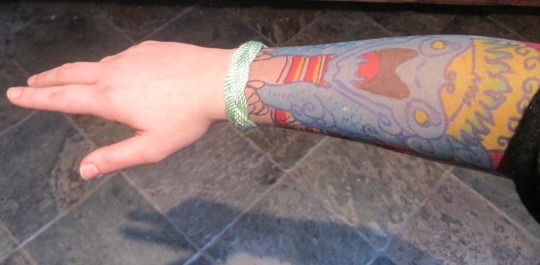
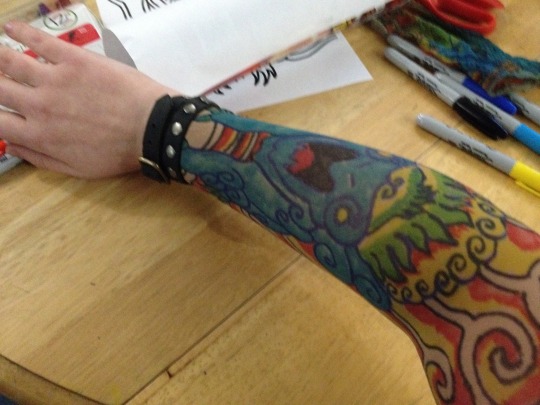
Got a cosplay idea but the character has lots of arm (or leg) tattoos? Don’t feel like painting on yourself with body paints or hunting down that horrendously expensive temporary tattoo paper? Here’s a quick tutorial for making tattoo sleeves using nylons and sharpie markers!
Upsides:
– Supplies are cheap! You may even have many or all the supplies you need right at home.
– Quick and not very messy! No paint is involved, and sharpie marker dries instantly.
– Easy! Great artistic skill not required.
– They move with your skin! People have legit thought these were real tattoos. From a distance, yes, but I had guys at cons with actual ink on their arms come over to compliment on my full (fake) sleeves.
– You get to eat pringles! More on that later.
Downsides:
– They are delicate. Nylons get holes in them super easy and forearms run into stuff, lean against things, and generally make it hard for the sleeves to survive. But if you only need them for a weekend, that’s ok.
– I haven’t experimented too much, but unfortunately this technique probably doesn’t work for wearers with darker skin tones. Sharpie ink is transparent, so any color it rests on just multiplies and the tattoo won’t show up very well. You’ll want to go the fabric paint or body paint route to get the best bold, bright tats.
– Can’t do white sections, because sharpie ink is transparent and doesn’t come in white. I leave them blank and they read OK, but the white areas will always be pink, tan, brown, etc. unless you dab in a little fabric paint, which will not be covered in this tutorial.
– Sharpie is supposed to be permanent marker, but on skin…it’s not. The ink will most likely wear off onto adjacent clothes. Not that big of a deal for me, as I tend to wear my tats with white shirts that can be bleached, but other shirts may not survive as well.
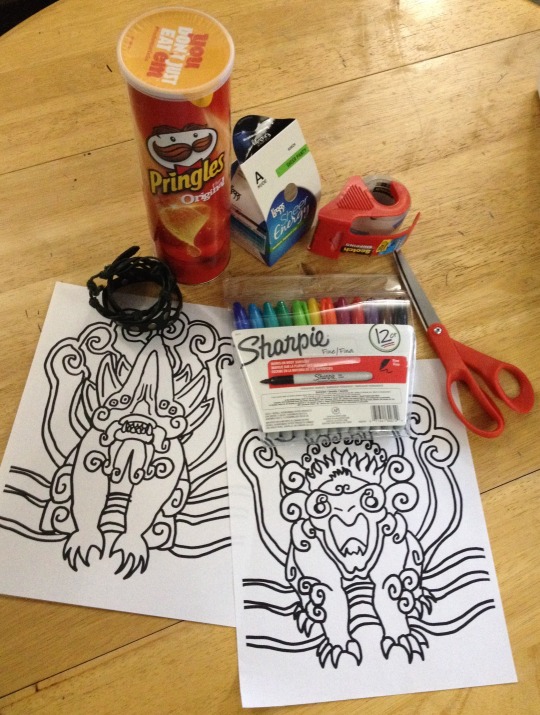
OK, let’s go! Here are your supplies:
You’ll need a pair of nylons, scissors, tape, a set of sharpies, your designs printed out on 8.5 x 11 paper, some bracelets, and a can of Pringles. You can use any design you want, of course, but Here is the link to these fine Newt Kaiju tattoo designs.
If your nylons have an undies part, cut the legs off and wear the undies on your head for the rest of the tutorial, if desired. Put the legs on your arm like so, and cut the toes off so you can slip your hand through. You can cut some of the top of the sleeve off as well, but don’t cut too much because you can’t put it back on if your sleeves are too short.
Here are my creepy sleeves. Now for the pringles.
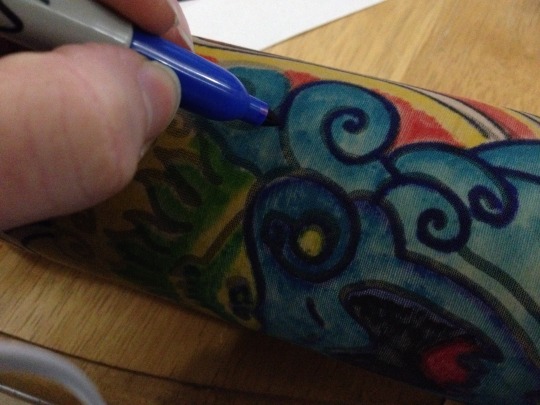
Tape your design template to the Pringles can. It doesn’t reach all the way around but eh. The Pringles can gives you a nice stable surface to draw on that is roughly the shape and size of an arm. It’s a little short, so just roll up the rest of the nylon above the workspace and adjust both template and nylon down when you get to working on that part of the sleeve.
Color with the markers! I recommend doing the colored areas first and then doing the black outlines on top of it, to avoid the black ink contaminating the ink pads of the lighter markers. Remember how that always happens to the yellow ones? Eww. Nylons are thin and slide around a bit, so it’s best to use short strokes and dotting to get the ink on.
Take the template off the Pringles tube, flip the paper to the blank side and put it back on again. The paper collects the extra ink, so it’s hard to see any missed spots. Now you can see any bits you may have missed. Fill them in for completion. Also, the paper doesn’t manage to wrap all the way around the Pringles can, so now is the time to free-hand a bit of the design where the template doesn’t reach. For Newt tattoos, that’s the back of the arm.
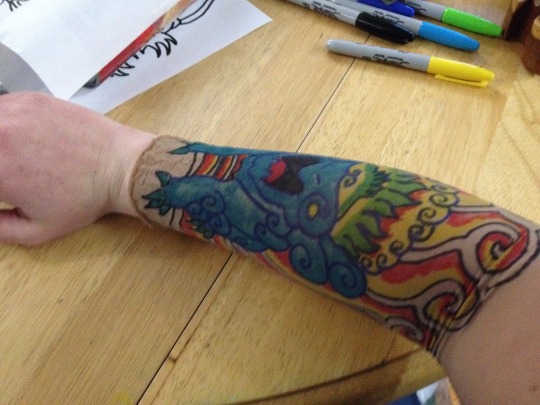
When you’re all done coloring, put them on!
There’s a rough end to the tattoo right at the wrist, of course. Disguise where the sleeve ends and your skin begins with some pretty bracelets:
There we are, much better!
Now…you’re done! Have some Pringles!
SLAMS THE REBLOG BUTTON
This is cool, and also a pretty good way to see if a sleeve tattoo idea would look good in real life too. I like this!
Mistake 1: Growing from seed. When you first start out trying to grow fresh herbs, I recommend you begin by trying to grow from seedlings rather than planting your own seeds. These great little starter plants are widely available in grocery stores in the late spring. For the same price as a packet of fresh herbs from the produce section, you can buy your own little starter plant. Lots can go wrong in the seed to seedling transition (including not thinning out plants properly), so its probably best to begin by skipping that complicated task or you are in danger of washing out before you really begin.
Mistake 2: Starting with the wrong varieties. I recommend you start by trying to grow fresh basil. It is the perfect trainer herb. First, basil grows quickly, allowing you to observe the effects of your care more easily. Second, basil leaves wilt visibly when not watered enough, but recovers well if you water the wilted plant. This makes basil a great ‘canary in the mineshaft’ to help you figure out how much water is enough.
Mistake 3: Watering herbs like houseplants. Instead, water herbs a moderate amount every day. While some houseplants flourish with one solid watering per week, most delicate herbs require moderate and regular watering. This is particularly true during hot summer months. If you have good drainage at the bottom of your pot (at least a drainage hole, possibly rocks beneath the soil), it will be difficult to water herbs too much.
Mistake 4: Not cutting early and often. As a novice gardener, it may seem like your puny little plant just isn’t ready for a trip to the barber, but then you will find yourself sitting there wishing for leaves without much success. Again, basil is a great herb to practice pruning. As with all herbs, you want to cut the herb just above a set of growing leaves. With basil, when you cut the plant that way, the originally trimmed stem will no longer grow. However, two new stems will grow around the original cutting, creating a “V” shape (see the photo above, can you spot the Vs?). If you don’t trim basil aggressively, it will continue to grow straight up, and become too tall and top-heavy. Making your first trim approximately 3-4” above the soil produces a nice sturdy plant. Of course you want to be sure you are always leaving a few good sturdy leaves on the plant (see below). As it continues to grow, continue to prune it approximately every 3-4" for a nice solid plant. I like to let it grow for some time and then cut back to within 2-3 inches of the original cut. After only a few early trial cuts, this usually makes for a nice clipping with plenty of basil to use for a pizza.
Mistake 5: Taking the leaves from the wrong place. When you are just starting out it seems to make so much sense to pick off a few big leaves around the bottom of the plant, and let those tender little guys at the top keep growing. Wrong. Leave those large tough old guys at the bottom alone. They are the solar panels that power your herb’s growth. Once your plant is big enough to sustain a decent harvest, keep on taking from the top, as you have been when you were pruning. That way you get all those tender new herbs that are so tasty, and your plant gets to keep its well developed solar power system in place. Plus, if you pluck from the base and leave the top intact, you get a tall skinny plant that will flop over from its own weight (and yes, I know this from experience). When you pluck from the top, instead of clipping off just below a pair of leaves, you want to clip off just above a pair of leaves. It is a bit counter-intuitive as a novice, but trust me it works. The place where the leaf joins the stem is where new growth will occur when your plant sends off new stems in a V.
Mistake 6: Letting your plants get too randy. If you are pruning regularly, this may never become an issue, but unless you are growing something for its edible flowers, be sure to cut back herbs before they start growing flowers. My friend once brought me to her backyard garden and pointed, frustrated, at her wimpy, small basil plants. “I just keep tending them, but they don’t even produce enough leaves to put on a salad!” she lamented. I pointed to the glorious stalk of flowers at the top of each plant, “That’s your problem” I explained. Because herbs are kind of like college boys: if you give them half a chance, they will focus all their energy on procreation and neglect growth. If you want leaves, keep cutting off the little flower buds whenever you find them (see photo above), and it will encourage your plant to focus on growing more leaves.
Mistake 7: Using tired soil with no nutrients. Tired soil that has been sitting in your garden or lawn for ages often looks grey and a little depressing. Would you want to grow in that stuff? Give your plants a dose of the good stuff and they’ll thank you for it. I grow my herbs in a combination of potting soil, used coffee grounds (with a near-neutral PH, available for free at Starbucks), and organic compost. If I have some on hand, I also throw in crushed egg shells. Those without access to compost (and no deep commitment to organic growing) may find Miracle grow useful. My momma swears by it for tomatoes. A diluted solution of Miracle grow occasionally can help many herbs flourish.
Mistake 8: Getting in a rut. There is an element to passion about herb gardening. In order to be good at it, you need to feel rewarded. So don’t stick too long with one or two herbs just because they work. Branch out to a few other basic herbs that you will use regularly in your kitchen. There are few things more rewarding as an urban foodie than being able to pop out to the fire escape to clip fresh herbs to use in my cooking. Once you have become comfortable with basil, I recommend moving on to try growing oregano, mint, rosemary and thyme. All are regularly useful herbs in the kitchen, and all are relatively easy to grow. You will notice that rosemary cleaves after cutting in a somewhat similar way to basil, but grows much more slowly, so the effect is difficult to notice. Some plants also respond to clipping by throwing out more full leaves at their base. I have long wanted to grow cilantro but have not had much luck with it.
Mistake 9: You mean there’s more than one kind of mint?When choosing herbs, read the label carefully. For example, there are two main varieties of oregano: Mediterranean and Mexican. Mediterranean oregano is the more common variety, and what you likely own if you have conventional dried oregano in your cupboard. I have Mexican oregano growing on my back fire escape. I love Mexican oregano in spicy dishes, for making beans from scratch, and often use it in tomato dishes where I don’t want the flavor to seem too much like marinara. Similarly, there are many different kinds of mint. You don’t want to be thinking of the pungent spearmint plant and accidentally take home the much more subtle (and not mojito savvy) applemint by mistake.
Mistake 10: Feed me Seymour! If you are planting in soil instead of pots, take care that your cute little herb seedling doesn’t become a giant plant that takes over your garden. A word of warning for oregano and mint: both can be voracious growers. If you are planting outside in a garden, rather than in pots, you may want to consider potting these herbs and then burying the pots in the ground. This will add a measure of control to the root systems of these herbs, which can otherwise take over a garden and strangle nearby neighbors. When in doubt, check out wikipedia, they usually are careful to point out which herbs are in danger of overwhelming your garden.
Some really useful info here if you’re new to herb gardening.
I feel like the reason certain dog-lovers insist cats are evil is because they read their body language as if they were dogs. So here’s a very basic guide to common “mean” things cats do that actually aren’t mean at all if you know what they’re thinking.
Rolling and exposing belly- attacks you when touched Does not mean: Give belly rubs! – haha I tricked you! Actually means: I’m playful! If you reach for my belly I’ll grab your arm and bite it because I think we’re playfighting!
Lazily exposing belly – still attacks when touched Does not mean: tricked you again! Actually means: I’m showing you my belly because I trust you. Please don’t break that trust by invading my personal space. I might accept a belly rub if I’m not ticklish and I know you well.
Snapping at you while being pet Does not mean: I suddenly decided I dislike you! Actually means: You’re petting me in a way that gives me too much restless energy. Please focus on petting my head and shoulders instead of stroking the full length of my back next time.
Is in the same room but makes no attempt to interact Does not mean: I’m ignoring you Actually means: We’re hanging out! I’m being respectful by giving you space while still enjoying your company.
Slapping/scratching your hand when you try to pet them Does not mean: I hate you! Actually means: You’ve failed to establish that we’re not playing, or the way you’re approaching me scares me. Be calmer, speak more gently, make eye-contact and blink slowly at me before you try again.
THANK YOU!! so tired of people calling cats evil cos they got scratched by one once when they were 12 🙄 the livelihood of animals does not come down to whether or not you “like them”
can i just get on with trying to interact comprehensibly with other humans now i’m anxious about misunderstanding cat social cues
alternates biting with licking: i’m combing out knots in the fur you don’t have, it’s part of the social grooming process
turns back on you: i trust you to watch my back
rubs your ankle and then dances out of reach when you try to pet: hey i was just saying hi, not in the mood for anything else
honestly i think a lot of cat hate comes down to dog lovers being used to dogs submitting, obeying, and being desperate to please them. cats are not submissive and they’re not desperate to please you. you’re not the axis of their universe. they know what they want and won’t put up with being treated like a thing. anyone who hates cats for enforcing their own boundaries is suspect, imo. are they going to hate me for the same reason?
Can confirm. I mean, even though my cat actually does put up with being treated like a thing, etcetera. But she’s weird.
your cat is so big and strong that she knows she could get down if she wanted, whether you wanted to put her down or not. so i think she feels pretty secure about being carried around like a teddy bear. also, she doesn’t let anyone but you carry her.
Right now, I’m sifting through 50+ applications for a new entry-level position. Here’s some advice from the person who will actually be looking at your CV/resume and cover letter:
‘You must include a cover letter’ does not mean ‘write a single line about why you want this position’. If you can’t be bothered to write at least one actual paragraphs about why you want this job, I can’t be bothered to read your CV.
Don’t bother including a list of your interests if all you can think of is ‘socialising with friends’ and ‘listening to music’. Everyone likes those things. Unless you can explain why the stuff you do enriches you as a person and a candidate (e.g. playing an instrument or a sport shows dedication and discipline) then I honestly don’t care how you spend your time. I won’t be looking at your CV thinking ‘huh, they haven’t included their interests, they must have none’, I’m just looking for what you have included.
Even if you apply online, I can see the filename you used for your CV. Filenames that don’t include YOUR name are annoying. Filenames like ‘CV – media’ tell me that you’ve got several CVs you send off depending on the kind of job advertised and that you probably didn’t tailor it for this position. ‘[Full name] CV’ is best.
USE. A. PDF. All the meta information, including how long you worked on it, when you created it, times, etc, is right there in a Word doc. PDFs are far more professional looking and clean and mean that I can’t make any (unconscious or not) decisions about you based on information about the file.
I don’t care what the duties in your previous unrelated jobs were unless you can tell me why they’re useful to this job. If you worked in a shop, and you’re applying for an office job which involves talking to lots of people, don’t give me a list of stuff you did, write a sentence about how much you enjoyed working in a team to help everyone you interacted with and did your best to make them leave the shop with a smile. I want to know what makes you happy in a job, because I want you to be happy within the job I’m advertising.
Does the application pack say who you’ll be reporting to? Can you find their name on the company website? Address your application to them. It’s super easy and shows that you give enough of a shit to google something. 95% of people don’t do this.
Tell me who you are. Tell me what makes you want to get up in the morning and go to work and feel fulfilled. Tell me what you’re looking for, not just what you think I’m looking for.
I will skim your CV. If you have a bunch of bullet points, make every one of them count. Make the first one the best one. If it’s not interesting to you, it’s probably not interesting to me. I’m overworked and tired. Make my job easy.
“I work well in a team or individually” okay cool, you and everyone else. If the job means you’ll be part of a big team, talk about how much you love teamwork and how collaborating with people is the best way to solve problems. If the job requires lots of independence, talk about how you are great at taking direction and running with it, and how you have the confidence to follow your own ideas and seek out the insight of others when necessary. I am profoundly uninterested in cookie-cutter statements. I want to know how you actually work, not how a teacher once told you you should work.
For an entry-level role, tell me how you’re looking forward to growing and developing and learning as much as you can. I will hire genuine enthusiasm and drive over cherry-picked skills any day. You can teach someone to use Excel, but you can’t teach someone to give a shit. It makes a real difference.
This is my advice for small, independent orgs like charities, etc. We usually don’t go through agencies, and the person reading through the applications is usually the person who will manage you, so it helps if you can give them a real sense of who you are and how you’ll grab hold of that entry level position and give it all you’ve got. This stuff might not apply to big companies with actual HR departments – it’s up to you to figure out the culture and what they’re looking for and mirror it. Do they use buzzwords? Use the same buzzwords! Do they write in a friendly, informal way? Do the same! And remember, 95% of job hunting (beyond who you know and flat-out nepotism, ugh) is luck. If you keep getting rejected, it’s not because you suck. You might just need a different approach, or it might just take the right pair of eyes landing on your CV.
And if you get rejected, it’s worthwhile asking why. You’ve already been rejected, the worst has already happened, there’s really nothing bad that can come out of you asking them for some constructive feedback (politely, informally, “if it isn’t too much trouble”). Pretty much all of us have been hopeless jobseekers at one point or another. We know it’s shitty and hard and soul-crushing. Friendliness goes a long way. Even if it’s just one line like “your cover letter wasn’t inspiring" at least you know where to start.
And seriously, if you have any friends that do any kind of hiring or have any involvement with that side of things, ask them to look at your CV with a big red pen and brutal honesty. I do this all the time, and the most important thing I do is making it so their CV doesn’t read exactly like that of every other person who took the same ‘how-to-get-a-job’ class in school. If your CV has a paragraph that starts with something like ‘I am a highly motivated and punctual individual who–’ then oh my god I AM ALREADY ASLEEP.
Very good post thanks for this.
Excellent advice for building and submitting job application documents.
This is the first good resume advice post I’ve seen on this site. Much better advice than the “lists of active verbs to use” and “here are resume templates”. Follow this advice.
Oh my gosh @crazyfanatic97 do you remember last year when we were discussing the logistics of how one might go about turning a prom dress into a murder dress? Well now we know.



 just moving along like everyone else