Anonymous asked: Hi! I’m writing novel and I’m having a really hard time figuring out filler events. I’ve got basic things that happen but nothing is really that exciting, to be honest. It’s just basic interactions with a group of around ten people. I guess I’m not really sure what my point of the novel is and I know I want it to mean something more than an abstract representation of who I am.
Well, you never want to have “filler events” in a novel, because all they do is waste time, and readers don’t like to have their time wasted.
Instead, do this:
1. Choose a conflict for your story.
Conflict is the engine which drives the story forward. Without it you have a flat story. It sounds complicated, but conflict is just the struggle that the story is all about. The conflict of Harry Potter series was the struggle to defeat Voldemort. The conflict of The Hunger Games series was the struggle to defeat the Capitol (first by winning The Hunger Games, then by winning the rebellion.) And the conflict of The Lord of the Rings series was the struggle to destroy the One Ring and bring peace to the land. But a conflict doesn’t have to be so grand–it can be as simple as the struggle to survive your senior year of high school, the struggle to make friends in a new town, or the struggle to win the heart of the cute guy who runs the yogurt stand near your work. Whatever you choose, this struggle–this conflict–will fill out your story and give it the point that it’s currently missing.
2. Choose a goal for your characters.
Conflict is the struggle itself, but the goal is the point the characters are struggling toward. In The Hunger Games, Katniss wasn’t really looking to defeat the Capitol so much as she just wanted to survive. It just so happened that in order to do that, she had to thwart and then defeat the Capitol. If your conflict is the struggle to survive the last year of high school, the goal the character is struggling toward might be to get good grades and stay out of trouble. The goal is tied to the main conflict but is more personal to the character.
3. Figure out your character’s motivation.
Motivation drives the character through the struggle, toward the goal. It’s the reason that they want to win the struggle. It’s why they do everything that they do. Why did Katniss want to survive? Because she wanted to take care of her loved ones. Why does your character want to get good grades and stay out of trouble all year? Maybe success means parental permission to backpack across Europe over the summer. Once you choose your character’s motivation, your character’s actions will make more sense.
4. Decide on an antagonist.
You can’t have a struggle without an opposing force. If you had a tug o’ war with people on only one end of the rope, they would pull the rope and instantly win. They would have nothing to struggle against, and it would be boring. But if you put people on the other end of the rope, pulling with all of their might, now the people on the other end of the rope have something to struggle against. The antagonist is the person, people, thing, things on the opposite end of the rope. Every time your character starts to gain ground in the tug o’war struggle of your story, it’s the antagonist’s job to yank hard on that rope and cause your protagonist to lose ground. The motivation provides the pull from the character’s end, the antagonist provides the pull form the opposite end.
The antagonist can be a super villain, it could be a well-meaning but overstrict parent, it could be bullies, a catastrophic weather event, an evil dystopian government–whatever you want. And it doesn’t have to be something bad. It just has to be something which, for whatever reason, creates obstacles to whatever goal your character is trying to reach.
5. Choose obstacles.
Once you’ve settled on your antagonist (or antagonists if you have more than one), you need to figure out what obstacles will best stand in your protagonist’s way. You should choose some they can tackle easily, and some that will throw them off their game. Sometimes they will fail and come back at it a second time and triumph. If your antagonist is a strict teacher, perhaps the first obstacle is a pop quiz which your character aces without batting an eyelash. But maybe the next obstacle is a group assignment–which is bad news for your character who doesn’t play well with others. The group assignment goes south and results in a D grade for the character. So, the character has to figure out how to tackle that bad grade and bring it up. Perhaps they choose to do extra credit which fails to get the grade up above a C. This is an “all is lost” moment for the character, but then maybe they do something great in class and the teacher awards them with more extra credit, which brings their grade up to a B. Your protagonist is ready to pack their bags from Europe when they find out that the final exam will account for a whopping 75% of their grade–mom and dad require all A’s for the trip to be a go… can your character do it? The uncertainty as your character attacks each obstacle is part of what keeps the reader turning pages.
When you’ve done all of the above, you’ll find that your story comes together much easier and that you suddenly have much more to write about. This is just the tip of the iceberg, but it’s enough to get your story to a much better place. 🙂
So you’ve got this bitch-ass fitted sheet that you would normally pile into a ball and shove into a closet so you won’t have to deal with it, yeah? Well. Quit acting like a piece of linen is better than you are. You can make a fitted sheet bend to your will. And here’s how…
First, put your sheet on the floor. Stand above it for a few seconds so it knows who’s boss.
Then, put your hand in the lower left corner so that it’s inside out. Do the same to the lower right corner.
Now, your lower left and right corners of the fitted sheet should be inside out. (Shoutout to Amy Poehler, love your work).
Then, take the lower left corner (that’s still inside out) and tuck it into the upper left corner. It should look like the picture above once you’re done. Then, do the same with your right corners.
It should look something like that. Right now, she’s your friend at the end of a good night out. Doesn’t look really bad, but you know she deserves better.
Pull at the corners until you get something like this shape, as it makes it easier to fold. You’ve given your friend some plain white bread and a glass of water. She’s looking much more presentable now.
Now, pull in at the elastic until you make a rectangle. You’ll want to tuck and smooth the excess fabric away from the elastic seams and towards the closed edge of the fitted sheet.
Once you’ve got a (semi) neat rectangle, fold the the top of the sheet down about a third of the way through. I like to fold the upper part of the sheet down first, because it’s not as straight of an edge as the bottom. You can find your own meaning within that description.
Now, fold the lower portion of the sheet on top of the part you’ve already folded down.
Fold the left side of the sheet into the middle, and then fold the right side of the sheet on top of what you just folded.
Congratulations. You just made a fitted sheet your bitch.
Gather ‘round kids: I had a coworker mention to me this morning that it’s impossible to get grease stains out of fabric. As a former chemistry minor who worked two years under the table doing housekeeping and who generally tends to be a fucking disaster, I am here to tell everyone that it absolutely is not impossible, in case this is a widespread belief. Here are a few of my favorite cleaning stain removers that I always have at home.
Here are some options:
A Tide™ pen.
I’m a generic kinda lady. I hate promoting brands 99% of the time. BUT if you catch absolutely any kind of stain before it gets ground in, you can get most of it out with one of these babies. I’ve tested it on blood, chocolate, coffee, guacamole, pizza sauce, red wine on, on that one time i accidentally slopped some oil I was supposed to be using on antiques onto a fancy rug (also an antique but not the one I was gunning for). If you’re washing something delicate, pump it onto your finger a couple of times and gently rub it in. I’m not sure what they put in these things but I’m pretty sure it’s an arcane secret.
Dish soap
Granted, this is a little trickier for upholstery/carpet, but it can still be done using a rag, some water, and some patience. But for clothing, just pour some soap on the stain and rub it in under cold running water.
Absolutely any clear alcohol is your new best friend
You know the old “white wine to clean red” trick? Well, this is its updated sister I like to call “you, too, can use coconut rum to get red jello shot out of your nice white dress”. It’s a nice party trick. Straight vodka works even better. For every day situations involving any kind of alcohol-related spills (including markers)–and especially work situations–rubbing alcohol is ideal. To quote another adage, this one from every chemistry teacher you will ever meet, “like dissolves like.”
Hydrogen Peroxide
It can get blood out of absolutely anything, including your mattress. It reacts with the iron in hemoglobin, which breaks down the molecule, causing it to lose its red color. So make sure you’re not using a cast iron skillet to wash your period underwear in.
Vinegar
This will dissolve lime buildup overnight. Fill a bag, tie it around your showerhead, and presto. You can also use it to scrub the area around your sink and to break up any buildup in pipes. (Limeaway™ is for rich people.)
Baking soda
This is great if you have a pet or child who peed on the carpet. Just cover the area, wait until it dries, and vacuum it up. The longer you leave it, the better it will do at removing the smell. It’s also good removing mild odors from a small space, like a fridge or a laundry hamper.
Charcoal
This is your heavy duty odor killer. A little goes a long way. In chemistry, activated charcoal is used as a purifier in reactions, and in medicine, it can be used to treat mild poisoning/overdoses. In your car that smells like someone died because you forgot you had potatoes in the trunk for six months? All you need are regular old charcoal briquettes. Stick a couple handfuls in a flat box and the smell will be gone overnight. Guaranteed. For larger areas, just use more charcoal.
Baking soda is also good for stuff stuck on pots pans and your stove top. Add a little bit of water and elbow grease and it’s like magic
vinegar will also de-scale your coffeemaker. add a cup of vinegar to a pot of water and run it through a few times, then brew a few pots of clean water to rinse.
for mold and mildew, use diluted bleach. it not only removes the fungus and the stain, it kills spores to keep it from growing again. if you’re using it on fabric, though, be aware that a) it’s still bleach and will still bleach things, and b) it will weaken the fabric if it’s not diluted enough or if you leave it on too long.
rubbing alcohol is best for ink stains from markers and ballpoint pens. it will NOT help with squid ink, which is protein-based, i believe; use peroxide for that as with blood. do not use vinegar or anything acidic for any stain on wool, silk, or other animal fibers, as it will set the stain like acid dye and you’ll never get it out.
as for india ink, i have no idea; once it’s dry, it’s molecularly bonded to itself and everything else. greedy grabby carbon atoms don’t like to let go of stuff.
Writing books often exhort you to “write a shitty first draft,” but I always resisted this advice. After all,
I was already writing shitty drafts, even when I tried to write good ones. Why go out of my way to make them shittier?
A shitty first draft just kicks the can down the road, doesn’t it? Sooner or later, I’d have to write a good draft—why put it off?
If I wrote without judging what I wrote, how would I make any creative choices at all?
That first draft inevitably obscured my original vision, so I wanted it to be at least slightly good.
Writing something shitty meant I was shitty.
So for years, I kept writing careful, cramped, painstaking first drafts—when I managed to write at all. At last, writing became so joyless, so draining, so agonizing for me that I got desperate: I either needed to quit writing altogether or give the shitty-first-draft thing a try.
Turns out everything I believed about drafting was wrong.
For the last six months, I’ve written all my first drafts in full-on don’t-give-a-fuck mode. Here’s what I’ve learned so far:
“Shitty first draft” is a misnomer
A rough draft isn’t just a shitty story, any more than a painter’s preparatory sketch is just a shitty painting. Like a sketch, a draft is its own kind of thing: not a lesser version of the finished story, but a guide for making the finished story.
Once I started thinking of my rough drafts as preparatory sketches, I stopped fretting over how “bad” they were. Is a sketch “bad”? And actually, a rough draft can be beautiful the same way a sketch is beautiful: it has its own messy energy.
Don’t try to do everything at once
People who make complex things need to solve one kind of problem before they can solve others. A painter might need to work out where the big shapes go before they can paint the details. A writer might need to decide what two people are saying to each other before they can describe the light in the room or what those people are doing with their hands.
I’d always embraced this principle up to a point. In the early stages, I’d speculate and daydream and make messy notes. But that freedom would end as soon as I started drafting. When you write a scene, I thought, you have to start with the first word and write the rest in order. Then it dawned on me: nobody would ever see this! I could write the dialogue first and the action later; or the action first and the dialogue later; or some dialogue and action first and then interior monologue later; or I could write the whole thing like I was explaining the plot to my friend over the phone. The draft was just one very long, very detailed note to myself. Not a story, but a preparatory sketch for a story. Why not do it in whatever weird order made sense to me?
Get all your thoughts onto the page
Here’s how I used to write: I’d sit there staring at the screen and I’d think of something—then judge it, reject it, and reach for something else, which I’d most likely reject as well—all without ever fully knowing what those things were. And once you start rejecting thoughts, it’s hard to stop. If you don’t write down the first one, or the second, or the third, eventually your thought-generating mechanism jams up. You become convinced you have no thoughts at all.
When I compare my old drafts with my new ones, the old ones look coherent enough. They’re presentable as stories. But they suck as drafts, because I can’t see myself thinking in them. I have no idea what I wanted that story to be. These drafts are opaque and airless, inscrutable even to me, because a good 90% of what I was thinking while I wrote them never made it onto the page.
These days, most of my thoughts go onto the page, in one form or another. I don’t waste time figuring out how to say something, I just ask, “what are you trying to say here?” and write that down. Because this isn’t a story, it’s a plan for a story, so I just need the words to be clear, not beautiful. The drafts I write now are full of placeholders and weird meta notes, but when I read them, I can see where my mind is going. I can see what I’m trying to do. Consequently, I no longer feel like my drafts obscure my original vision. In fact, their whole purpose is to describe that vision.
Drafts are memos to future-you
To draft effectively, you need a personal drafting style or “language” to communicate with your future self (who is, of course, the author of your second draft). This language needs to record your ideas quickly so it can keep up with the pace of your imagination, but it needs to do so in a form that will make sense to you later. That’s why everyone’s drafts look different: your drafting style has to fit the way your mind works.
I’m still working mine out. Honestly, it might take a while. But recently, I started writing in fragments. That’s just how my mind works: I get pieces of sentences before I understand how to fit them together. Wrestling with syntax was slowing me down, so now I just generate the pieces and save their logical relationships for later.Drafting effectively means learning these things about yourself. And to do that, you can’t get all judgmental. You can’t fret over how you should be writing, you just gotta get it done.
Messy drafts are easier to revise
I find that drafting quickly and messily keeps the story from prematurely “hardening” into a mute, opaque object I’m afraid to change. I no longer do that thing, for instance, where I endlessly polish the first few paragraphs of a draft without moving on. Because how do you polish a bunch of fragments taped together with dashes? A draft that looks patently “unfinished” stays malleable, makes me want to dig my hands in and move stuff around.
You already have ideas
Sitting down to write a story, I used to feel this awful responsibility to create something good. Now I treat drafting simply as documenting ideas I already have—not as creation at all, but as observation and description. I don’t wait around for good words or good ideas. I just skim off whatever’s floating on the surface and write it down. It’s that which allows other, potentially better ideas to surface.
As a younger writer, my misery and frustration perpetuated themselves: suppressing so many thoughts made my writing cramped and inhibited, which convinced me I had noideas, which made me even more afraid to write lest I discover how empty inside I really was. That was my fear, I guess: if I looked squarely at my innocent, unvetted, unvarnished ideas, I’d see how bad they truly were, and then I’d have to—what, pack up and go home? Never write again? I don’t know. But when I stopped rejecting ideas and started dumping them onto the page, the worst didn’t happen. In fact, it was a huge relief.
(Just thought I’d share this in case someone finds it useful!)
This is basically all the advise my speech therapist has given me so far, just condensed and without the exercises and it’s really amazing advice! I’d also suggest that if you have a smartphone get an app called voice analyst because it gives you feedback on your average pitch as well as showing you how low your pitch gets, and for me and lots of other girls an issue in passing as that we can get our voices up to around 200hz but several times per sentence drop back to like 120 and it shows you when you’re doing that so you can focus on it.
I’ve been reading a lot of Check Please fic lately, and while they tend to be well researched on the actual hockey gameplay, they are not always accurate when it comes to some specific college hockey conventions. So since I go to a school that plays ECAC hockey, and happen to know a good bit about the team from being in the band (side note – where are my Samwell Pep Band headcanons? Come on guys), I figured I would share.
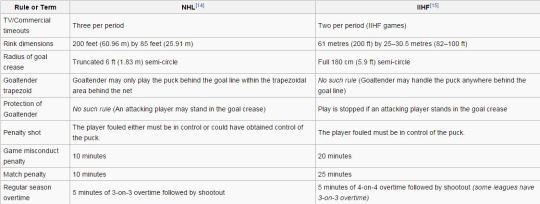
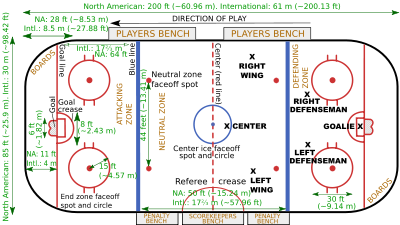
The size of an international rink is 200 ft by 100 ft (61m by 30.5m)
The size of an international rink is 200 ft by 85 ft (61m by 26m)
There are three periods in a game
Each period lasts for 20 minutes with a 17 minute period break in between
“In the National Hockey League, between stoppages of play, teams have 18 seconds (five seconds for the visiting team, eight seconds for the home team, five seconds to line up at the faceoff location) to substitute their players, except during TV timeouts.” [x]
TV Time outs are 2 minutes long and occur 3 times per period (In the NHL)
There are 6 players allowed on the ice per team at one time (1 LW, 1 Center, 1 RW, 2 D-men and 1 goalie)
A shutout is when a goalie doesn’t allow any goals in during a game. For example the score could be 3-0
A shootout is a way to break the tie after 5 minutes of overtime.
Each team names three shooters. If the game remains tied after the three shooters are done, teams continue shooting in “sudden death” mode. The game cannot end until each team has taken the same number of shots. [x]
Too Many Men on the Ice (this video gives a good visual of what this penalty looks like. There are 6 players plus the goalie on the ice for one team which is against the rules.)
G =Goals. A goal is awarded to the last player on the scoring team to touch the puck prior to the puck entering the net. Note: Goals scored during a shootout do not count towards a player’s goal total.
A =Assists. An assist is awarded to the player or players (maximum of two) who touch the puck prior to the goal, provided no defender plays or possesses the puck in between.
P or PTS =Points. The sum total of goals and assists.
GW = Game-winning goals. After the final score has been determined, the goal which leaves the winning team one goal ahead of its opponent is the game-winning goal (example: if Team A beats Team B 8-3, the player scoring the fourth goal for Team A receives credit for the game-winning goal). Note: Goals scored during a shootout are not credited as game-winning goals.
W = Wins.A goaltender receives a win if he is on the ice when his team scores the game-winning goal.
L = Losses. A goaltender receives a loss if he is on the ice when the opposing team scores the game-winning goal.
OT = Overtime or shootout losses. As of the 2005-06 NHL season, a goalie is credited with an “OT” if he is on the ice when the opposing team scores the game-winning goal in overtime or during a shootout.
GA = Goals against. Empty net goals do not count towards a goaltender’s goals against. Goals scored during a shootout do not count towards a goaltender’s goals against.
SO =Shutouts. If two goaltenders combine for a shutout, neither receives credit for the shutout. Instead it is recorded as a team shutout. If a regular season game is tied 0-0 at the end of overtime, both goaltenders are credited with a shutout, regardless of how many goals are scored in the shootout.
Team/League Stats:
A team’s stats are determined by their Win-Loss-Loss in Overtime record. For example: a team could be 12-5-4. That team would have 12 wins, 5 losses and 4 losses in overtime.
A team’s points are determined by their Win-Loss-Loss in Overtime record. Continuing on with the previous example, the team would have 28 points. Multiply the team’s winning record by 2 and add it to their OT loss record. (one point awarded for a loss in overtime) 24+4=28
An empty net goal occurs when a team scores a goal into a net with no goaltender present. This usually occurs in one of two different occasions:Usually in about the last two minutes of a game, if a team is within two goals, they will often pull the goalie, leaving the net defenseless, for an extra attacker, in order to have a better chance of scoring to either tie or get within one goal. If the team with the lead gets control of the puck they will often shoot at the net after clearing center ice. It is less common for a team to shoot from their own zone at an empty net because icing could occur if the shooter misses the net. Sometimes a team will pull their goalie when they are on a two-man advantage, even if not nearing the end of the game. With the team then gaining an advantage of six skaters to three, this will increase even further the chances of the team scoring. [x]
A goal is scored when the puck passes entirely across the red line painted between the goal posts and below the crossbar. A goal may be disallowed under the following circumstances:
the scoring team takes a penalty (except if the other team accidentally puts the puck into its own net untouched by the team to be penalized);
the puck is directed in by an attacker’s high stick (above the crossbar), or when the puck has been directed, batted, thrown or kicked into the net by an attacking player other than with a stick (angling one’s skate so the puck deflects off it into the goal is allowed).
goaltender interference (which can also result in a penalty)
the puck goes in after the Referee intends to stop play (e.g. the net has been dislodged)
the puck deflects off a referee or linesman and goes directly into the goal (exception to the rule that a puck hitting a referee or a linesman is still live)
a goal was allowed at the other end (this can happen if a video review clarifies a goal scored prior)
DO NOT EVER PARTICIPATE IN MEAN GOALIE CHANTS IT IS VERY RUDE (remember: love thy goalie)
The maximum number of players on an NHL roster is 23.
The diameter of a hockey puck is three inches (ooh fun fact 😀 )
Regulation hockey nets are six feet wide and four feet tall.
82 games are played per team in one season (NHL)
There are 30 teams in the NHL and they are divided into two divisions: The Eastern and Western Conferences
There are 16 teams in the Eastern Conference
There are 14 teams in the Western Conference
The NHL regular season starts in October and ends in early April
DON’T EVER CALL SOMEONE A PUCK SLUT/PUCK BUNNY. RESPECT ALL FANS!!
I know it’s a lot to take in, but hopefully you learned a little something about the sport. Remember: everyone has to start somewhere, you’ll catch on soon! Please feel free to add on to this list as I might have forgotten something!
Reblogging for my followers who might have trouble remembering whether or not they’ve taken their medicine!
OH MY GOD, THIS WILL HELP ME SO MUCH. I GET SO SCARED WHEN I DON’T KNOW IF I JUST TOOK MY MEDS TWICE.
THANK YOU, I’M ABOUT TO CRY.
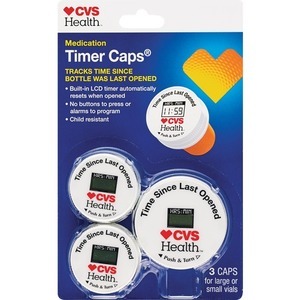
Let me share with you guys a product that super helps me remember if I took my meds or not (because while the above is great, I still would manage to confuse myself):
They count as soon as you put the top back on. So if I don’t know if I’ve taken my medication for the day, I can check the cap to see how long ago I opened the container! It’s brilliant!
JFC THIS IS A GAME CHANGER.
I KNOW THIS IS MY ART BLOG BUT EVERYONE WHO TAKES MEDS SHOULD SEE THIS.
“Organic” isn’t better for you or for the environment. It actually means nothing of any significance at best and is sometimes even the more wasteful, more hazardous option.
A shitload of “natural” food including a lot of imported produce is grown and harvested through slave labor in inhumane conditions.
Pizza, fried chicken, french fries, fast food, candy bars and chips ARE nutritious. They are loaded with good things. Just because they have an abundance of excess fats and might not be healthy as a staple doesn’t mean they are “nutritionless” or that their calories are “empty.” Those are hokey buzzwords pushed by the people in charge of how much you pay for the alternatives.
Eating healthier costs more. Much more. Looking down on people for their reliance on cheaper food is extremely classist and expecting everyone to be able to live off fresh veggies and cage-free meats is insultingly unrealistic in the modern world.
“Processed” literally only means the food went through some kind of automated process. This can be literally the exact same thing a human being would have done to the food for it to be labeled “unprocessed.” Being processed does not make something less healthy.
Chemicals with long, scary names are part of nature. An apple is full of compounds you probably can’t pronounce. A shorter ingredients label only means they didn’t bother listing all 300 things the product is actually made of and HAS to be made of.
Preservatives, artificial flavors and other additives are not the devil. Most are harmless and in general they are part of the reason you haven’t already starved to death or died of a food borne illness.
MSG is not bad for you at all.
The fact that something might be made of “scrap” meats like pig snouts or chicken necks only means one thing: that we didn’t waste perfectly normal, edible meat.
I DON’T KNOW HOW I FORGOT THIS IN MY FIRST VERSION OF THIS POST BUT GMO’S ARE NOT DANGEROUS TO EAT. GMO’S ARE SAVING LIVES. YOU’VE ALREADY EATEN GMO’S BEFORE YOU EVEN KNEW THE TERM. IT’S FINE. EAT THEM.
It pisses me off when big time chefs go “guys do you not know what goes into canned meatballs? They’re disgusting!” yeah parts of the animal they don’t use for anything else and also they’re tasty fuck you
I could find no material that references pig snouts and chicken necks as any different from meat from the more commonly eaten parts of those animals. Most people use them in soups to make a stronger broth, since they do contain a lot of flavor despite not a lot of tangible meat.
Hey thanks! I didn’t add sources to the original post just because I thought it was minor personal venting and not something that would get tens of thousands of notes.




 just moving along like everyone else