“When you believe without knowing you believe that you are damaged at your core, you also believe that you need to hide that damage for anyone to love you. You walk around ashamed of being yourself. You try hard to make up for the way you look, walk, feel. Decisions are agonizing because if you, the person who makes the decision, is damaged, then how can you trust what you decide? You doubt your own impulses so you become masterful at looking outside yourself for comfort. You become an expert at finding experts and programs, at striving and trying hard and then harder to change yourself, but this process only reaffirms what you already believe about yourself – that your needs and choices cannot be trusted, and left to your own devices you are out of control.”
“I suggest that the only books that influence us are those for which we are ready, and which have gone a little further down our particular path than we have yet gone ourselves.”
“Being what you are looks like this: You enter every room as a calm, neutral observer. You are average. You don’t have an agenda. Your only job is to listen and observe and offer your support. Your only job is to watch and learn and allow room for yourself, even when you don’t say a word, even when you don’t look that good, even when you seem useless. There you are, giving yourself the right to be without running or hiding or dancing. That is grace. It matters.
Being still and silent and broken is its own kind of religion.
Doing this — existing around other people without proving yourself — works well because it feels good. It feels good when you’re not trying hard to win people over. It feels good to stand without adornment and know that you are enough. But it also works because good people respond to it. Trustworthy people will accept and embrace your listening and support and your silence. Untrustworthy people will think you’re a fucking weirdo, or believe that you’re not worthy enough because you’re not dancing or running or staying half-hidden and building suspense.
In contrast, it is exceptionally difficult to feel connected or close to other people when you’re sure that your value is conditional. You can spend decades in this state, and the more energy you put into keeping other people happy, the more convinced you become that no one is dependable and no one loves you for you. That doesn’t mean that you haven’t withstood abuse or tolerated selfish friends. But refusing to give yourself the right to simply exist is a way of preventing other people from simply existing. Everything is bartered or traded. No relationship is what it is: lopsided and weird and flawed and sweet. Every effort must be reciprocated with equal and opposite force (even if your emotional accounting is never shared with anyone) or you’re being ripped off or taken for granted. No one is allowed to be broken. You have to be better than you really are, and so does everyone else.
Once you develop an independent faith in your own value (this takes constant, repeated reminders to be compassionate and patient with yourself for the first time ever), then you can start to treat other people as valuable even when their value isn’t immediately apparent. You can enter the room as a broken person, sit with your brokenness without hiding it, and let it exist out in the open. You don’t have to share your own secrets straight out of the gate. You can ask people about the things that broke them, because you understand that being broken is interesting and includes a good story, or maybe 100 good stories. You listen to their stories not because you expect that then they’ll listen to yours, but because you’re making it your goal to take in reality, to connect, to get closer to the real world and the real people who live in it.”
“Ovi told me that ‘I’ll take the cup first, then I’ll give it to you’, which I already had a feeling he would. We’ve been on this roller coaster up and down together, and finally we’re here. Finally we’re champions.”
“i am a monument to all your sins” is such a fucking raw line for a villain it’s amazing that it came from halo, a modernish video game, and not some classical text or mythos
classic texts have nothing on the crazy people come up with in modern times tbh
“I survived because the fire inside me burned brighter than the fire around me.”
– Joshua Graham, Who Is A Fallout New Vegas NPC, Something Most People Throwing This Quote Around Don’t Realize
“If the world chooses to become my enemy, I will fight like I always have.”
– Shadow the Hedgehog in what is widely considered one of if not the single worst game in the Sonic the Hedgehog franchise
this is the source for this text and it haunts me on a regular basis
“Pick a god and pray.”
-Fredrick from Fire Emblem Awakening
Huh, it’s almost like art isn’t just fine art…
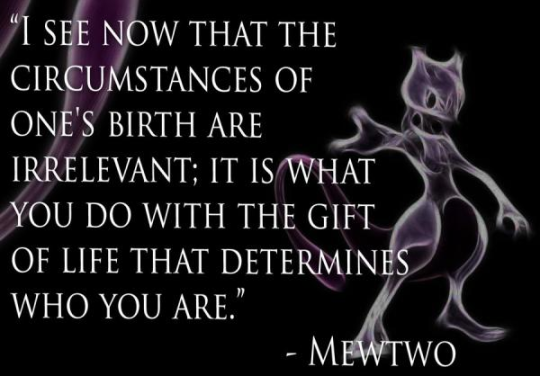
this is my addition to this ever growing list of raw quotes originating from unexpected sources
Calypso’s island is magical. It supplies every possible demand Odysseus might have for food, drink, clothing, sex, companionship or conversation. He has only to pay over the coin of his self. His entire self. Calypso wants Odysseus body and soul. She wants everything about him. Physical, moral, and verbal. She wants the work of art that he has made of his own human being. And she wants it for all time. She promises to immortalize him.
When he rejects the transaction she’s baffled. Why would anyone choose to abandon a consumer paradise where he could live forever with a ravishing divinity? Odysseus’s answer is: “I know you’re a goddess and bigger and better looking than my wife, for you are deathless and ageless while she is a mere mortal, and yet, I prefer Penelope and what I really long for is the day of my return.” Odysseus’s answer sets up a calculus. He measures the infinite days and infinite pleasures of Calypso against the single day of his homecoming and the mortal attractions of his wife. The infinite comes up lacking.
Neither Odysseus nor Homer ever tells us exactly what the infinite lacks. That is, we never get an objective description of Penelope. We do not know if she is dark or fair. Odysseus no where itemizes the qualities that make her more desirable than a goddess. What becomes clear in the final stages of the poem however as husband and wife engage in a so called recognition scene that extends from Book XVII where Odysseus shows up in disguise at Penelope’s house to Book XXIII where she falls weeping in his arms and calls his name is that these two people are a match for each other in wits and ambiguity.
We watch Her throughout the six books seduce him by the simple tactic of never letting him know what she’s thinking. She dangles herself. She dangles the prospect of homecoming before him in a series of tantalizing interactions. She gives him clothing, a meal, a bath, a bed in the courtyard and several deep conversations without ever letting on whether she’s recognized him or not. Scholars still disagree on where exactly in the poem she decides Odysseus is Odysseus and she should welcome him home. Penelope’s power is the power of a meaning withheld.
—Anne Carson on the distinction between selling and selling out
There’s nothing free about non-commitment rooted in intimacy avoidance. There’s nothing free about polyamory emanating from unresolved trauma history. There’s nothing free about wanderlust sourced in relational terror. Being a ‘free spirit’ has its place- as part of the exploration of self, other, ways of being- but if it’s emanating from woundedness, it’s just another prison. Our defenses can trick us into believing that our hunger for freedom is fundamental to our soul’s imprint, but it’s often something else. It’s often an ungrounded flight of fancy, a delay tactic, a hide and seek game we are playing with our pain. If we avoid closeness, we can fool ourselves into believing that we have healed. But it only works for so long. Because we aren’t healed, and the remnants of our unresolved pain will show up everywhere. Simply put, we are wounded in close relationship, and some part of our healing has to happen in close relationship. There’s no way around it. The best way to free ourselves from pain-body prison is to learn how to trust again.
“When I was young there were beatniks. Hippies. Punks. Gangsters. Now you’re a hacktivist. Which I would probably be if I was 20. Shuttin’ down MasterCard. But there’s no look to that lifestyle! Besides just wearing a bad outfit with bad posture. Has WikiLeaks caused a look? No! I’m mad about that. If your kid comes out of the bedroom and says he just shut down the government, it seems to me he should at least have an outfit for that.”
I think there’s a lot of mess in solidarity, because the point of solidarity is a concept—an emotion. You don’t have to like the people you have solidarity with; you just get to be on the same team, and have the project of making the world better. But one of the things that we debate when we’re trying to do that is: Do we want the same world? We agree that we don’t want the world that exists, but do we want the same world? And a lot of politics, a lot of the humorlessness of the political, comes when you realize that the people who share your critique don’t share your desire.
Lauren Berlant in conversation with Bea Malsky, “Pleasure Won: A Conversation with Lauren Berlant,” The Point Magazine (x)


 just moving along like everyone else