Ordinary nightmares (that have nothing to do with the circumstances, just stupid nightmares much more often than the average person)
Getting sharp pains in your back/neck/collarbones that make it hard to breathe (due to hypervigilance/constant high anxiety)
Learning that “high anxiety” does not mean “generalized anxiety” like other people have with panic attacks and not feeling that they can accomplish thing. PTSD anxiety just means this frenetic energy that makes you want to talk/think/do things (even as an introvert) to avoid stopping.
Feeling constantly bored like you have to chase after something, even if you’re just at home: I spend hours on tumblr, pinterest, watching tv, reading books, making art, never just laying there alone…because if you stop…the darkness is there
Thinking up stories before bed. This is a symptom of high anxiety because you’re trying to calm down and fall asleep in a “safe world” where people are looking out for you and caring for you.
Trouble falling asleep (which is distinct from insomnia) because turning off electronics etc. doesn’t help since your heartrate/fight or flight response is engaged
Periods of racing heart (mine has gotten to 120bpm for five hours) that make you feel like you’re waiting for something to happen
Exaggerated startle response. When I was a kid I used to hide behind corners to surprise my sisters. Two years ago my friend hid under my desk to scare me. I literally screamed, fell out of the chair, and started crying. She was laughing because she thought the joke went well, and then got concerned because I kept crying.
Purposefully “tanking” a bad day with sad music/tv/movies/books because it “was already ruined anyway”
i’ve mentioned this here before, but it will remain one of the most ideologically influential experiences of my life: when i was in fifth grade i did a report on post traumatic stress as manifested in veterans of the vietnam war, and my father did me the huge favor of connecting me w/ a vietnam vet friend of his who was diagnosed with PTSD, assuring him that while i was only ten i was bright and curious and he should be as honest with me about his experience as possible.
i remember entering his office with my tape recorder, sitting in a chair that was too big, and asking him questions about war, and his life after war, while swinging my legs over the edge of the chair. i remember being very, very quiet as he spoke of pulling the car over on the highway for fear of crashing when his hands would shake uncontrollably in response to song on the radio or a smell that he couldn’t be sure was real or sense-memory. and of ruined relationships and anger and american hypocrisy.
and i also remember that was the day i learned what “valor” meant. he used “valor” in a sentence and i didn’t know that word, and when i asked him to explain “valor” he became very quiet. and i can’t remember precisely what he said, if he ever offered me the dictionary definition or not, but i do remember him looking very sad, and saying something about our country’s idea of “valor”, and also something about a broken promise. and there was an edge to his words that i couldn’t parse at the time that i would later come to understand was bitterness, that he sounded bitter.
to this day i can’t hear or read the word “valor” without seeing sunlight coming through his office window at a slant, close-to-sunset light, and feeling the kind of quiet, confused, completely internalized panic a child feels when they sense that a grown up is trying very hard not to weep in their presence.
for the record, ‘not feeling anything’ is a valid and not unusual response to trauma or grief
so if you feel empty and devoid of feeling, it’s not because you’re a cold and uncaring person.
Sometimes, not feeling anything is the only way you can cope.
Be prepared for a delayed reaction, too. It’s very common to be totally calm during a crisis, and then days or weeks (or years) later suddenly get hit with a tidal wave of “HOLY SHIT THAT HAPPENED.”
Sometimes your mind waits until it feels safe to start processing things emotionally. It’s a powerful survival strategy, but it can really blindside you, because just as you start to feel like things are okay, you’re overwhelmed by the realization of how not-okay things were before.
This may not happen, and that’s okay too. But it’s something to watch out for when your initial reaction is numbness.
It’s also okay to have seemingly inconsistent reactions sometimes, or reactions that seem contrary, especially if you’re exhausted or in shock. Be open to how you feel, and accept it.
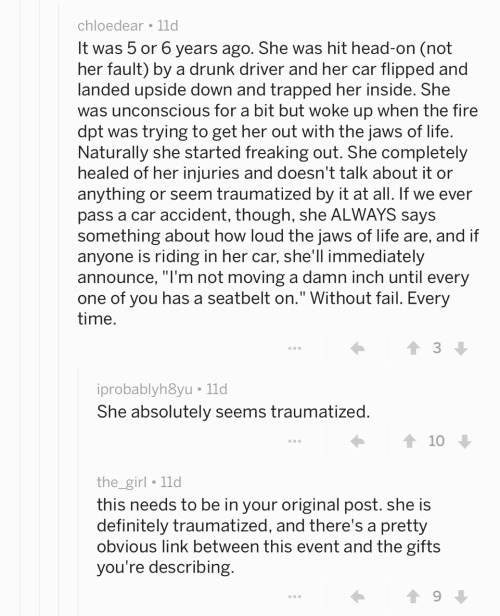
Just so people know, I looked at the source and the sister was in a very bad car accident and these gifts are likely her way of dealing with her trauma.
honestly…. the fact that they didn’t include this in the original post fucking sucks.
but also… i know these gifts may seem “creepy,” but they’re all really practical (well, aside from the book) and show that she clearly cares about the safety of her loved ones.
This makes me wonder how people view trauma. You see a lot assholes online of shitting on “sjws” for being triggered and not having ~real~ PTSD, but things like this make me wonder if people simply have no idea how to recognize PTSD when it’s not people freaking out over a loud noise.
recovery from CPTSD is complex. Sometimes, it can feel so hopelessly complex that we totally give up and get stuck in inertia for considerable lengths of time. This is why it is so important to understand that recovery is gradual and frequently a backwards and forwards process.
Effective recovery is often limited to only progressing in one or two areas at a time. Biting off more than we can chew and trying to accomplish too much too soon is often counterproductive. As a flight type, I spent years in mid-range recovery workaholically spinning my wheels trying to fix and change everything at once.
We often need to simplify our self-help efforts in early recovery. Accordingly, I recommend making shrinking the critic your “go to” response if you feel unsure how to proceed.
Once the critic is reduced enough that you can notice increasing periods of your brain being user-friendly, impulses to help and care for yourself naturally arise. As this happens, it becomes easier to tell whether you’re guiding yourself with love or a whip. When you realize its the whip, please try to disarm your critic and treat yourself with the kindness you would extend to any young child who is struggling and having a hard time.
Complex CPTSD: From Surviving to Thriving, Pete Walker, pg 70 (via thetwistedrope)
PTSD is your brain trying to make sure you DON’T DIE.
Humans are really good at adapting so that we don’t die. That’s kind of our whole *THING*. We adapt.
If something BAD and SCARY and DANGEROUS happens, your brain tries to teach you to react better next time. If the Bad Scary Dangerous thing happens a lot, that’s reinforcing it. With CPTSD, the Bad Scary Dangerous thing happened often enough and frequently enough that your whole psyche developed around it.
You learn to notice the tiny things that signal the Bad Scary Dangerous Thing might happen – even if you don’t consciously know that you know that – so that you are braced to react and defend yourself. They become triggers so that you are primed to respond.
Hypervigilance? Better to panic unnecessarily than to get dead because you didn’t recognize a threat in time, right? It’s uncomfortable and a waste of energy but you’re not dead.
Nightmares about the Bad Thing? Dreams are PRACTICE. You are trying to learn how to react better or faster or more effectively next time.
Avoidance? Dissociating is better than just completely breaking and shutting down entirely.
The thing is, even if you are not in that situation anymore, your brain did not get the memo. It is trying! But it takes a lot of work to convince it that “No really, it is safe now!”
I guess what I’m saying is cut yourself some slack. You are doing your best and you’re not dead. ❤
So they go around the world bombing and killing people and then expect us to feel sorry for them?? Nah son, you deserve it.
me if i ever find out any of my neighbors are veterans
Hmmm. I mean, just because the army as an institution is flawed and damaging doesn’t mean everyone in it is a terrible person. To paint every single veteran with the same brush is reductive and to make light of the debilitating mental disorders many have just seems wrong. Like yes, fuck the military as an institution completely 100%, but blaming disabled ex-front-line infantry maybe isn’t the best direction for our anger, perhaps.
A lot of veterans are poor people who were intentionally targeted by scouting programs coming to their schools starting at age 13, and most of them are worse off coming back than they were to start with… let’s be courteous to folks with PTSD
Don’t be an ableist fuckface. Intentionally triggering someone is disgusting.
I thought people on this godforsaken website at least understood this one basic principal, but apparently not, so let me make it crystal clear:
IT IS NOT POSSIBLE TO BE SELECTIVELY PROGRESSIVE
You can hate Ann Coulter. But if you suggest that she deserves to be raped, you are a misogynist.
You can hate Woody Allen. But if you say he’s part of a Jewish conspiracy or joke about putting him in an oven, you are an antisemite.
You can hate Michael Vick. But you call for him to be lynched or call him the N-word, you are an anti-black racist.
You can hate Caitlyn Jenner. But if you misgender her, or make comments about her genitalia, you are a transphobe.
And you can hate the military. But if you deliberately try to trigger veterans with PTSD, you are an ableist piece of shit.
You do no get to pick and choose which people to treat fairly when it comes to acknowledging and combatting prejudice.
Not liking a person is not a free pass to disregard anti-prejudicial words and actions. Either you respect marginalized peoples as a whole (even if you don’t like an individual), or you don’t respect them at all. There is no middle ground.
If anyone really like, agrees with harassing veterans with PTSD or anything similar, unfollow me right the fuck now. I don’t want you following me.
You don’t have to like the military, it’s massively fucked up but y’all needs understand that most people in the military are victims of propaganda and are usually poor or part of a minority who are taken advantage of in order to join.
^^^ All of these comments tbh
Mhmm
Wasn’t it Hawkeye in MASH that talked about the fact that, except for a few brass very high up the food chain and very far removed from actual fighting, pretty much everyone in war is a victim?
Kids in poverty without hope of paying for college to dig themselves out of the cycle of being poor are the ones who enlist. Kids who have been busted for small offenses that suddenly make them hard to employ are the ones who enlist. Kids who would give anything to get away from the abuse and neglect of shitty home lives are the ones who enlist. They’re indoctrinated hard about strong they are, how much they’re a part of a greater good, how they’re heroes. Kids who have been fighting and scrapping and hustling their whole lives just to survive. Those kids are the ones with combat PTSD, not the fuckheads to use them like they’re disposable pawns on a chessboard. Most of those kids have basically zero good prospects without the military.
Enlisted kids are, by and large, victims. And they pay for it their whole lives with damaged bodies and damaged minds. Get your shit straight. Protest high ranking officers all the way up to the president, but leave combat vets the fuck alone.
Also, we’re not so far removed from the Vietnam War, which HAD A DRAFT. You didn’t get to choose to go, you didn’t go because you had no other options, you went because you were legally required to go.
My dad was drafted and fought in Vietnam. His family was poor, so unlike the wealthier members of his extended family, he couldn’t buy his way out (paying a doctor for a medical deferral) and he wasn’t in college. The only choice my dad had was to voluntarily enlist with the Marines, which gave him a 90 day deferral period.
(Which he freely admits was because he had just bought a motorcycle, and if he was going to die, he was going to die after he spent a summer riding his bike.)
My dad has PTSD. Sometimes, he’ll even admit it. But the resources that are available for Vets today weren’t for Vets from Vietnam. It’s called the forgotten war for a reason, and soldiers who returned home from Vietnam were vilified and attacked. A lot of them didn’t choose to go, and they certainly didn’t choose to be hated for fighting a war that they didn’t believe in. They didn’t have the option.
And I know I am a tumblr old, and my parents were older when they had me, but for the kids out there? My dad could be your grandfather. I hate these kind of comparisons, because human decency people, but think about how you’d feel about this post if the people advocating the disregard of combat Vets’ feeling were talking about older Vets from Korea and Vietnam?
IT IS NOT POSSIBLE TO BE SELECTIVELY PROGRESSIVE
yes, that. a world of that. stop using progressive ideals as an excuse to be a vicious bastard. and if i catch you blaming individual soldiers for the wars that used them, i’ll give you such a Disappointed Dad Look you’ll feel six inches tall for a week.
when you go from a bad situation into a better one you may collapse exhausted and unsure what to do and full of grief, you may need time to regain the ability to do things as yourself or motivated by anything other than terror, you may need time to process or mourn or fall apart in ways you could not before,
and people may use this as proof that the old situation was better for you, proof that you need to go back, and it is not proof that it was better for you or proof that you need to go back
!!!
It’s so incredibly common to “fall apart” when you’re finally safe. You no longer need to stay so tightly coiled in on yourself, you can finally leave survival mode and process your trauma. You’re not holding yourself up by sheer terror anymore and suddenly the damage that terror has done to you becomes immediate and obvious.
This is so important. Don’t go back. Things are already getting better, even if it doesn’t feel that way.
This is a documented phenomenon with abuse in particular. I’ve had a number of people ask me why they’re falling apart now after they’ve moved into a safer home, or they’re in a less dangerous area, or they’ve left an exploitative job, or they’re in a healthy relationship for the first time. Generally, it’s because they made that positive change.
When we’re still in the midst of crisis, we’re often too overloaded and physically/emotionally unsafe to really feel or process anything. So for most of us, everything gets pushed down/repressed/dissociated until later, when we’re safe and supported. The threshold of safety at which processing begins to occur varies from person to person. And the mental calculations used to determine “safety” usually happen on an unconscious level. Very few of us have the conscious thought “I’m safe now, so I can process what happened to me.” Instead, the subconscious realizes some level of safety has been achieved, and so it just dumps a load of suppressed stuff.
Sometimes, it’s contrast to past experiences that makes us realize something was traumatic at all. In such cases, it’s not that we’ve reached a level of safety and can thus begin to process, it’s that we finally have a basis for comparison to know that what went before was unacceptable.
this is also the case for getting treatment/medication for an ongoing illness. it’s theorized that’s why antidepressants sometimes seem to cause suicide – someone who was too defeated and exhausted to even try to kill themself might react to the return of energy by following through on suicidal ideation they just didn’t have the wherewithal to address before.
i’ve even observed something similar with physical illness. when i found a pain medication that worked for my chronic pain, i slept like 14 hours a day for the first couple weeks – because finally i COULD sleep without being woken up by pain.
please spread the word that it’s normal to faceplant when a long-term stressor is removed. you’re not getting worse. you’re starting to heal.
I think a lot of people’s experiences of trauma have looked like “being forced to grow up too fast”. Having things they weren’t ready for pushed on them, whether that was being sexualized against their will or tasked with raising younger siblings in a parent’s absence. For those people to feel safe, they need a space where vulnerability is acknowledged and a strong boundary is maintained between dominant people and their potential victims. Hence the “I don’t care how mature she is; having sex with a 17-year-old is wrong” line of thinking. Those people’s pain is valid. Their boundaries are valid.
I think a lot of other people’s experiences of trauma have looked like “being infantilized against their will”. Things like growing up in a family that didn’t acknowledge your sexuality, or being institutionalized, or being disabled and therefore seen as a child long past the age of maturity. For those people to feel safe, they need a space where their agency is affirmed and no one will try to control them “for their own good”. Hence the “I may be young, but please believe me when I say I know what I’m doing sexually” line of thinking. Those people’s pain is valid. Their boundaries are also valid. And neither group deserves to take precedence over the other,
I, personally, fall into the latter category. My experience of abuse involved being treated like a petulant child who didn’t know her own mind or desires. I could not be in charge of my spirituality – of any aspect of my inner life, really. I couldn’t have the things I wanted; I couldn’t even be trusted to know what I wanted. And all of it, all the micromanaging, all the gaslighting, was allegedly for my own good.
So when I see statements like “having sex with a girl of X age is necessarily wrong, no matter what the girl says”, I have a very deep, very instinctive middle-finger reaction. I have had enough of being told that what I want doesn’t matter, isn’t important, and isn’t even really what I want. I can’t make my own decisions? Fucking WATCH ME.
That said, the statement “having sex with a girl of X age is necessarily wrong, no matter what the girl says” may be enormously beneficial for someone from the former group! I can absolutely see how, if someone has been sexualized against their will from a young age and groomed into wanting things they now regret, that someone might find it empowering to admit “I said I wanted it, but I wasn’t really mature enough to make that decision, and the adults in my life were at fault for that”. We just have to be mindful of splash damage to Group B, who will, predictably, prickle at the notion that what they say doesn’t matter.
It applies in non-sexual situations too. Someone from Group A, who was forced to drop out of school and raise their siblings after the death of their parents, might say something like “teenagers just aren’t capable of taking care of children. they’re still developing; they deserve to have a youth”. Meanwhile, someone from Group B, who is developmentally disabled and has fought for years to be allowed to babysit their siblings, will see that and think “fuck you, I’m just as capable as anyone else”.
I also think each group makes the mistake of projecting an abuser-centric view onto the other. Group A, for instance, might accuse Group B of secretly wanting to sexually coerce young women, while Group B might accuse Group A of wanting to sexually restrict those same young women. This is a mistake. Because both groups are speaking from their own trauma, neither is necessarily serving the needs of abusers. They are talking about what they, personally, need in order to feel safe and to extend aid to those like them, and both models are valid. We just can’t pretend that one can exclude the other.
This is relevant to a lot of the discourse.
this makes a lot of sense to me, and also explains why i crashed so dramatically into all the pedophile drama. i’m definitely a member of Group B, who chafed all my adolescence at being condescended to and controlled, and couldn’t wait to be grown up and powerful. i hated the idea that i was too young to do anything, especially anything sexual, and i admired my upperclassmen who maturely discussed smut and yaoi like they were suave experts. i had sex as soon as someone i liked was offering, at 16, and never regretted it. i was really enthusiastic about sex in my late teens, and had as much as i could. i was writing smut by the time i was 18.
so to me, 16 always seemed like a perfectly normal and healthy age for consensual age-appropriate sexual relations, and i was totally startled to find out a lot of 16 year olds disagree. i was then an idiot who realized way too late that it’s incredibly creepy for a grown woman to be arguing with teens that they are too old enough to have sex, and by the time this fact was rammed through my dense skull i had said some stuff that Group A people interpreted (incorrectly but understandably) as sexually predatory. and of course, call-out posts never include a user’s apologies or retractions…
ironically, my abuse was a kind of group C – people being rulebound and judgy in a very personal and dehumanizing way, controlling and punishing not because they wanted to infantilize me, but because they saw themselves as heroes and me as a monster. they didn’t want to make me into their baby doll or their sex toy or their ego stroker or anything at all; they wanted me to not exist.
which means the entire fucking discourse is a huge trigger to me, whichever side it’s coming from. although the anti side is much MORE triggery, seeing as they tend to play the hero/monster game.
i was seen as a monster because i’m autistic – my expressions are wrong, my tone of voice is wrong, my eye contact is wrong. pretty much everyone in my childhood except my parents, and uncountable other people through my youth and adulthood, many of them in positions of power over me, decided i was Bad or Not Real and treated me accordingly, and nothing i could do would change their minds. now roach is being seen as a monster ecause she’s been honest about her lived experience, by people who actively campaign to spread vicious rumors, and nothing anyone can say will change their minds.
In trauma survivors, Van der Kolk notes, the parts of the brain that have evolved to monitor for danger remain overactivated and even the slightest sign of danger, real or misperceived, can trigger an acute stress response accompanied by intense unpleasant emotions and overwhelming sensations. Such posttraumatic reactions make it difficult for survivors to connect with other people, since closeness often triggers the sense of danger. And yet the very thing we come to most dread after experiencing trauma — close contact with other people — is also the thing we most need in order to regain psychoemotional solidity and begin healing. Van der Kolk writes:
Being able to feel safe with other people is probably the single most important aspect of mental health; safe connections are fundamental to meaningful and satisfying lives.
This, he points out, is why we’ve evolved a refined mechanism for detecting danger — we’re incredibly attuned to even the subtlest emotional shifts in those around us and, even if we don’t always heed these intuitive readings, we can read another person’s friendliness or hostility on the basis of such imperceptible cues as brow tension, lip curvature, and body angles. But one of the most pernicious effects of trauma is that it disrupts this ability to accurately read others, rendering the trauma survivor either less able to detect danger or more likely to misperceive danger where there is none.
“Social support is not the same as merely being in the presence of others. The critical issue is reciprocity: being truly heard and seen by the people around us, feeling that we are held in someone else’s mind and heart.For our physiology to calm down, heal, and grow we need a visceral feeling of safety. No doctor can write a prescription for friendship and love: These are complex and hard-earned capacities. You don’t need a history of trauma to feel self-conscious and even panicked at a party with strangers — but trauma can turn the whole world into a gathering of aliens.”

 just moving along like everyone else