As someone who loves my son Steve Rogers, I have to say that he could never kick Diana’s ass, like literally, and also he would never do that, because Steve Rogers would grow up idolising the mysterious hero from WW1, and would probably swoon if he got to meet her, would call her “ Your Majesty” unironically, until Diana has to literally punch him to make him stop, and even then, he’d call her “Ma’am” with the utmost respect, and also he’d follow her to Hell and back without blinking.
They would meet in Vichy France, and after he settled down around her they’d be fine. She’d call him Steven (because it still hurts a little to say Steve). She would teach him the Shield move, and when she called for it in battle he would crouch down with his shield raised, waiting to feel the impact of her boots, then launch her forward – at a line of panzers, across battlements. He would take half a minute to watch in awe as the dust billowed around her landing, watch her upend tanks and pulverize fortifications. Then he’d sprint after, taking out machine gun nests and artillery, and the Wehrmacht would have another tale of the two Allied soldiers with shields who they could never, ever defeat.
I so love the idea that little Stevie Rogers read about and idolized the mysterious superwoman who aided the Allies in the Great War.
I love “Patriotic Leotards” as a friendship OR a romance. Or as a mutual admiration society long before they meet in person.
I’m officially taking it as canon now that the reason Steve knew how to properly launch Natasha at the Chitauri is cuz Diana taught him, and no one can tell me different.
You have this… friend. Really nice bloke, buys you a beer when you’re feeling down, kills the people who’ve wronged you, etc. You don’t actually know his name though.
You watch him make his way through the crowded bar, clapping seemingly random people on the back and shaking his head at others. One woman leans forward and plants an enthusiastic kiss on his mouth. He responds by spinning her to the pub’s music and releasing her with a good-natured smile.
You wonder if she knows his name.
The pint in your hand is cold and exactly what you need right now. You can’t get the image of your husband’s body lying broken on the ground out of your head. You think you should be angry or scared or sad, at the least, about his death, but all you can drudge up is a mild sense of relief.
You drink half the pint in one go and the bartender looks a little more approving of you. You’ve proven that you’re not just a well-dressed woman in her mid-thirties who’s out of her depth in this dive bar. You’re a well-dress woman in her mid-thirties who’s out of her depth in this dive bar who can drink. That makes all the difference.
You actually don’t remember when you and he became friends. You didn’t know him in high school which is where you met your husband. Ex-husband. You didn’t meet him in college either, you would remember if anyone had died then. Surely you would have?
You are no longer sure. You don’t even know his name.
You see him on the other side of the bar, talking lowly to a rough looking group in the corner. They all seem friendly, nearly worshipful, of your friend. He’s clearly asking them for something, a favor maybe, and no one seems to be denying him. They look happy, glowing under his regard.
You know the feeling.
When he comes back, he’s smiling comfortingly. “My friends will take care of the body. I know that you can’t afford the police involvement right now, not with Senator Hudson’s reelection so close.”
Somehow my boss’ seat at the table is the last thing on my mind, you almost say. But you don’t because, as usual, he’s right. Police involvement right now would be disastrous and would make it so that you never worked on the Hill again.
“You’re always looking out for me,” you say, looking down into your almost empty pint. You are actually no longer sure that that’s true. In fact, the more you think about it, the more sure you are that it’s not true.
He pauses for a moment, head cocking. “I want to look out for you. I’m happy to do it. I think there’s something else on your mind, though. Wanna talk about it?”
There is a chill working its way up your spine. it tells you that your…friend must not know that you have doubts about his ‘looking out for you.’
The answer is apparently “because we’re actually able to eat it”
Fun fact: white people (specifically Northern European white people) have a genetic mutation that allows them to digest lactose even after weaning, which is abnormal for all mammals and also most humans. It’s theorized that because Northern Europe doesn’t get a lot of sun, an alternative source of vitamin D (like milk) would be a useful trait. It’s a very recent mutation that would only have happened after humans started domesticating animals like cows and goats.
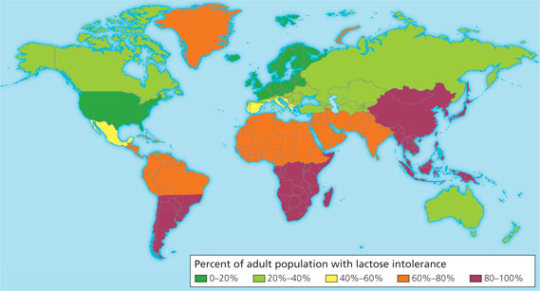
oh no, my bizarre moment has come, cause lactose tolerance is actually A Thing I Know About because it’s played a fascinating role in human evolution for thousands of years. This chart displays some of the broad trends, but it’s giving near continental averages, which doesn’t showcase how this kind of thing really breaks down and some of the surprising exceptions.
Lactose tolerance is the majority trait for only a very few population groups: North Europeans (and therefore populations that draw heavily from that stock, such as America,) nomadic central Eurasians, and sub-Saharan pastoralist Africans, but that latter group is often overlooked. The vast majority of Africans cannot process lactose, but certain people groups whose lifestyles have revolved around cattle for thousands of years will have 80% and even approaching 100% lactose tolerance rates. They’d be spots of dark green amidst a sea of orange and burgundy on the above chart.
Our hunter-gatherer ancestors were almost entirely lactose intolerant, that is definitely the biological norm (and people groups who maintained that lifestyle, such as Native Americans, remained as such – along with groups who transitioned to sedentary agricultural lifestyles, but I’ll get into that). As such, lactose tolerance is an adaptive trait that only became prevalent in environments that exerted strong selective pressure for it. So, cows were domesticated some 10,000 odd years ago in the Middle East (and some have contended for an independent domestication event in Africa as well). In either case, cattle quickly spread across the continent and we know there was milking and cheese production at least 6,000 years ago in both the Nile and Mesopotamia. While cow meat would have been enjoyed by all, in agricultural societies milk and cheese would have been options, but hardly staples as there were plenty of other things to eat as well, and therefore there would have been no selective pressure for processing lactose. Also, sedentary societies had ways of processing milk and cheese that allowed lactose intolerant people to drink/eat dairy products. Fermenting milk or aging cheese breaks down lactose, making it a non issue once ingested. This is why fermented milk may seem utterly foul to many Westerners, but is extremely common in other parts of the world. But, fermentation and aging requires time, and the ability to store things in a single location for weeks or even months. Sedentary societies adapted the milk to fit their biology, but nomadic societies did the reverse.
There are still mobile pastoralist societies in Africa today, and there have been for thousands and thousands of years. For many of them, cows are not one of many dietary options, they are the single dietary staple around which their lifestyle revolves. Biologically, this means you gotta get with the program if you wanna survive. For most mobile tribes, fermentation and aging weren’t options, so there would have been strong selective pressure favoring those who could drink milk straight outta the cow, as they would have had an additional, highly nutritious food source available to them. Milk also allowed for a marked shortening of the weaning process, transitioning children from breastmilk to cow’s milk, which would again be advantageous for groups where both the men and women work and are always on the move. Over generations these populations specialized into essentially cow-based lifestyles, creating a survival niche highly advantageous to them, and fast forward thousands of years and there are groups in Africa with near ubiquitous lactose tolerance, while the rest of the continent (and the world really) is nearly entirely intolerant.
Many of these same factors would have influenced the central Eurasian populations, which is why Mongolians and other descendants of nomadic steppe peoples are largely lactose tolerant, as mare’s milk would have been a dietary staple (though they also developed efficient ways to ferment it).
North Europeans developed lactose tolerance in response to deficiencies in certain nutrients. The northern climate limited Vitamin D production, and the agricultural products available to them were often low on calcium and protein, and so dairy farming developed alongside agriculture to create a more rounded diet (and this was limited to Northern Europeans, as Mediterranean peoples such as the Romans wrote about their great confusion at the northern barbarians’ ability to drink fresh milk)
And I promise all of this is fascinating because the ability to process lactose evolved independently in several different population groups and in response to different factors: lifestyles revolving around cows, lifestyles revolving around horses, deficiencies in climate and agriculture. Besides providing insight into human history and biology, lactose tolerance is also a great example of convergent evolution, where different genetic populations in different environments produce similar results.
And uh, that’s my rant about the role of milk and lactose tolerance in human evolution.
Beautifully written, very concise and informative. Good stuff. Interesting stuff. Thanks for your input.
This explains a lot about my family, actually.
as a descendent of nomadic central asians on my dad’s side, and celts and vikings on my mom’s, i am double plus dairy certified and should probably just buy a cow.
man, no matter how good or bad the movie ends up being, the editor of this trailer deserves an award
I’ve seen it twice now in theaters, and the rhythmic and narrative coherence of the whole thing PUMPS ME UP
(especially in contrast to the fucking mess of the Transformers trailer that inevitably followed both times, and consisted solely of loud french horn honks and crashes interspersed occasionally with meaningless overwrought dialogue delivered with zero conviction)
in any case, I’m going to now forever associate that Kanye song with Charlize Theron pummeling a man with a freezer door, and I have no complaints about that
the song is a mashup of personal Jesus by depeche mode and black skinhead by kanye, its on soundcloud by fa$ion $en$e and its called personal yeezus
its so fuckin good y’all
wow first of all I was not expecting this post to blow up, I’m glad other people appreciate good trailer editing
and secondly THANK YOU FOR THE INFO ON THE MASHUP, YESSSS, I’ve had it stuck in my head all week and it is gr9
LOOK MORE INFORMATION & also just the trailer again because nnnnnnnhhh.
A Genie offers you one wish, and you modestly wish to have a very productive 2017. The genie misunderstands, and for the rest of your life, every 20:17 you become impossibly productive for just 60 seconds.
“Well, it was a nice day.” You kiss your sweetheart gently on the forehead and sigh as the last remaining seconds of 20:16 tick away. “See you at 8:18,” you say.
Then it happens. Every ounce of fatigue or hunger leaves your body. The face of your beloved is perfectly still, their expression exactly the same. The ticking of the clock on the wall has stopped. Once again, it’s 20:17.
You stretch your arms and walk to the table with the homework for the three doctorates you’re working on. The work is mentally stimulating and enjoyable, but it’s finished far too quickly. You check your pocket watch and see that not even one hundredth of a second has passed.
You knew it was too soon to be able to see any movement on the watch, but you can never quite help yourself from looking early on every 20:17. Time to move on.
You clean your home, do your budget, then go outside and fix a noise that your car was making earlier that afternoon. (Oh how you already miss afternoons.) Then you go back inside, boot up your computer (which magically speeds up to keep pace with you as long as you’re in contact with it) and check for any new orders.
You’ve set up a website for the small business you started called “Magic Elf Services.” People in your area can pay a modest fee on your site to have different tasks and odd jobs done by “The Magic Elf” at 8:17pm every day. It was a little slow to get started, but word has spread and these days you have a steady stream of clients.
The money that comes in from the business is nice, but you’re mostly grateful that it gives you a clear list of things to do. You print off your updated list of clients, step outside, and start making your way through the neighborhood with your to-do list.
There’s the apartments down your street where several neighbors have hired you to tidy up, do the dishes, and mop the floors. You do the windows too, just to see if they notice. There’s the large house across town that paid the “Magic Elf” to clean out the gutters. After the first dozen jobs are done, you manage to stop looking at your pocket watch.
As near as you’ve been able to determine in the past, 20:17 seems to last for approximately one normal year. But it’s not exact. For one thing, it’s hard to keep track of “time” when everything but you has crawled to an almost total standstill. For another thing, time seems to move differently depending on how “productive” your behavior is. One time you tried to spend all of 20:17 sitting at home in your pajamas, but that was getting you nowhere, so you eventually gave up and got busy. (Though you defiantly stayed in your pajamas the whole time.)
During 20:17 your body doesn’t get tired, hungry, sick, or injured. You’re essentially tireless and immortal for the duration of the “minute.” So sleeping or eating away your boredom has never really worked for you.
One of the houses on your list forgot to follow the instructions and leave a key for you to get in. At first you figure you’ll just send them an email telling them to pay more attention and that you’ll do the job tomorrow. Then you decide to go home, get your locksmith tools, and come back.
After finishing up all the jobs on your list, you go into several other homes and small businesses in the area, performing tasks you hope they’ll find helpful, and leaving a hand-painted business card at each one. (The business cards don’t contain your real name just in case somebody thinks “The Magic Elf” should be subject to breaking and entering laws.)
Speaking of laws, you head down to the local police station to pick up your case file. You’ve been in contact with a detective who’s been investigating corruption within their department, and your ability to investigate unseen and get in almost anywhere between the ticks of the clock has proven invaluable. You see that they’ve also added five missing person cases to your file this evening, which certainly raises your interest in the job.
You make your way through town gathering evidence, and start making your way to the outskirts of town. Since you happen to be out that way (and you’ve already solved three of the five missing person cases) you decide to swing by the stone castle you’re building and do some more work there.
The castle walls stand about 20 feet right now, but you know they’ll be much higher when you’re done. You’re far from any roads and pretty safely tucked away, so for now it’s your little secret. You’ve been excavating and moving all the rock yourself, which has been much easier than you first expected since your body doesn’t get tired or sore. You’ve also got a nice system of tunnels going underneath the castle, and you dig and build more of that network for a while.
All that time spent underground has left you feeling rather lonely, so you walk back home to see the face of your sweetheart. Their facial expression has moved ever so slightly since you last saw them, which is a comfort to you. Looking at them gets your imagination going and makes you dream up a story you’d like to tell, so you sit on your couch, plug in your laptop, and write a book.
After you finish editing the last chapter for the third time, you finally allow yourself to look at your pocket watch again. Three seconds have officially passed so far.
It’s gonna be a long 20:17.
Wow, Dave. You managed to take a concept that seems nice on the exterior and make it into a real nightmare. This is some good stuff.
Which is EXACTLY why you should never trust a wish-granting djinn.
they are married to each other like yas fuck my whole life up
i feel like this never has enough info when it goes around so for those curious: this is ayabambi (otherwise known as aya sato and bambi), a japanese dance duo who are in fact engaged in real life and actually did a vogue photoshoot to celebrate the supreme court marriage ruling
theyve been in lots of music videos and adverts and stuff
i found this manga called Club 9 at a used book store and i can’t get over it i’m gonna dream about it i swear to god
Club 9 is awesome. The girl in the middle is a stereotypical country rube and talks with a thick accent and is just hilariously un-cultured, and people love her. It’s adorable.
Y’all been getting told not to hit on the barista since before we went off the gold standard.
Personally, my favorite is finding out that people have been using punctuation in the middle of a sentence (!) to indicate expression since at least the 1920s.
Since the 1890s at least!
The Philadelphia Inquirer, Pennsylvania, February 19, 1897:


 just moving along like everyone else