I was thinking a lot about this moment. Somehow it feels like the agni kai was a watershed moment not only for Zuko, but also for Iroh.
I think this something that Iroh is intensely ashamed about – and is the source of all the patience he has with Zuko and his determination to make things right for him.
Because Zuko’s scar is not just a testament of Ozai’s cruelty as a father, but is a scar on the soul of the entire Fire Nation.
Their supreme ruler publicly mutilates on his own son, a 13-year old child, who merely spoke the truth about a nation that in a quest for power has lost perspective on the worth of human life – and everyone cheers.
The scarring and humiliation of the young prince (who should be really the symbol of the future to his people) is a grotesque public spectacle.
And Iroh, who was once next in line to leading these people, former great war hero, one of the most powerful benders, and still one of the nation’s leaders – all he can do is to look away.
The boy who spoke the truth, who stood up for kindness, who tries to do the right thing, who refuses to fight his own father, who begs for forgiveness – he faces completely alone his horrible punishment, and nobody speaks up for him.
And I think this is Iroh’s moment of truth – that disagreeing privately is not enough, he cannot look away anymore. He realizes that healing this boy could be the chance to heal the Fire Nation, that he is maybe destined to be their leader, but not from the throne of the Fire Lord. He has to get Zuko through this trauma and show him kindness, love and acceptance in a way he has never experienced it. He has to teach him that speaking up and saying sorry should not and will not lead to harsh punishment, that kindness is not weakness and cruelty is not strength; that honor is not violence, but doing the right thing.
– Praise the living daylights out of a show and shove its greatness in everyone’s face
– 2 years later, pick it apart violently and insult everyone who still enjoys it in as edgy a way as possible because negativity is cool
!!!
uhh maybe marginalized ppl were excited at the possibility of a show (such as su) representing them, only to be rightfully angry when the show ends up racist, homophobic etc. anyway, super bad post all around
I feel like a lot of hardcore accusations of problematic and offensive content that get thrown at media that was previously lauded as progressive come from a few sources; first, the creators are often a lot more accessible than the creators of mainstream media. you can message rebecca sugar on twitter personally to call her a racist bitch, but you can’t do the same to, say, jj abrhams or another large-scale creator. likewise, you can’t stand on a streetcorner and scream at people until they agree to stop watching law and order, but you can certainly bully large groups of people online until they stop supporting an independent creator.
second, the fandoms that tend to form around progressive media tend to be younger, more volatile, looking to media and fandom as forms of activism. mainstream media they can write off as garbage, but progressive niche media that makes a sincere attempt to represent marginalized folks must be Absolutely Perfect. the idea that a piece of media can have good parts and bad parts, that it can try and only partially succeed, but that that partial success is still worth something, is completely lost on many young fans. either its irredeemable garbage or its the literal messiah, there’s no in-between. so if a show falls short of perfect, as is inevitable, then it goes straight into the “total garbage” pile and must be condemned by the masses.
genuinely trying to represent certain groups and making a few missteps is not the same thing as being ignorant or malicious. making a sincere effort to mean something to folks who don’t get a lot of things made for them is something to be proud of. would you rather go back to the times when fucking nothing got made for us? when the only characters we saw that we could relate to were only there to be made fun of? you’re spoiled by a rush of new creators who took “go make your own thing then” to heart and set out to make content for people like them, you have the gall to look at what they’re trying to do and spit on it for not being better. no creator owes you shit, no creator has to bow to a bunch of teenage bullies who do nothing but demand and harass, that’s all there is to it.
Dear lord can everyone please read this post because it’s so relevant
that gifset made me think but ‘are we really even friends’ would actually be something keith thinks considering he spend last 2+ years with krolia and before that with BoM with minimal contact with the team like?
or do yall consider people you havent talked with for more than 2 years your friends? Jus saying
Tbh, I understood where Keith was coming from, too??
It’s not even just the time spent apart. The writers didn’t really do a good job making me believe that the Paladins were super close. Yes, they’d fight and sacrifice for each other in battle; that’s how a combat unit survives. Yes, they’ve had some fun times together.
But there are some hallmarks of really close friendships – the kinds that easily endure years of absence – that the Paladins just never hit in my eyes. (At least, not all of the Paladins together. Maybe subgroups.) Really tight friends know your quirks. They know how you tend to think, because you’ve been together through some shit and have had some deep, personal conversations. They can’t read your mind, but they can guess your motives to their general neighborhood and proceed from there.
Pretty much all of the paladins other than Shiro have repeatedly mischaracterized and wildly misinterpreted Keith’s motives. After spending months, if not years, together on this mission, they still don’t seem to know how he ticks. Keith can be withdrawn, yeah, but you’d think there would have been more progress after so long. It makes sense Keith would characterize their relationship as “just a bunch of people thrown together by coincidence” when he’s so often misunderstood.
Good friends also recognize when they’ve gone too far and apologize or – if this is difficult for them – at least express guilt or try to make up for the error. This is another thing that just never seems to happen, particularly where Keith is concerned. The VLD writers have a habit of creating these interpersonal conflicts (good) and then never really resolving them (bad). Lance, in particular, often accuses Keith of selfishness or cowardice, and I can’t remember a single instance of him ever apologizing or even showing remorse. Yeah, you can let some stuff go as “water under the bridge”, but how much?
I dunno. It’s terrible, but I kind of anxious-laughed at Keith’s “Are we even friends?” line, because I felt it was skirting uncomfortably close to the truth. I think the writers meant for the Paladins to have a deep, familial, platonically intimate bond, but that’s not something I think they executed on successfully. I don’t know if it was because of outside sources demanding more robot fights and fewer conversations or what, but for me, a lot of the Paladins’ friendship has been all tell, no show.
Because when Keith demanded to know if they were really even friends, I didn’t think he was entirely wrong to do so.
I started and re-started my answer to this ask half a dozen times. Because it’s a really, really important question, but it’s also a hard question to answer in a useful way. I’m going to do my best.
Nothing is as important as what you believe is true. If I can control what you think, I can control every decision you make. I can control what products you buy, who you vote for, which of your friends you trust—and which of them you distrust; I can choose which social causes you apply yourself to, and how effectively you champion them; to a very great extent I can even decide what you’ll major in in college, who you’ll marry, IF you’ll marry, if you’ll STAY married if the marriage goes bad, what job you’ll go for, how well you’ll do in that job, how you spend your leisure hours, how you treat your children, how you feel about yourself when you look in the mirror, what you’ll eat for dinner, and if you’ll respect yourself in the morning.
EVERY DECISION YOU MAKE is based on what information you’ve accepted. So if I can make you believe what I want you to believe, I own you.
And make no mistake: my best interests are NEVER the same as your best interests. The most you can hope for from ANY source is that their interests and your interests align. If I’m a company, then it’s in my best interest if you buy my product. I am only interested in the quality and safety of my product to the extent that you will not buy it if it’s garbage, or too dangerous. If I’m a newspaper, believe me, my goal is not to make you a more informed citizen of the world. My goal is to sell newspapers.
However, it may be that my reputation is an important part of reaching my goals: and if I feed you misinformation, my reputation may be damaged. And so a degree of trust may be invested in sufficiently reputable sources, since their goal (“to maintain a high reputation”) and your goal (“to learn something”) are aligned. Be VERY CAREFUL when bestowing this kind of trust on a source, and NEVER let them act as your ONLY source. You can never know for sure how important that reputation really is to them, or for what ends they may be willing to compromise it.
“But this information is from a random Tumblr post, not a news corporation, or a professional blog. Nobody’s making money, here. So why would they lie to me?” Attention? Attention’s a big one. Those posts you see going around, full of SHOCKING CLAIMS, usually have tens of thousands of notes. Tens of thousands of people shocked – shocked! – to learn that feeding bread to ducks makes them sick, or that Charlie Chaplin was a Nazi, or that bleach mixed with baking soda can eat through concrete. It doesn’t matter that none of those things are true. It doesn’t even matter if the OP, or all of the people reblogging it, BELIEVE that they’re true. What matters is that EVERY SINGLE ONE OF THOSE PEOPLE had in their own interest something that was more important to them than “make sure the things I’m reblogging are accurate.”
Maybe they wanted the prestige of being the first to bring interesting new information to their social group. Maybe they were alarmed by what they read, and they wanted to keep their friends and loved ones safe. Maybe what they read reinforced some bias that they had, and so they disseminated it because they wanted it to be true. Maybe having this surprising intel on their blog made them feel more intelligent, or more socially conscious. There are lots of reasons, because there are lots of people, and every single one of those people had their own best interests.
And none of those interests are yours.
So because what you believe is SO important, and because you are the sole guardian of your own best interests, I think it’s downright reckless to accept any piece of information as fact without asking two questions first:
– Who is telling me this? Do I have reason to trust them? Should I trust them SO MUCH as to let them be the sole arbiter of what I believe on this subject?
– Who benefits if I accept it as the truth? THIS IS VERY IMPORTANT. A lot of information masquerades as being in the interests of one thing when really it’s in the interests of something else. Really think about it.
When you choose to believe someone – anyone – about anything, you are giving them power over you. And skepticism is the only thing that protects you from giving that power to people who don’t deserve it.
When you choose to believe someone – anyone – about anything, you are giving them power over you. And skepticism is the only thing that protects you from giving that power to people who don’t deserve it.
And this is why we research outside of tumblr before reblogging posts that claim something as fact, and why we research by looking at more than one source.
…hey Harry Potter fans, we’re all in agreement that Dumbledore brought the Philosopher’s Stone to Hogwarts in Harry’s first year as a test to see whether Voldemort was paying attention and what sort of state he was in, now that Dumbledore’s chosen champion was old enough to hold a wand, right?
Like, Harry learns what magic is and it’s time to start moving towards the full and final destruction of Tom Riddle Junior, so Dumbledore has a chat with his long-time alchemy friend who’s been keeping this thing safe for literally six centuries straight, and ‘borrows’ the easiest source of immortality he can find as bait for a trap to lure Voldemort out into the open so Dumbledore can get the lay of the land to prep for the next seven years. This is canon, right?
Yes, this is canon. In none of the other books is the climactic array of trials set up as a video-game dungeon perfectly tailored to the skillsets of three specific children. Hermione and Ron are drafted into this war quickly.
Draco gets so much shit for trying to kill Dumbledore but honestly who wouldn’t
I’m perfectly capable of enjoying the idea of “person A, a hero, ‘saves’ person b, a villain, with the power of love” in a fictional context, and all the different ways it can play out, while also recognizing that it’s a bad idea to try to save someone from themselves if they’re dangerous in real life. I’m an adult and I understand the difference. My enjoyment if hero/villain ships in fiction does not inform my real life relationship choices. On the contrary, they allow a safe outlet me to explore and live out these ideas without suffering negative consequences in my real life.
This continued insistence by self-described feminists that I actually don’t know the difference, and am potentially endangering myself by consuming fiction featuring that trope, is not helpful. It’s not progressive or radical. It’s not liberating or empowering. It’s not “smashing the patriarchy.”
On the contrary, it’s nothing but a rehash of old misogynistic stand-bys: that women can’t be trusted to understand their own thoughts and emotions, that they have to be told what they feel and think and why, that women are blinded by innate naivety and compassion, or by sexual desire, that women need a guiding hand to protect them from their own bad judgment.
The fact that it’s women applying this to other women this time around. does not magically make it okay, does not make it less condescending, less patronizing, less violating. Women have been enforcing misogynistic social norms for other women for ages; this is nothing new. It’s no different than when my female Sunday school teachers told me that my body is inherently a temptation to sin, and I must take counter-measures to prevent others from falling from grace by covering it at the expense of my own comfort. It’s no different than when they told me that women who aren’t virgins are equivalent to chewed up gum or licked cupcakes. Sexism doesn’t stop being sexism because it’s enforced laterally.
It’s funny that these people keep implying that women who enjoy this fictional trope have a savior complex. From where I’m sitting, we aren’t the ones trying to save people who don’t need or want to be saved.
Honestly I think we need a name for this kind of condescending “it’s for their own good” themarysue-style fauxminism and I’m formally submitting “helicopter feminism” as that name.
if thanos wanted to kill off half of the population because there weren’t enough resources……..but then snapped half of the vegetation and animals (according to the russos)……..then isn’t he back at square one……………and there aren’t enough resources for the population……………
what about……..all of the empty and abandoned planets……..he couldn’t have restributed populations there? or like………..what about endangered species they’re pretty much gone now thanks to T Hanos…………..he really didn’t think this through………….
this is deadass what part 4 is gonna be. like he’s gonna realize “huh…. maybe this wasn’t a good idea” and reverse time.
Or he literally could have just doubled the resources
Maybe I’m wrong but all he would need is the Space Stone to teleport and redistribute resources + life. But I guess killing half of all life made more sense.
Or he could’ve just created more planets and teleported the halfs but a bitch is too dumb
He can throw a moon for a fight but teleporting some resources is too much work?
He can change reality but he uses it to fake his death and do a power point presentation?
He has the time stone, in which he could literally go back in time and save his home planet ….not by killing half of them …but by using these new powers?
The best way I can explain it, is that talent is something you have a particular natural aptitude for and skill is something you can acquire.
I’ve met plenty of talented and even gifted writers in my time, but a lot of them actually lack the skill to do anything with that talent. So they might churn out a golden phrase and an absolutely soul shaking concept here and there, but when it comes down to putting it on paper, they lack for fortitude to persevere with it.
Talent, after all, can make things feel like second nature, so when something doesn’t flow easily or is not perfect on the first or even second try, they lose interest because well, if they were talented this would be working out for them, but it’s not, so clearly there’s no point in trying. They’re just not Talented Enough.
This is a mindset I labored under for a lot of my teens and my early 20s. I am a talented writer, I was made aware of this by my elders using words like “gifted” and “extraordinary” a lot, right up until I hit college age and suddenly talent counted for absolute shit compared to those able to sit down and methodically work their way through something without having to wait for the lightning strike of genius to occur.
Which is when I had to go back and learn the actual skill of writing, and I’ve been honing it ever since, both through my work and through my personal meanderings in the written word.
By contrast, skill is something that is acquired, it’s a tool that you will spend years fiddling with to get it working the way you want it to. It takes whatever small aptitude you have for something, and provided you keep nurturing it and learning from your experiences, you will eventually improve. You can also, with significant mastery, make it look effortless like talent.
Combining the two should be a goal of any writer, however small or large their inherent talent is. Cause I’m telling you from experience, talent alone does not a success make. I’ve watched careers be built on talent and discovery, only for it to melt away in the wake of realizing they don’t actually know how to sustain what they’re doing. They burn out and fizzle before they really get a chance to shine. While on the other hand, I’ve seen plenty of skilled writers become absolute powerhouses of fiction because they found the formula that works for them, and they’re going at it like a dynamo.
Talent might get you noticed amidst the sea of voices all vying for attention, but it’ll be your skill that keeps you afloat.
Talent’s nice and all, I guess, but skill builds careers.
20+ years ago, a friend of mine was doing research on “collaborative filtering”, the technology that underlies things like Netflix showing you movies you’ll probably-like. There was discussion of a project applying this technology to Usenet (a discussion medium) or internet forums or things like that, and one of the people, I think a faculty adviser, rejected it completely and said “no, this would be evil”. Because if you filter out all the posts you don’t like, you live in a bubble of people who agree with you.
Facebook proved him right.
I think this is a key thing to understand about all this “do we talk politely to people who disagree with us” discourse: 90% of the people supporting any given evil thing are not strongly committed to it. They’re just going along with what the people around them believe and say. If any people around them believe and say differently, that will have a significant impact on them.
Convincing people on things like this isn’t some kind of incredible one-in-a-million chance. If you just talk to them on a regular basis and go about your business, just existing, but occasionally mentioning conflicting views, that will convince a lot of them that the extremist things they are picking up are possibly-bullshit. Just being queer near people who are default-homophobic can, and does, get many of them to gradually change their minds.
There’s plenty of research on the polarizing impact of things like facebook’s default sorting of things so you see people who agree with you more and people who disagree with you less.
Failure to distinguish between genuine militants and people who are supporting crazy bullshit because no one they know personally is suggesting there’s a problem means further radicalizing the latter.
I know this is anecdotal, but in my 31 years of life, I have never convinced anyone to let go of some toxic or cruel attitude or practice. No amount of calling attention to it or explaining why it’s bad ever made a difference. No amount of just “being there” made any positive influence whatsoever.
People don’t change their minds, and they don’t consider anything beyond what they heard when they were five years old.
Convincing people on things is not a “one-in-a-million chance” like you say, but that’s only because you think it would actually work one time.
It doesn’t.
Even me saying this isn’t going to change anyone’s minds. No one is going to read what either of these posts say and reconsider their stance on anything.
Talking to other human beings is a pointless, frustrating waste of time and energy that could be better spent jerking off.
@despicableplankton I think this is a valuable perspective, and I have some questions, because if you’ve covered all the bases I can think of to cover in your efforts to convince people and still saw no success, it would warrant a significant update on my perspective on the matter.
As a starting point for what my perspective is, I can summarize it as follows: We don’t convince people by explaining how wrong they are. We convince people by trying to understand how right they are, and if they feel that we’re genuinely engaging with their ideas they’ll realize their errors themselves along the way as they try to explain them to you.
So what I normally do – unless I see a good reason for doing otherwise – is any time my mind raises a disagreement, I try to find some way to formulate it as a “I want to understand what I’m missing” sort of question. Incidentally, for me this aligns perfectly with me actual desire to learn anything that I might be missing.
So with that said, I’d actually like to know, if you don’t mind taking the time: have you tried the above, if so, could you go into details as to how those interactions went, and in what ways has it failed you?
TL;DR: I don’t think it matters what mental strategy you have, or how you present an argument, or even what you use to back up your beliefs. People decide ahead of time they don’t want to change, so they don’t. People have learned to throw out whatever information they don’t want to believe. Your pitch and your presentation is pointless if they’re not buying what you’re selling.
VERY LONG, RAMBLING, DEPRESSED RESPONSE BELOW THE BREAK:
One thing to remember is that you won’t always know if you’ve changed someone else’s mind.
I have had vehement arguments with people where I dug in and didn’t give an inch, didn’t even show the slightest appreciation for their viewpoint – only to change my mind later, long after the conversation was over, based in part on things they told me.
I have also had times where I’ve watched two other people argue, in one of those arguments that goes absolutely nowhere, and shifted from agreeing with person A to agreeing with person B without ever actually involving myself in their conversation.
If you regularly argue about things you’re passionate about, and use good argument strategies, it’s quite likely that you have changed some minds without even knowing that you have. Especially if those conversations were in a public forum, and therefore likely to involve many silent bystanders who choose to observe without contributing.
I agree with the one above me. I’ve been in lots of arguments, and I’ve never once changed my mind during the argument. But I have charged my mind, sometimes months or years later, due to things that people argued at me.
I’ve persuaded literally dozens of people to change their minds on contentious issues, that I know of, and sometimes I find out later about people I didn’t realize I’d convinced.
If you don’t think people can be persuaded, git gud.
Most people change their minds many many times in life. Even fanatics. What you don’t get, as merely one single outside participant in another human being’s life, is awareness and control over the timing or results of the change process, or credit for the results. this is not a bad thing.
i would encourage skeptics to consult exmormon.org and observe large groups of “hopeless” fundies undergoing massive ideological healing in real-time. Look at their stories. Count the people who were saved from lifelong mental prisons by the words of strangers.
Just because you can’t tell you’re winning doesn’t mean the other guy is a lost cause. That kind of surrender just indicates you got some stuff to work on yourself.
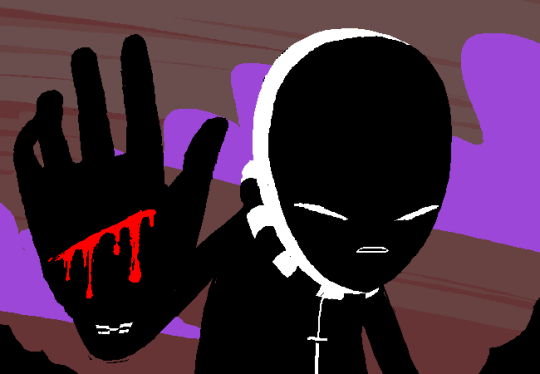
I love him because out of all the iterations of Jack Noir in the world of Homestuck, Spades Slick is the most morally upstanding. Oh, he’s still a huge fucking murderer and a caustic asshat with no regard for life or really any social skills to speak of, who thinks himself the center of the universe and won’t hesitate to get rid of anyone who gets in his way… But he’s the only Jack who ever showed empathy for another person of his own volition.
Bec Noir’s love of Jade is artificial, forced onto him from the prototyping. Union Jack doesn’t have any agency of his own at all for the majority of the time. Spades Slick goes out of his way to do this.
I’ve always believed that the strongest way to convey a scene is not through self-explanatory or long winded dialogue, nor is it through looking at still establishing shots of things that aren’t moving. It’s having the context of a scene inform the meaning behind the actions taken by the characters.
To break that down a little more, it’s about A Person the Audience Knows who Does Something with Another Person We Know that Changes Something Between Them Forever
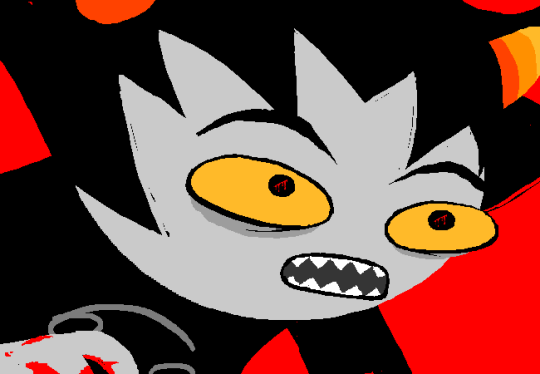
Spades Slick is a character we know to be crass, evil, mean, angry all the time, the kind of person who calls people he doesn’t like “coffin stuffers” and feels no remorse in killing them. Karkat we know is an asshole who’s full of himself and judgmental of everyone around him.
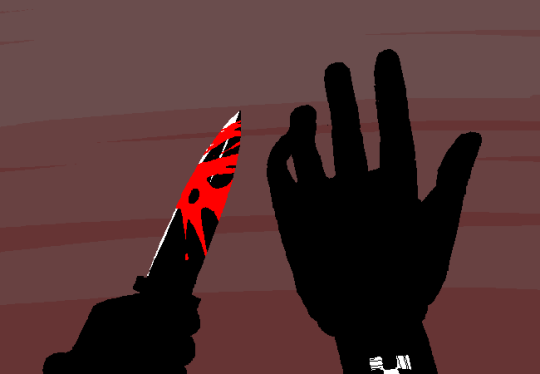
In this scene, we learned that Karkat has been hiding something about himself that he cannot change, but that fills him with shame and makes him feel like an enormous weirdo. He overcompensates for this enormous insecurity by being a pompous asshole. When Spades Slick initially meets him, he stabs Karkat in the gut, and Karkat doesn’t even care about the wound, he just worries that this chess guy is going to tattle on him and reveal his secret that he’s been tightly guarding for all his life.
Instead, Spades Slick decides to cut open the palm of his hand and let Karkat know that he’s in the exact same boat. We never see another Jack Noir willingly, and with sound mind, comfort a child ever again. This is the only time. And that has just colored my perception of Spades Slick forever, because while he is an enormous dickwheel, he’s also the only Noir who naturally has a soft side.






 just moving along like everyone else