Of all the many wonderful, complex characters in Fullmetal Alchemist, I find that Izumi Curtis is one of the most nuanced and original, both within the series and in the shounen manga field. In a genre full of dead mothers and overbearing harpies, Izumi stands apart as a physically and magically talented fighter who is also an “ordinary housewife”; she has, most unusually for a shounen manga female character, survived not only childbirth but also an horrific, failed attempt to resurrect her dead baby.
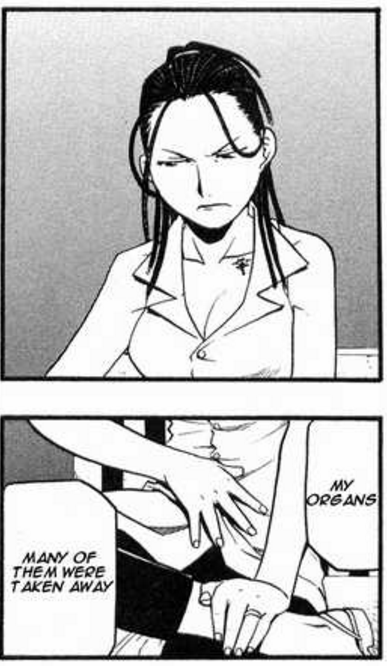
She is chastened but not broken by the experience. Izumi is the only female alchemist within the series to have seen “the Truth.” Her payment is highly gendered – I take “my organs” (or “some of my insides,” as another scanslation group renders it) to mean her womb and ovaries. And she is the only character whose payment is neither returned nor compensated for with automail or a surrogate body*.
I think it is so gutsy (no pun intended) of Arakawa to have Izumi remain in this state. It feels so radical to see a woman whose worth extends far beyond her ability to give birth. Who lost a child but still finds meaning in her family, work, and community. Who has a fulfilling life but still mourns for and thinks about her lost baby, even after her guilt is assuaged. In another author’s hands, Izumi would be long dead, a woman with no value beyond her womb, existing only to provide fodder for another character’s development. Or she would be a villain, a broken woman madly hungering for what she cannot have. Or she would have her organs restored, and be shown pregnant or holding a newborn at the series end. Instead, Arakawa gives us a female character who is both happy and wanting, powerful and poignant, and presents those dualities as valid, inseparable aspects of a whole.
*Within the context of the FMA universe, adoption is shown as an option, but one which the Curtises appear not to have pursued. Surrogate pregnancy, I believe, is not discussed within the series.
I feel like we as a society don’t talk enough about the fact that Faramir and Boromir could see the future, and that Faramir might have been a fucking psychic??
No listen now I’m finding page references because I honestly can’t believe I didn’t find this weirder the first million times I read these books
So we all know that the reason Boromir goes to see Elrond in the first place is because Faramir has been having these dreams about “seeking the sword that was broken” in Imladris and that Isildur‘s bane is there and such. Presumably after Denethor ignores him for long enough, whoever is sending out these prophetic dreams gets fed up and sends one to Boromir so Denethor will actually finally listen and take action (my complex feelings about Denethor are for another post lmao)
So there’s some solid evidence that Faramir, and at least to some extent Boromir can fucking. SEE THE FUTURE. And that little fact just doesn’t really get brought up again AT ALL in Fellowship of the Ring? (JRR Tolkien I love you but why were we deprived of the random travel conversations the fellowship must have had while traveling all over middle earth together)
Later on, Faramir describes seeing Boromir’s body in the boat he was sent down the Anduin in, and he knows way ahead of time that Boromir was dead – another instance of somehow knowing about things that happened hundreds of miles away when there is ABSOLUTELY no way he should have.
BUT THEN things get a lot weirder in The Two Towers when Faramir captures Frodo and Sam and Gollum. Faramir is interrogating Gollum about whether he had ever been to Henneth Annun before, and this is what happens:
Slowly Gollum raised his eyes and looked unwillingly into Faramir’s. All light went out of them, and they stared bleak and pale for a moment into the clear unwavering eyes of the man of Gondor. There was a still silence. Then Gollum dropped his head and shrank down, until he was squatting on the floor, shivering. “We doesn’t know and we doesn’t want to know,” he whimpered. “Never came here; never come again.”
“There are locked doors and closed windows in your mind, and dark rooms behind them,” said Faramir. “But in this I judge that you speak the truth.”
– The Two Towers, pg 689
That’s kind of a really weird thing to say. Maybe Faramir is being poetic and not literal when he says he can see into Gollum’s mind, but the elaborate description of their eye contact almost makes it seem like there’s something else going on here. Plus, somehow the eye contact alone is enough for Faramir to judge definitively that Gollum is telling the truth. This brings up something Gandalf says to Pippin about Denethor:
“[Denethor] is not as other men of this time, Pippin, and whatever be his descent from father to son, by some chance the blood of Westernesse runs nearly true in him; as it does in his other son, Faramir, and yet did not in Boromir whom he loved best. He has long sight. He can perceive, if he bends his will thither, much of what is passing in the minds of men, even of those that dwell far off. It is difficult to deceive him, and dangerous to try.“
– The Return of the King, pg 759
Like father, like son, it seems. I bet Denethor just loved that.
Again, maybe Gandalf is just speaking figuratively and is saying that Denethor is just really insightful. But it’s kind of weird to interpret it like that that in light of Gandalf putting that right next to a statement about Denethor’s bloodline that makes him and Faramir “different” somehow. Is Gandalf saying that they both can literally perceive “what is passing in the minds of men”??
BACK TO ITHILIEN (sorry this is more of a ramble than a well structured essay)
Faramir is asking Gollum if he knows what Cirith Ungol really is:
“It is called Cirith Ungol.” Gollum hissed sharply and began muttering to himself. “Is not that its name?” said Faramir turning to him.
“No!” said Gollum, and then he squealed, as if something had stabbed him. “Yes, yes, we heard the name once.”
– The Two Towers, pg 691
“As if something had stabbed him”?? There’s really no indication of what this “stabbing” could be in this context. It’s not Smeagol trying to keep Gollum from spilling the beans, because Gollum is the one who wants to keep the hobbits in the dark about Shelob. So who/what is stabbing his fucking mind?
Faramir sends Gollum away with Anborn and is talking to Frodo about Gollum.
“I do not think you should go with this creature. It is wicked.”
“No, not altogether wicked,” said Frodo.
“Not wholly, perhaps,” said Faramir; “but malice eats it like a canker, and the evil is growing. He will lead you to no good.”
– The Two Towers, 691
Gollum leading Frodo to no good might be the understatement of the year, as well as an incredibly accurate one. I don’t need to keep saying this but of course he could be speaking poetically or figuratively. It just seems to me that there’s a LOT of these instances over the course of these books.
Putting Denethor and Faramir in a room together is, of course, always fucking wild for a MYRIAD of reasons, but let’s look at (the part that always fucking kills me) this scene:
“Do you wish then,” said Faramir, “that our places had been exchanged?”
“Yes, I wish that indeed,” said Denethor. “For Boromir was loyal to me and no wizard’s pupil.”
–The Return of the King, pg 813
I’m pretty sure this is the first(?) instance of Faramir being referred to as Gandalf’s pupil. I’m highlighting this point because it kind of sets a precedent as to why Faramir and Denethor, despite both seeming to have these supernatural abilities to read people and situations, come to SUCH different conclusions about what to do with The Ring. Faramir has been studying with Gandalf, a magical wizard, since he was a kid. I really don’t think it’s that far of a stretch that Gandalf, who once again is literally a god or Maia or whatever, was able to teach him how to actually use this ability to read and/or influence minds. (Plus he wasn’t wrecking his own mind by staring into a palantir 24/7 but I digress)
I’ve been writing for too long, so here’s just a couple of other points that come to mind.
When Denethor is on the pyre, Faramir, who apparently hasn’t moved for like two straight days, somehow seems to know that his father is nearby
When Faramir is retreating from Osgiliath the first (second overall, first in the book) time, he can somehow get his horse to turn around and go back for the men being chased by FIVE NAZGUL when every other instance seems to involve people and animals just immediately losing their shit
When he’s talking to Eowyn in Houses of Healing, he mentions that this situations “reminds” him of Numenor’s destruction, which took place, hmm, an AGE ago. And he says that he dreams about this all the time (this one is linked to that weird ability to see things happening when they’re not happening in real time)
Anyway. Those are my two cents on the subject. Everyone in the line of Stewards is a fucking psychic to some extent and that’s what Tolkien intended
okay, it’s late and I don’t want to cite things but I really want to respond to this: yes! Yes, this is all 99% certainly true! Welcome to magic in LotR! This is the mother of all fantasy, but magic is not a flashy thing of wands and jets of light (HP) nor explicable on a frankly scientific level (Cosmere) nor even, say, the lack of definition and rules but the definitive effects, like time travel or mega lightning strikes, of Robin McKinley’s Damar books. No, LotR magic is incredibly subtle, and could at almost every turn be explained away by saying that a particular person is insightful, or inspiring, or just makes really good fireworks.
Seriously, Gandalf is The Wizard, but the most explicit magic we see him do is those more-than-natural fireworks at Bilbo’s going-away party, and in RotK when he, like, “casts a light” at a swooping Nazgul. Compare him reviving Theoden in the book vs in the film, which of course follows a more modern (and film-appropriate) dramatic view of magic – sure, the book has a bit of illusory storm and then light, and Gandalf definitely knocks Wormtongue out for lightning for a moment, but there’s no weird possession and magically induced aging going on. It’s like 90% psychology. (”Headology” – Pratchett knew what was up.) Note that this passage is begun with Gandalf singing, in the book – song is magic/divine power, in LotR, ever since Eru first began singing the world into existence. It is arguably not a matter of characters casting spells so much as a signifier to the reader that “magic” is happening now, or about to? But also it’s straight-up a spell. It’s no mistake that the runes readable on the Ring are a part of a poem describing its power and intent.
Faramir can use such power, a little, as can Denethor and Aragorn, because in all three of these men, the blood of Westernesse runs strong – in Aragorn in particular, who can heal, and wrest the focus of a Palantir away from Sauron with will and right. (It helps, per the extremely vague rules that govern LotR’s magic, that the Palantir is his by right of inheritance. For extra fun, se…a post somewhere that I’m not going to spend more time finding about how Frodo arguably “cast the spell” that sealed Gollum’s fate.)
Anyway, yeah, Faramir and Denethor have, like, metaphorical recessive genes of what Aragorn has in a more truly direct line, that is, a the blood of the Men of Westernesse, who were given longer lives and a home in sight of Valinor (home of the gods, ish) way back when. Literal physical proximity to Valinor is a rough equivalency for Right/Good and, consequently, granted Magic/Divine Power in The Silmarillion, or at least classist elves think so. Perhaps, as rumored, there’s even a dash of elvish blood in them, though I’m skeptical of that – Elrond does have two spare uncles, whose fates are unclear, but there are really only supposed to be 3 unions of Elf and Man and we know about all of their progeny. Possibly Elros got around, but he would have been doing that in the early days of Westernesse anyway, sooo…same thing.
Tldr: You’re absolutely right, but it’s deliberately vague bc that’s just how LotR works, and I love it.
Anyone else here familiar with the essay
Ósanwe-kenta? It’s subtitled/translated “Enquiry into the Communication of Thought” and is the closest Tolkien gets to discussing the actual rules of “magic” in Arda. The rules concerning telepathy (as understood by the Eldar and written down by Pengolodh), are outlined and discussed.
It was published in volume 12 of HoME, The Peoples of Middle-Earth, and was written sometime around 1960, so a few years after Return of the King was published, and according to the Tolkien Society’s timeline, shortly after his retirement and at the same time as several of his other essays about Middle-Earth.
Although Tolkien was beginning to rework parts of his cosmology at this point, I find that the concepts and details discussed Ósanwe-kenta are very consistent with the descriptions of telepathy found in LotR, of which several examples have already been discussed.
In brief, telepathy is an ability inherent to all minds (sámar, here distinguished from fëar, spirits). Bodies tend to get in the way, though, so it is harder for Incarnates to use than for Ainur, and harder for Men than for Elves. Therefore, Incarnates typically need their telepathy to be strengthened for effective communication. This can happen through affinity (as between family or friends), urgency (any great need), and authority (duty, or rightful command). Furthermore, any mind can refuse to permit entry of any other’s thought.
By these conditions, then, Faramir’s questioning of Gollum makes more sense. As the Steward’s son and an officer of Gondor in one of Gondor’s territories, Faramir has the authority to find out what Gollum knows and ensure he is not a danger to Gondor or ally of Sauron. This would naturally strengthen his telepathy, which is probably already stronger than average due to his Númenorean heritage. The “closed doors” he perceives in Gollum’s mind are likely his experience of Gollum refusing to allow him in fully, so Faramir is limited to mostly observation. Whether or not Faramir knows exactly what he’s doing, this leads to a very accurate assessment of Gollum.
Faramir, Denethor, and Gandalf aren’t the only ones who are shown using telepathy, either. Aragorn does it repeatedly and deliberately, particularly after entering Gondor. Galadriel examines the Company telepathically upon their arrival in Caras Galadhon. Sauron seems to use telepathy to command and control his armies. Celeborn, Galadriel, Elrond, and Gandalf chat that way on the journey home.
Okay, if you couldn’t tell, I really like this subject, and think it’s a pity it’s not more widely recognized. Tolkien is always stranger than most people assume, and it’s wonderful.
I’m reminded of the bit in Lothlorien where, in response to being asked if the elvish cloaks were magic, the elf being questioned was like “I don’t really know what you mean by that, but sure?” in the same way that a modern-day person might respond if they gave someone a bullet-proof camouflage vest and were asked “Is this a technology?” For an equivalent in our world it’d probably be like being able to sense and maybe even manipulate the Earth’s magnetic field. If your whole race can do that at a fairly competent level then you’re probably going to develop electricity and associated tech a lot faster than people who can’t, but from their point of view it’s not, like, mystical or anything.
Also, because it’s passed down via bloodline, most people who have the thing live in a community where the base assumption is that everyone has the thing, and most people who don’t have the thing “know” that it’s this exotic talent that only turns up in Magical Beings, so the idea that it might turn up in a Gondorian isn’t really an everyday concern or something people are on the lookout for. So it takes an outsider observer like Gandalf to be like “Two of these Men are not like the others, and the specific way in which they are not like the others is similar to this other thing”, while Faramir’s just going around with his psychic powers like
Ok, this is going to be a controversial one, but her me out: do you think it’s a bit weird that so many women in the fandom (most of them straight or bi) only show interest in mlm ships? I know on a personal level everybody has their reasons and I don’t think there’s anything wrong with liking mlm in any sense, but for so many women to only relate to relationships where they aren’t represented is a bit… weird. Not to mention knee-jerk reactions to any mlf pairing 🤔
This is far from a controversial question. People have been mystified that transformative fandom – primarily made up of women* – is ‘only’ interested in mlm for as long as transformative fandom has been a recognized phenomenon.
A caveat for the terminology in this post: as society at large tends to forget/ignore/reject the gender spectrum and transgender people, ‘male/men’ = characters referred to with male pronouns in canon and ‘female/women’ = characters referred to with female pronouns. (NB/agender/genderqueer people don’t come up, unfortunately.)
In other words,Fanworks are NOT mostly mlm; it’s just likely that we tend to notice m/m more than m/f because m/f is the ‘default’ – unmarked, and thus overlooked.
secondly, while you’ve lumped straight and bisexual women together in your ask, if you separate straight and bisexual fandom participants you get an interesting picture in regards to the typical ‘straight women are the biggest m/m fans’ common wisdom:
Now with those caveats out of the way … why is mlm popular in a space that is primarily dominated by women**? I honestly don’t think this can be truly quantified. the reasons vary from person to person too greatly. But there’s a lot of theories and a lot of anecdotal evidence for those theories. Here’s some of them, in no particular order:
it’s male privilege (sexism/misogyny).
Male privilege: Male societal privilege and and bias feeds into media bias. media is heavily male-dominated (more male characters, usually played by cis men where actors are called for, with more central/leading roles and more screentime). Even conversations between female characters tend to focus on the male characters. The media bias then itself contributes back to societal bias – and fandom bias – towards seeing men/male characters as more interesting, more dynamic, and more varied than women/female characters.
Flip side: societal bias towards men leads directly to a relative lack of interest in women/female characters. they have less screentime, less interaction with one another, and are less centralized by the plot. Their stories are more likely to revolve around a male character in the cast. And when they do get the same treatment as male characters, audiences are very hard on them.
it’s simply a function of statistics. the overrepresentation of male characters compared to female characters has a natural consequence. If you do the math, that exponentially increases the odds of a mlm ship being fanned over compared to an m/f or wlw ship.
in addition to having more roles, relationships between masc characters are often where the emotional heart of a story lies. people tend to ping on that in and create fan content for it.
it’s because fanworks are a function of wish fulfillment, taking various forms:
straight women, being sexually attracted to men, consume mlm (nsfw) fanworks for the same reason straight men might consume wlw porn: double the eye candy. (the fact that straight women are actually less likely to consume or create mlm fanfic than non-straight women suggests this may not be as prevalent as often assumed.)
non-straight characters are still incredibly uncommon in mass media; transformative fandom, which is mostly non-straight, creates their own representation (perhaps with bias towards the characters with more emotional connection in canon.)
non-straight relationships are even less common than non-straight characters, and are unlikely to get much canon focus if they do exist. fandom fills this gap. (conversely, m/f pairings are far more likely to receive canon fulfillment and canon focus, so there’s less need to create fan content for it.)
(white cis) male bodies are both more common in (western) mass media and ‘unmarked’. like m/f pairings, white cis males are perceived as ‘default’ due to white/cis/male privilege. If racism, transphobia, and sexism weren’t enough on their own to increase content about pairings between characters of that description, that privilege also means that fictional characters of this description are the least likely to be seen as needing protection by policing elements in fandom, increasing the free rein on content creation. thus: fandom produces more mlm fanworks despite being fannish over m/f and f/f ships as well, which increases content obscurity, which increases free rein, which increases content creation, etc.
relatedly: women’s stories/sexuality is too fraught. male privilege/internalized misogyny leads directly to women’s stories and afab bodies being politicized. some afab people have hangups about fictional representations of themselves in nsfw content, being uncomfortable with portrayals of people like themselves in fiction, and even sickened by depictions of pleasure experienced by bodies with vaginas (particularly in f/f works). mlm stories create enough distance for women to enjoy it without distraction by concerns of misogyny or fear of something hitting too close to home in the experience (and cis mlm nsfw content in particular provides a safe space for afab people who are bothered by depictions of afab pleasure for whatever reason).
In conclusion: at first glance it might seem weird that fandom seems to spend a lot of time on mlm, but this is both not entirely true and (where it is true) there are many, many reasons for it.
I’ve spent 8 hours compiling links and piecing together this post now so that you can have a comprehensive guide to the reasons that parts of fandom seem to be dominated by mlm stories, so I’m going to wrap up now. For more fanwork statistics, try these links:
One final note: the comparative prevalence of mlm to wlw would suggest that male privilege and bias is primary motivation for its popularity, but wlw was not always so scarce as it seems to be now. Just as you might expect, shows with a mostly-female cast had massive amounts of wlw content: sailor moon, utena, etc. Butthere’s reason to believe that purity culture has stifled wlw popularity, and that’s a damn shame.
*The largest fandom demographic survey from a reputable source (that I am aware of) was based on AO3 users, advertised primarily via Tumblr, and analyzed by @centrumlumina in 2013. I’m pulling my stats from this survey, but be aware it has significant limitations.
**in my personal experience, many of those in fandom who identify as women are cis women, but also many of those in fandom who do not identify as women are afab/were socialized as a woman before identifying differently. However, I don’t currently have survey data to back this up.
One small note regarding making inferences from AO3 as opposed to ff.net: don’t forget that ff.net has in the past engaged in wholesale deletion of homosexual content. This suggests that it, at least, represents a selected sample and thus cannot be used for inferences without some transformation.
I don’t know enough about the data to be able to say anything definitive about how to fix it, but I will suggest that a small, random sample is more representative than a large, selected sample. That’s just statistics.
this was never official policy, but there was a bit of that kind of effect.
I was there for the NC-17 fic purge in 2002 (the announcement can be read here). This was meant to ban any kind of explicit sexual content from the site, but it disproportionately affected m/m fic because LG content of any kind was just considered to be not-kid-friendly, and thus tended to be higher-rated by default (this person’s experience of feeling that any m/m content had to be rated NC-17 was not my experience, but it illustrates my point). m/f kisses were G-rated; m/m kisses were PG-13-rated. and after the NC-17 purge, people who dodged by just dropping the rating on their explicit fic were were more likely to get reported if their work was LG.
Apparently this sexual nsfw ban was reiterated in 2012 and pushed a whole new group of authors to nsfw-friendly sites likes AO3.
Even though fandom often obsesses over the question of why we like mlm so much, the truth is that fandom mlm content has been under fire from outsiders and also from insiders for many, many years. if you go back into the depths of ff.net, you’ll see a plethora of fics with warnings like MM CONTENT! YAOI! DON’T LIKE DON’T READ! taking up precious character-counter space in the tiny summary line. If you didn’t do that, you’d get ‘flamed’ (nasty reviews with personal attacks in them). It’s only been in the last 5-8 years or so that fandom has come to be considered slash/femslash-friendly and people who are bothered by LG content are the weirdos – which is why it’s so bizarre to me to see this flip happening, where LG content is bad again because the wrong people are writing it.
(*’MM’ instead of ‘M/M’ because ff.net took ‘special’ characters- including slashes! – out of summaries a while back and most people never edited in response :v )
Oh man, wow, okay, I have two answers for you Anon, short and long.
Short: OMG, no, I don’t mind at all if you read me! I don’t like anti-Steve content either!
Also, before we get to the long answer, I need you to understand that everything I’m about to say is yelling at fandom, and not at you. In fact, I am gently hugging you while yelling at fandom over your shoulder. Just hold that in your mind.
Long Answer:
So, what you said crams an incredible amount of information about present-day fandom into two sentences. I’d like to break it down a little because I want to dispel some of the toxic myths that are flying around in fandom culture.
One, it is truly mind-blowing to me that in the span of about five years, fandom has gone from Tony/Steve being the massively dominant ship to a person believing that if they like Steve Rogers they can’t like Tony Stark or vice versa. For decades, they were the best of friends in comics, and fandom loved both their friendship and the super gay subtext it contained. Even after the comic book Civil War, where Steve and Tony basically argued the exact same thing as the movie, they were a heavily dominant ship. I don’t think the movie changed that, necessarily – I think fandom culture did, more on that below.
And I’m okay with the ship losing people. There’s still tons of fanfic out there, it’s not that I’m mad I get less content now, I consume less content now anyway. It’s this bizarre idea that if you like one character you cannot like a character who is in opposition to them, even if those two characters still have a relationship. Or if they don’t!
It is okay for two characters to fight with each other and even spend time hating each other and for them to both be protagonists, and for you to still like them both. This isn’t a dysfunctional divorce, you don’t have to choose, whatever Marvel and the more toxic side of fandom is telling you. One of the reasons my old Stealing Harry fic is so popular (aside from being kidfic) is that I wrote Sirius Black and Severus Snape as two thoroughly damaged war veterans who hated each other not because one was good and one was bad but because they were very different people who had a long history of being assholes. They could both still be likable characters. And because of that, they could both experience growth into Non Assholes in my story.
You can like Steve Rogers and still like Tony Stark. Or like Steve Rogers and just not give a shit about Tony Stark. I love them both deeply, separately and as a partnership. And so I don’t allow haters on my dash. Of either of them.
And that leads us to point two. Not allowing haters on my dash isn’t some kind of purity thing. It’s not a form of CASTING OUT ALL WHO DISAGREE, there’s no ideology behind it. Not that I could stop them reading me anyway – even if you ban someone, they can still read your tumblr unless you password-lock it, and we’ll come back to banning in a minute.
Not allowing haters on my dash is about the active curation of my fandom experience and no one else’s. I like Tony Stark so I don’t want to see people hating on him. I do have friends who don’t care about him one way or the other, and some who don’t like him, but the difference is that when they don’t like something…they ignore it and talk about the stuff they do like. I do the same with them. We aren’t haters. We’re just people with disparate interests.
When there is a culture of hating on any character, which is apparently what the tonky stank thing is about (according to reports; I haven’t seen it for myself), it tends to be less about that character and more about an excuse to indulge in a kind of mob-based negativity. If it’s interesting to examine canon critically, that’s one thing, I could and often do engage in critical discussion of canon. If it’s fun to hate a character so you do a lot of it as a pastime, or all your critical focus is on one specific pinpoint of canon that you just hate so much, then, well, you are enjoying hating something, and that’s…not a great mental place to be, tbh. (We saw this in Torchwood with the antigwenallies, so it’s not new, it’s just in a new fandom.) It’s essentially schoolyard bullying where you feel okay about it because the victim is fictional.
And I’m not here to say “Stop, you are hurting Tony Stark’s feelings.” He doesn’t exist, he has no feelings to hurt. But bullying is like an addiction – it’s an unhealthy outlet for people who haven’t got healthy ones.
So, here’s part three: you can’t stop haters reading what you say, but I don’t even bother trying. I don’t care who reads me because I only care about what I consume and where my work goes, and someone else’s reading involves neither of those. Besides, you can tell people not to read you, but someone who hates something you love is still probably going to do it.
If they make a nasty comment, then you can ban them, but that goes back to curating your own experience. Banning is best when used to shield you from hearing their voice or to stop them putting your work on their blog. Like unfollowing someone, it’s not meant to indicate a difference of opinion, it’s meant to remove that harmful influence from your life. Because even if someone you TRULY HATE is reading your blog passively and not commenting, you pretty much have no way to tell. So why worry? Maybe they’ll learn something.
So that’s pretty much my ban policy: I don’t ban people unless a) they’re motivated solely by a desire to ruin someone’s fun or b) I don’t like the content of their blog and don’t want my name appearing on it (porn bots, Nazis, misogynists, etc). There’s a significant overlap, for sure.
Anyway, in closing, it is possible to like multiple characters even if fandom is telling you otherwise, your fannish experience is your own to control and not a stick to hit people with, and I don’t care who reads me because they will anyway and also I want to model good, healthy fannish behavior for those who do, especially for those who maybe haven’t learned that healthy behavior yet. I do my best, anyway.
PHEW. We got through it. I’ll stop hugging now.
this is a really good takedown of some toxic aspects of fandom culture, and a building up of some healthy ones. i really feel that people who took ‘civil war’ to mean you had to hate either tony or steve really missed the point of the work. the tragedy and power of that story came from the fact that the heroes were divided and fighting over a real issue, but still loved each other. not just tony and steve, but all the avengers. they’re still family even when they’re fighting.
and whether you ship stony or see them as friends or what, it hurts to see them fighting, and it hurt THEM to be fighting, and that’s what makes it a powerful story.
all the ‘team cap vs team iron man’ merchandizing was playing on that, and simultaneously leaning on the tension and lessening it by treating it kind of like a pickup football game. like, shirts vs skins, kinda thing.
you see it lampshaded a bit in the actual movie when natasha and clint are fighting, because they’re reassuring each other they’re still best friends even while they kick the crap out of each other.
anyhow, i feel like fandom infighting is fading back a little now that there are so many obvious and undeniable enemies in the real world. but i’m hoping maybe we can all remember this perspective and not go back to biting holes in each other over fiction once the nazis are beaten.
Also Tumblr: *adds a gay romance plot to every story*
Tumblr: It’s okay when we do it, because it appeals to our fetishes, even if we say it’s “because progressiveness!”
to be fair a lot of hetero romance feels forced as fuck, and if it wasnt literally everywhere i wouldnt have an issue with it. dont really watch movies but seeing actually healthy gay relationships is rare the times i do watch tv
a lot of women: we’re really tired of constantly seeing trite heteronormative bullshit romances shoehorned in to every piece of media, no matter how flat the female character or unappealing the male character, that never lets us forget our place as sexual accessories to men. also, a whole bunch of us are queer. also queer men are here too.
a lot of women: so we’re going to write our own romances that are actually hot and appealing as well as useful for exploring— or escaping— the various traumas and kinks we’ve picked up around living in a world that sees us as sexual accessories. relationships based on equality and friendship, or relationships that specifically foreground inequality and exploitation, are really hot and fun to examine in the context of a couple hundred thousand words of hardcore gay smut—
inevitable dudes: but this makes us uncomfortable! because you’re sexual accessories, your involvement with sex should be as a passive receiver, a subject, not an active agent, let alone a creator or an instigator. we’re going to make fun of you now until you stop.
a lot of women: it turns out that once you read a couple hundred thousand words of hardcore gay smut you get a lot harder to shame.
If Venom is so much of a loser back home, how did they end up on this highly important mission? What possible purpose would they serve? Riot is the leader, of course, and I’m assuming Carrion (yellow) and Blight (blue) would probably be like combat and study, so why is this dumb gay there?
And then it hit me.
The only constructs Venom ever produced during fights were defensive. When the Foundation goons bust up Eddie’s apartment, they make a shield to protect the people whose window they just crashed through from getting shot. The fight with Riot, they produce a big one to keep him from tearing their face off. After the rocket, they created a parachute so Eddie didn’t get hurt—at what could easily have been the cost of their own life. They told Anne not to get involved because it would be dangerous.
Venom was just a tank. The only reason they were there was to take damage and keep the others safe.
Fuck, man.
…and of COURSE the team protector would be the one to look at this planets sweaty inferior meatbags and go ‘but consider: what if I protect THIS, actually’
I feel like we as a society don’t talk enough about the fact that Faramir and Boromir could see the future, and that Faramir might have been a fucking psychic??
No listen now I’m finding page references because I honestly can’t believe I didn’t find this weirder the first million times I read these books
So we all know that the reason Boromir goes to see Elrond in the first place is because Faramir has been having these dreams about “seeking the sword that was broken” in Imladris and that Isildur‘s bane is there and such. Presumably after Denethor ignores him for long enough, whoever is sending out these prophetic dreams gets fed up and sends one to Boromir so Denethor will actually finally listen and take action (my complex feelings about Denethor are for another post lmao)
So there’s some solid evidence that Faramir, and at least to some extent Boromir can fucking. SEE THE FUTURE. And that little fact just doesn’t really get brought up again AT ALL in Fellowship of the Ring? (JRR Tolkien I love you but why were we deprived of the random travel conversations the fellowship must have had while traveling all over middle earth together)
Later on, Faramir describes seeing Boromir’s body in the boat he was sent down the Anduin in, and he knows way ahead of time that Boromir was dead – another instance of somehow knowing about things that happened hundreds of miles away when there is ABSOLUTELY no way he should have.
BUT THEN things get a lot weirder in The Two Towers when Faramir captures Frodo and Sam and Gollum. Faramir is interrogating Gollum about whether he had ever been to Henneth Annun before, and this is what happens:
Slowly Gollum raised his eyes and looked unwillingly into Faramir’s. All light went out of them, and they stared bleak and pale for a moment into the clear unwavering eyes of the man of Gondor. There was a still silence. Then Gollum dropped his head and shrank down, until he was squatting on the floor, shivering. “We doesn’t know and we doesn’t want to know,” he whimpered. “Never came here; never come again.”
“There are locked doors and closed windows in your mind, and dark rooms behind them,” said Faramir. “But in this I judge that you speak the truth.”
– The Two Towers, pg 689
That’s kind of a really weird thing to say. Maybe Faramir is being poetic and not literal when he says he can see into Gollum’s mind, but the elaborate description of their eye contact almost makes it seem like there’s something else going on here. Plus, somehow the eye contact alone is enough for Faramir to judge definitively that Gollum is telling the truth. This brings up something Gandalf says to Pippin about Denethor:
“[Denethor] is not as other men of this time, Pippin, and whatever be his descent from father to son, by some chance the blood of Westernesse runs nearly true in him; as it does in his other son, Faramir, and yet did not in Boromir whom he loved best. He has long sight. He can perceive, if he bends his will thither, much of what is passing in the minds of men, even of those that dwell far off. It is difficult to deceive him, and dangerous to try.“
– The Return of the King, pg 759
Like father, like son, it seems. I bet Denethor just loved that.
Again, maybe Gandalf is just speaking figuratively and is saying that Denethor is just really insightful. But it’s kind of weird to interpret it like that that in light of Gandalf putting that right next to a statement about Denethor’s bloodline that makes him and Faramir “different” somehow. Is Gandalf saying that they both can literally perceive “what is passing in the minds of men”??
BACK TO ITHILIEN (sorry this is more of a ramble than a well structured essay)
Faramir is asking Gollum if he knows what Cirith Ungol really is:
“It is called Cirith Ungol.” Gollum hissed sharply and began muttering to himself. “Is not that its name?” said Faramir turning to him.
“No!” said Gollum, and then he squealed, as if something had stabbed him. “Yes, yes, we heard the name once.”
– The Two Towers, pg 691
“As if something had stabbed him”?? There’s really no indication of what this “stabbing” could be in this context. It’s not Smeagol trying to keep Gollum from spilling the beans, because Gollum is the one who wants to keep the hobbits in the dark about Shelob. So who/what is stabbing his fucking mind?
Faramir sends Gollum away with Anborn and is talking to Frodo about Gollum.
“I do not think you should go with this creature. It is wicked.”
“No, not altogether wicked,” said Frodo.
“Not wholly, perhaps,” said Faramir; “but malice eats it like a canker, and the evil is growing. He will lead you to no good.”
– The Two Towers, 691
Gollum leading Frodo to no good might be the understatement of the year, as well as an incredibly accurate one. I don’t need to keep saying this but of course he could be speaking poetically or figuratively. It just seems to me that there’s a LOT of these instances over the course of these books.
Putting Denethor and Faramir in a room together is, of course, always fucking wild for a MYRIAD of reasons, but let’s look at (the part that always fucking kills me) this scene:
“Do you wish then,” said Faramir, “that our places had been exchanged?”
“Yes, I wish that indeed,” said Denethor. “For Boromir was loyal to me and no wizard’s pupil.”
–The Return of the King, pg 813
I’m pretty sure this is the first(?) instance of Faramir being referred to as Gandalf’s pupil. I’m highlighting this point because it kind of sets a precedent as to why Faramir and Denethor, despite both seeming to have these supernatural abilities to read people and situations, come to SUCH different conclusions about what to do with The Ring. Faramir has been studying with Gandalf, a magical wizard, since he was a kid. I really don’t think it’s that far of a stretch that Gandalf, who once again is literally a god or Maia or whatever, was able to teach him how to actually use this ability to read and/or influence minds. (Plus he wasn’t wrecking his own mind by staring into a palantir 24/7 but I digress)
I’ve been writing for too long, so here’s just a couple of other points that come to mind.
When Denethor is on the pyre, Faramir, who apparently hasn’t moved for like two straight days, somehow seems to know that his father is nearby
When Faramir is retreating from Osgiliath the first (second overall, first in the book) time, he can somehow get his horse to turn around and go back for the men being chased by FIVE NAZGUL when every other instance seems to involve people and animals just immediately losing their shit
When he’s talking to Eowyn in Houses of Healing, he mentions that this situations “reminds” him of Numenor’s destruction, which took place, hmm, an AGE ago. And he says that he dreams about this all the time (this one is linked to that weird ability to see things happening when they’re not happening in real time)
Anyway. Those are my two cents on the subject. Everyone in the line of Stewards is a fucking psychic to some extent and that’s what Tolkien intended
honestly I always just took this as read & presumed it was down to this:
‘(Denethor) is not as other men of this time, Pippin, and whatever be his descent from father to son, by some chance the blood of Westernesse runs nearly true in him; as it does in his other son, Faramir…’
ie, Faramir & Denethor are basically full-blooded Numenoreans, who had special powers due to being half-elven. This would also shed some light on why Faramir is able to ‘recall’ the destruction of Numenor.
This suggests that Aragorn is also psychic which I believe there’s some evidence for, tho the only thing I can recall off the top of my head is this passage:
Aragorn said naught in answer, but he took the (messenger’s) eye and held it, and for a moment they strove thus; but soon, though Aragorn did not stir nor move hand to weapon, the other quailed and gave back as if menaced with a blow. ‘I am a herald and ambassador, and may not be assailed!’ he cried.
in which Aragorn MIGHT be having a psychic battle of wills with the Mouth of Sauron (who is also of Numenorean descent & knows ‘great sorcery’).
So. Yes. the Blood of Westernesse gives people psychic powers. probably.
not to be all “tw*light did nothing wrong” but misogyny honest to god killed the hunger games
it was no masterpiece sure but it also sure as hell wasnt the love triangle bullshit everyone made it out to be. seriously everyone blames this whole “YA fiction with the special One and teens overthrowing the oppressive government tropes” trend on the hunger games but the truth is that none of those books are anything like thg
god!!! im mad!! name one cliche YA novel where the government actually is BAD like not just “oh love is illegal” or “they barcode you!!uwu” instead of like. actual slavery and rampant poverty while the rich waste their money on dumb bullshit!! and name one main character who ACTUALLY suffers under the government’s regime!! who actually starves and works and suffers and has genuine REASON to rebel!! thg is the only YA book that had anything to say about wealth disparity and the dehumanization of the poor,, every other YA book uses it as a plot device to put some dumbass romance together or show how “badass” the MC is!! thg is genuinely emotional and the focus of the book isnt katniss’s archery and how cool she is and its NOT gale or fucking peeta bread. and then the marketing for the stupid fucking movies took the WHOLE POINT OF THE BOOK (which is to satirize and critique how women in entertainment have any serious things about them ignored in favor of whatever dress theyre wearing or who they’re dating) and turns that into……….. a fucking love triangle. and then the world forgets it because its just another dumb teen girl series. okay.
Me @ myself rn
oh also last thing. the fact that at the end katniss chose to kill Coin (the rebel leader/soon to be newest dictator) instead of just having a plain and simple boring happy ending shows just how different thg is from the YA fiction its compared to. no other book in this genre would have the guts (or even the idea) to put out such a blatant, obvious “the fight against oppression never ends, stay diligent” message and thg is iconic for it and it shows how much thought was actually put into its message. im sorry to susan collins for my 12 yo self for not understanding at the time and thinking it was just bad writing
thanks to everyone adding on about the representation! about finnick’s story and being trafficked! and about peeta and his disability!! and katniss and her indigenous coding and PTSD!! And about how it shows how war n dictatorships always prey on marginalized groups!! and a billion other things!!! that the movies just fucked off n forgot about!!!
I remember reading these books and being SO struck by the part where Katniss and Peeta were at a party and the rich were throwing up to eat more food and that was just so disgusting to them because their whole lives, they didn’t have enough to eat (more so for katniss) yet in the capitol there was some excess of food and food was treated like a thing to indulge in and throw around. I still remember reading that and realizing what it was truly like for them, how katniss’s relationship with food differed so much from what I was used to. Those books made me think critically about the rich when I was only in middle school and they deserve more credit.
For some reason I had the idea that SBURB will try to kill any extraneous people who get brought along into the game. Not supposed to be here, don’t need you messing around, die and get out of the way. Presumably this impression is from the beta session, but that was Bec Noir, and there is nothing normal about Bec Noir even by SBURB standards.
What SBURB tries to do with extraneous people is throw them in jail on Derse. Keep them out of the way, but offer them to the successful player as a bonus reward.
Now that I’ve thought of this it seems incredibly obvious.

 just moving along like everyone else