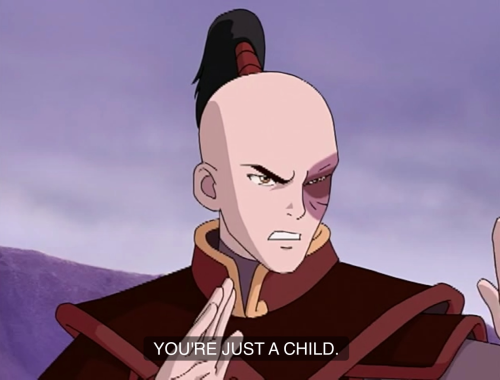
Sometimes I think about the fact that there is exactly one time that we hear someone express surprise at the fact that Aang–the Avatar– and his companions are children. And it’s in the second episode, from Zuko:
From an out-of-universe perspective, this makes sense. And it wasn’t something that surprised me when I was a ten-year-old in 2005 when A:tLA first aired. One of the tenants, I think, of adventure children’s television is that there is a degree of wish fulfillment. Children want to be taken seriously as agents, and so it makes sense from that vantage point, that everyone takes the Gaang seriously as agents except the person portrayed as an antagonist.
But, I think this also makes sense, heart-breakingly and unlike other children’s adventure television, from an in-universe perspective. This is a world ravaged by bloody, bloody war for a hundred years. A world in which child soldiers are commonplace. We see countless examples of this throughout the series:
When we meet Sokka–fifteen-years-old and in-charge of security for his village–he is training small children to be soldiers. This is played off as something of a laugh, but if Aang hadn’t returned in the second episode, I think we’re supposed to think that Sokka very much would have tried to lead these little boys into battle.
Jet and the Freedom Fighters, who practice guerrilla warfare (fairly successfully) and regularly raid Fire Nation outposts, are children. Jet, who I think we are supposed to assume is one of the eldest of the group, is sixteen when he dies (according to the Avatar wiki).
The Kyoshi Warriors are one of the elite-most fighting force in Avatar World, eventually taken seriously by the Earth Kingdom military and given military jobs. And the general of the Kyoshi Warriors, Suki, and the eldest member of the group (again according to the Avatar wiki) is fifteen. She can’t have always been the eldest member. I’m willing to bet the older women are sent off to war, and Suki becomes the eldest member and the leader by default. (Much like Sokka–probably why they connect so well).
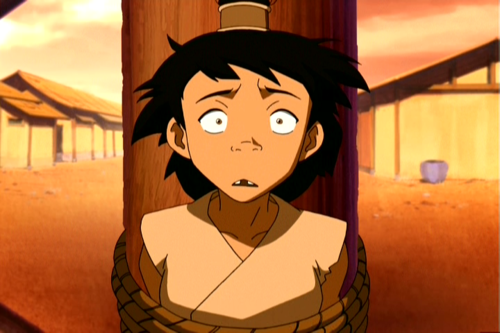
In Zuko, Alone, the soldiers in the village threaten to send Lee off to join the army at the front, and based on the mother’s reaction, and what we see of him when he’s tied up, this doesn’t seem like an empty threat, and it’s probably not the first time this has happened to children in the Earth Kingdom in villages like these.
I could go on.
So of course, after living in a world of child soldiers like these, no one is going to bat an eyelash to learn that the Avatar–perhaps the ultimate non-Fire Nation soldier–is twelve-years old, and his companions aren’t much older. When Aang starts to bring this up himself to Yue, for instance, Yue doesn’t seem to understand. He’s the Avatar, he has to save them, she insists. Who cares if he’s a child?
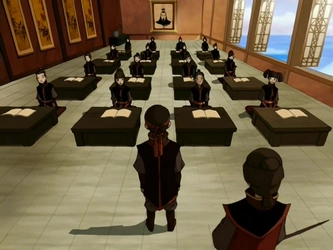
But the Fire Nation Army isn’t filled with child soldiers. It doesn’t need them. Fire Nation children are in school. It is adults that make up the Fire Nation Army.
And, (with the exception of Azula and her gang), when we do see a Fire Nation child attempting to take on the role of an adult member of the military, he isn’t taken seriously. (E.g. Zuko, and the way Zhao brushes him off.)
So of course it is only Zuko, who grew up in the absolute center of the Fire Nation, and, though he is banished, hasn’t really seen much of the reality of the war until he meets Aang, that looks at the Avatar and remarks in surprise that he is a child.
(If anyone is interested, I wrote a fic that deals with a lot of these themes. It can be found here.)
i think the moment i was disillusioned about life was when i was maybe 7 years old and realized the reason all my friends had become assholes was because boys aren’t allowed to have any physcial contact that isn’t fighting
my parents were hippie feminists so my brother and i could play clapping games and sleep in puppy piles and give each other weird hairdos, but all the ‘normal’ boys just up and stopped knowing how to touch anyone without hitting sometime between kindergarten and first grade
and my little kid mind briefly saw the vastness of life stretching out in front of all of us, and all the hugs everyone would need and not get, and for a moment i was just like
maybe life is not such a good idea after all
I grew up around a Russian ballet school. Let me tell you something about Russian men: They touch each other. Especially dancers, who are in my experience almost always super tactile people. They rough house like Americans, but they also hug each other, and sit on each other’s laps, and share blankets when it’s cold backstage.
So I grew up knowing full well that the whole Men Don’t Touch thing was puritanical bullshit.
What I was absolutely not prepared for, however, is the super intense effect it has on straight men’s romantic relationships.
Because when you are literally the only person it is okay for your boyfriend to touch, Jesus fucking Christ, that changes the game.
I strongly suspect that a lot of Str8 Dude feelings of entitlement to women’s bodies, particularly the bodies of their wives and girlfriends, is a direct result of those women being the only non-violent physical contact they’re allowed to have.
I know for certain that the framing of any and all platonic physical contact as un-manly has been directly responsible for a lot of sexual dysfunction (and then the attendant misery of trying to get that treated at the ripe old age of 22) with at least one of my exes. It’s a mess when you can’t get it up because you’re depressed and want to be held but you’ve been brainwashed into thinking what you actually want is sex because being held is for girls.
Amazing how the erectile dysfunction went completely away when he learned the difference between feeling horny and feeling cuddly. /sarcasm
“I strongly suspect that a lot of Str8 Dude feelings of entitlement to women’s bodies, particularly the bodies of their wives and girlfriends, is a direct result of those women being the only non-violent physical contact they’re allowed to have.”
Omfg
No wonder the worst of them seem crazy… profound isolation does exactly that
When I taught in Japan, the boys were all super comfortable with each other. They’d sit on laps and hug and roughhouse and it wasn’t seen as bad ? Like it surprised me at first, but then you realize the problem is with so many men feeling that they have to prove… something? I dunno. I personally don’t like hugs or touches, but that is my own personal reasons and nothing of how I was brought up.
Because when you are literally the only person it is okay for your boyfriend to touch, Jesus fucking Christ, that changes the game.
Things I never thought of…I couldn’t imagine if my husband were the only person I was allowed to touch. As I think on it, that extends to the kids, too. The dudes aren’t allowed to really even cuddle their own damned children or nieces and nephews.
Wow.
Also explains why western media romanticizes co-dependency in romantic relationships to such an insane degree.
I think, on a first readthrough of the Silmarillion, there were a lot of things I accepted as happening because the plot required it, not because, you know, it actually made any sense. Like the departure of the Noldor from Aman, or Morgoth stealing the Silmarils, or Thingol wanting a Silmaril, or Celegorm and Curufin turning evil in Nargothrond.
But I think that’s selling Tolkien short, and selling the story short. I’ve made the case in detail for why some of these apparently-plot-motivated decisions made sense, and today I’m going to tackle another one by exploring the Silmarils: why they deserve the reverence they’re treated with by the text and by the characters, why the determination of everyone to steal them or hold onto them isn’t as stupid as it looks, and generally why I think we sell the story short by behaving as if they have only sentimental value.
no really though, can anyone explain to me why fictional depictions of violence are only wrong when they’re sexual? why it’s universally understood that simulated violence can be consumed without danger of influencing society, but any depiction of any part of the sexual violence spectrum will inevitably contribute to real world sexual violence? have any antis made an attempt at really explaining that? I’d love to see it
Obviously I’m not an anti, but as someone who has always had an underlying reaction of ‘this comparison doesn’t feel right’ whenever someone calls hating fictional sex but not fictional murder hypocritical, I wanted to respond.
I think it’s a reflection of how society reacts to sexual assault victims differently from murder/attempted murder victims. Specifically: society behaves as if the thoughts and fantasies of a sexual assault victim have an effect on the severity of their rapist’s actions but does not do the same for murder victims.
in other words: in an anti’s eyes, it’s easy to see that only a murderer is responsible for murder. But rape culture (not the rapists) are responsible for sexual assault and anyone contributing to it (i.e. creators of dark fandom content) is/are responsible for cleaning up and ending rape.
*
Frank talk about about rl sexual assault and murder below.
Neutrally speaking, sex itself can be a good or a bad experience. murder or attempted murder can only ever be a bad experience.
When someone says they were sexually assaulted, society zeros in on whether or not the victim enjoyed/wanted/previously fantasized about the sex instead of focusing on the being forced part. If we treated murder victims the same way we treat sexual assault victims, we’d concern ourselves with whether the victim enjoyed/wanted/previously fantasized about being stabbed/choked/poisoned/etc to death instead of focusing on the being dead part.
“[A]s long as society pushes the blame for sexual violence off the abuser/rapist and onto the victim, or the state of society… antis will contribute to this mindset by demanding that the victims and society clean up their act first.”
This is good but I’d like to add: “antis”(or, well, their philosophical ancestors) TOTALLY tried to do this with violence.
For most of the 90s and early 00s, people with precisely this mindset fought HARD to ban or censor games and music(exclusively rap and other “deviant” genres) for violence(and, surely by coincidence, anti-establishment messages) with the same sorts of arguments and on the similar theory that violence in art caused violence in society. That violence and crime in US society during this period were persistently falling inspite of its, to their eyes, ever-increasing “deviance” never seemed to register with them, oddly enough. And before THAT -during the 70s, 80s, and 90s- the same folks campaigned against violence in films, tv, and music. Antis lost all those fights, eventually(well, TV censorship is more complex. The FCC was, and remains, very susceptible to their gaming, particularly on language and sex).
And during all these eras, mostly the same folks were caught up in the anti-porn fight as well. Which also failed. So why does this particular arm of the anti-porn campaign continue? Here’s one theory:
All of this -from slasher flicks to pornography- were normalized by society in the wake of their success; they became, or became part of, billion dollar industries and, in the US, how can something worth billions of dollars be deviant? Commodities are as American as Apple Pie. These are all also Industries controlled by, and profitable to, white men. Fanfic is (mostly)non-profit. It’s non-commoditized and, in fact, very difficult to commoditize due to IP laws. It’s primarily controlled by folks afab. Because it’s non-institutionalized, the sort of structural gatekeeping which keeps poc and non-men out of positions of influence and control aren’t as developed and established(racism and sexism are still social institutions that impact and exist in fandom, obvsl; upholding them is the point of the racist+sexist harassment which happens in it). Fanfic sex remains “deviant”, and thus an open target for christian moralizers(disguised, unaware, or otherwise), because Fanfic communities themselves are “deviant”; more open to those excluded by establishment society, and more difficult for capitalists to integrate into their system of profit-exploitation.
BUT NO SERIOUSLY CAN WE TALK FOREVER ABOUT HOW SHE STOLE THE ENDING. Because as soon as you get the idea that she’s alive, you think “oh, she’s going to come in at the last second and land a few punches and give Tony – the hero – enough time to get back on his feet and finish the battle, while she cheers from the side lines.” Just. Like. Every. Other. Movie. And then she FINISHES THE BATTLE. SHE KILLS HIM.
One of the (many) reasons I love Iron Man 3: its subversion of the norm on so many levels, including what’s “normally expected” of a movie heroine (and a movie hero…).
i loved this, and i loved how tony did not for even a split second resent her or show any jealousy, or any sense that ‘his’ victory had been ‘stolen’ – he was up shit creek without a paddle, and she rescued the living hell out of him, and he was just in absolute wondering awe.
i am pretty sure the only thing about it they have any conflict over afterwards is how she doesn’t really want to talk about it any more than necessary, because it was a traumatic and upsetting time, but he wants to talk endlessly about how cool she was. he’s like “and then you just FWOOM” and she’s like “tony can we not” and he’s like “sorry babe sorry, ok, i know, i’m stopping. it’s just. FWOOM” and she’s like “tony please.”
yeah.
stark comes across as a narcissistic asshole, but believe me, an actual narcissistic asshole would not have been so happy here.
i dont think ive ever been more excited to watch a 1:50 hour video
it starts off tearing into doctor who under moffat and hbomberguy i could kiss you i love you great video already
please watch this video if you care about or have cared about sherlock or doctor who on any level its cathartic
this is the third time i’ve seen someone discover this video and watch all of it despite it’s length because it’s… that good
anyway, how do i letterbox this
im 20 minutes into this and it’s a work of art
EDIT: im 40 minutes in and he’s covered the horrific queer coding of sherlock and the more horrific coding of moriarty
I will also vouch for this vid. It is, among other things, a very good explanation of Moffat’s egotistical conviction of his own cleverness(and failure to display any actual cleverness as a showrunner) and disdain for others(especially his own audience).
i wonder if magnus ever lies awake at night, thinking there must be something wrong with him because he can’t remember small things that should be important
he knows his parents and he knows great sideburns run in the family (or he thinks they do? the evidence is in his name and face, so he has to be right). but he doesn’t remember where his parents even live. he’s their only child and he can’t even get an address in his head, can’t even send a letter.
you know what, maybe he tried to send a letter once, when he was drunk. he scribbled a messy letter that made sense at the time, but was nonsense later. the mailman knew him (because everyone knew him in Raven’s Roost) so he got the letter back with an added note that “sorry mag, we can’t read the address.” and the address isn’t quite illegible, because the letters are all there on the paper. but when anyone, even magnus himself, looks at it, they can’t string the letters together. and magnus kept that letter in his nightstand and kept trying to understand it through the headaches every day (because something important is written there, he’s sure) until his house burns down with his village and he loses grasp on the thought of it entirely.
A big failure mode – maybe the biggest – is punishing people for suffering.
You see someone suffering, you feel like you ought to help, but you don’t want to help, and therefore you are compelled to insist that they’re not suffering, or punish them for making you feel guilty, or paint them as a villain.
Examples include laws that outlaw being homeless in public, outlaw doing things that primarily poor people need to do to survive, make it hard for abused children to emancipate themselves, etc.
Also, social norms that make it okay to be mean to people just for being unhappy or lonely or frustrated in your presence.
In my book it’s not necessarily obligatory to help every suffering person. But it is important to not punish them out of spite. If you’re not going to help, at least don’t harm. This is hard for me sometimes, but it’s important. You have to be okay with somebody being upset or unfortunate in your presence; like, “yes, you’re unhappy, and there’s no way I’m going to fix that (either I can’t or I’m not willing to), but I’m not going to add to the problem by being mean to you.”
I’m working on this. If someone has a problem I’m not going to fix, just think “Okay.” Not “fuck you for having a problem at me.” Not “How dare you obligate me to help you.” Just… “Okay.” And don’t make it worse.
bringing this back because it’s so so important
you can’t help everyone. you can avoid being cruel to people who need help you can’t give.
(x) Oh wow. Tbh I don’t think there’s a single thing I wouldn’t apply to antis? Amazing.
I wanted to c/p the text and discuss it, but springhole won’t allow me to that so, sorry.
Honestly I would recommend this entire page as a must-read for anyone. It’s entirely possible for any group to become this toxic and you could end up swallowing extremist ideologies without even realizing that it’s happening.
I know this isn’t an exact answer to the questions you’re still waiting on from me, but I think this website is definitely directly addressing some of your thoughts on how to identify your community as being abusive in the first place.
Here’s the text of the section being discussed above:
The group fosters and nurtures irrational hatred and fear of anyone or any outgroup (often by creating an atmosphere where negative generalizations are the norm).
The group fosters and nurtures the belief that it is inherently superior to any outgroups, and that members of outgroups are inferior by default.
The group justifies actions that in any other circumstances would be considered morally wrong or abusive.
The group ignores or minimizes flaws within its own members and ideology that would be harshly criticized if they came from anyone or anything else.
The group’s narrative and ideology are more important than facts, truth, and logic; and they demonize anyone, inside or outside of the group, that questions it.
The group thinks little to nothing of exploiting people to achieve its goals – eg, by defrauding them, by overworking them, or by pressuring them into giving up absurd amounts of money and assets “for the good of the cause.”
The group takes a “shoot first, ask questions later” or “guilty until proven innocent” attitude, especially toward dissenters and outsiders.
The group doesn’t consider it possible to go too far in what they do to spread their beliefs or agendas, or they have no concept of what would constitute unethical means of spreading their beliefs or agendas.
The group doesn’t consider it possible to go too far in what they do against their opponents, or they have no concept of what would constitute a crime or wrong against their opponents.
i think the thing with harry potter – why it’s so loved, why it’s so derided, all by people who grew up reading the books – is just that. a lot of the people on sites like this who are reading it and critiquing it and analysing it are people who were kids reading these books, and grew up reading them. (mostly because we’re a large age demographic on these sorts of social media) i know i was four or five when i read them for the first time; i think they might have been the first novels i read independently like that. and i loved them! of course i did, i was four or five, and already an up-and-coming urban fantasy fan. they were full of magic, and kids who were sort of like me, and i loved them.
of course, i’m not four or five now. and neither are any of the people who grew up with the books when they were released. we’re all in our late teens and twenties, and when we look back, we’re looking back with an adult’s critical eye.
because when you’re nine years old, as i was when half-blood prince came out, or eleven, as i was when deathly hallows was released, the idea of harry going into the cave with dumbledore, or snape’s past with lily, don’t seem all that bad. after all, harry’s sixteen, and that’s way old – and snape’s past totally absolves him of any wrongdoing, right? it’s so romantic
and then we got older, and we read that series we’d loved when we’re kids, but we’re older and more critical. we look at it as adults, and see where it’s lacking. how there’s maybe five people of colour in harry’s year, how the only lgbt+ character was revealed to be so outside the books and it was never mentioned inside them, how messed up it is that harry did all this stuff and lived through so much when he was just a kid. even silly stuff – holes in the worldbuilding, little details that make no sense when you look at them twice.
now i’m twenty one and wondering why dumbledore couldn’t have put more adult wizards on harry’s case to help and protect him; why jk rowling imagines a world that seems to be white and straight and cis in its makeup. because i’m older, i understand these things a little more. and i can critique them, because why not? all media is flawed, in some way or other.
but at the same time, i’m still that four or five year old reading these books for the first time and imagining myself with harry, ron, and hermione. having magical adventures in a land far more interesting than mine.
and i think that’s what i, personally, got from harry potter. it inspired me to write my own stories, the kind of stories i want to see. and on its flaws and failings, i want to build my own worlds, building on the things that annoyed me about the worldbuilding to make my own thing.
and it’s gonna be flawed, too. in different ways. but if i can make one person feel the way i felt, sitting up past my bedtime devouring philosopher’s stone like a starving person at a banquet, it’ll all be worth it.
 just moving along like everyone else