recently (and by recently i mean, since act 7 – if it was around before then i didnt see it) some hs bloggers, namely lesbian hs bloggers, have been presenting a lesbian reading of vriska that is pretty convincing imo. @revolutionarygays has written about it at length and unfortunately i cant… currently find any of her posts on the topic for u but im sure if u asked she would elaborate ;0
basically to my eyes, vriskas childhood and history of interactions with boys is very sympathetic and relatable to a lot of lesbian readers… she spends her whole childhood trying to aspire to mindfang, this high-femme fatale ideal who, in accordance with troll social norms, had both male and female sexual conquests and populated her quadrants the way a healthy, “normal” troll adult would be expected to, but her most important relationships (or the ones she devotes the most space in her journals to) are with men. so vriska tries to follow in her footsteps – she pursues a black romance with eridan (to mirror her ancestors kismessitude w dualscar) and red with tavros (ditto for the summoner) – but its very quickly made PAINFULLY clear that she doesnt have any actual investment in either of these relationships
eridan is introduced complaining about vriskas lack of commitment or interest in their kismessitude, and when vriska actually gets her hands on tavros, shes massively disappointed in the experience. its a hallmark adolescent gay experience of “maybe ill start being interested in the other gender when i date/kiss/have sex with them” and the ensuing disappointment when you find none of the joy or contentment in doing Straight Things, as heteronormativity had told you you would. hell, she only started interacting with john because terezi did it first – look how quick she is to bring her up in their first conversation!
on the other hand, vriska has a turbulent and passionate relationship with basically every girl she interacts with. she has a fucking emotional breakdown when faced with the reality that the once bright, cheerful aradia is now a lifeless shadow of her former self, and specifically that shes that way because vriskas the one who killed her (and that she was manipulated into doing so by scratch). kanaya, vriskas former moirail, punches her in the face and vriska immediately starts waxing red for her. (and that relationship was pretty frantic for a moiraillegiance in the first place – look how many 8s vriskas dropping near the end there.) … and i dont even have to address her relationship with terezi, because theyre obsessed with each other.
tl;dr vriskas struggle with gender norms, compulsory attraction to men (dont want to say compulsory heterosexuality because trolls dont have that, and compulsory bisexuality sounds stupid), and inability to pinpoint her feelings for girls as “romantic” is relatable to lesbian readers. she is lesbian-coded if nothing else.
this is SUCH a good post – i have to call it a night but i will definitely elaborate on this VERY soon!!
i think vriska’s very tomboyish and messy presentation (she.. appears to wear makeup? maybe? but to this day i don’t understand if it’s a stylistic choice or actual proof that she puts on makeup every day) also further her being gay-coded… vriska is very easily the most tomboyish and aggressive girl in homestuck, and her complete disenchantment with every boy she’s ever attempted to court is a huge part of her character.
it’s worth noting too that the only characters who can pull genuine softness and affection out of vriska are girls. she was absolutely smitten with meenah, very introspective and chatty and inquiring and just generally very devoted to her. she actually went out of her way to sincerely tell kanaya she appreciated her before she disappeared. she was very good, honest, and supportive of terezi in a way that made terezi genuinely feel better. vriska was the only person terezi opened up to – dave and karkat tried so hard to push terezi to open up to them but she was closed off and vague. but with vriska? she spills her feelings honestly and unprompted because she respects and admires vriska, and wants their relationship to be built on trust and honesty
vriska’s a miserable asshole 99% of the time but the only real emotion we’ve seen from her is either through introspection or connected to her relationships with the girls around her – never the boys.
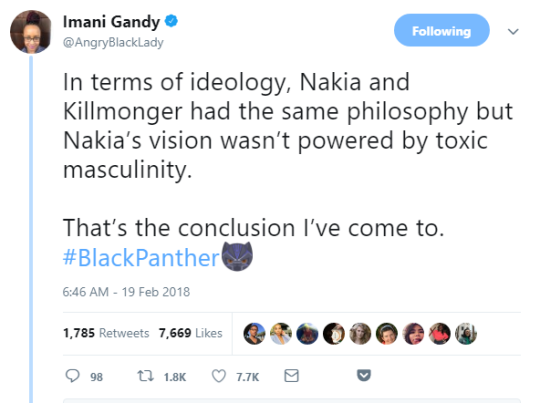
I don’t understand how you can see Killmonger disrespect culture, attack women, basically was trained by military to tear down civilizations, his own father says he is disappointed in what he’s done, move to arm black people outside of Wakanda with high tech weapons (yes cuz giving Leroy and em cannon blasters is gonna help the cause) and y’all still fix ya lips to say he was right lol when Nakia exists. Wild.
I was waiting for someone to say this.
There’s a reason he was the villain. He killed his girlfriend in cold blood. His anger was understandable, true, but his methods abhorrent and destructive. The end result would have been huge amounts of death and chaos. No positive outcome.
[Killmonger was an amazingly written villain and a great, if not perfect, example of how to execute a “tragic backstory villain arc”. Due to his characters anger and Michael’s incredible acting it made Killmonger a character a large amount of people could empathize with. An amazing villain. Truly.]
Nakia LITERALLY was team “let’s stop having Wakanda be an isolationist nation and help the worlds oppressed” from the jump and she doesn’t get enough credit.
Another realization: “disgust as morality” leads directly to “mere exposure leads to moral decay”
As you are exposed to something frequently, you become acclimatized to it. It stops eliciting disgust. This happens with everything from gore to porn.
There has been research after research showing that fictional depictions don’t lower empathy for real victims or decrease the perceived severity of the crime, but it does lower disgust reactions at fictional depictions of it.
To antis, this lack of disgust is the normalization they are fighting against, because disgust is how you know something is wrong. If you no longer feel disgust, your morality is compromised.
That’s what I mean when I say antis resemble Puritan Christian morality. Christianity has so many conflicting instructions regarding morality, and many areas where it’s flat-out vague. And yet they know exactly what is good and natural, and what is horrifying and sinful.
How? It’s disgusting.
Antis are impossible to argue with, because the logical arguments are made post hoc to defend what they already know: this disgusts me because it is wrong. The disgust is the true basis of their argument, and no reasoned argument will touch it.
“There has been research after research showing that fictional depictions don’t lower empathy for real victims or decrease the perceived severity of the crime, but it does lower disgust reactions at fictional depictions of it.”
This. This is another reason we have to fight.
Because disgust is a messy and destructive emotion, it doesn’t target perpetrators of violence – it leads to victim blaming.
Disgust is not empathy. It is a source of harm to vulnerable people. Reducing it is good.
I guess I have some…quibbles with this? Disgust is, in fact, a healthy emotion. It’s foundational to the human emotional spectrum and is extremely useful to human survival instincts. Often, you can’t control whether or not you feel it. And it’s okay to feel it. It means that your lizard brain is trying to protect you from a hazardous, unsanitary, or unwanted situation.
What you do with it, however, is what can lead to trouble. And that’s true of any emotion, even positive emotions. And, like any emotion, disgust can be a tool through which you experience empathy, but it’s not the same as empathy itself. It’s a tool that you have in your emotional toolbox, and you need to learn how to use it. Even if your lizard brain is screaming in repulsion, you thankfully have your human cognitive functions with which you can decide how – or even if – you should manifest your disgust.
You need to ask yourself: is my disgust warranted, or is it my lizard brain having a kneejerk reaction? Will showing my disgust hurt anyone, or otherwise harm them? To whom can I show my disgust, and where is it appropriate to express?
One example that comes to mind is the medical field. A doctor might have to clean out a pus-filled wound, for example. Is it normal and healthy to feel disgust in that situation? Totally! Your lizard brain is telling you that it’s unsanitary and that you ought to stay away. However, because doctors have taken an oath to help people, they do not let themselves express their disgust in front of a patient – or, at least, the good ones don’t. For a doctor to treat a patient or their problems as disgusting is unethical and sometimes even abusive. Often, instead, they channel that pent up emotion into dark humour that they share privately with fellow doctors so as not to upset or hurt the patient. So there’s a big gap between the feeling, which is often involuntary, and the expression of that feeling, which is voluntary.
That’s where we get into emotional regulation. Learning emotional regulation doesn’t mean changing what you feel, it means changing how you process the feeling, both internally and externally. And it’s true: often people who’ve experienced trauma have a very hard time with emotional regulation, because the trauma has changed their neural pathways. Children and teenagers also have a very hard time with emotional regulation, because their neural pathways are still developing.* However, it can be learned. As with anything, practise makes perfect.
Disgust is not the same as morality, this is true, and if you let your disgust dictate what you believe to be moral or immoral, you’ll very often end up hurting others and making a hypocrite out of yourself. However, you are still allowed to feel disgust. You’re not a bad person for feeling disgusted. It does not, in and of itself, hurt anyone, because it’s just a neural response to stimuli. What you do with that neural response is what hurts people. Using disgust as a weapon in order to shame others is harmful. Using disgust as a foundation for ethics is harmful. That is what needs to be reduced, and it can be reduced by practising emotional regulation.
Don’t just react. Talk yourself through it. Kneejerk reactions do not make you a more ethical person, they just make you a more impulsive person.
* I’d wager that this is why so many antis are very reactionary. They’re usually young and often have experienced traumatic situations, which is a double whammy on their regulatory abilities.
Any emotion can be dangerous and harmful to yourself and others if taken to an unhealthy extreme; so I agree, disgust is a healthy emotion to have– it is vital to our survival even now, despite being “civilized.”
So calling a specific emotion dangerous or harmful just because some people take it too an extreme and cannot handle this specific emotion or their emotions in general isn’t a good thing to do.
Anger can be a harmful emotion– but it’s healthy to accept it and learn how to handle it to the point you do not harm yourself or others.
So, the emotion disgust isn’t at fault here– it’s the people who have not learned how to understand or handle their emotions, or someone who has such a huge fear regarding disgust they simply cannot control it, and thus need some type of professional help.
You know who isn’t disgusted by a serious problem? The people who actually fix it. A surgeon is not disgusted by putting their hands in a person’s guts, because they had to train away that emotion in order to do their job and save lives. A therapist is not disgusted by all the nasty shit that goes through your head, because they’re the person responsible for talking you through how to keep living and be a good and happy person in spite of that. Hell, a sanitation worker isn’t disgusted by your piles of garbage because it’s their job to get rid of that shit and keep the streets clean. Being disgusted by something is a sure sign that you’re not helping with that thing.
So for example, take pornography. There’s no question that there is some evil, despicable shit going on in that industry. But the people who are disgusted by porn, they don’t do jack shit to prevent abuse or stop sex trafficking or bring down criminal producers, because they’re too busy being nauseated by the idea that a woman might choose to be a sex worker and piling the entire industry, criminals and victims and honest folk alike, in the same category of ‘gross therefore evil’. The only way to actually help any of those victims or end any of those crimes is to look at the whole industry without being blinded by your disgust and sort out what’s actually happening.
Yeah, this.
I’m not saying “never find anything disgusting and you’re doing something wrong if you do”. Like, I am disgusted by things too! I can’t handle cleaning out slimy mold from things, for example – it makes me gag no matter how many gloves I wear.
But disgust is a barrier against fixing the problem. It’s harmful the way depression is harmful – it can be a completely understandable and blameless response to your circumstances, but if it dominates your life, those circumstances won’t get better. And it’s one thing to accept that negative experience as a neutral condition of your life and another thing to try to trap others in it. (See also: pro-eating-disorder communities.)
So teaching andenforcing disgust, telling other people “you should be disgusted”, etc, is what I’m decrying here. Telling people that they’re a bad person if they’re not disgusted by something – i.e. if they develop the kind of emotional regulation skills that @bai-xue is talking about, to move through it – that’s an act of harm.
There are lots – billions – of religious people who don’t think ‘God is real the way poetry is real’ or ‘God is real the way love is real’, they think that the universe was created by a specific entity with thoughts, intentions, and desires, and which sometimes acts in the world, and which has expectations about our conduct which were communicated through historical prophets. Many of them think you can directly communicate with God through prayer.
There are lots – billions – of religious people who think that humans have immortal souls, which survive the destruction of our bodies and which have an eternal fate of some kind.
Call those type-1s. They have a belief about the supernatural. They think their belief is true, and tells us things.
These are claims about the world. They’re not claims about lenses we can use to see the world; they’re not claims about what makes us empowered and happy to believe; they are statements about what is actually true. If you say to these people ‘oh, you mean you find it fulfilling and empowering to think of yourself as having an immortal soul’, they’ll say “uh, no, I mean that humans have an immortal soul”.
This is true of some religious people on tumblr/participating in this argument, but a lot of religious people on tumblr are a different kind of religious, one which is more common now than it has been historically. They are more likely to agree with claims like “God is how we find ourselves in the world” or “God is whatever you find when you’re looking for God” or “God is love”.
Call this type-2.
There are also, separately, a bunch of people whose attitude about God is “people who have believed in God have gotten something really powerful out of this, or they wouldn’t do it. What is that? Can I inhabit that state and get a good description of what the powerful thing they’re getting out of it is?”
Call these ones type-3.
So now that we’ve described our groups, here are some fights they have!
Atheists: “Okay, it looks like there is no entity with thoughts, intentions and desires that created the world. Also, those historical prophets were recording their own beliefs/interests, they didn’t have any access to what a god thought.”
Religious people-type-1: “We disagree. God exists, and we have a lot of information about what specifically he wants, and he wants this.”/ “We disagree. Souls exist, and…”/ “We disagree. Eight different gods exist, and…”
Religious people-type-2: “You’re treating this like it’s an answerable question, when it isn’t. And then you’re acting like you have the one right answer, you dick.”
Religious people-type-3: “yes, yes, we know, but God is doing something, and that’s really interesting, and you’re missing out on a huge part of the human experience if you’re not trying to inhabit the perspective associated with faith in God”.
Atheist: “…fine, but God doesn’t exist. Like, actually, if you go and check for Jews in Egypt there weren’t any, and this is true for every revealed religion, they make claims that are factually false, and you’re talking about something other than that, but there are still people murdering gays because of that, so I want to talk about that!”
Religious-people-type-1: “You’re equivocating between ‘this belief causes people to behave badly’ and ‘this belief is false’. God exists, and also people do bad things in their mistaken understanding of what God wants. It’s bad that they’re doing the bad things, but we have to find a way to address that other than claiming God doesn’t exist, because as a fact about the world, God exists and cares how we act.”
Religious-people-type-2: “if you’re trying to think about God by checking for archaeological evidence of Jews in Egypt you’re completely misunderstanding how to think about God. God isn’t the sort of thing that even in theory would be disprovable by looking at evidence. And also you are still being a colossal dick. I’m not murdering people over my beliefs, so why do you even care what I believe? My beliefs are mine, they’re private, and they’re a huge part of who I am.”
Religious-people-type-3: “People who are religious are happier; that’s a true fact about religion. People who are religious have tighter-knit communities; that’s a true fact about religion. People who are religious have more kids; that’s a true and important fact about religion which will affect whether the next generation is religious. You’re focusing on the false claims but missing the true ones, and the true ones matter!”
Anyway the current argument on tumblr is unproductive because all of these people are talking at each other without much clarity about what they believe and which people they’re directing their arguments at. And I think a lot of people think that “God isn’t an answerable question” is a concession everyone should be willing to make instead of one specific opinion about religion which you could hold.
This.
When I say I am an atheist, I’m saying something that’s compatible with 2 and 3, but I’m also saying “if you believe 2 or 3, I don’t understand why you consider yourself a theist. That seems weirdly imprecise.”
I can and have gotten a lot out of the kind of Christian practice that goes like “Jesus is this being that is maximally compassionate. He wants you to try to be, knows you will fall short, and doesn’t mind as long as you tried because he’s… well… maximally compassionate. We get together every Sunday and remind one another to try to imitate Mr. Maximally Compassionate as much as we can, and to try to push ourselves to do it more than we usually do and thereby become morally good through practice.”
However, I am uneasy about calling myself “a Christian” because I do not believe Mr. Maximally Compassionate existed. I think he’s a template, used as a reminder to be moralLy good and an inspiration to be more morally good than you currently are.
And an imperfect one at that.
I’m an atheist, someone who used to be type 1, and really don’t understand why type 2′s and types 3′s keep wanting to use the name of the religion that type 1s originally used.
if you say ‘i’m spiritual but not religious/ i’m animist/ whatever’ then fine, but acting like christianity/ islam was never about type 1 stuff, and suggesting it ever was is a strawman from lazy unsophisticated atheists who don’t know what they’re talking about and that’s not an interesting or important question anyway is disingenuous and frankly infuriating as someone who used to be type 1, knows a LOT of type 1s, and tbh thinks type 1 is probably more common than type 2 or 3 at least when it comes to abrahamic religions and maybe even in general, but if it’s not an actual majority is still a HUGELY relevant chunk and not a tiny minority.
Also, i’m someone who cares about the truth. Like, i care about things like ‘people are killing gays because they think god told them to’, but i ALSO care about the truth, and whether or not the actual type 1 claims are true. If there was a religion that had adherents who ALL behaved morally and were super nice and caused no problems, but they also said that ‘you have an imortal soul and dying is not a big deal and some people who die will go to heaven and some will go to hell’ that’s something that i actually care about whether it’s true or not. Whether when i die i go to heaven, hell or oblivion is kind of a big deal to me, i don’t know about you guys.
Yeah, that. I feel like type 2s and 3s want atheists to stop talking about type 1s but I don’t know why that would be required.
Endorsed. I’m even going to go a bit further and state that type 1′s make up the overwhelming (as in, >99%) majority of the religious, and so I’m a little tired of being treated like an unsophisticated /r/atheism philistine for pointing this out and treating it as a baseline in discussions.
It’s usually the type 2′s that are doing this. Type 1′s and I just have a fundamental disagreement about the facts-of-the-world. I think the evidence is clearly on my side, but they don’t… and that’s about as far as most discussions get. They are, at least, usually upfront about the material differences between our positions. Type 3′s, you guys are an odd bunch, and I think you really should call yourselves atheists, but you don’t usually give me grief and so I return the favor. As long as you’re not hurting anyone, you do you.
But it’s the type 2′s who are really condescending toward atheists, which especially bugs me because most of the time their arguments are muddy and confused. They are very slippery and won’t state plainly what they believe, leaving me with no way to actually examine and invalidate their claims, which they then take to mean I’m just a STEM-lord who can be brushed off because I don’t understand Kant or whatever. Hey guys, “communicating badly and then acting smug when you’re misunderstood is not cleverness”.
So, as a type-2 and type-3 believer, your reblog here just gave me a big clue as to why such people wander into your debates and get mad at you:
You assume type 1s are 99% of religious people but they’re really not.
But more to the point, type 1s like to assume that they are and should be 99% of religious people.
And it’s erroneous as heck according to the vast majority of demographic data, but it’s also, specifically, a power play in support of religious fundamentalism, against the rest of us. It’s the claim that they have the only ‘real’ way to believe. And when you accept their claim unchallenged, you are unwittingly supporting that power play.
Can you see now why we’d be against that, and very tired of it?
Anyway, already having typed this response, I see your tags say you’re tired of this, and that’s fine, I don’t know that I’ve got the spoons to really engage at length. But I thought you might want to know that, like, if you’re running into people saying “you sound like a fundamentalist”, and it’s confusing to you, what they’re saying is, “you’re accepting as basis an unsupported statement that the fundamentalists are using to try and trample us, please stop helping.”
*Even leaving aside Christian denominations which do so, and Christians who exist in type 1 denominations as a type 2 or 3 adherent, there are several religions that explicitly encourage type 2 and type 3 practice and belief. Buddhism, Judaism and Neopaganism are among those. That’s at least twelve million Americans. And it’s not a new movement in Judaism either; the Talmud deals with this stuff and there are tons of Jewish in-jokes about how Jews often wind up basically being atheists. This is not new, and the cultural erasure of it by fundies isn’t new, either.
one thing i think is interesting, as someone who basically grew up playing video games non-stop, is how some types of video game just don’t gel with people
like, it’s easy to forget that, even though i’m pretty bad at most games, that my skill at handling video games is definitely “above average.” as much as i hate to put it like this, i’d say my experience level is at “expert” solely because I can pick up any game controller and understand how to use it with no additional training.
a friend of mine on twitter
posted a video of him stuck on a part of samus returns. the tutorial area where it teaches you how to ledge-grab. the video is of him jumping against the wall, doing everything but grabbing the ledge, and him getting frustrated
i’ve been playing games all my life, so i’d naturally intuit that i should jump towards the ledge to see what happens
but he doesn’t do that.
it’s kinda making me realize that as games are becoming more complex and controllers are getting more buttons, games are being designed more and more for people who already know how to play them and not people with little to no base understanding of the types of games they’re playing
so that’s got me thinking: should video games assume that you have zero base knowledge of video games and try to teach you from there? should Metroid: Samus Returns assume that you already know how to play a Metroid game and base its tutorial around that, or should it assume that you’ve never even played Mario before?
it’s got me thinking about that Cuphead video again. you know the one. to anyone with a lot of experience with video games, especially 2D ones, we would naturally intuit that one part of the tutorial to require a jump and a dash at the same time.
but most people lack that experience and that learned intuition and might struggle with that, and that’s something a lot of people forget to consider.
it reminds me a bit of the “land of Punt” that I read about in this Tumblr post. Egypt had this big trading partner back in the day called Punt and they wrote down everything about it except where it was, because who doesn’t know where Punt is? and now, we have no idea where it was, because everyone in Egypt assumed everyone else knew.
take that same line of thinking with games: “who doesn’t know how to play a 2D platform game?” nobody takes in to consideration the fact that somebody might not know how to play a 2D game on a base level, because that style of gameplay is thoroughly ingrained in to the minds of the majority of gamers. and then the Cuphead situation happens.
the point of this post isn’t to make fun of anybody, but to ask everyone to step back for a second and consider that things that they might not normally consider. as weird as it is to think about for people that grew up playing video games, anyone who can pick up a controller with thirty buttons on it and not get intimidated is actually operating at an expert level. if you pick up a playstation or an Xbox controller and your thumbs naturally land on the face buttons and the analog stick and your index fingers naturally land on the trigger buttons, that is because you are an expert at operating a complex piece of machinery. you have a lifetime of experience using this piece of equipment, and assuming that your skill level is the base line is a problem.
that assumption is rapidly becoming a problem as games become more complex. it’s something that should be considered when talking about games going forward. games should be accessible, but it’s reaching a point where even Nintendo games are assuming certain levels of skill without teaching the player the absolute basics. basics like “what is an analog stick” and “where should my fingers even be on this controller right now.”
basically what i’m saying is that games are becoming too complex for new players to reasonably get in to and are starting to assume skill levels higher than what should be considered the base line. it’s becoming a legitimate problem that shouldn’t be laughed at and disregarded. it’s very easy to forget that thing things YOU know aren’t known by everyone and that idea should be taken in to consideration when talking about video games.
All of this. Basic game literacy is remarkably complicated. I grew up on the earliest ones and had high fluency up to around the Super Mario 64 era. I fell out of regular gameplay at that point and even from that baseline, I experience a really bewildering disconnect from what’s required to approach most games today.
I wonder if this is partly a gatekeeping thing, keeping games for G A M E R S by assuming the player already has an ‘expert’ level of literacy re: the game’s mechanics and lore, which provides both a way to keep out Others (read: non-gamers) from their game space & a way for players to rank themselves by how well they do/how much they know, setting up a hierarchy they constantly struggle to rise up in so they can look down on those who can do/know less.
I.e., a manifestation of the Curator Fandom vs. Creative/Transformative Fandom split.
I started thinking about who looks up to who on the team the other day, and the more I thought about it, particularly the Dex:Ransom::Nursey:Holster dynamic, the more interesting I found the parallels.
vriska really was a broken abused child tho. like i’m not saying she did nothing wrong or whatever, she’s like chronically stupid and full of bad decisions but like. she was a teenager and her life was so fucked up. it was so fucked up. she hates herself so much. she’s gay and considers herself unworthy of love because she’s impulsive and has poor social skills due to chronic childhood abuse. i love her and feel sorry for her and that’s just how it is on this bitch of an earth
keys to understanding why ppl love vriska, or understanding why u still root for her beyond her awkward funniness and pseudo charisma, or understanding why you feel bad for her but can’t figure out why:
1) she’s being abused by her guardian figure almost as blatantly as dave is. when she touches on this there is an underlying sense of anxiety and pain that sets her apart from her peers, much like dave is set apart from the other kids bc his guardian is blatantly abusive but (like vriska) he isn’t sure how to come to terms with or acknowledge it, much less explain it to his friends. in vriska’s case, her friends (for decent enough reasons) resent her for being insufferable regardless. outside of homestuck itself the paradox space comic “vrisky business” deals with this heavily and i while bring this up on a regular basis it’s still true
2) doc scratch is a pedophile. beyond being obviously a child predator, one of his primary targets is vriska. vriska is an easy target, of course, bc she’s already been dealt a pretty fucked up hand in life. vriska calls doc scratch as a “creep” more than once, to his face, refers to his behavior towards her as “getting off on [a young girl]”, and expresses extreme distress towards him continuing to have conversation with her when she’s asked him to leave her alone. she mentions that she’ll log out so that he’ll leave her alone… but then he takes control of her account and forces her to log back in and talk to him.
i mean i feel like this is laid on pretty fucking thick but in case the implication went over your head: it’s a metaphor for CSA lads
terezi alludes to the damage doc scratch has done to vriska during her own (rife with sexual innuendo and all around fucking creepiness, because he is Literally a pedophile) conversation with doc scratch while trying to get revenge on vriska for aradia’s murder:
“no wonder she snapped” – vriska took a sharp downturn under the influence of doc scratch, and the reader sees it firsthand. the murder of aradia was largely orchestrated by doc scratch, who forced vriska’s hand even while she frustratedly explains that these are her friends and she didn’t want to hurt them
here’s the whole pesterlog, since it’s all pretty telling:
take note that vriska calls doc scratch a “sick fuck” almost immediately after he contacts her. she’s very much backed into a corner here. tbh there’s a looot to pick up on in this conversation between them re: vriska being abused by an adult man
I find this really fascinating, since I am a victim of childhood parental abuse and yet I hated Vriska because her behavior towards Tavros was reminiscent of my abusive parent. Admittedly I was pretty young when I first read it and I could not pick up on metaphors for shit, and definitely missed the part about her being a victim as well. While I am coming to see her more as a grey character (thanks to things like this) I am still not sympathetic to her belittling of others and harsh self-righteousness. Survivors can be as kind as anyone else and their unhealthy behaviours shouldn’t be dismissed because of their past trauma.
Yeah, absolutely, plenty of perfectly interesting characters ping to close to home for me to enjoy. Heck, plenty of actual real people come too close to my trauma buttons for me to want to spend time around them or be a part of their healing, even though I still sincerely wish healing and mental healthiness for them.
So this isn’t meant to be a “you are wrong for not enjoying these characters” post.
This is just me picking at what pings me about them.
I have major imposter syndrome in my life. I was raised by an abusive narcissist and have hella fleas from that. I have a lot of trouble distinguishing extrinsic and intrinsic motivators. I am a pleaser and an overachiever, and I have lots of trouble not letting external sources define what my identity should be or how I should pursue happiness. I am meanest to others when I say the things in my head that I am already saying to myself. (I don’t think I do this much anymore. I am getting better on both ends, but I hope especially the first.)
Anyway.
Characters that externalize their self-hatred onto others in ways I find interesting: Vriska, Bakugo, Loki
These are not nice people; these are, in fact, distinctly abusive people. To me, they are also engaging, sympathetic, and more than anything fascinating characters because they are all so clearly unhappy. Because they are all, so clearly, equally cruel to themselves.
Like, example:
Loki finds out he’s an ice giant and literally tries to genocide all ice giants. And on the one hand, hello, genocide, wtf, but on the other hand it is impossible for me not to see that as the intensely suicidal gesture it is. Notably, immediately after his attempted metaphorical suicide is stopped, he literally jumps off a bridge.
Now Vriska. Damn, that girl is messed up. Does anyone even know why she walked Tavros off that cliff? Does Vriska? What the fuck. What the fuck.
You want to understand what’s going on in Vriska’s head, you just have to look at the conversation she has with her dead self. (Andrew Hussie is a master of metaphorically presenting serious mental issues like depression and suicidal ideation as conversations w/ self. See the conversation Dirk has with AR.).
I mean, seriously, this shit is vicious.
She explicitly points out that she’s never felt happy. (And later that she’s never felt safe.)
She explicitly characterizes her own desire to be happy as “selfish” and “narcissistic.”
She is not allowed to want small, nice things that make her feel safe. Not only is she not allowed, wanting happiness makes her bad as a person.
And she repeatedly frames all this in the most gaslight-y, emotionally charged, self-hating language imaginable: “the worst kind you’re capa8le of”, “stupid”, “self-indulgent”, that she deserved “to get killed”.
Live Vriska frames personal growth as explicitly incompatible with happiness. She is supposed to do what’s necessary (as defined by unclear sources, but most strongly linked to her ancestor and her society) and live up to exterior expectations.
Live Vriska frames this intensely vitriolic, negative, self-hating take on life as “harsh truth” that she (dead, happy Vriska) “USED to understand.”
Live Vriska is not allowed to feel bad when bad things are said about her because these “tiny little 8arbs” are harsh truths and part of life (and not, you know, devastating and abusive attacks on her sense of self and desire for happiness/safety/stability.)
Live Vriska has normalized abuse. She does not recognize it aimed at herself. She, in fact, mirrors and echoes and amplifies the abusive messages she has internalized, both to herself and to the people around her.
Vriska, quite explicitly, believes happiness is selfish, believes she is not allowed to feel bad about abuse, believes she deserves anything bad that happens to her, considers herself an inherently bad person, and hatesherself.
And the thing is, like:
Vriska is 13-16 over the course of the comic.
13 year olds aren’t born with these ideas existing in their heads. They learned them somewhere. They heard them over and over. They were hurt, repeatedly, and repeatedly told that wasn’t hurt, that was harsh truth, and having bad feelings about what was happening made them weak and selfish. Made them deserve what happened to them. Their sense of normal and not normal and abusive and not abusive was deeply distorted by their childhood environment.
(Like, possibly, having a parental figure who has trained you to sacrifice other child victims to her for your own continued survival.)
And, you know, I also think we have evidence that Vriska’s particular mental set up makes her more vulnerable to this. Shades of BPD or NPD, she seems to react very strongly to perceived criticism and to have a very externally-defined sense of self. We know she can hear other people’s thoughts; we know she is sensitive (or even hypersensitive) to other people’s perceptions of her.
We see this even in the happier, shaking-off-old-patterns, dead Vriska. Dead Vriska spends some time with a (significantly older) troll she admires and you can see how malleable her sense of self is, her sense of goals and values are, as she almost completely remakes her identity in Meenah’s image.
Also, returning to the topic, hell yes Vriska is abusive towards others. Hell yes she causes a lot of harm and emotional damage (and death!!). And hell no those people don’t owe her any more of their time or trauma.
But I do think it’s clear her abusiveness towards others hella mirrors the patterns of abusiveness she’s playing out in her own head. You can see the things she says to herself in the things she says to others. You can see her turning around and mirroring the “hard truths” she’s internalized, and all the uncontrollable scariness of the world she’s in. (If you don’t do these things, if you don’t live this way, you will be hurt and you will deserve it. You will deserve to die.)
And I still don’t know what the fuck was going on when she mind-controlled Tavros off a cliff in some kind of hysterical fit, but just in writing this post I have had the dawning, creepy realization that that was a very chilling manifestation of “I’m hurting you to help you grow/this is the only way” coupled with the enactment of a suicide.
…..Yikes.
Anyway, tl;dr: I find Vriska very interesting and I am like 99.999% convinced that live Vriska has the (so far) failed character growth arc and dead Vriska has the actual successful character growth arc (as resolved by her eventual reunion with much healthier partner dead Terezi).
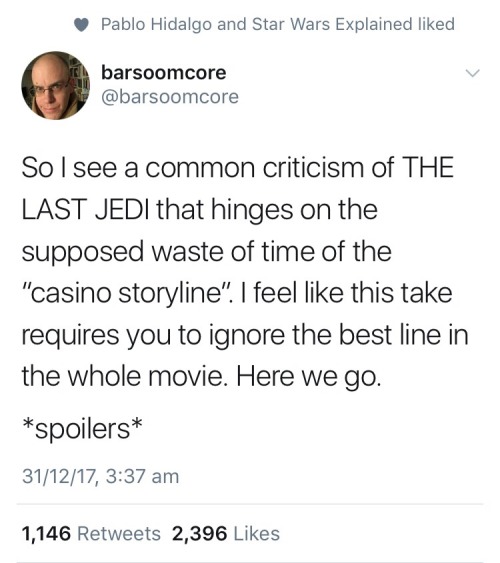
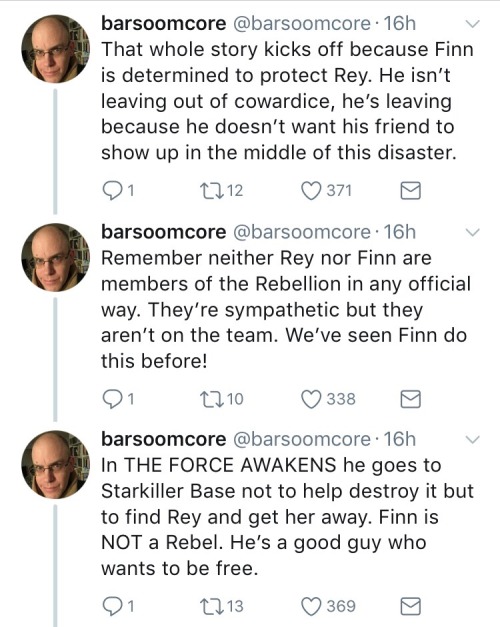
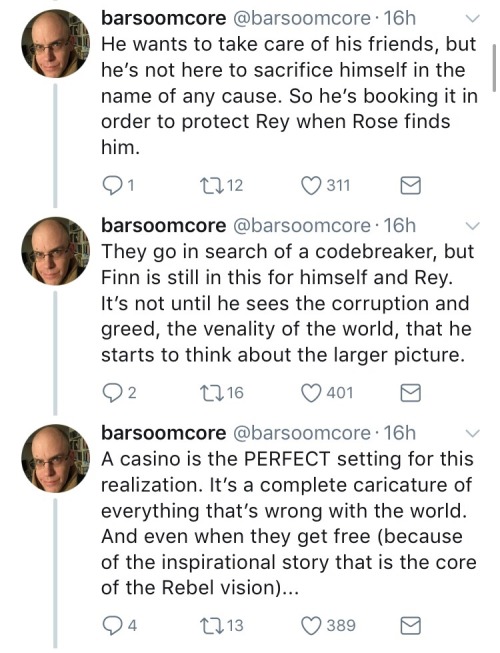
also it was important for rose to be able to live out the ultimate female power fantasy, which is freeing something large and majestic and abused, then riding it on a terrifying destructive rampage through the corrupt halls of its captors, then freeing it to go cavort in the wild and be free. just look at how women write horses, and dragons, and wolves. just look at the passionate empathy teenage girls have for chained and wounded beasts.
so, i was extremely fucking delighted that star wars finally had a really specifically, quintessentiallyfemale power fantasy in it for once, instead of just more girls stepping into / reclaiming male power fantasies (and thereby reaffirming the universality of male desires and power structures).
i’m not at all surprised that so many adult men are saying ‘what’s the point of that?’ because they’re not the point of it at all. that part wasn’t written for them. it was for girls. even more than general leia was for girls, the Horse Girl Fantasy Ride was for girls, and i love that, and it was great, the end.
I think I’m a little resistant to the “Lance is actually a genius” headcanon because a. it implies that a character can’t be useful unless they’re super intelligent and b. part of Lance’s charm is that he’s not an expert in anything. He’s all about practical knowledge.
Like, listen, Lance could never fix an engine, but when something goes wrong with their ship in episode one, he knows exactly what the problem is. He can’t fight as well as Keith, but when they need to wreck those Galra ships on the Balmera, he comes up with a plan that’ll take out the most. He probably couldn’t write a code or do all the funky math stuff Pidge does, but he can calculate the number of vargas they have to wait until they’re able to go into the Marmora base.
Lance’s thing is “okay what do we need?” Lance doesn’t have to fix a ship, he just needs to know enough to tell Hunk what to fix. He doesn’t have to know crazy math, he just needs to know enough to know whether Coran and Allura are talking about a minute or an hour so he doesn’t get killed during a mission. And he doesn’t have to be an incredible fighter, he just needs to come up with the best way to stop the ships from taking off without hurting the Balmera– ie, close the door.
Lance isn’t super book smart or amazing at flying or fighting; he’s a creative little shit who’s good at asking practical questions: Do I need to know this or can someone help me with it? Would knowing this help someone else? and Is there an easier way to do this? He’s really good at knowing what he needs to know and putting things together based on what he has. Rover’s here, but Pidge isn’t with it and it’s beeping? Yikes, that’s a bomb. The queen seems to be out of a trance and says she didn’t mind control us? Must be that creepy snake I was asking about earlier.
He’s perceptive. He looks for simple solutions to difficult problems. He’s aware that he’s not the best at everything, so he uses any resource he has to his advantage, whether it be things in his environment (yo his fight against Hunk in the Depths was nice) or people. In the comics when Pidge has to fight a mind controlled team Voltron, she calls Lance a “top priority” because he has good range and is likely to team up with others. Lance actively seeks the help of other people when he can and distances himself from problems when he can’t so that he can come up with a different solution.
I honestly think that his biggest strength is that he’s not a genius in the way the other members of the team are. Because it makes him take full advantage of what he does have.
Lance is the quintessential jack-of-all-trades: he’s not exceptional at any one thing (unless possibly sharpshooting), but he’s good enough at a LOT of things that he’s a very useful guy to have around. Even if he personally doesn’t necessarily have the technical skill to accomplish what he needs, he can provide ideas or partial solutions to almost any problem he encounters. His versatility and practical thinking are, in and of themselves, exceptional.
He’s also, as you said, perceptive, particularly with people. His disastrous attempts to flirt aside, Lance is clearly the best out of the Paladins at functioning in social situations (Hunk arguably is a close second, but he’s generally more shy and nervous around strangers, while Lance is able to dive right in). Lance is able to make snap decisions about people and when he isn’t being blinded by a pretty face, he’s usually pretty spot on. He’s good at understanding the dynamics of the people around him.
I don’t know which headcanons/metas/whatever you’ve specifically seen or are referring to, but for me at least, when I talk about Lance being really smart, I don’t mean it in the same way that I do when I talk about Pidge or Hunk. I do make it a point to talk about his intelligence, though, because I believe Lance has a kind of intelligence that is sorely under appreciated, both by people in real life and by his fellow fictional characters.




 just moving along like everyone else