does anyone else have those moments where they just fall in love with being alive? like, maybe you’re in art class with soft music and you realize that this peaceful feeling is a part of life that you love and you want to just keep forever, and there are so many other parts of life too that are so wonderful and maybe existing isnt so bad after all
is this what being not depressed is like
no, this is what recovery is like. this is what being depressed is like, and it’s why we stay. because even when we’re sure this is it, this is the last day we can put up with it, this is the last hour, the last second – some part of us remembers these moments, and thinks – what if tomorrow has one of them.
i used to joke i have bad days and worse days. i almost never do well. i feel like i keep barely a nose above the water.
but in those rare, rare, rare seconds where the waves stop for one second and i catch sight of something other than dark, i see it. the way a rose looks after a rain. how my mother smiles when she knows it’s my favorite meal that’s cooking. my best friend looking over his shoulder to flip me off again. the bike i rode at 7 and crashed at 17. a little bug struggling with five little legs – but walking, walking.
recovery isn’t smashing into these moments and realizing it’s finally happened, what those people said is true and it “all gets better”. recovery is remembering those moments and deciding – i want them back. it’s looking for them. sometimes it takes hours. sometimes days. sometimes months without any sight of them. but you look, you search even when you’re too tired to keep your eyes open, because you promised yourself … tomorrow. tomorrow will be the day we find one. a four leaf clover we know is our sign, the rainbow, the wishing well – the way out.
and when you find one, they get easier. four leaf clovers always grow in the same patch, after all. and your eyes get sharper. you figure out what makes any small part of you happy. you figure out that you might not be happy, but it’s good enough to stick around to watch the way oil looks in puddles and how she always cries at new year’s. and it might not be blisteringly, soul-crushingly happy in the way other people seem to feel things – in that mind-numbing wordless joy that shines in them, that glow i’m so envious of, that effortlessness – but it will be like this, just quiet, a moment of rest, of the shouts dimming for a minute, a peace.
it’s easy to say “i’m depressed, i’ll never be happy.” maybe. i hope not, because i’m still looking. and in these moments i’ve rediscovered that i am funny, that i like the color pink, that kittens and puppies never fail me. in these moments i’m still depressed, still me, still fighting an illness that wants to end me. but i’m fighting. i seek these moments in every second i get because i’m here and breathing and after all this i’m going to be pissed if this gets the better of me.
maybe i’ll never figure out how to feel effortless and free. but i know that i feel love when the music is blaring and my hands are out the window and i feel love somewhere on the beach and i feel love watching salamanders wake up in the mornings. it’s not other people’s love, it’s far-off and it’s distant and it might not be “normal”, but it’s goddamn important to me.
i didn’t wake up better. i forced better to come fight me. i’ve been walking towards recovery since i was 19. five years later and no, i’m not cured, but i see a lot more of these moments. or maybe they were always there, and only now am i realizing what i got in front of me.
and when it’s been bad again? when i’m not even breathing? when it’s been months since i felt anything, when the stress is too much and the sky is dark and the moon in me has fallen silent? i say: hang on. tomorrow might be the day we find it. tomorrow might be worth the fight.
the best part about this? eventually, i’m right.
Like, I get that you and a lot of people find this helpful, but I don’t see it. I’ve had so many moments where it feels like I’m getting better and then nothing improves in the long run. I’ve heard of people having one or two depressive episodes and then getting over it, and I’ve heard of people never getting depressive episodes at all, and I’ve heard of people being depressed for more or less their whole lives, but I don’t feel like I ever hear about people being depressed for a decade or more than then finally making lasting, long term progress that makes the struggle worth it.
I do. I’m married to one of them. I know others.
And… Like, even some of the people who are depressed their whole lives are still, on the whole, okay with that. Anhedonia’s a bitch, but sometimes you find a way to derive value from things anyway. I dunno, man.
But I know a fair number of people that I know felt just like you describe feeling for, I dunno, a decade or more, and now they’re happy they made it through that. It happens. Which is no guarantee for you, and… I dunno. People link me to a lot of your posts, and I just want to say, I don’t think you’re doing anything wrong, I don’t think it’s your fault, and I think you deserve better, and I hope you find it.
recovery from CPTSD is complex. Sometimes, it can feel so hopelessly complex that we totally give up and get stuck in inertia for considerable lengths of time. This is why it is so important to understand that recovery is gradual and frequently a backwards and forwards process.
Effective recovery is often limited to only progressing in one or two areas at a time. Biting off more than we can chew and trying to accomplish too much too soon is often counterproductive. As a flight type, I spent years in mid-range recovery workaholically spinning my wheels trying to fix and change everything at once.
We often need to simplify our self-help efforts in early recovery. Accordingly, I recommend making shrinking the critic your “go to” response if you feel unsure how to proceed.
Once the critic is reduced enough that you can notice increasing periods of your brain being user-friendly, impulses to help and care for yourself naturally arise. As this happens, it becomes easier to tell whether you’re guiding yourself with love or a whip. When you realize its the whip, please try to disarm your critic and treat yourself with the kindness you would extend to any young child who is struggling and having a hard time.
Complex CPTSD: From Surviving to Thriving, Pete Walker, pg 70 (via thetwistedrope)
PTSD is your brain trying to make sure you DON’T DIE.
Humans are really good at adapting so that we don’t die. That’s kind of our whole *THING*. We adapt.
If something BAD and SCARY and DANGEROUS happens, your brain tries to teach you to react better next time. If the Bad Scary Dangerous thing happens a lot, that’s reinforcing it. With CPTSD, the Bad Scary Dangerous thing happened often enough and frequently enough that your whole psyche developed around it.
You learn to notice the tiny things that signal the Bad Scary Dangerous Thing might happen – even if you don’t consciously know that you know that – so that you are braced to react and defend yourself. They become triggers so that you are primed to respond.
Hypervigilance? Better to panic unnecessarily than to get dead because you didn’t recognize a threat in time, right? It’s uncomfortable and a waste of energy but you’re not dead.
Nightmares about the Bad Thing? Dreams are PRACTICE. You are trying to learn how to react better or faster or more effectively next time.
Avoidance? Dissociating is better than just completely breaking and shutting down entirely.
The thing is, even if you are not in that situation anymore, your brain did not get the memo. It is trying! But it takes a lot of work to convince it that “No really, it is safe now!”
I guess what I’m saying is cut yourself some slack. You are doing your best and you’re not dead. ❤
I suppose there’s at least one silver lining for us executive dysfunction sufferers: you can’t normalise problematic behaviour if you never do anything.
do u ever feel like you’ve accidentally tricked certain people into thinking you are smarter and have more potential than you actually do and do you ever think about how disappointed they’ll be when you inevitably crash and burn
Fun fact: Impostor Syndrome is ridiculously common among high-achievers, particularly women. If you identify with this post, odds are pretty good that you’re exactly as smart as people think you are, and the failure you’re afraid of isn’t inevitable at all.
and don’t forget this is one of the psychological barriers placed in by thousands years of patriarchy and male supremacy.
My computer science professor actually talked about this on the first day, it was really cool.
Fun brutal fact: in addition to the existence of imposter syndrome, being “twice exceptional” (also known as 2e) is also a thing. That means being intellectually gifted AND ALSO having a disability that affects your ability to succeed at study or work. Such as ADHD, autism, dyslexia, dyscalculia, etc etc etc. A lot of people believe that it’s not possible to be both, but it very much is.
Society tends to have very high expectations for how well gifted people will perform. Society tends to have low expectations for how well disabled people will perform. Society tends to attribute invisible disabilities, including mental illness, to a failure of willpower or effort or a bad attitude.
So if you read this post and went “no, but seriously, this is not just low self esteem on my part, people keep thinking I’m smart and then I keep crashing and burning and disappointing them and they can’t understand why I didn’t live up to their expectations, it happens again and again and when I tell someone how I feel and ask for help, they just tell me to stop being so hard on myself and that I’ll succeed if I have more self-confidence,” it is not just you.
(Also, one of the previous posts in this thread buried the lede a little. Imposter syndrome is ridiculously common in people from underrepresented groups in academia and other high pressure/high status fields, particularly women and people of colour. Maya Angelou did not only feel out of place because she was a woman.)
This essay also totally changed my view on the intersection of impostor syndrome and mental illness.
– walking past your favorite snacks at the grocery store and not having the energy to even want them
– listening to your favorite songs and feeling nothing
– only being able to muster half a smile when your lover finishes telling a joke
– everyone asking you to speak up because your voice feels too heavy to raise
– getting irritated at things that force you to feign interest or participate in small talk
– knowing you’re kind of acting like a dick but feeling too drained to do anything about it
depression: hi you’re now addicted to anything that makes you feel better
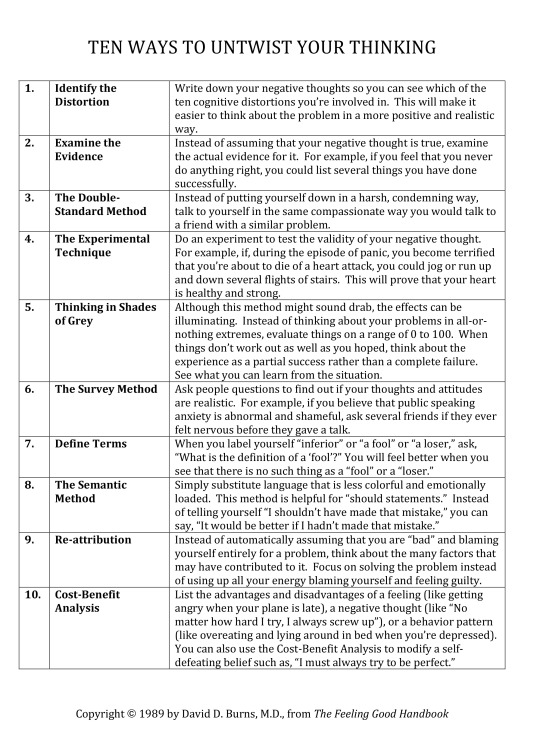
During my first month with my therapist, I was given this worksheet to read and work on. She noticed that while I was talking with her, that my thoughts followed a lot of these. I wasn’t aware that my anxiety had brought me down paths of low self-worth and stinky thinking.
After a couple of weeks of talking with her, she gave me this worksheet to work on.
While, at first, I thought these weren’t going to work out, I was very surprised to see just how easy they were to use . My homework at that time was to identify which sort of thinking I used on the regular and which ones would best challenge them for me.
So, what do you think? Do any of the maladaptive thinking patterns sound like you? which ways would you like to untwist your thinking?
A reminder to all of the mentally ill kids seeking treatment and other people new to the psych system:
If you absolutely hate going to your therapist, you have the wrong therapist
If you feel like your therapist doesn’t understand you, has misdiagnosed you, or is focusing on the wrong things, you have the wrong therapist
If your therapist is too old to understand the things you’re going through, like cyberbullying or LGBT related issues, you have the wrong therapist
If you feel like therapy isn’t working for you, YOU HAVE THE WRONG THERAPIST!
I went through five therapists before finding mine. FIVE. Sometimes it takes a while to find someone who works for you, but you do NOT have to be stuck with a therapist you don’t enjoy seeing or you don’t feel is helping you!
I’ve been through over 13 therapists in my life- no joke.
 just moving along like everyone else