
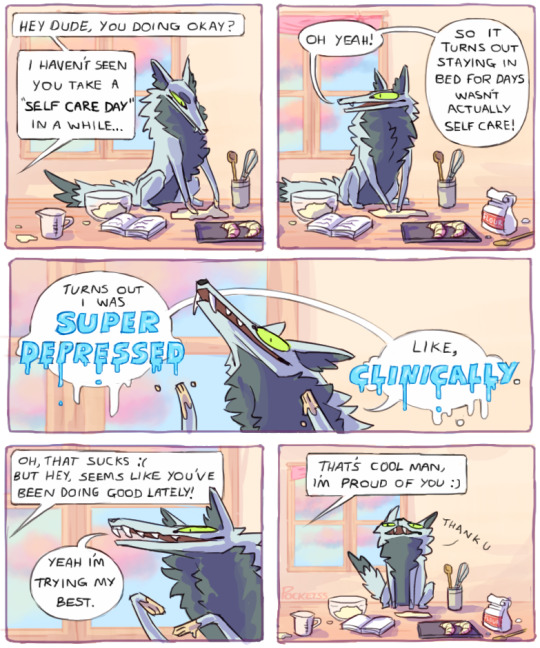
saw this in r/tumblr and was like OH HOLY SHIT IT’S ME.
*takes my medication* oh fuck thats right i like things
A couple months ago I left Friday evening, after work, for a trip up the coast with my girlfriend @suspected-spinozist. We drove up to Mendocino and spent the weekend hiking along the coast and exploring botanical gardens and having a lovely time, and then drove back down for work Monday.
I was basically useless the whole next week. I’d predicted that would happen, and I thought it’d be worth it (and it was absolutely worth it.) When I do things, I am spending my ability to do things. If I do things all weekend, I will find it nearly impossible to get anything done all week. I know exactly how much energy for extraneous tasks I have, and if I spend it I will start failing at my non-extraneous tasks, and if I push that I will start failing to eat.
Because this is my experience of the world, resource conservation models of disability are super relatable to me. I experience really sharp tradeoffs between all of the things I care about. I frequently say no to doing something cool or fun or interesting because I need to save the energy. I have limited ability to do stuff, it regenerates slowly, and having to do stuff when I’m out of ability-to-do-stuff will set me back for even longer. For that reason, I spend lots of my energy on resource conservation – thinking and planning how to do as little stuff as possible while staying on top of my life.
The most common conservation model of disability is the ‘spoons’ one that originated in the chronic illness community. There’s been a lot of arguing over who gets to lay claim to ‘spoons’, but certainly anyone can lay claim to a resource conservation model in general.
I talked recently to someone whose brain works very differently from mine. If they have the structures in place that they need to succeed, they will just keep on being able to do stuff until one of those structures breaks down. They can pack their weekend and then work all week; they can have something after work every single night. But if a structure crumbles on them, suddenly they can’t do much of anything.
The person I talked to was familiar with resource conservation models, and this really harmed them when their structures crumbled. They found advice to cut back on the stuff they were doing, save energy, commit to the minimum necessary, cancel plans. And none of that helped, plus it’s actually really depressing and isolating to do the absolute minimum you need to survive every day, so they ended up just as stuck and now without any of the things that made them happy.
So I think there are people who, instead of a conservation model, benefit from a momentum model – they have a state in which they can get stuff done, and once they’ve built up the structures they’ve need they can just stay there and add stuff to the structure. If they lose their ability to do things there’s a structure that needs replacing – cutting back in general won’t help.
In practice, almost everyone is probably a mixture of these things. Even people who mostly run on momentum would probably hit the point where their ability to do stuff traded off against their ability to do other stuff if, say, they were cutting back on their sleep to crowd more things into their day. Even people who have to shepherd their resources really carefully sometimes have things (like blogging, for me) which are easy and effortless as long as it’s part of their daily routine. And I bet there are people who need to resource-conserve for physical activity but whose socialization or intellectual output is best modeled as a momentum thing, or conversely people who can exercise every day as long as it’s part of their routine but need to carefully plan when they’ll have to expend willpower on tasks like writing.
So it’s probably good to have both models in your head – both because they could both apply to you, in different contexts, and because they will definitely both apply to some people you’re giving advice to.
- Getting overwhelmed in crowds
- Getting upset or angry at a loud alarm
- Ordinary nightmares (that have nothing to do with the circumstances, just stupid nightmares much more often than the average person)
- Getting sharp pains in your back/neck/collarbones that make it hard to breathe (due to hypervigilance/constant high anxiety)
- Learning that “high anxiety” does not mean “generalized anxiety” like other people have with panic attacks and not feeling that they can accomplish thing. PTSD anxiety just means this frenetic energy that makes you want to talk/think/do things (even as an introvert) to avoid stopping.
- Feeling constantly bored like you have to chase after something, even if you’re just at home: I spend hours on tumblr, pinterest, watching tv, reading books, making art, never just laying there alone…because if you stop…the darkness is there
- Thinking up stories before bed. This is a symptom of high anxiety because you’re trying to calm down and fall asleep in a “safe world” where people are looking out for you and caring for you.
- Trouble falling asleep (which is distinct from insomnia) because turning off electronics etc. doesn’t help since your heartrate/fight or flight response is engaged
- Periods of racing heart (mine has gotten to 120bpm for five hours) that make you feel like you’re waiting for something to happen
- Exaggerated startle response. When I was a kid I used to hide behind corners to surprise my sisters. Two years ago my friend hid under my desk to scare me. I literally screamed, fell out of the chair, and started crying. She was laughing because she thought the joke went well, and then got concerned because I kept crying.
- Purposefully “tanking” a bad day with sad music/tv/movies/books because it “was already ruined anyway”
I’ve been living with the effects of complex trauma for a long time, but for many years, I didn’t know what it was. Off and on throughout my life, I’ve struggled with what I thought was anxiety and depression. Or rather, In addition to being traumatized, I was anxious and depressed.
Regardless of the difference, no condition should ever be minimized. If you are feeling anxious or depressed, it’s important and urgent to find the right support for you. No one gets a prize for “worst” depression, anxiety, trauma or any other combination of terrible things to deal with, and no one should suffer alone. With that in mind, there is a difference between what someone who has Complex PTSD feels and what someone with generalized anxiety or mild to moderate depression feels.
For someone dealing with complex trauma, the anxiety they feel does not come from some mysterious unknown source or obsessing about what could happen. For many, the anxiety they feel is not rational. General anxiety can often be calmed with grounding techniques and reminders of what is real and true. Mindfulness techniques can help. Even when they feel disconnected, anxious people can often acknowledge they are loved and supported by others.
For those who have experienced trauma, anxiety comes from an automatic physiological response to what has actually, already happened. The brain and body have already lived through “worst case scenario” situations, know what it feels like and are hell-bent on never going back there again. The fight/flight/ freeze response goes into overdrive. It’s like living with a fire alarm that goes off at random intervals 24 hours a day. It is extremely difficult for the rational brain to be convinced “that won’t happen,” because it already knows that it has happened, and it was horrific.
Those living with generalized anxiety often live in fear of the future. Those with complex trauma fear the future because of the past.
The remedy for both anxiety and trauma is to pull one’s awareness back into the present. For a traumatized person who has experienced abuse, there are a variety of factors that make this difficult. First and foremost, a traumatized person must be living in a situation which is 100 percent safe before they can even begin to process the tsunami of anger, grief and despair that has been locked inside of them, causing their hypervigilance and other anxious symptoms. That usually means no one who abused them or enabled abuse in the past can be allowed to take up space in their life. It also means eliminating any other people who mirror the same abusive or enabling patterns.
Unfortunately for many, creating a 100 percent abuser-free environment is not possible, even for those who set up good boundaries and are wary of the signs. That means that being present in the moment for a complex trauma survivor is not fail-proof, especially in a stressful event. They can be triggered into an emotional flashback by anything in their present environment.
It is possible (and likely) that someone suffering from the effects of complex trauma is also feeling anxious and depressed, but there is a difference to the root cause. Many effective strategies that treat anxiety and depression don’t work for trauma survivors. Meditation and mindfulness techniques that make one more aware of their environment sometimes can produce an opposite effect on a trauma survivor. Trauma survivors often don’t need more awareness. They need to feel safe and secure in spite of what their awareness is telling them.
At the first sign of anxiety or depression, traumatized people will spiral into toxic shame. Depending on the wounding messages they received from their abusers, they will not only feel the effects of anxiety and depression, but also a deep shame for being “defective” or “not good enough.” Many survivors were emotionally and/or physically abandoned, and have a deep rooted knowledge of the fact that they were insufficiently loved. They live with a constant reminder that their brains and bodies were deprived of a basic human right. Even present-day situations where they are receiving love from a safe person can trigger the awareness and subsequent grief of knowing how unloved they were by comparison.
Anxiety and depression are considered commonplace, but I suspect many of those who consider themselves anxious or depressed are actually experiencing the fallout of trauma. Most therapists are not well trained to handle trauma, especially the complex kind that stems from prolonged exposure to abuse. Unless they are specially certified, they might have had a few hours in graduate school on Cluster B personality disorders, and even fewer hours on helping their survivors. Many survivors of complex trauma are often misdiagnosed as having borderline personality disorder (BPD) or bipolar disorder. Anyone who has sought treatment for generalized anxiety or depression owes themselves a deeper look at whether trauma plays a role.
damn, this is important!
I have CPTSD and I really feel this. I have had many frustrating, shitty experiences with mental health professionals that will barely acknowledge my serious mental health issues mostly come from complex trauma.
They don’t know how to deal with it, they treat it like regular anxiety and depression, and when it doesn’t work, it makes me feel like I’m too fucked up and too far gone.
ohhh
ohhh man
We Can’t Keep Treating Anxiety From Complex Trauma the Same Way We Treat Generalized Anxiety
I know you’re tired bitch but keep fucking going
Have you ever thought “Man, I feel impossibly shitty and I don’t know why”?
Run through this checklist before you do anything else.
- What have I eaten in the last 24 hours? Is it enough? If not, go and eat some food, you butt.
- Am I hydrated? If not, put some fluids in your body, fool.
- Have I slept an acceptable amount in the last 24 hours and preceeding few days? If not, do your utmost to have a nap. You need a reset, bro.
- Have I been outside/partaken in whatever form of exercise I am capable of? You’re stagnating, homie.
- Have I communicated with anyone? At all? About anything? In the last 24 hours? Sup, you’re not actually a lone wolf, and even if you’re just shouting BUTTLUMPS at someone over the intertubes, it’s better than shouting it at yourself inside your own head.
So basically: eat, drink, sleep, walk, and talk. If you still feel like emotional ass after that, start looking for more involved explanations.
This shit is no joke.
All of these are extremely important.
Adding: 6. Have I communicated too much? Am I overstimulated? Do I need some quiet time? Go stare at a blank wall in utter silence for a bit.
I try to go through this kind of checklist whenever I feel funky. It really helps.
i cant sleep
is this the medicine? if so why is this happening now? alao btw sleeping 12 hours a day isnt great but NOT sleeping isnt acceptable either




 just moving along like everyone else