So many people seem to think YA and NA are the same thing, or NA is YA but with the sex. Have a bullet list from someone who’s tired of seeing them lumped into the same category.
Young Adult
the target audience is 12 to 18 years old
the protagonists are usually kiddos that still live at home and need their parents’ signatures on official documents
themes commonly work with personal relationships on an emotional level, and do a lot of coming-of-age/coming-into-ones-own-identity
sex, swearing, and violence are all watered down for a younger audience
New Adult
the target audience is 18 to 30 years old
the protagonists are of the moving-out age and can start making the big decisions on their own
themes commonly encompass the overall lifestyle shift of taking on adult responsibilities, moving away from home, and dealing with the consequences of the aforementioned big decisions
there is potential the sex, and the swearing, and the violence
These are incomplete lists, but the point is please, please, please stop equating these two different, but equally valuable, genres.
“I suggest that the only books that influence us are those for which we are ready, and which have gone a little further down our particular path than we have yet gone ourselves.”
I was talking to someone today about writing, and I was surprised by how amazed they were by writers’ ability to create a story. They couldn’t understand how JKR was able to create the world of Harry Potter–how she came up a world so far removed from our reality.
It made me realize something; not everyone can come up with worlds on a whimsy. Not everyone can create characters that they grow so fond of that they’re like real people in their eyes. Not everyone has gone through the experience of a character derailing their story and swearing it wasn’t them typing those words in that document. Not everyone can just envision a story and then just write it.
I’ve been making stories since I was a small child–it’s something so ingrained in me that to imagine not being able to write (no matter how much I agonize over writing woes) is such a foreign concept to me. Writers, cherish your ability to create stories. Because not everyone can create stories. Because there isn’t anyone in the world who can write the stories you are writing. Because you don’t know when or where there might be a person in the world who needs to hear your story.
Out of all my posts to hit 5k, I’m glad it was this one. All my fellow writers out there are amazing, and don’t ever be afraid to express yourself through writing! I support every single of you guys ❤
This made me emotional. Sometimes I don’t feel like a good enough writer, but things like this really help put it into perspective. To all my fellow writers, we are amazing!
As someone who is so utterly convinced that everything they write is bad, I needed this so much… yeah. Yeah, we’re awesome.
objective quality of a media (show/game/anime/etc) has almost zero meaning compared to: what you go in expecting, what you need emotionally in that period of your life, and how you see it through the lens of resonant thematic elements specific to you as an individual.
You’re comparing highly polished mainstream examples of iconic Japanese media to low budget, indie, and amateur american works. If you wanted to be fair the second image should look more like this:
The cultural exchange between American and Japanese art, particularly in animation, is hardly a one way streak.
Here we have Panty and Stocking, which boasts an artistic style that draws heavily upon modern western animation with it’s hard outlines and comical proportions. Shows like Dexter’s Laboratory barrow dynamic posses, dramatic framing, and highly expressive faces form anime and manga. Early anime and manga developed it’s distinct big eyes and childlike features by taking cues from western animation of the 20′s and 30′s
Betty Boop, in particular, was immensely popular in Japan. Her creators even made this short in appreciation of her Japanese fan-base.
WAIT I CAN ADD TO THIS ALREADY OBSCENELY LONG POST.
The entire Magical Girl genre is a big example of Western (primarily U.S.) and Japanese cultural exchange!
BeWitched (which was inspired by the 1940′s American movie “I Married a Witch”) was incredibly popular with young girls! This prompted the creation of the first popular Magical Girl Sally the Witch.
When the “Little Witch” Subgenre was big in the 70s the U.S. countered with animated Sabrina (from the Archie comics) which followed the same formula albeit with an older girl.
The 80s we start seeing more “flash of light” henshins/transformations being utilized along with the rise of the “Magical Idol” sub-genre in Japan it gave birth to shows like Creamy Mami and Magical Emi, in the U.S. it made way for Jem and the Holograms and She-Re Princess of Power (not a magical idol but still uses “flash of light” transformations). Jem was even a collab with U.S. doing the writing and Japan doing the animation!
The “Magical Warrior” sub-genre emerges in the 90s (even tho it has roots in the 70s with shows like Cutie Honey). This doesn’t catch on in America until the early 00′s with Atomic Betty (Canadian creation) and The Life and Times of Juniper Lee but we did see the start of it with the Canadian/Argentinian collab called Cyber Six. We also get W.I.T.C.H. and WINXClub in the early 00s from Italy which are both probably the most heavily influenced from Japan’s then current MG show structure.
Today we have Steven Universe, Bee and Puppycat, Star vs. the Forces of Evil, Lolirock, The Miraculous Ladybug, and if it gets picked up Twelve Forever which are all great Western MG shows that are influenced by Japan!
I could go on, I haven’t even scraped the ice berg on this! I have a whole hour panel I run on this subject called “Magical Girls from Around The World”
The point is the Magical Girl genre- and tbh animation in general- has been Japan and America (with some other Western countries thrown in) talking back and forth since the 60s. I leave you with probably the most direct influence:
can I add to this that Osamu Tezuka aka “the God of modern Manga”
was inspired by Bambi
into deciding to give big eyes to his drawings so that they would look more expresive. He also remained a big fan of a certain Jewish American animator until his death, oh yeah this guy
Walt Disney himself was also intrested in Tezuka’s work, with Astroboy being one of his favorites. A similar case exists now between John Lasseter (Pixar and Disney fame) and Hayao Miyasaki (Studio Ghibli) who are big fans of each other’s work.
Japan and America are less of a competition to those who work on it and more of an inspiration, it is very often the fans and not the creators who create rivalries between people that would be friends in real life.
My Love Storyis pure distilled comfort food from start to finish if you like anime; lionhearted brick shithouse of a dude falls head over heels in love with the sweetest tiniest girl while their gay ace best friend smiles approvingly.
let’s plays for silly soothing games are a godsend; I’ve watched this playthrough ofSamorost 3more times than I can count, and same for Machinarium.
the griffin mcelroy nuzlocke rundeserves a spot on this list despite the fact that watching it four times means i should probably have to register myself somewhere.
nature specials like Planet Earth, the Hunt, and Blue Planet always soothe the hell out of me, and travel shows like Parts Unknown usually accomplish the same thing, especially the Quebec, Senegal, and Leon episodes.
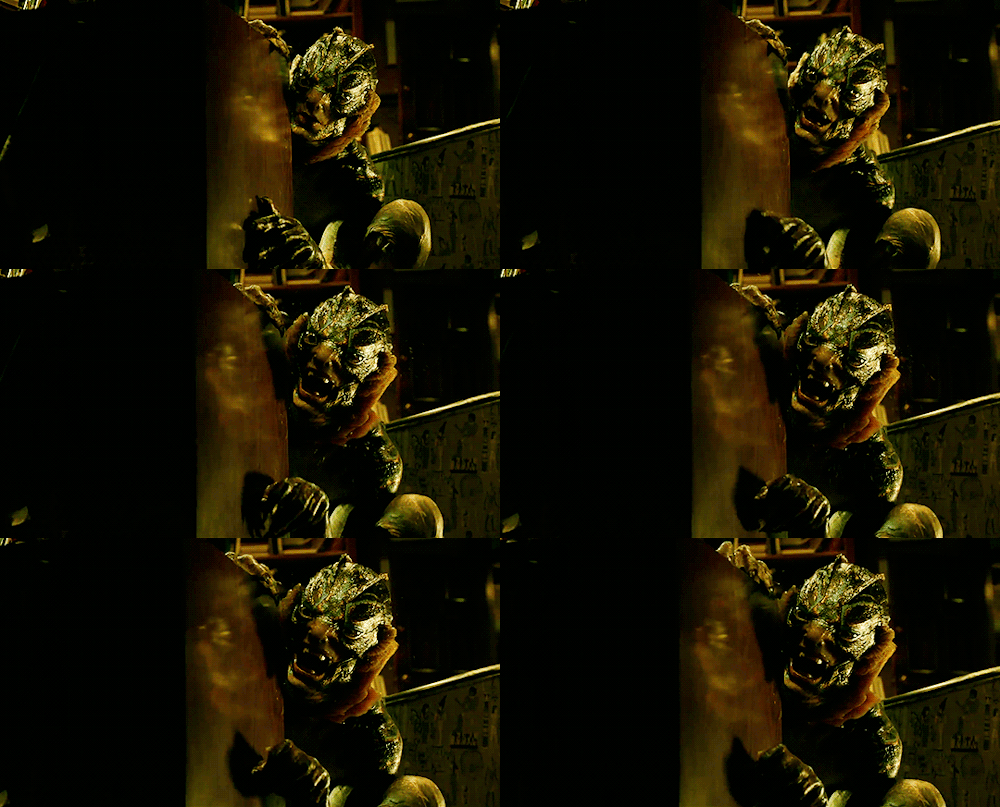
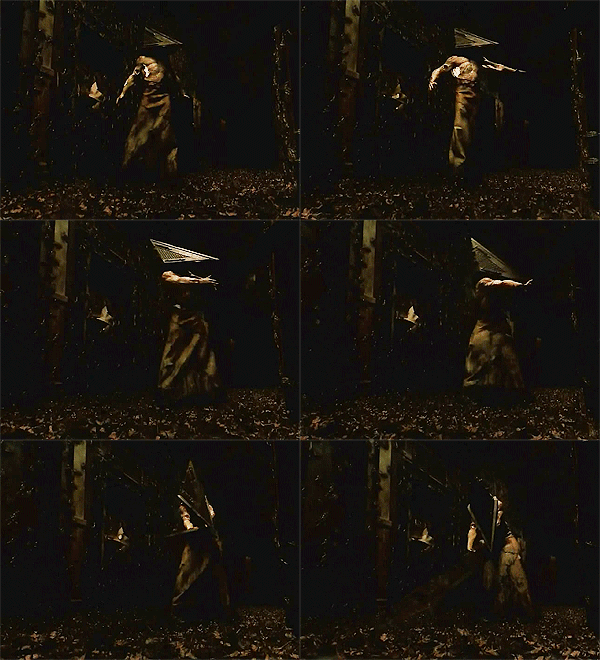
The distinction I think is that the top characters are mostly designed to be monstrous with sexual undertones, whereas the bottom ones are mostly designed to be sexual with monstrous undertones. In other words, the guys up top were built as primarily monstrous and then people sexualized them (the Shape of Water guy not really, but he’s based on one that worked that way), whereas the Monster Musume cast and most “monstergirls” generally are designed as sexy cheesecake type characters first and then the monstrous elements are like the Miscellaneous Forehead Putty on Star Trek aliens.
If you look around art sites, though, you can totally find the counterparts to each pattern: monstrous female monsters being sexualized, and beefcakey sexpot guys with some monstrous elements. And definitely nobody would ever accuse guys of having trouble sexualizing female characters, so it’s clearly not a lack of imaginination. I think what’s actually reflected here is patterns of media creation rather than consumption.
In the media, primarily-sexual characters default to female because being sexual is coded female. But being female is marked while being male is unmarked, so if a character’s point is mainly to be a monster without being overtly hypersexualized, they’ll almost never be made female. Conversely, given a female monster creators will often sexualize her to an excessive degree just out of habit. There’s an underlying assumption here in content creation that sex sells, but only to men, and that there’s no other reason for a monster to be female except for that. And maybe that’s true to some extent in the sense that it probably shows up in raw sales numbers. But I’m pretty sure that if there were more female-coded monsters that were seriously monstrous, you’d see a comparable amount of Tumblr thirst, if only because Tumblr is that way. (And, comparably, if they made Monster Musume but all cutesy hypersexualized monsterguys, it might not move mountains in Akihabara but it’d do pretty okay.)
We don’t know yet if Mueller has the goods — documentary or testimonial proof of explicit collusion — or if he can get them, so we have no idea how this is ultimately going to play out.
But we are disturbingly close to the following scenario:
Say Mueller reveals hard proof that the Trump campaign knowingly colluded with Russia, strategically using leaked emails to hurt Clinton’s campaign. Say the president — backed by the Wall Street Journal editorial page, Fox News, Breitbart, most of the US Cabinet, half the panelists on CNN, most of the radio talk show hosts in the country, and an enormous network of Russian-paid hackers and volunteer shitposters working through social media — rejects the evidence.
They might say Mueller is compromised. It’s a Hillary/Deep State plot. There’s nothing wrong with colluding with Russia in this particular way. Dems did it first. All of the above. Whatever.
Say the entire right-wing media machine kicks to life and dismisses the whole thing as a scam — and conservatives believe them. The conservative base remains committed to Trump, politicians remain scared to cross the base, and US politics remains stuck in partisan paralysis, unable to act on what Mueller discovers.
In short, what if Mueller proves the case and it’s not enough? What if there is no longer any evidentiary standard that could overcome the influence of right-wing media?…
Epistemology is the branch of philosophy having to do with how we know things and what it means for something to be true or false, accurate or inaccurate. (Episteme, or ἐπιστήμη, is ancient Greek for knowledge/science/understanding.)
The US is experiencing a deep epistemic breach, a split not just in what we value or want, but in who we trust, how we come to know things, and what we believe we know — what we believe exists, is true, has happened and is happening.
The primary source of this breach, to make a long story short, is the US conservative movement’s rejection of the mainstream institutions devoted to gathering and disseminating knowledge (journalism, science, the academy) — the ones society has appointed as referees in matters of factual dispute.
In their place, the right has created its own parallel set of institutions, most notably its own media ecosystem.
But the right’s institutions are not of the same kind as the ones they seek to displace. Mainstream scientists and journalists see themselves as beholden to values and standards that transcend party or faction. They try to separate truth from tribal interests and have developed various guild rules and procedures to help do that. They see themselves as neutral arbiters, even if they do not always uphold that ideal in practice.
The pretense for the conservative revolution was that mainstream institutions had failed in their role as neutral arbiters — that they had been taken over by the left, become agents of the left in referee’s clothing, as it were.
But the right did not want better neutral arbiters. The institutions it built scarcely made any pretense of transcending faction; they are of and for the right. There is nominal separation of conservative media from conservative politicians, think tanks, and lobbyists, but in practice, they are all part of the conservative movement. They are prosecuting its interests; that is the ur-goal.
Indeed, the far right rejects the very idea of neutral, binding arbiters; there is only Us and Them, only a zero-sum contest for resources. That mindset leads to what I call “tribal epistemology” — the systematic conflation of what is true with what is good for the tribe.
There’s always been a conspiratorial and xenophobic fringe on the right, but it was (fitfully) held in place by gatekeepers through the early decades of America’s post-war prosperity. The explosion of right-wing media in the 1990s and 2000s swept those gatekeepers away, giving the loudest voice, the most exposure, and the most power to the most extreme elements on the right. The right-wing media ecosystem became a bubble from which fewer and fewer inhabitants ever ventured.
As the massive post-election study of online media from Harvard (which got far too little attention) showed, media is not symmetrical any more than broader polarization is. “Prominent media on the left are well distributed across the center, center-left, and left,” the researchers found. “On the right, prominent media are highly partisan.”
When mapping out sources of online news, researchers found that the two basic poles were the center-left and the far-right.
The center of gravity of the overall landscape is the center-left. Partisan media sources on the left are integrated into this landscape and are of lesser importance than the major media outlets of the center-left. The center of attention and influence for conservative media is on the far right. The center-right is of minor importance and is the least represented portion of the media spectrum.
In short, they conclude, “conservative media is more partisan and more insular than the left.”
That insular partisan far-right media is also full of nonsense like Pizzagate that leaves the base continuously pumped up — outraged, infuriated, terrified, and misled. At this point, as the stories above show, the conservative base will believe anything. And they are pissed about all of it.
As Brian Beutler wrote in a scathing piece recently, the mainstream media has never learned to deal with the right-wing bubble — it has not learned how not to take bad-faith lies seriously. And now we will all reap the consequences…
Say he pardons everyone. People will argue on cable TV about whether he should have. One side will say up, the other will say down. Trump may have done this, but what about when Obama did that? What about Hillary’s emails? Whatabout this, whatabout that, whatabout whatabout whatabout?
There is no longer any settling such arguments. The only way to settle any argument is for both sides to be committed, at least to some degree, to shared standards of evidence and accuracy, and to place a measure of shared trust in institutions meant to vouchsafe evidence and accuracy. Without that basic agreement, without common arbiters, there can be no end to dispute.
If one side rejects the epistemic authority of society’s core institutions and practices, there’s just nothing left to be done. Truth cannot speak for itself, like the voice of God from above. It can only speak through human institutions and practices.
The subject of climate change offers a crystalline example here. If climate science does its thing, checks and rechecks its work, and then the Republican Party simply refuses to accept it … what then?
That’s what US elites are truly afraid to confront: What if facts and persuasion just don’t matter anymore?
…I think we all know already that it’s going to go this way.
Once this tax-cut plan goes down in flames, which it looks like it will
currently(remember, they wanted to get this passed the first week of
Sept or some crazy thing like that, so it’s already been massively delayed and the opposition to it is huge), then it’s possible the Rs will
decide Donny’s a liability and cut him loose.
I find this less likely
than some do, though, given how committed the Rs have been to the Infallibility of Republican Presidents since Nixon.
It’s not just the chorus of “Nixon did nothing Wrong” they’ve been warbling, faux-emotional, since his resignation, either; the Republican party basically responded to an RPres being forced out of office for committing serious crimes that threatened our very democracy itself by… doubling down on presidential criminality. Every Republican president since Nixon, with the possible exception of Bush1(haven’t looked him up in awhile so I’m shakier on his term), has committed impeachable crimes. None of them faced any punishment at all for them; hardly anyone in their administrations did. There was never even any serious attempt by Congress or through the Courts to punish them. The Republicans really are the party of “Faction Before Country” and have been for decades now, so the possibility of them choosing to ignore further evidence of Donald’s criminality(there’s already plenty out there unrelated to Russia, campaign finance fraud, and providing aid and comfort to an enemy of the Union that they’re choosing to do nothing about) is very real.









 just moving along like everyone else