Send me to Mars with party supplies before next august 5th
No guys you don’t understand.
The soil testing equipment on Curiosity makes a buzzing noise and the pitch of the noise changes depending on what part of an experiment Curiosity is performing, this is the way Curiosity sings to itself.
So some of the finest minds currently alive decided to take incredibly expensive important scientific equipment and mess with it until they worked out how to move in just the right way to sing Happy Birthday, then someone made a cake on Curiosity’s birthday and took it into Mission control so that a room full of brilliant scientists and engineers could throw a birthday party for a non-autonomous robot 225 million kilometres away and listen to it sing the first ever song sung on Mars*, which was Happy Birthday.
This isn’t a sad story, this a happy story about the ridiculousness of humans and the way we love things. We built a little robot and called it Curiosity and flung it into the star to go and explore places we can’t get to because it’s name is in our nature and then just because we could, we taught it how to sing.
That’s not sad, that’s awesome.
*this is different from the first song ever played on mars (Reach For The Stars by Will.I.Am) which happened the year before, singing is different from playing
The caffeine in coffee “beans” is a natural plant defense against herbivory, i.e., a toxic substance that protects the seeds of the plant. Fruits and leaves are both sources of caffeine as well and a tea can be made of the leaves, but neither are used commercially.
This is the year five point five slash apple slash twenty-six. Five billion years in your future, and this is the day the Sun expands. Welcome to the end of the world.
If space travel doesn’t involve sea shanties then I think we’ll have missed an opportunity.
You see though, for sea travel you want big strong people who are capable of managing rigging. For space travel you want small low-mass people who are technically educated, as they are called, nerds. Your space shanties are going to be less booming and more squeaky.
in so far as there will be space shanties, they’ll be filk
I call shenanigans on the big strong people; sailors were young and malnourished by modern standards, and climbing around the rigging is easier if you’re small and light.
Like, I am 100% in favor of shanties in as many situations as possible, but I’m having trouble coming up with a mode of space travel that would require multiple humans to move in concert, thus necessitating songs with a strong beat to move to.
Sea chanties were for providing a strong beat to move to. Space chanties might very well arise just because we’re bored, out there between point A and point B for so long.
(Also yes, @gdanskcityofficial up there has the right of it.)
Space shanties are for warp piloting. Under warp drive, human time perception and time as measured by crystal or atomic oscillators don’t match. Starship pilots listen to a small unamplified chorus singing a careful rhythm while keeping their own eyes on a silent metronome that the chorus can’t see, linked to a highly-precise atomic clock. How the chorus and metronome fall in and out of sync tells the pilot how to keep the ship safely in the warp bubble and correctly on course.
Depending on route, a typical warp jump can last anywhere from one to ten minutes, and most courses consist of five to fifteen jumps before a necessary four to six hour break to check the engines, plot the next set of jumps, and give everyone a chance to recover. A good shanty team, with reliable rhythm, a broad, versatile, and extendible repertoire, and the stamina to do 3-4 sets a day over the course of a voyage, is just as vital to space travel as a pilot, navigator, or engineering team.
Other reasons Shanties will experience a revival in the space age:
We will sing for any freaking reason, or no reason at all, and Shanties are FUN to sing.
Deep Space is a lonely place and recruiting people suited to long periods of isolation might be a good idea. People from Newfoundland/Labrador, for instance.
SPACE WHALES
THEY’RE DEFINITELY REAL I FEEL IT IN MY SOUL
“What Do We Do With A Drunken Sailor” is basically a revenge fantasy against your most incompetent co-workers and if there’s something humans love doing, it’s being petty.
okay 17776 is really fucking delightful? it’s got exactly the thing i love, like, the attitude, the quality, the perspective? which is, humans are put in a completely insane situation that calls into question the very nature of humanity itself… and then the humans just act like total maniacs for fun, anyway. like when faced with immortality, they just keep playing football. they play football for thousands of years. one single football game lasts 800 years and winds up with 22 players stuck at the bottom of a canyon, still playing a football game that is now explicitly impossible for anyone to win. later, some other guys with a podcast joyfully make fun of them for it.
i really like stories that have this much affection for what enormous goddamn dinguses humans are.
The answer is apparently “because we’re actually able to eat it”
Fun fact: white people (specifically Northern European white people) have a genetic mutation that allows them to digest lactose even after weaning, which is abnormal for all mammals and also most humans. It’s theorized that because Northern Europe doesn’t get a lot of sun, an alternative source of vitamin D (like milk) would be a useful trait. It’s a very recent mutation that would only have happened after humans started domesticating animals like cows and goats.
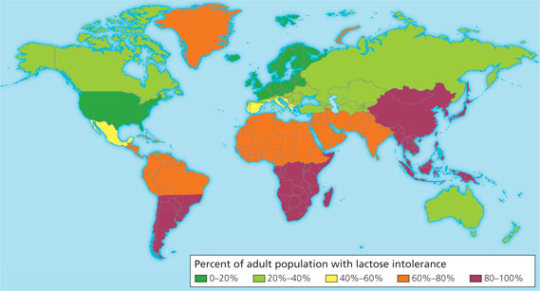
oh no, my bizarre moment has come, cause lactose tolerance is actually A Thing I Know About because it’s played a fascinating role in human evolution for thousands of years. This chart displays some of the broad trends, but it’s giving near continental averages, which doesn’t showcase how this kind of thing really breaks down and some of the surprising exceptions.
Lactose tolerance is the majority trait for only a very few population groups: North Europeans (and therefore populations that draw heavily from that stock, such as America,) nomadic central Eurasians, and sub-Saharan pastoralist Africans, but that latter group is often overlooked. The vast majority of Africans cannot process lactose, but certain people groups whose lifestyles have revolved around cattle for thousands of years will have 80% and even approaching 100% lactose tolerance rates. They’d be spots of dark green amidst a sea of orange and burgundy on the above chart.
Our hunter-gatherer ancestors were almost entirely lactose intolerant, that is definitely the biological norm (and people groups who maintained that lifestyle, such as Native Americans, remained as such – along with groups who transitioned to sedentary agricultural lifestyles, but I’ll get into that). As such, lactose tolerance is an adaptive trait that only became prevalent in environments that exerted strong selective pressure for it. So, cows were domesticated some 10,000 odd years ago in the Middle East (and some have contended for an independent domestication event in Africa as well). In either case, cattle quickly spread across the continent and we know there was milking and cheese production at least 6,000 years ago in both the Nile and Mesopotamia. While cow meat would have been enjoyed by all, in agricultural societies milk and cheese would have been options, but hardly staples as there were plenty of other things to eat as well, and therefore there would have been no selective pressure for processing lactose. Also, sedentary societies had ways of processing milk and cheese that allowed lactose intolerant people to drink/eat dairy products. Fermenting milk or aging cheese breaks down lactose, making it a non issue once ingested. This is why fermented milk may seem utterly foul to many Westerners, but is extremely common in other parts of the world. But, fermentation and aging requires time, and the ability to store things in a single location for weeks or even months. Sedentary societies adapted the milk to fit their biology, but nomadic societies did the reverse.
There are still mobile pastoralist societies in Africa today, and there have been for thousands and thousands of years. For many of them, cows are not one of many dietary options, they are the single dietary staple around which their lifestyle revolves. Biologically, this means you gotta get with the program if you wanna survive. For most mobile tribes, fermentation and aging weren’t options, so there would have been strong selective pressure favoring those who could drink milk straight outta the cow, as they would have had an additional, highly nutritious food source available to them. Milk also allowed for a marked shortening of the weaning process, transitioning children from breastmilk to cow’s milk, which would again be advantageous for groups where both the men and women work and are always on the move. Over generations these populations specialized into essentially cow-based lifestyles, creating a survival niche highly advantageous to them, and fast forward thousands of years and there are groups in Africa with near ubiquitous lactose tolerance, while the rest of the continent (and the world really) is nearly entirely intolerant.
Many of these same factors would have influenced the central Eurasian populations, which is why Mongolians and other descendants of nomadic steppe peoples are largely lactose tolerant, as mare’s milk would have been a dietary staple (though they also developed efficient ways to ferment it).
North Europeans developed lactose tolerance in response to deficiencies in certain nutrients. The northern climate limited Vitamin D production, and the agricultural products available to them were often low on calcium and protein, and so dairy farming developed alongside agriculture to create a more rounded diet (and this was limited to Northern Europeans, as Mediterranean peoples such as the Romans wrote about their great confusion at the northern barbarians’ ability to drink fresh milk)
And I promise all of this is fascinating because the ability to process lactose evolved independently in several different population groups and in response to different factors: lifestyles revolving around cows, lifestyles revolving around horses, deficiencies in climate and agriculture. Besides providing insight into human history and biology, lactose tolerance is also a great example of convergent evolution, where different genetic populations in different environments produce similar results.
And uh, that’s my rant about the role of milk and lactose tolerance in human evolution.
Beautifully written, very concise and informative. Good stuff. Interesting stuff. Thanks for your input.
This explains a lot about my family, actually.
as a descendent of nomadic central asians on my dad’s side, and celts and vikings on my mom’s, i am double plus dairy certified and should probably just buy a cow.
jumping on the “humans are space orcs” bandwagon, I’m just imagining what our food must look like to an outsider
like imagine trying to explain that we eat spoiled food. like, sometimes it grows bacteria on accident and we dislike it, but sometimes we deliberately expose it to bacteria so the exact same reaction can happen but for some reason this time we’re okay with it and call it stuff like “wine” and “cheese” and “yogurt”
we eat capsaicin, a natural pesticide and fungicide. and we think adverse reactions to it are so funny that we make videos that are just people eating extremely hot things.
we eat halite, a literal fucking rock, with such frequency that a dish is not considered properly seasoned without it.
on the subject of Humans Are Space Orcs i keep thinking it would be funny if ‘pursuit predator’ humans got together with an ‘ambush predator’ feliform species. and like. humans enjoy walking around with their friends! and the feliforms enjoy huddling in a concealed location with their friends! and it takes all of half an hour for a human to pick up a scarf and make a sling to take their pal with them while they go grab some lunch.
our new friends are like ‘are you sure this isn’t an inconvenience’ and the humans are like ‘are you kidding we do this with terran cats whether they like it or not’
also the team-up of humans and the feliform species gives most herbivore species in the galaxy screaming nightmares because here is a mobile tower that will follow you for 16 hours straight and it’s carrying a bag full of sneaky murder like it’s a baby this is not okay
Lately it occurred to me that, in all the “Humans are Weird/Great/Space Orcs” genre of posts I’ve seen, I haven’t seen any yet that deal with the relatively low level of sex-related morphological difference in human bodies, compared to other species. Like, things as simple as the length of a particular human’s hair, or the pitch of their voice, or their vocabulary can confuse other humans, with brains evolved to analyze these differences, as to the sex of said particular human. History is filled with examples of men and women posing as the other through the simple expedients of clothing and grooming. For that matter, history is filled with examples of people assigned male or female at birth living as the other through the same expedients. And then there’s all the complexities of gender presentation and identity. And then there’s all the ways environment mucks up conventional “gender differences”. And then there’s the obvious fact that, the minute technology allows humans a new way to experiment with gender and sexual anatomy, they jump at it.
I think, ironically, aliens might end up being better at just referring to people as they wish to be referred to if only because, to them, all humans look basically alike and it’s just easier to ask each person and stick with what you’re told. I’d imagine they’d view all the gender-enforcement common to some human societies as being pretty ridiculous and impenetrable.
no like morphologically humans are very similar to each other. we have only two states of physical polymorphism and there both sexual and have very few differences. Apart from that the only obvious differences between two groups of humans are skin color, hair color, and eye color, and any human can have any combination of this three traits. Most insects have three kinds of polymorphism (worker, breeder, and male) at a minimum often much more( soldier, architect, queen servant etc.) all of which have traits that only they can posses. Many furry pack predators have dozens of different fur patterns and colors, many creatures have uniques patterns of stripes or dots, etc. many species can change physical sex characteristics, skin color and even skin texture at will often as a form of communication or in response to external stimuli. We have to have an entire global fashion industry to come close to the diversity that can be found in other species, and those changes are temporary and superficial, and would at best make it even harder for an alien to distinguish between two humans. We on the other hand can identity and remember a stunning number of faces, body builds, voices, hairstyles, etc. even though the details separating any two of them are very slight and easily missed. Even when many of the other identifiers are temporary, fluid, and superficial.
 just moving along like everyone else