In all seriousness I took a death and dying course in college for fun and that’s when I fell in love with, and began to seriously study, spontaneous or “street shrines”. These are the organic, unplanned placements of items when someone is killed, generally, and the community almost descends on a spot. I am fascinated by that interfaith, inter-spirit moment of connection fostered. What drives someone to leave the first item? Who guides them there? What do we, as humans, seek from the leaving of a memorial on a place that now hallowed? And we know it is, to some extent, even if we’re not spirit-workers. We have this human need to bear witness, no matter who we are, and over and over again it manifests as this need to build some space, some monument that says “they were here, and now they aren’t here, and we, collectively, of all faiths and walks of life, strangers to each other, will remember them”
We take comfort in, and protect to some measure, that space we create with tea-light candles and stuffed bears and flowers and it just feels like the Right Thing to Do. We rebuild these spaces when they are torn down by authority and we keep building them up and that’s beautiful
Street shrines are TRULY universal, too. They are largely non-verbal but it’s like we just KNOW what to do, like something moves inside all of us and it doesn’t fucking matter if we can’t understand anyone else standing at the site, it’s just a Knowing. It’s phenomenal
God forgot to give sins to the angels and thumbs to the goats, so that angels have more thumbs than they can handle, and goats have more sins. To this day goats and angels both adore and resent humankind for having BOTH thumbs AND a capacity to sin, in balanced and wieldy amounts. That’s a fact about the creation of the universe
……i can’t tell if this is shitposting or talmudic midrash
So, set aside all the speculation about what kind of scary aliens humans would be from the perspective of other species. Let’s talk fantasy for a second.
Everyone knows half elves, and we know the other half is human but we don’t call them half humans. Why? Because it’s assumed all half breeds are part human, since humans will fuck anything.
See it’s not just elves. In D&D, for example, there are half orcs, half angels, half demons, half elementals, half spirit-things, half snakes… humans are out there fucking whatever pops a tentacle through to the material plane.
And of course I’m not saying this is never consentual so the other races must have people that are dtf with humans but I don’t think they’re known for it. I think humans are the ones that initiate pretty much every time.
So I feel like in fantasy when someone is like “oh I’m the cursed offspring of a magic cow and a -” everyone will just cut them off and be like “ – human, yeah, fucking a magic cow sounds about right for those horny bastards.”
have y’all seen that nasa pic of the earth with the sun behind it on the night time side it really really fucked me up my own soul became solid and like………….. weeped!
who wouldn’t see this and then look deeply into their own emotional playing field to see what improvements could be made purely inspired by the vulnerable earth. this is the face of all literal gods
i dearly love the ‘humans are space orcs’ trope, but here’s a different take: what if humans, among all the spacefaring races, have looked at the grim and gritty side of interplanetary colonization and said politely, “no thank you. we prefer to be civilized about this.”
imagine, if you will, Proud Warrior Races galore, each one more scarred and eyepatched and bristling with weaponry than the last, being baffled and insulted that the emissary the humans sent is this soft, clean, fluffy person with carefully done nail enamel and maybe a fancy hairdo or a curly waxed mustache or something.
the human has no scars and smells faintly of flowers. the human is wearing perfectly tailored soft clothes and no armor whatsoever. the human is completely unarmed! not even a knife! the human is wearing shiny jewelry and carrying a delicate little shiny all-purpose device, and what’s to stop a warrior from just taking everything from them? the human smiles and offers the most polite greeting their translator could dig up. it’s like the humans WANT to be destroyed.
the Proud Warrior Race leader strides forward decisively, intending to tear the human’s soft little head off and prove who is going to be the conquerer and who is going to be the conquered in this particular first contact.
what the leader assumed to be jewelry suddenly bursts off the human’s body into a cloud of bead-sized autonomous drones and delivers a numbing shock to every joint in the warrior’s body. the leader sits down hard, twitching. the human is still smiling politely.
one of the leader’s lieutenants snarls, “if you were a being of honor, you’d do your own fighting instead of having machines –” but breaks off at a gesture from the leader.
“those beads,” the still-shaky leader says, “are not the largest automatic weapons you have. are they.”
“oh, goodness, no,” the human smiles. “not the smallest either, not by several orders of magnitude. you’ve been breathing the smallest ones for twenty minutes. now, shall we have a civilized meeting, gentlefolk?”
they have a civilized meeting.
there are cucumber sandwiches with the crusts cut off.
later, the Proud Warrior Race leaders will not divulge exactly why they agreed to a binding treaty never to make war on humans or their allies for the rest of time. but whenever someone starts making noise about breaking the treaty, because what the hell, they’re just soft humans, the leaders get a haunted look. “imagine how strong you’d have to be,” they say, “before you could afford to be that soft.”
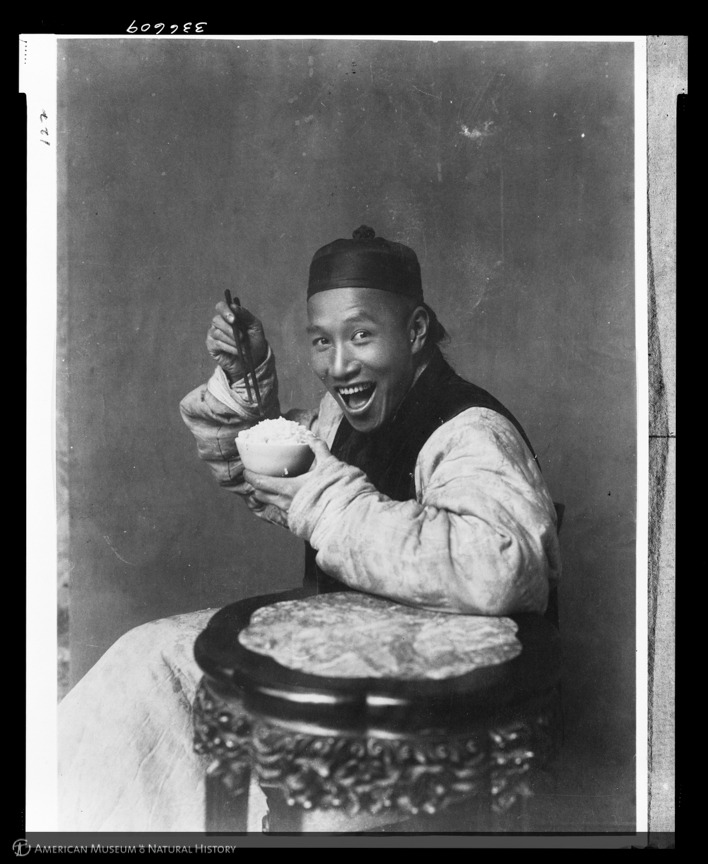
No but the history behind this picture is really interesting
The reason that everyone always looked miserable in old photos wasn’t that they took too long to take. Once photography became widespread it took only seconds to take a picture.
It was because getting your photo taken was treated the same as getting your portrait painted. A very serious occasion meant so thst your descendants would know that ypu existed and what you looked like.
But one time some British dudes went to china to go on an anthropological expedition, and they met some rural Chinese farmers and decided to take their pictures. Now, these people weren’t exposed to the weird culture of the time around getting your photo taken, so this guy just flashed a big grin during the photo because he was told to strike a pose and that’s the pose he wanted to strike.
I think painted portraits and old photos give us the idea that in general people were just really unhappy because those are the visuals we have. This is so refreshing.
Hey, look; “Man Laughing Alone With Rice” is back on my dash.
always reblog Happy Rice Guy. once upon a time, he really enjoyed his lunch, and that’s beautiful.
the fact that placebos can work even when you know they’re placebos is so fucked up. what the hell is up with the brain
like some kind of fucked up wrinkled goblin that won’t unlock the chemical secrets if you just ask politely, you have to give it some kind of pill. you can tell it that the pill doesn’t do shit, but it doesn’t care, it just wants the pill
A few years ago I had the privilege of proof-reading a dissertation on drug addiction interventions which touched on the placebo effect (because it turns out successful addiction interventions share the basic elements of the placebo effect: a desire to get better, a change in one’s beliefs about one’s condition, and a positive relationship with a trusted authority figure).
How the placebo effect works, in terms of feedback between the brain and (presumably) the inflammatory system, is still unknown. But the logic of why the placebo effect should happen is not that mysterious. There are two basic principles.
One, pain is protective. A lot of the conditions we take medicines for are in fact interim defence mechanisms. Pain stops us doing things that damage our bodies. Fever kills pathogens. Vomiting gets rid of poisons. Fainting cuts the work-load on the heart.
Two, healing takes resources. Before the body commits to expending those resources fully it needs to be certain they’re not needed for something else, like fighting off a secondary bacterial infection. And of course the circumstances in which we get sick in the first place are the same circumstances in which we might want to hold resources in reserve for dealing with further assaults on the body.
This means that our healing systems will stay in the interim condition until they get a signal of some kind to let them know that our circumstances have changed and full healing is a good investment now. What part of our body processes that kind of complex information? The brain, that’s what.
The information basically needs to take the form: “Something external has changed and we have confirmation that as a result we are going to recover from this condition.” Apparently our healing systems can tell when we’re just making it up to jolly them along.
The logic is presumably the same in most species, but in humans, being language-users, that external change can take the form of someone whom we trust to know what they’re talking about saying “These pills will do the trick. Drop into the pharmacy on your way home and hand them this bit of paper.”
Most likely the signal from the brain takes the form of some kind of hormone, triggered by a new emotional state.
The word for the subjective experience of that emotional state? Hope.
man this has been said before by cleverer folks than me, but sometimes you have to sit down and let the sheer size and age of the storytelling tradition just completely overwhelm you, ja feel?
like– think for a second about how mind-bogglingly incredible it is that we know who osiris is? that somebody just made him up one day, and told stories about him to their kids, and literally thousands and thousands of years later we are still able to go “there was a god whose brother cut him into pieces”, it’s so arbitrary, it’s so incredible
that in talking about scheherazade and her husband, you are doing something that someone in every single generation has done since it was written– you are telling stories that have lasted an impossible amount of time
can you conceive of telling a story, and then traveling into the future and hearing that same story told– with alterations, and through media that you could not possibly conceive of, but your story– in the year 3214?
the fact that we! as a species! have been telling the same damn stories for so long– the fact that we’ve seen homer’s troy and chaucer’s troy and shakespeare’s troy and troy with fucking brad pitt because we never fucking stop telling stories! never ever ever!
we never stop caring about stories, or returning to the same stories, or putting our own spins on stories. we never stop talking about the characters as if they were real, or asking what happened next, or asking to hear it again.
generation after generation, they never ever ever stop mattering to us.
The Osiris one is interesting because it was dead or very heavily mutated until we started translating hieroglyphs and it was reborn. Like those seed vaults in Norway written language has a way of preserving stories which then reemerge and spread virulently across the population again.
being a storyteller is both a sacred trust, and the wildest, freest rebellion. it’s as ancient as language, as ancient as thought, but it’s also as fresh as drunken improv comedy and the latest meme. everyone tells stories instinctively and easily, but to be a master takes decades of practice. we learn about the human condition and the real world through stories, but they also let us speculate about impossible places and alien people.
it is possibly the only abstraction more universal than religion. i’m not sure humanity could survive without it.

 just moving along like everyone else