This is my first coding assignment for my software engineering class that started today. It’s going to be a really good semester.
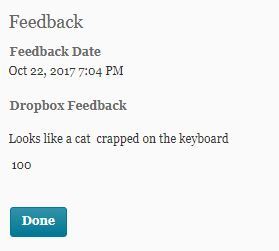
UPDATE: I got my grade back and
“100″
Since this post has gotten some attention, I feel like it’s worth mentioning that this was just the first half of the assignment.
The second half, which we weren’t made aware of until the day we were meant to turn this one in, was to trade USB drives with the person sitting next to us and MODIFY their “unreadable” code without getting any help from them.
This was to teach us two things:
1) In this field, you’ll spend more time working with code written by other people than you will writing original code from a blank slate. The people who wrote the original code will probably not be around to help you. Learning to read code is IMPORTANT, even if it seems unreadable.
2) There is a strong brotherhood/sisterhood among programmers and software engineers. Respect that bond when you’re writing code and documentation. In my professor’s words: “When you write code, pretend that the person who will have to maintain it after you’re gone is a homicidal maniac who knows where you live.”
This class and professor are incredible.
AHHHHHH I need this in my life.
If anyone wants to send me obfuscated code to fix I would be fucking delighted.
@the-real-seebs this looks like a job for the Obfuscated C Contest
It’s sad how much of what is taught in school is useless to over 99% of the population.
There are literally math concepts taught in high school and middle school that are only used in extremely specialized fields or that are even so outdated they aren’t used anymore!
I took calculus my senior year of high school, and I really liked the way our teacher framed this on the first day of class.
He asked somebody to raise their hand and ask him when we would use calculus in our everyday life. So one student rose their hand and asked, “When are we going to use this in our everyday life?”
“NEVER!!” the teacher exclaimed. “You will never use calculus in your normal, everyday life. In fact, very few of you will use it in your professional careers either.” Then he paused. “So would you like to know why should care?”
Several us nodded.
He picked out one of the varsity football players in the class. “You practice football a lot during the week, right Tim?” asked the teacher.
“Yeah,” replied Tim. “Almost every day.”
“Do you and your teammates ever lift weights during practice?”
“Yeah. Tuesdays and Thursdays we spend a lot of practice in the weight room.”
“But why?” asked the teacher. “Is there ever going to be a play your coach tells you use during a game that requires you to bench press the other team?”
“No, of course not.”
“Then why lift weights?”
“Because it makes us stronger,” said Tim.
“Bingo!!” said the teacher. “It’s the same thing with calculus. You’re not here because you’re going to use calculus in your everyday life. You’re here because calculus is weightlifting for your brain.”
women’s sports are??? not under developed versions?? of mens sports?? they’re the own thing?? with different rules and regulations and run by different people???
The Fair Folk: “I can’t believe this. Twenty years I’ve cleaned your house and you DARE to try to REPAY me with GIFTS. This is such an insult. Fuck you, you insolent humans. I’m leaving here and never returning because you have insulted me so deeply.”
Also the Fair Folk: “Remember that one time you pulled a thorn out of a cat’s foot? That was me. To show my gratitude, here is a house made of solid gold, a life-debt, my daughter’s hand in marriage, and a promise that all your children will be gorgeous and successful at all that they do. I can also throw in a blow job if you want. I hope this is enough. I don’t want to seem ungrateful.”
“homasse asked about the differences in flirting styles in the different countries I’ve been in, and Meg asked the same question only about sex (-_-);;; um, I don’t travel the world treating it like a smorgasbord of guys, sampling various ones from each country (tragically). But I can talk about Japan, and it’s pretty different. So…”
Flirting in Japan
Flirting seems like a misnomer. It’s more like an absense of flirting. If you like someone in Japan, there are a couple of different ways of showing it and/or approaching them, none of which really resemble flirting in the west.
1. Nanpa (the “pickup”)First off, only guys do nanpa; in the rare case that girls do it, it’s called gyaku-nan (“reverse nanpa”), but I never heard of gyaku-nan actually happening, it always seemed like it was more of an amusing theoretical idea, rather than something girls really did.
Nanpa only refers to the case when you don’t know the other person at all, and you want to pick them up. Nanpa is direct. “You’re cute. What’s your name? Do you have time? Let’s go somewhere.” That is the classic script of nanpa. It can be shortened to just: “Kawaii yo. Jikan aru?” If you hear that, you’re being nanpa-ed. Of course, if you are a non-Asian foreigner, you will probably never hear that, because Japanese guys are too shy to try and nanpa a white or black woman. Most Japanese guys are too shy to nanpa at all. If you ask a Japanese if he has ever done nanpa, he’ll probably say, “ZOMG! No way! I’m too embarrassed!” since nanpa is direct, and mostly, if you are Japanese and you like someone, you embark on a series of subtle, indirect stealth manoeuvres, because liking prohibits action, especially for women, but also for men.
Why is this the case? Japanese social interaction is all about intuiting the other person’s wishes without discussing them openly, at the same time that they are intuiting your wishes without discussing them openly, so that although nothing is ever verbalised, the two of you will always exist in a compromise position of equilibrium. If you like someone, that intuitive part goes into overdrive, because you should be able to understand everything about that person without them ever telling you, and you should be able to please them without ever asking how, even more than you would with a normal person. So it’s more important than ever to be indirect. Which leads me to:
2. Negotiating through a third partyAgain, it’s not really flirting, but since flirting is showing your feelings openly–that is, pushing your feelings onto another person, which is direct and rude–it’s better to show no sign to the other person and meanwhile exploit the back channels. Sort of like in high school. So that convoluted human chain whereby: you like Hiro and you tell Junko that you think Hiro has a nice smile knowing that Junko will intuit that you want to know if Hiro likes you back, since Junko is friends with Goro who is friends with Hiro and Junko will talk to Goro and Goro will bring it up with Hiro etc etc etc etc etc etc. Once everything is confirmed, Hiro will ask you out. (The girl ask the guy out? Ahahahaha. Be serious.) If you don’t have a third party to negotiate for you, you may be forced to use other methods, all of them so subtle that a westerner may not even notice them at all.
3. Subtle signals – Shyness. Pronounced shyness is form of flirting, since it’s a sign of liking, especially from girls, but also from guys. She interacts with everyone else more than him, she doesn’t sit next to him, she doesn’t talk much to him, she doesn’t initiate anything with him. – Attentiveness. You make life easier for the other person without being asked to. For example, when you got to a restaurant in Japan it’s normal to share food, so flirting means not ordering what you like, but ordering what s/he likes, which you already know without asking, because you’re observant. Stuff like that.- Eye contact. It’s the opposite to the west, where you gaze deeply into someone’s eyes if you like them. Direct eye contact is a bit rude in Japan at the best of times. If you’re flirting you look down and away a lot.- Indirect compliments. I can’t think of a good example. It’s pretty rare to give direct compliments and even more rare to compliment someone’s looks. (It’s especially rare for guys to compliment girls directly.) I wish I could think of a good example! I’ll come back to this one.
Sex in Japan It’s really different. It’s just so completely different. The first time I had sex with a Japanese guy was easily the most bamboozling experience of my entire life. Before I launch into anything, I should say that while I lived in Japan for five years, I have had sex with only a select few people, and that was within long term relationships, so it’s not as if I have personally taken a wide sample. But I had a network of Japanese friends (mostly female) and every time I encountered a cultural difference I immediately pumped them all for information, asking my millions of questions. I make generalized statements only when something that I personally experienced was confirmed as The Norm. The biggest difference is that sex in Japan is not a mutual sharing experience with both partners spontaneously doing whatever they feel like or enjoy whenever they feel like doing it. Sex has rules and sex has roles just as every social interaction in Japan has rules and roles. There is an active partner and a passive partner. Active means moving; passive means unmoving. In heterosexual sex, the active partner is always male, and the passive partner is always female. In gay sex you work out your roles beforehand: the seme is active, the uke is passive (for gay guys); the tachi is active, the neko is passive (for gay women). If you are familiar with seme/uke conventions from yaoi manga, you can use them as a way of relating to what I’m talking about, because those conventions are not a fictional construct, randomly decided upon by a group of yaoi mangaka. Straight people have sex like that too, in reality.
So there is an active partner and a passive partner, which causes various flow on effects. You can’t have “Whoo-hoo! Go for it!” sex because both partners are constrained by their roles. The passive partner (obviously) because she can’t move, and the active partner because he has to take care of the passive partner, instructing her on what to do and exerting himself so that she has a good time. Japanese guys are generally more stressed out by sex than western guys and that is because they are responsible for the sex; as the active male, the sex is their burden, they have to do everything, it’s all up to them. Sex equates not only (sometimes not even primarily) with ‘fun’ or ‘pleasure’, it also equates with ‘work’ and ‘obligation’.
I also can’t emphasise enough just how passive the passive partner is. The way a woman kisses is by submissively opening her mouth, not moving her tongue unless she is cued to do so; if she’s really feminine she won’t open her mouth at all, until she’s told to. Sometimes women will move around a (very) little during sex, but mostly not at all. The slang term for a woman who lies completely still in bed is maguro (tuna). For me, with my western sensibilities and preconceptions, calling someone a ‘tuna’ in bed sounds like an insult, conjuring up images of cold dead fish, but in Japan that word has a very positive connotation. Tuna’s an expensive delicacy.
Part of what was so bamboozling the first time I had sex in Japan was that I didn’t know there was a Way of Sex, with strict gendered roles, and I just was happily doing my own thing, throwing my partner into total confusion. Seiji told me much later that dating me made him feel like he was gay, because I was active in bed, and he couldn’t connect that with anything except masculinity. When it came to the guys I dated, even though it was completely outside their experience, they sort of (kind of) eventually adjusted their thinking and accepted the fact that I was active (because I was Foreign and Foreign Women Are Different) but the thing I could never completely change was the fixed idea they had that someone must be passive. Yes, I could be active in bed, but they had no template for how to react to that other than the female/passive/uke template. So at best we could alternate “active periods”, and though the lines between active and passive blurred a little over time, they never blurred completely. And total shutdowns still happened: thirty seconds tick past and my partner hasn’t moved at all … oh, okay, I get what’s happened.
If I’m making cross-cultural sex sound like a bit of a nightmare: yeah, it was. In this case, once I worked out what was going on, I thought all my problems could be solved by a simple conversation or two, explaining the more free-form nature of western sex, and encouraging my partner along the lines of, “You don’t have to act a certain way, you can act however you like! You can relax! Enjoy yourself! Doesn’t that sound great?” but that was also a failure to understand the Japanese psyche. It’s not liberating for a Japanese person to be told there are no rules, it’s frightening. I was inadvertently terrorizing my partner by dropping them into the middle of a scary foreign wilderness and telling them to make do without a map.
Sex and hygiene Sex in the west can be spontaneous, but sex in Japan isn’t, or at least, not in the same way. In Japan, you can’t get in the front door and immediately start stripping each other’s clothes off in the hallway. Well, you can, and your Japanese partner will probably acquiesce because they are Japanese, but deep down they will be hideously uncomfortable and thinking, “Sex? But I’m not mentally prepared! I haven’t done my kokoro no junbi! And she hasn’t had a shower! And I haven’t had a shower! This is kind of gross!” Shower is important. You should shower directly before and after you have sex. Before is more important than after. This makes me sound like I only ever dated people with OCD, but it’s the norm. The way I first found out about this was in conversation with my friend Natsue.
Me: I was at Seiji’s place hanging out and he randomly told me that I could use his shower if I felt like it. Don’t you think that’s weird? Natsue: *cracks up laughing* Cat, that means he wants to have sex with you! If a guy mentions having a shower, he is saying that he wants to have sex. Me: But isn’t it kind of rude to imply I needed to shower first? Like, it was a date, obviously I had showered before going over to his apartment! Natsue: Well, I suppose so… *sounding unconvinced* … but didn’t you say he lives in Yokohama?Me: What does Yokohama have to do with it?Natsue: Well, you went on the train to get there … it’s better to have another shower. If a guy had sex with me without showering first, it would make me really uncomfortable. Sensing yet another cross-cultural disaster in the making, I began the investigation, hitting up all the usual suspects for information, including my friend Tomoko, who was dating a western guy called Andy. Me: Sorry to bring this up suddenly, but does it weird you out that Andy sometimes initiates sex without showering first?Tomoko: YES! I’m so glad I finally have someone to talk to about this! Cat, are all westerners like this? It’s so dirty and I can’t relax! It makes me feel like we are just animals! After I heard basically the same story from all my Japanese girlfriends, I went back to Seiji.
Me: First of all, westerners don’t always shower or have a bath before sex. However, I will try to accommodate you on this because the idea of sex without showering seemed to horrify everyone I talked to right down to their very bones. Secondly, when you suggested that I shower the other day, and I said no, I was not rejecting you. I didn’t understand that it was your Japanese signal that you wanted to have sex. If I had understood that, I would definitely have said yes. Seiji: *spits tea all over the table*Me: …this is one of those deeply unspoken Japanese things that I’m not supposed to talk about directly, isn’t it.Seiji: Yes. Another thing that is considered rather icky and unhygienic is ejaculate. Guys are really embarrassed by it. They will be desperately scrabbling for a tissue almost before you realise they’ve come at all, since it is really bad form to get ejaculate anywhere, without cleaning it up immediately afterwards (and immediately means immediately). This is yet one more thing that men are responsible for as the ‘active’ partner. The more of a nice, polite guy they are, the more stressed out they will be about it. It’s also yet one more way that the sex is prescribed and controlled; the guy can never really let go, because even at the moment of climax, he’s already worrying about cleaning up, or trying not to make a mess in the first place.
… okay, wow, I have been writing and thinking about this entry for more than an hour, and I feel like I’ve barely scratched the surface, so I’m just going to stop here. Flirting in other countries I’ve been to should be easier to write about, I might come back to that in a separate post. Meanwhile, if there’s anything else you want to know, feel free to ask.
Of all the skills that futurists predicted would become valuable in the era of constant communication, I don’t think anybody saw “conversational multithreading” coming.
No, I don’t mean holding multiple conversations with different people at the same time. I mean holding two or more completely separate conversations with the same person, via the same medium, at the same time.
Like when you’re texting, and the person on the other end asks you a question, then mentally eight-tracks and asks a different, unrelated question before you’ve finished keying in your response to the first one. So you answer the first question, and a conversation based on that answer ensues; then you answer the second question, and a totally different conversation based on that answer ensues, and now you’re having two separate conversations with the same person at the same time, and have to keep track of which responses pertain to which conversation purely from context.
Sometimes I wonder what the generational cutoff for that seeming unusual is – I didn’t pick up the skill until I was like thirty, so there’s always that undercurrent of generational novelty there.
My favorite thing is that Europe is spooky because it’s old and America is spooky because it’s big
“The difference between America and England is that Americans think 100 years is a long time, while the English think 100 miles is a long way.” –Earle Hitchner
The Stanford prison experiment tapes were so stupid when I watched them in AP psych and so stupid when I watch this film about them. Literally they could’ve all sat and played cards and got $15 a day to tell ghost stories all day and be best friends. But masculinity and whiteness and power created this violent irrationality that positioned young ass men to be met with brutality and trauma and disrespect even when it was obviously taken too far. and it makes no sense. If someone put me in a room with Black girls and said I would get paid $90 a day (that’s the equivalent apparently) to be a prison guard, do you know how fast I’d be sitting with them and learning about them and exchanging Instagrams and like.. sleeping.. like what the fuck was the point of any of that…
My psych teacher introduced us to this study and literally before she showed us was like “don’t ever confuse a study based on one type of person (white men/boys) to be an example of an Everyman situation. There is strong evidence that if this was recreated with diversity, or even just with girls, that the results would have been drastically different. This is an example of bias and sexism in the medical research community.”
“Other, more subtle factors also shaped the experiment. It’s often said that the study participants were ordinary guys—and they were, indeed, determined to be “normal” and healthy by a battery of tests. But they were also a self-selected group who responded to a newspaper advertisement seeking volunteers for “a psychological study of prison life.” In a 2007 study, the psychologists Thomas Carnahan and Sam McFarland asked whether that wording itself may have stacked the odds. They recreated the original ad, and then ran a separate ad omitting the phrase “prison life.” They found that the people who responded to the two ads scored differently on a set of psychological tests. Those who thought that they would be participating in a prison study had significantly higher levels of aggressiveness, authoritarianism, Machiavellianism, narcissism, and social dominance, and they scored lower on measures of empathy and altruism.”
The thing about this study is that whether or not it’s generalizable to the public is debatable at best.
But it’s certainly generalizable to the population of people who tend to be drawn to prison system and law enforcement jobs because that’s exactly the demographics that tend to show up in those positions.
“But it’s certainly generalizable to the population of people who tend to be drawn to prison system and law enforcement jobs because that’s exactly the demographics that tend to show up in those positions.”
“It asked ‘Do you really know yourself’ and asked for men to take part in a social science experiment to be shown on TV. It warned that the research would be a challenge and involve ‘hardship, hunger, solitude, anger’.
In the case of the BBC Prison Experiment, the mock prison did not devolve into the torturous, abusive hellishness of the Stanford Prison Experiment–even though the experimenters very deliberately attempted to create conditions that would destroy cohesion among the prisoners and encourage authoritarian behavior from the guards. Prisoners were told that they might be able to be promoted to guardhood in an effort to keep them divided, shaved upon entry to the prison, and the guards were encouraged to create the rules of the prison and enforce them in any way they saw fit.
Because food–both quantity and quality–were very salient and powerful status treatment differences in the prison, there was almost immediately a showdown over food. (Prisoners were fed much, much smaller and worse-tasting food than the guards, and indeed prisoners were made to serve the guards their meals and watch them eat in part so everyone would be aware of these status issues.)
The guards almost immediately felt guilty and attempted to share their sausages with the prisoners by giving them the guards’ leftovers… and the prisoners immediately go “not until we consult with the other prisoners,” and then collectively decide to refuse absolutely to take small rewards from guards in lieu of the right to good food.
Guards tried repeatedly throughout the study to get prisoners to see them as basically equal, bar the circumstances of their current positions; prisoners instead repeatedly pointed out the actual circumstances of their current situation placed them at very different power levels indeed and insisted that guards actually change the system in order to make the conditions fair and equal. In general, prisoners quickly and collectively exploited the guards’ shame at the unequal conditions in order to receive fair treatment.
At this point, out of curiosity, the experimenters introduced a new prisoner into the system, one who had been trained as a trades unionist…
….and this unionist prisoner quickly chose to approach a disaffected guard, empathize with his unhappiness, and turn the blame for the situation at the unequal and unfair conditions set in the prison. Those conditions, of course, were set not by the guards–they were set by the experimenters. The very first thing, then, that this unionist does is build bridges to unify all the people in the prison.
Prisoners steal the guards’ keys; guards choose instead of “cracking down” or punishing the prisoners to ask politely for the prisoners to help them find the keys, and cheerfully accept them when provided. This gives prisoners leverage for a negotiation, which is then deftly picked up by the experienced negotiator (although not without some pushback from another charismatic and decisive prisoner).
Here’s what the negotiator had to say:
Negotiations begin. pDM outlines the forum proposal. One of the Guards points out that the Prisoners are asking to be rewarded for stealing the keys. pDM responds by outlining a stark choice. Certainly the Guards can refuse to accept his plan, but the alternative is a return to conflict: “It’ll not be the keys tomorrow, it’ll be something else. It’s a game. All I’m saying is that there is a way to resolve that game”.
pDM is confident. He knows he speaks for the Prisoners. The Guards, even in their own mess, are despondent. They know that they can’t handle the Prisoners. And so they accept the new order. Even if they have given up much of their power, at least this system might work and offer them some respite:
gTM: I’m in high spirits after that. gBG: It actually went alright. This geezer is alright. We can all deal with him.
At this point, experimenters withdrew the negotiator to see what would happen to the egalitarian vision he set out. As it turned out, the prisoners peacefully overthrew the rule of guards (by, effectively, mounting a sitdown protest in the guard’s sanctuary) and decided instead to organize an egalitarian commune for the remainder of the experiment.
 just moving along like everyone else