If I can, I always opt to ditch my name tag in a dementia care environment. I let my friends with dementia decide what my name is: I’ve been Susan, Gwendolyn, and various peoples’ kids. I’ve been so many identities to my residents, too: a coworker, a boss, a student, a sibling, a friend from home, and more.
Don’t ask your friend with dementia if they “remember your name” — especially if that person is your parent, spouse, or other family member. It’s quite likely to embarrass them if they can’t place you, and, frankly, it doesn’t really matter what your name is. What matters is how they feel about you.
Here’s my absolute favorite story about what I call, “Timeline Confusion”:
Alicia danced down the hallway, both hands steadily on her walker. She moved her hips from side to side, singing a little song, and smiled at everyone she passed. Her son, Nick, was walking next to her.
Nick was probably one of the best caregivers I’d ever met. It wasn’t just that he visited his mother often, it was how he visited her. He was patient and kind—really, he just understood dementia care. He got it.
Alicia was what I like to call, “pleasantly confused.” She thought it was a different year than it was, liked to sing and dance, and generally enjoyed her life.
One day, I approached the pair as they walked quietly down the hall. Alicia smiled and nodded at everyone she passed, sometimes whispering a, “How do you do!”
“Hey, Alicia,” I said. “We’re having a piano player come in to sing and play music for us. Would you like to come listen?”
“Ah, yes!” she smiled back. “My husband is a great singer,” she said, motioning to her son.
Nick smiled and did not correct her. He put his hand gently on her shoulder and said to me, “We’ll be over there soon.”
I saw Nick again a few minutes later while his mom was occupied with some other residents. “Nick,” I said. “Does your mom usually think that you’re her husband?”
Nick said something that I’ll never forget.
“Sometimes I’m me, sometimes I’m my brother, sometimes I’m my dad, and sometimes I’m just a friend. But she always knows that she loves me,” he smiled.
Nick had nailed it. He understood that, because his mom thought it was 1960, she would have trouble placing him on a timeline.
He knew that his mom recognized him and he knew that she loved him. However, because of her dementia, she thought it was a different year. And, in that year, he would’ve been a teenager.
Using context clues (however mixed up the clues were) Alicia had determined that Nick was her husband: he was the right age, he sure sounded and looked like her husband, and she believed that her son was a young man.
This is the concept that I like to call timeline confusion. It’s not that your loved one doesn’t recognize you, it’s that they can’t place you on a timeline.
What matters is how they feel about you. Not your name or your exact identity.
THIS. sometimes ole miss thinks i’m her son, or her husband, or her cousin bill or her friend kathi, and once she called me “mommy.” doesn’t matter. she knows i’m someone who cares about her.
when my grandmother developed dementia, she took to calling me ‘virginia’. she had gone to a time in her mind when long red hair did not mean her metalhead grandson, it meant her eldest son’s fiancee. she gave me a lot of advice for how to keep my head and my temper with young leo, who could be a handful but was a gem if you didn’t let him push you. “i know you’re a firecracker, ginger,” she’d tell me, “but don’t make a fight out of it. just hear him out and then make your own decision. he respects that.”
i didn’t correct her on my gender or the year or my name. i didn’t tell her that virginia and leo had been married forty years and were doing fine; i thought that might reassure her, but then, it might just throw her for a loop, so i kept it to myself. i kind of wanted to tell her leo had been an excellent mentor to me and she’d taught him well, but i figured i could save that for a better opportunity. (as it happened, i didn’t get the chance, but i think she knew she did a good job.)
i just understood that she saw me as a young person she wanted to teach and look out for, and maybe a person whose agency she wanted to validate despite society trying to squash it.
so i listened to her advice and thanked her, and told her i’d think on it, and she was happy. and i did think on it, too, and it helped me in my relationship with seebs.
people with dementia are still themselves. they’re not clear on the details, but they still love and care and have things to teach.
It’s relatively popular so you might have already, but in case you haven’t:
If you like BNHA / Boku No Hero Academia / My Hero Academia then you should definitely watch Tiger and Bunny
It’s the spiritual 2011 precursor to BNHA in that it is a modern, self-aware, intelligent play on the superhero genre with a cast of unique and likeable characters and interesting world building.
It’s basically the world of BNHA but in reverse. When I first watched BNH I said “this is literally Tiger and Bunny but with school children and more powers”. Tiger and Bunny is like BNHA but with a cast of adults instead of teens.
People with powers are called NEXT, they make up a small percentage of the population, were seen as anomalies and hated until a man decided to make them into reality TV show stars and profit off broadcasting their heroism. Now superheroes are superstars, and the anime was funded specifically by ad revenue for REAL companies that they have on their suits, but with an in-universe explanation. Clever.
The main character is Izuku Midoriya if Midoriya were a hot dad.
Not kidding.
The main character is Kotetsu AKA Wild Tiger, who’s the only hero who seems to truly believe in real heroism instead of the capitalism it feeds. Though people at first think he’s outdated and idealistic and a little stupid, everyone in the cast is basically in love with him by the end of season 1, and he’s inspired all of his fellow heroes, ESPECIALLY his partner, the prettyboy Batman Iron Man pastiche, Barnaby (who Kotetsu nicknamed Bunny), with whom Kotetsu shares a superpower.
There are lots of other great cast members too, INCLUDING A SUCCESSFUL AND WELL-LOVED QUEER CHARACTER WHO HAS AN EMOTIONAL CHARACTER ARC IN ONE OF THE FILMS
The plot of Tiger and Bunny follows Tiger being paired up with Barnaby after his own agency goes bankrupt. Barnaby, meanwhile, is the only superhero without a secret identity, who’s actively looking for the man who murdered his parents. A man who’s literally The Joker. He even has a Harley Quinn.
THEY EVEN HAVE A KILLER WHO BELIEVES HEROES ARE HYPOCRITES AND NO TRUE HEROISM EXISTS ANYMORE EXCEPT IN ONE PERSON AND ALL FALSE HEROES NEED TO BE TAUGHT A LESSON. SOUND FAMILIAR?
Yeah his name is Lunatic and he’s literally Stain the Hero Killer if Stain weren’t a human ninja turtle
You may also have noticed the ridiculous number of BL / Yaoi doujin dedicated to this anime and its two main characters. Which is actually how I got to watching the anime in the first place. Because they’re all really ridiculously beautiful.
Which is unsurprising considering their relationship, which half the creators have stated can be read as romantic.
But it sadly isn’t shown to be onscreen. Yet. Maybe one day.
It’s two seasons long plus a couple of movies (the movies have a different art style but are still mostly worth watching), and there have been teases of films and a third season recently with the still ongoing success of superhero shows, including BNHA.
IN SUMMARY: WATCH THIS SHOW. IT’S VERY GOOD. THE DUB IS ALSO EXCELLENT, ONE OF THE BEST.
My girlfriend Marna has been a queer activist since the late 80s. She’s told me about the incredible deliberation and debates LGBTQ+ activists had, in the late 90s and early 00s as the community began to see past the AIDS crisis and immediate goals of “surviving a plague” and “burying our dead.” There were a lot of things we wanted to achieve, but we had to decide how to allocate our scarce reserves of money, labour, publicity, and public goodwiil. Those were the discussions that decided the next big goals we’d pursue were same-sex marriage equality and legal recognition of medical gender transition.
From hearing her tell it, it seems like it was actually a wrenching decision, because it absolutely left a lot of people in the dust. A lot of people, her included, had broad agendas based on sexual freedom and the rights of people to do whatever they wanted with their bodies and consenting partners—and they agreed to put their broader concerns aside and drill down, very specifically, onto the rights of cis gays and lesbians to marry, and the ability to legally change your sex and gender.
As a political tactic it was terrifically effective. In less than two decades, public opinion in many countries has totally reversed on gay marriage, and we’ve won some truly enormous legal landmarks. Gender transition has entered public consciousness and the first landmark battles allowing people to define their own gender have been won. Marriage equality means that husbands and wives are protected from being banned from their dying spouse’s bedside, being forcibly separated from their children, or not being recognized as an important part of their spouse’s life.
The LGBTQ+ community knew they were taking a gamble, focusing so exclusively on marriage equality, and trans activists knew that they wouldn’t be able to achieve anything else until they’d gotten basic medical transition recognized. By and large, prioritizing things this way paid off. But they knew going in that there would be costs—and we’re reaping them.
Activists of 20 years ago chose to sideline and diminish efforts to blur and abolish the gender binary. Efforts to promote alternative family structures, including polyamorous families and non-sexual bonds between non-related adults. Efforts to fight the Christian cultural message that sex is dirty, sinful, bad, and in need of containment. Efforts to promote sexual pleasure as a positive good.
Those efforts have been going on for the last 20 years, but they’re marginalized—activists who had to decide where their finite time, money, publicity, and social capital went literally sat in committee meetings and said, “Marriage equality is our top priority. Legal gender transition is our top priority. Everything else will have to wait.”
This happened especially because sex education, sex positivity, and youth outreach were incredibly dangerous areas. Our enemies have been saying for years that all LGBTQ+ people are pedophiles, perverts, seeking to corrupt and recruit children to our cause; anyone trying to teach children basic facts about how to avoid disease, what’s happening to their own bodies, or what possibilities they have for identity and orientation, risks having their name, career, and life ruined. As a sex educator in the 90s, Marna had to tell teenagers, “I can’t answer your questions about safe sex now. Come back when you turn 18.”
So kids who grew up being told that girls and boys are different and ought to lead different lives, and sex is dangerous and sinful and gross, and you definitely shouldn’t want sex UNTIL you get married to your One True Love, only had that message tweaked a little bit. Now you can cross the floor from the Girl Side to the Boy Side or vice-versa. Now your One True Love doesn’t have to be a different gender from you. But those kids could survive with the rest of their worldview relatively intact. And I think that’s what we’re seeing in fandom, with an emphasis on “pure” OTP ships, on only including LGBT+ identities that use crisp, clear gender binaries and result in nuclear family life. The rest of those cultural messages about sex and love remain: men’s and women’s worlds are and should be different, “impure” sex degrades and defiles you, sexual urges that do not contribute to your One True Love and family life should be repressed, shamed, or destroyed, and sexual thoughts are every bit as bad as acting on them.
This isn’t because kids today are bad or stupid. It’s because as a community, we had to decide where our effort was going, and now we need to pay down the debt we’ve racked up over years of prioritizing marriage equality and legal trans recognition over sex positivity, sex education, and deconstructing gender.
TERFs, SWERFs, exclusionists, and transmedicalists have stolen a march over liberal queers because they’re doing the work to educate youth. While liberal queers have been staging protests and lobbying politicians, half a dozen of my undergraduate professors were radical feminists. Communities of exclusionists and anti-sex activists have honed their expertise at engaging teenagers with their ideas and theories. They’re the ones writing the FAQs, answering the asks, and doing the groundwork of saying, “Here is a basic framework of sexual ethics for you to follow.”
If we want to win back the culture wars, we have to step up our own efforts. Go back to the sex educators and gender activists whose good work has been ignored or underfunded for all this time and support them. Let major LGBTQ+ activist organizations know that their work so far is very nice, but it’s time to renew our focus on youth outreach and mentoring young activists. Brainstorm a way to help angry, isolated, disenfranchised young people form communities based around positive action and a sense of belonging. Get into mentorship or education yourself. Help us pivot as a community, to reach out to the kids who have obviously been underserved.
This is a delightful post and I’m delighted you linked it over on Dreamwidth, which is where I saw it. I’m sitting here and chewing it over and integrating it into my personal experience of being, y’know, a twenty-eight-year old who reaped many of both the victories–Coffee wouldn’t be right here, living with me, without DOMA going down; wouldn’t have health insurance without Obergefell; wouldn’t feel safe if anything happened to me without legal recognition of our relationship–and also someone who came from a really different microculture.
God, I feel like the “HI I AM BRINGING THE ACE PERSPECTIVE TO BROADER HISTORY” person these days, but here’s a thing that strikes me: my communities, growing up, were also out there having sidestepped the marriage discussion and instead having chosen to focus on youth outreach, education, and engagement. I mean, for a decade the central ace-spec community out there was AVEN, which literally chose to call itself the Asexual Visibility and Education Network.
And the thing is, the same community was also quietly but heavily influenced by a lot of those ideas about blurred gender binaries and new family structures. There have always been quiet but powerful sex-positive currents in ace communities, to the point that in 2011 there were quite a lot of us going “Hang on, hang on, why the hell are we the standard-bearers of how great sex is?” in frustration. Ace communities are such a haven for nonbinary folks that in 2011 fully 40% of the surveyed community for one widely published study found that people ticked their gender identity as something other than “male” or “female.” (This is counting folks who put down identifications along the lines of “male-ish” or “female-ish”, which was a viable option.) And anyone who has looked at an ace community for five minutes or listened to ace folks talk about fantasies of family has seen how much focus these communities place on alternative family styles.
A lot of that sort of burst back all over mainstream queer communities again circa 2010-2012ish, as AVEN shattered and ace communities sprang up without necessarily referencing it. But those discussions and those currents and those feelings go right back to the roots of what AVEN was, and more to the point they go back to the roots of those older activism strains that were deliberately unfed by many “mainstream” queer activists: for example, asexual folks probably didn’t come up with romantic orientation wholesale–I ran into it described as “affectional” orientation often enough in ~2005ish that I’m pretty sure it was picked up from bisexual communities and dialogues. But it was indisputably asexual culture that burst out around 2011 and repopularized the concept within younger queer communities, to the point that I’ve run into a lot of allo folks asking if it’s appropriation to pick up the concept and borrow it for themselves.
Or–I’d ask @coffee-mage-sans-caffeine for more input than me on early nonbinary/genderqueer communities, because they know more about those spaces than me by a country mile, or maybe @xenoqueer has thoughts. But for a while there, when I met any given person who didn’t identify as male or female I could often work out whether they were coming from an ace-influenced or a non-ace-influenced background just by seeing if they used the word “nonbinary” or “genderqueer.” I’m pretty sure I wrote something about it at the time, but I haven’t got the time to go digging right now.
So I’m sitting here tilting my head and wondering: because while mainstream LGBTQ activists, for lack of a better turn, might have given this fight up wholesale while putting their muscle and their blood and sweat and tears into marriage equality, I don’t think TERFs et al. were the only pockets of queer community who were going out and focusing very specifically on youth engagement. I actually think that ace communities–and maybe the non-ace nonbinary communities of trans folks–might have been picking up and incubating many of these ideals and engaging in outreach all on their own.
It’s an interesting thought, thinking about AVEN as the vanguard of all of these older, tactically silenced priorities for queer liberation. And it makes a certain amount of sense in the context of the inclusionist/exclusionist wars c. 2003-2004 within ace communities outside of AVEN, too.
The reason why NBC’s Hannibal found such a huge female audience is because Fuller’s/Mads’ Lecter is not a male power fantasy: he’s a female power fantasy.
He’s not a broody snippy git whose appeal is assumed apriori and who in real life would drive away absolutely everyone he met (e.g. any sad manboy ever trotted out as a lead by Moffat).
He’s not an “aspirational” over-muscled hulk.
He’s not a fighter for ‘truth’ or ‘justice’ for whom bodies are just collateral on his path to heroic self-actualization
This Hannibal is the Head Bitch In Charge.
He is independent to the n-th degree. He lives to please himself and no one else. He is fabulous. He shamelessly geeks out over obscure and refined pastimes and shares them with friends. He is the Queen Bee of his social circle. He takes any excuse to treat himself, but he also has perfect self-discipline: gym is not optional. His time-management skills are superhuman. He can decorate and keep a house like Martha Stewart, hold down several jobs, and practice multiple hobbies daily.
(And what are his hobbies, aside from slaughter? Cooking, foreign languages, drawing, playing musical instruments and composing. And clearly clothes shopping. He is probably on first-name basis with the best tailors and cordwainers in town. Contrast with Will, whose hobbies are stereotypically masculine: fixing motor boats, fishing, playing outside with his dogs.)
Hannibal is not young, but he wears his age gracefully. He regrets nothing, like an embodiment of Piaf’s “Non, rien de rien”. His hair is perfect because he clearly spends time in front of the mirror styling it, not because the show’s producer wanted him to look effortlessly cool (*cough*Sherlock*cough*).
He never, ever loses his temper in public, as if he knows that the world/audience will not fawn over him for trying to assert himself through vulgarity, posturing, or volume – all the typical ways in which men like to hijack and dominate conversations.
He can dispatch a creepy stalker like Franklyn with a single neck twist, with no consequences. A sweet fantasy, indeed. If only real life stalkers were so easy to dispose of.
Hannibal’s victims – those who were not killed in self-defense or as ‘murder presents’ for Will – tend to fall into two categories: other killers who act like *they* are the baddest bitches in town (Gideon, Tobias, the mural guy) and people who disrespect him. Of those, there are surprisingly many. In fact, it seems like the very esteemed pillar of Baltimore society Dr. Lecter goes through life constantly being dissed. This is rather puzzling. Hannibal is a tall good-looking white gentleman who speaks like a professor, dresses like a count, and drives a Bentley that costs more than people’s houses. And yet something about him prompts many people, especially in the service industry, to be rude to him.
But he doesn’t confront these “pigs” (already a gender-loaded term, even though it gets applied to victims of both sexes) in a head-on, macho way. Instead, he bides his time and dispatches his prey through some kind of a sneak attack. His preferred philosophy of fighting is “feminine”: assume your opponent is physically stronger and don’t try to out-muscle them. (Even if his opponent is much smaller and weaker, like Chilton.) Subterfuge, ambush, sedatives – Hannibal wins his fights by fighting on his own terms. Nevertheless, if a man should come at him with a weapon, he defends himself with perfect adroitness: Tobias, Jack, Mason’s henchmen, etc.
Even some aspects of Hannibal’s relationship with Will would make more sense if he were female. In particular the issue of, well, issue. Hannibal is clearly Not Okay with Will having children with anyone but him. This is somewhat odd for a man, especially one who seems to have never wanted kids before this. But it makes sense for a woman just past menopause: fate finally delivered her dream partner, but it’s too late to have a family. And so Hannibal sets up the dominoes for Margot’s pregnancy to be terminated practically as soon as he learns of it. If he can’t have Will’s kids, then no one can. They may be adopted, but they have to be *theirs*.
It also makes sense that when Hannibal discovers Will’s treachery, he goes full Medea on him. Killing the man’s children is common to cultural narratives of wronged women all over the world. It’s often the only leverage they have over the men, the only way they can exact revenge. Hannibal can take much more than Abigail from Will, but she is the only thing he can take that truly matters.
Bonus exercise for the reader: imagine a version of the show where everything is the same, but Hannibal is played by Meryl Streep.
Or even just swap Mads Mikkelsen & Gillian Anderson places. Let her be Hannah Lecter; let him be Dr. Bennett Du Maurier, her wary shrink. Both the characterization and plot still work almost 100%.
I wrote this before season 3, and I just want to point out something that happened on the show afterwards. We saw Hannibal engage in more stereotypical male combat: protracted, hand to hand, with improvised weapons. Once against Jack and once against The Great Red Dragon.
Both times, Hannibal was smaller and physically weaker. In Mizumono, he only got to Jack through cleverness; physically, Jack could throw him around like a rag doll. When they met again in Italy, Jack kicked his ass so thoroughly Hannibal had to save himself by falling out the window and hobbling off. Same with the Red Dragon: had they gone head to head, Hannibal would have been thoroughly pwned.
Bryan Fuller described Hannibal and Will fighting to “two jackals trying to take down a rhinoceros”. He might as well have said “two women trying to take down a man”.
So are you saying that they are a gay couple who is in the same time a lesbian couple
yes.
I love this. It’s a woman’s show in so. many. ways.
For me (apropos of nothing), the scene in Antipasto when Prof. Sogliato humiliates Hannibal is EVERYTHING. In that moment, Sogliato is every dick who name checks a badge at an academic conference and dismisses you with a glance. Who doesn’t take you seriously because you’re ‘just’ a woman. And when he turns around and starts reciting Dante… in that moment, he is me and I am not prepared to get too worked up about Sogliato’s inevitable demise.
this analysis is SO spot on!
OP’s comment about Franklin really struck me – I could never pity him like so many in the fandom do, because that’s what I saw him like: the creepy, obnoxious dude you were taught not to antagonize just in case. His demise at Hannibal hands was… cathartic.
Fact: bisexuals make up a majority of the LGBT population.
Fact: the majority of bisexuals are closeted.
Theory: If all bisexual people came out, straight people would no longer be the majority.
Do we really make up a majority? Cause the way we’re erased i had no idea. Like really. I thought we were in minority…
The Human Rights Commission of San Francisco released a groundbreaking report on Bisexual Invisibility in 2010 which revealed that, even though only 28% of bisexuals are out (compared to 71% of lesbians and 77% of gay men.) bisexuals out-number gays and lesbians combined, Many studies have followed which verify this data.
Bisexual Invisibility more like Bisexual Invincibility
reblogging for the last comment
I’ve had a lot of bi people tell me “I thought bisexuality was almost nonexistent?” when I brought this up.
Bisexuals make up the majority of the LGBTQ+ community and a huge percentage if not the majority of people in general.
It’s easy to feel like you’re alone if you’re bi or questioning. The most powerful thing we can tell bi youth is ‘you are not alone’. It’s what saved my life as a kid.
All my bi siblings are more than welcome here!!! I love yall!
I am aware that at some point when I wasn’t paying attention Imagine Dragons slipped past that social tipping point of popularity that transforms things into ‘cringe-inducingly mockable’
which is a phenomenon I do not seem wired to understand
just in general
but also from like – a music theory standpoint I also don’t get it and I wish someone would explain what critiques are even being leveled in this case?
like I do not have coherent musical tastes or whatever, i don’t understand music well enough to assess anything much beyond ‘like it’ and ‘don’t like it’ and maybe ‘liked it until I heard it 10 trillion times a day for 1 year’
and I am just really curious? I have literally never managed to come across a specific critique for this group, just taken-for-granted ‘this is bad’ and I just
?
As a weird additional datapoint:
the FIRST time a remember noticing the popularity==>cringe phenomenon sticks with me vividly to this day
I was 12 and Titanic, and by extension Leonardo DiCaprio, were EPICALLY popular. And then suddenly Titanic, and to a much larger extension Leonardo DiCaprio, were EPICALLY unpopular.
And I was SO confused by both ends of things and just went on watching Leonardo DiCaprio movies when they seemed good and here we are a few decades later and people are like ‘wait, nevermind, he actually is a good actor after all.’
And then I kept seeing this pattern repeating forever with Too Popular things and I still don’t get it
…….ohhhh.
Imagine Dragons had a weird longevity imo because the young boys who liked it, as a group, got enough of their own clannish momentum going to remain oblivious to how many young girls also liked it.
“The camera adds 10 pounds” is a phrase of the past. Now people look better in their pictures than they do in person
When people say that the camera adds ten pounds it’s because cameras used in filmmaking/TV production have a wider focal length and therefore subjects look wider or bigger. Whereas cellphone cameras have a short focal length that makes subjects appear thinner or smaller.
Nowadays, with DSLR’s and a variety of lenses, we are able to depict a wide range of focal lengths by using one kind of camera.
So that is why most people on social media may seem to look thinner than they do in person (especially in selfies because the front facing camera on phones especially have short focal lengths).
And that is also how the phrase “the camera adds ten pounds” came about.
If you can explain to me how I am fetishizing queerness by being queer, I will take your words into consideration.
Nonie has the sheer audacity to call you incoherent.
Yet does not use an apostrophe, space-key or question mark where it is clearly needed.
I assume- and it’s an assumption made on little evidence other than personal experience- that they’re typing poorly because they’ve got the shakes because they’re very upset that someone pointed out that their behaviour is unacceptable.
Trauma responses are Like That, and the majority of antishippers, especially those who are angry enough to send me detailed fantasies about post-mortem rape torture, tend to be dealing with trauma.
They’re dealing with it badly, but I try to cut them a little, little bit of slack in that regards.
That’s actually heartbreaking.
It’s a very common kind of reaction to the abusive manipulation that dominates antishipping “discourse.”
People with severe trauma are collected and preyed upon by a small group of aggressors, usually sex-negative radical feminists, and turned into a self destructive police force.
They are then praised for harming themselves, as long as they also harm others.
It’s actually one of the many ways that anitshipping discourse models itself, consciously or not, after cult dynamics which claim that it is noble to suffer as long as you make your enemy suffer too in the name of righteousness.
You also see this kind of thing a lot in extremist Christian sects, for example.
You make the right choice in trying to leave situations that are harmful for you. That is one of the healthiest coping mechanisms out there.
But it’s also something that has to be learned. At least in the context of abuse. If you grew up in a situation where abuse was unavoidable, you rapidly lose the “flight” stress response, and it takes conscious effort to regain it. Instead you rely very heavily on your other fear responses (fight and friend, usually, and sometimes freeze). This makes you extremely valuable as a tool for future abusers, as your “friend” response will tend to make you more accessible to them, and your “fight” response will tend to make you a useful attack dog against others.
Now, of course, I imagine the great majority of antis aren’t trying to indoctrinate themselves into an abusive cult dynamic. They’re victims here, too. They deserve an escape from the shithole they’re stuck in, and if they ever want to leave it all behind, I support them wholeheartedly.
But just because they don’t know better doesn’t make it acceptable for them to do the things they insist on doing.
An incisive, lucid and important analysis.
Now, of course, I imagine the great majority of antis aren’t trying to indoctrinate themselves into an abusive cult dynamic. They’re victims here, too. They deserve an escape from the shithole they’re stuck in, and if they ever want to leave it all behind, I support them wholeheartedly.
word. I will welcome them with arms wide open, just as I would any trauma survivor.
@
fangasmagorical, if you have time and interest, could you talk a bit about the “friend” response? I’ve never heard of it before, and I think it may be something I do. I think I and others could benefit from your thoughts.
“Friend,” also called, “fawn,” is one of the primary ways human beings react to fear. It’s like fight or flight, but there are other ways people respond to fear, especially people dealing with trauma.
Fawn types seek safety by merging with the wishes, needs and demands of others. They act as if they unconsciously believe that the price of admission to any relationship is the forfeiture of all their needs, rights, preferences and boundaries. –Pete Walker, Psychotherapist
Trying to talk your way out of a stressful situation. Rather than Fight, Run, or Freeze on the spot, we decide to reason or rationalize the situation. This can be anything from flattering the abuser, cringing in obedience, attempting to please and seek favor, offering alternatives; doing whatever we have to do to save ourselves by talking our way out. –Surviving My Past, abuse support group
It basically involves trying to turn the thing that made you afraid into an ally, or getting help from existing allies to face the threat. It’s part of why humans are so super social.
Unfortunately, in people who have been traumatized or abused, this natural response to fear can become overactive. You may have heard that people who are abused once are more likely to find themselves in abusive situations later in life?
This is because the friend/fawn reaction is very easily taken advantage of, and abusers know it (albeit often a subconscious knowledge). People who are overly likely to respond to fear by ignoring their own needs in favour of pleasing others are much more attractive to abusers, including cults.
While it’s called a fear response, friend/fawn is a response to stress of all kinds. You don’t necessarily have to be afraid of the person you’re appealing to, just experiencing stress that you’ve learned can be reduced by appealing to others, especially to authorities.
The way you see this work in the context of antishipping, since that’s the discussion at hand, tends to be a little bit like this.
Victim: I saw something that set off my PTSD, and now I am in a stress induced panic and I don’t know what to do!
Manipulator: Don’t worry, if you just listen to me, I will tell you what to do and you will be fine.
Victim: Okay! I completely believe you, because you are offering me safety from my trauma, and by subconscious mind perceives this as you literally saving my life.
Manipulator: Great, so since I saved your life taught you how to repress your fear, you should do anything you can to please and appeal to me.
“Manipulator” here refers not only to the handful of “ringleaders” in antishipping circles, but also to the social group of antishippers as a whole.
Social pressure is one of the most important reasons the friend response exists, and the larger or more aggressive a social group is, the more likely people will fall in line with it just for that feeling of safety.
This is also why major political movements that rely on fear-mongering are so effective: they create a stress response in the populace, and then say, “come with me and we will eliminate your stressor.”
This is so true though. I’ll never forget the shock and almost trauma of being bluntly told by my therapist that it isn’t wrong for people to like things I think are misogynistic and predatory. It took a longer time to understand that people who consume media I hate are not a direct threat to my well-being. It’s not at all an age thing either, I didn’t receive access to proper care and a safe environment till my late twenties and was therefore extremely volatile and reactionary. Less now but it’s a work in progress.
The fawn response makes so much sense. I’m mad confrontational but also takes a long time to call out the bad behaviour or wrong arguments of anyone who is nice to me or sides with me because it feels like ingratitude and I’m afraid of them turning on me.
I appreciate OP’s empathy towards triggered people so much. Regardless of whether you’re right or not, a hyper-aroused brain is an awful thing, like an earthquake in your head, shakes, mutism, nausea, inability to disengage. At no point are you more convinced that the ferocity of your emotional response matches reality than when you’re triggered.
Absolutely true. During the throes of a flashback, I’ve done and said some truly fucked up things to try to get away from the stimulus.
One of the more horrifying things that abusers manipulating victims in this way do, is ensure that their victims are in a state of hyperarousal as often as possible. This makes their victims more reliant on the abuser for guidance, and much more vicious to their targets if their abuser tells them to fight someone.
This cocktail is something that antishippers do to each other constantly, even without any organized leadership, because it’s what they’ve been taught. At this point they are a self policing group, and the law they enforce is “be constantly on the edge of stress overload.”
But you can’t live in a state of constant hyperarousal. If the over taxing of your adrenals and sympathetic nervous system don’t kill you, the sharp decrease in impulse control and altered concept of self preservation will.
Constantly exposing yourself to triggering material to gain the approval of a group that is abusing you is self destructive.
Unfortunately, I’m not trained to help people escape the fear conditioning of group abuse, and if I was, it would certainly be unethical for me to do so online and outside a clinical capacity.
But I know enough about the problem to know that sometimes the people who come in this blog looking for a fight will see discussions like this, and that can be the start to realizing that the “help” they’ve been getting is dangerous, and that there are alternatives.
!!!!!!!!!!!!!!!!!!!!!!!!!!!!!!! This just keeps getting more important and relevant.
Interestingly enough, online clinical work is becoming more and more accessible for trained workers to offer to clients, and is, in fact no longer an inherently unethical practice. There’s still a lot of grey area that clinicians are working out how to make as beneficial as possible, but the combined rise of internet’s own cultural linguistic quirks and telemedicine means that more and more clinicians are able to offer some level of support to people seeking this kind of work online. I’m pretty excited about it actually, and figure I’ll probably make some arrangements for people to be able to hit me up if they like in about *checks watch* four years.
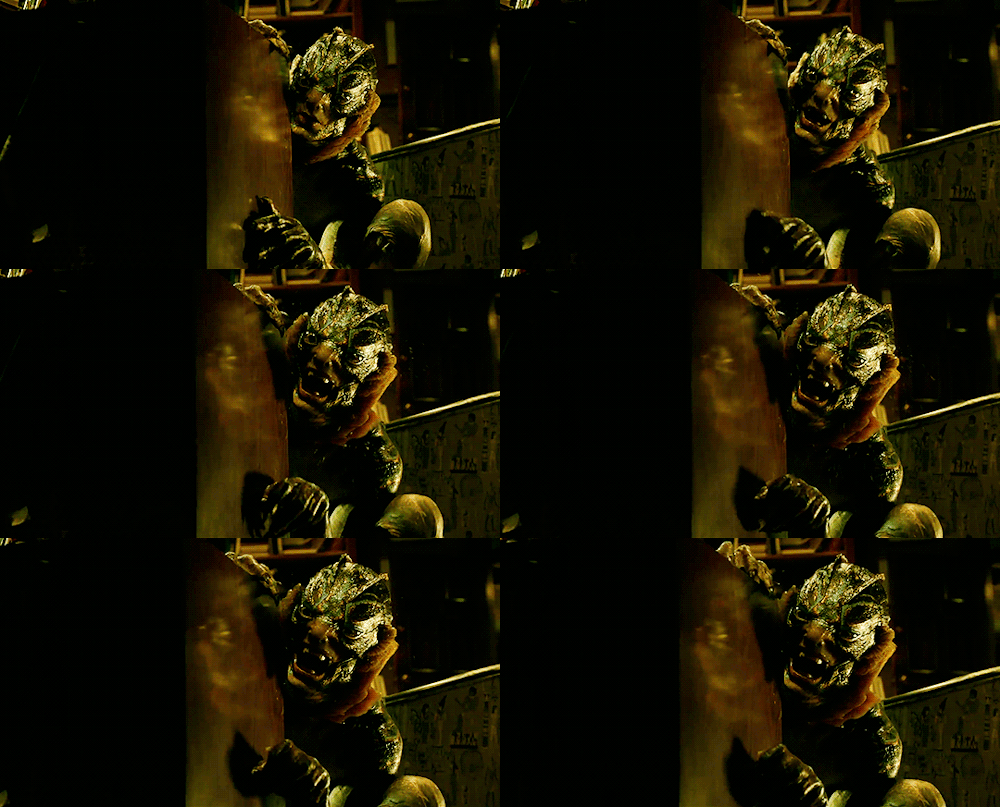
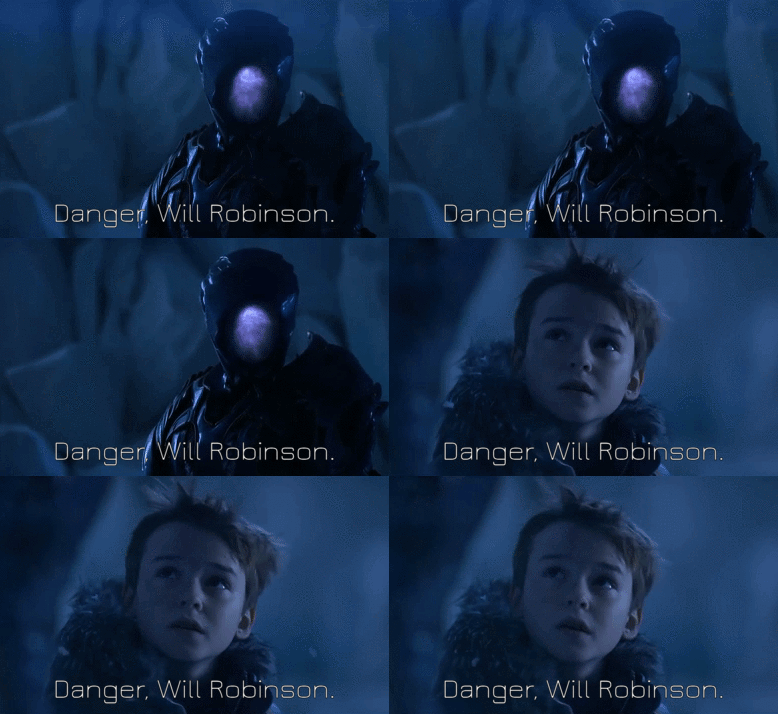
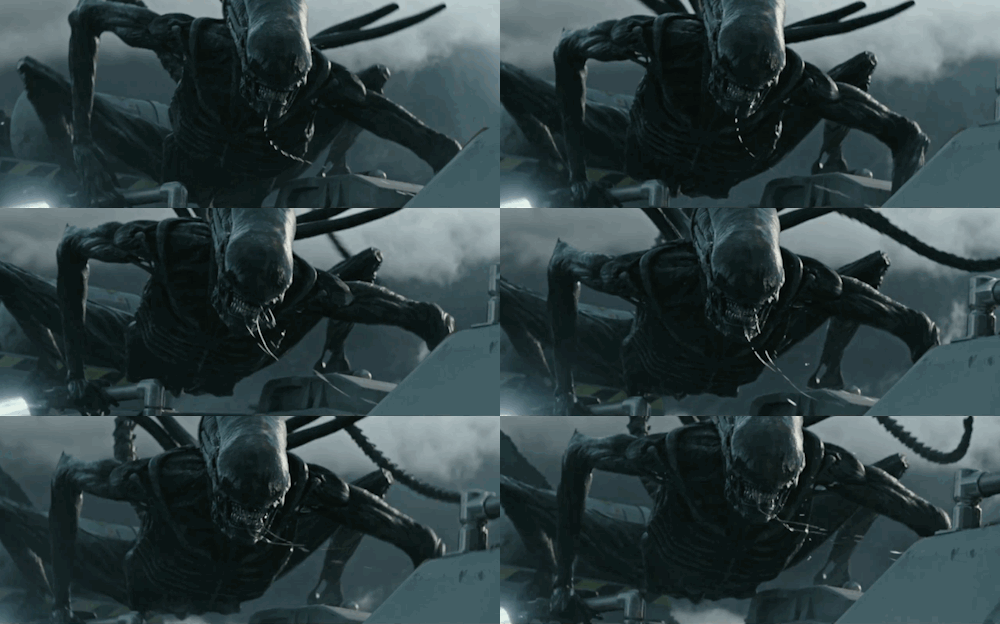
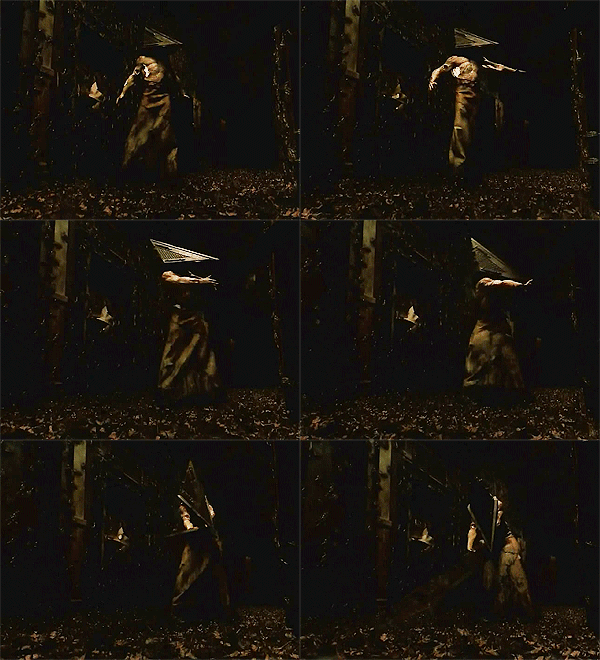
The distinction I think is that the top characters are mostly designed to be monstrous with sexual undertones, whereas the bottom ones are mostly designed to be sexual with monstrous undertones. In other words, the guys up top were built as primarily monstrous and then people sexualized them (the Shape of Water guy not really, but he’s based on one that worked that way), whereas the Monster Musume cast and most “monstergirls” generally are designed as sexy cheesecake type characters first and then the monstrous elements are like the Miscellaneous Forehead Putty on Star Trek aliens.
If you look around art sites, though, you can totally find the counterparts to each pattern: monstrous female monsters being sexualized, and beefcakey sexpot guys with some monstrous elements. And definitely nobody would ever accuse guys of having trouble sexualizing female characters, so it’s clearly not a lack of imaginination. I think what’s actually reflected here is patterns of media creation rather than consumption.
In the media, primarily-sexual characters default to female because being sexual is coded female. But being female is marked while being male is unmarked, so if a character’s point is mainly to be a monster without being overtly hypersexualized, they’ll almost never be made female. Conversely, given a female monster creators will often sexualize her to an excessive degree just out of habit. There’s an underlying assumption here in content creation that sex sells, but only to men, and that there’s no other reason for a monster to be female except for that. And maybe that’s true to some extent in the sense that it probably shows up in raw sales numbers. But I’m pretty sure that if there were more female-coded monsters that were seriously monstrous, you’d see a comparable amount of Tumblr thirst, if only because Tumblr is that way. (And, comparably, if they made Monster Musume but all cutesy hypersexualized monsterguys, it might not move mountains in Akihabara but it’d do pretty okay.)







 just moving along like everyone else