Several weeks ago, I became frustrated with the failure of words like ‘straight’ or ‘gay’ to encompass relationships of non-binary people. I coined the term dionysian to describe non-binary relationships and attraction, which are neither ‘opposite gender’ nor necessarily ‘same gender’. You can read the original post and the elaboration in the provided links.
The term itself, referring to a hellenic deity of trans and intersex people, was met with justified criticism. In response to ensuing debate, a channel was started on Discord and promoted on tumblr for NB people to come and help decide on a new word to fill this lexical gap. After a solid week of hard debate, the dozens present narrowed our work down to two terms and then held a poll on tumblr.
The results of the poll favored diamoric as the replacement term for dionysian.
The best place to read about the definition of diamoric is in the two links in the first paragraph. Simply substitute the old term for the new. The definition provided for dionysian still accurately describes the spirit of this term.
The Definition
Diamoric is an intentionally flexible, loose term.
It came out of recognizing the failure of binary terms like “straight” and “gay” to be useful or accurate for many NB people. NB genders vary so vastly that even two non-binary people in a relationship may not feel that their relationship is accurately described as “same-gender” or “gay”, and can even feel misgendered by the implications. For example, my own relationship as an androgyne with an nb trans boy can only be construed as a gay relationship if you reduce us both to our genitals. A non-binary person in a relationship with a binary man or woman is at an even further loss. Their relationship is far from “straight”, but it’s not technically “gay” or “same-gender” either. So what is it?
It’s diamoric.
The Etymology
From the greek prefix “dia-”, meaning “passing through”, “going apart”, and “thoroughly/completely” and the latin “amor” for love, diamoric literally refers to love, attraction, or partnerships that pass through, go apart from, or completely encompass the gender spectrum.
The use of this word includes all types of love, romantic or not.
The preferred pronunciation is [ ,daɪə’mɔɹɪk ], or “dye – uh – MOR – ik”.
A diamoric relationship or attraction is one that involves at least one non-binary person.
A genderfluid person’s attraction to a woman is diamoric.
An enby’s hook-up with an androgyne is diamoric.
A man’s queerplatonic partnership with a demiboy is diamoric (and could also be achillean if they chose to use both).
A genderfluid woman’s romance with a genderfluid man is diamoric (and could also be gay, sapphic, or achillean depending on how their genders line up in time.)
A bigender person’s marriage to an agender person is diamoric.
A triad between a woman, a demigirl, and an agender person is diamoric.
A man’s attraction to an enby is diamoric.
A lesbian dating an agender person is a lesbian in a diamoric relationship.
A diamoric person is a person who centers NB people and NB partnerships in their life.
Only non-binary people may use diamoric as an identity. Only NB people can call themselvesdiamoric. Technically, any NB person who seeks partnerships of any kind with any gender could call themselves diamoric, but it’s most useful and meaningful for NBs who wish to proclaim their prioritization of other NBs.
An NB person who is most interested in, happiest, and most comfortable with other NB people may find it a useful self-identifier; they are diamoric. Even if they would be content dating men or women, but they don’t want to define themselves by that, and would rather define themselves by their love for NB people and for being NB – they are diamoric.
Diamoric is not meant to replace existing words.
It is meant to give language to people who feel they have none.
If you’re an NB lesbian and your sapphic attraction is your priority, you may never feel inclined to use diamoric, and that’s fine. But if you’re an NB lesbian who wishes to emphasize your NB identity in addition to your love for women, “diamoric lesbian” might be a label that you like.
If you’re a demiboy who loves men and ‘achillean’ is all you need, more power to you. You don’t have to use this word if it says nothing about you that achillean doesn’t.
This word is a supplement to existing language that is free to use by NBs who want or need it. It is not a word to be imposed on NBs who don’t need it.
Fun things:
I’m so gay? More like I’m so dia 😉
Calling your NB partner your diamour!
Want to include diamoric in your sexual orientation? How about dia-bisexual! Dia-pansexual! Dia-gay!
for real though. summer is #bulkingseason for winter athletes. say jack wants to be at 215 at the start of the season, which is on the higher end of average for nhl players, but by the end of playoffs he’s at like 200ish, maybe 195. he’s gotta eat between 5500 and 6000 calories a DAY during the summer. he NEEDS to gain around 20lbs. athletes try to eat clean enough, but they for sure aren’t staying away from full-fat foods and dessert. if they eat TOO clean, they won’t get enough calories.
i know we joke about meal plans and “cheat days” and stuff but that’s not really how it works. athletes do have meal plans, but a lot of it is just outlining how much to eat, what kind of food to eat, and when. if he’s working out at 7 am, he’s got to wake up an hour early and have a his pre-workout meal – maybe a smoothie with some protein powder and some oatmeal. then immediately after his workout he’s going to be taking more protein. then a meal at noon – even if it’s just a couple hours after. he can’t just eat when he’s hungry. he’s got to have like 6 big meals a day + snacks, while working out a LOT. it seems like a lot to us normal folk, and it is, but remember he’s been conditioning himself for this since he was 15/16.
bitty too, because we often forget that bitty is one of the best athletes in his division, in a league that’s pretty much the level below nhl, where he played on the same line as jack zimmermann. he won’t be eating as much as jack but still easily in the 4000-calorie range. that means if they’re having bbq chicken for supper, jack’s going to be eating three chicken breasts and bitty two. or a 12 oz steak. four, five eggs for breakfast. tons of carbs and veggies. and dessert, for sure. and they go through protein powder like you wouldn’t BELIEVE.
what i’m saying is, it’s mama b’s and moomaw’s dream come true, and zimbits is a match made in food heaven. of course, it’s hella expensive to eat as a pro athlete so jack definitely slides coach some grocery store gift cards when the moms aren’t watching, and coach won’t say anything, because he knows.
source: my sister, with whom i lived this summer, is a division-1 CIS athlete (canadian equiv of NCAA) in one of the best soccer teams in the country AND a kinesiology student. and her boyfriend is one of the best weight-lifters of his weight-class in the province and also a kin student. she’s 5″ and weighs 125 pounds and while i’m slightly taller and weigh more than twice that, could not eat what she puts away. seriously. she eats all the time. so much. it’s ridiculous.
of course, post-retirement is a whole different ball game. can you say dad bod jack? hell. yes.
I love reading fics about OTPs having mental bonds and things like that, but they’re always so profound. It’d be so much more entertaining if they still thought like normal people. Imagine this stuff:
“You’ve had that song stuck in your head for days. It’s driving me nuts, too.”
“Why are you making a grocery list in your head while we’re having sex?”
“Is that really what you think about my ass?”
“Stop projecting so much belligerent boredom. I love this TV show.”
“No, you didn’t forget to lock the door. You can quit fixating on it now.”
“Yes, that sounds much better in your head.”
“Is that really who you’re daydreaming about naked?”
“Less homicidal thoughts about your annoying coworker right now, please. I’m in a meeting over here.”
“It’s coffee you’re craving. Go get some. And bring me some. You made me want it, too.”
“Thanks for the road rage thoughts. I’ll take the back roads home. See you in an hour.”
“If you think ‘knit, knit, purl,’ one more time, I’ll stab you with those needles.”
Caveat: I’ve only been a massage therapist for about 7 months. But I’ve noticed that lots of people come in with the same issues, and I wind up giving the same stretches and exercises as “homework.” So I thought, why not tell everyone? Here they are:
You know that spot between your shoulderblades that gets tense all the time? Well, it’s not actually tense: it’s stretched. Those are your rhomboids and the pain they experience is the price we pay for using a computer, studying, driving a car, texting, and any other activity that involves our arms being out in front of us. That position brings our shoulders and our shoulderblades forward into protraction. That stretches out the rhomboids and causes them to tense up in an effort to counteract our slump.
What do? Take your arms out to the sides, Jesus-style. Now bend your elbows and try to bring them behind your back. Your forearms should still be out to the sides. You’ll kind of look like you’re trying to pick a fight with someone. Do 25 of these and you should be able to feel those rhomboids getting stronger, pulling your shoulders back where they should be.
2. “Write the alphabet with your nose” aka neck exercises.
Stiff neck? Tension headaches? You might be tempted to stretch. Don’t. Necks are super-prone to adhesions and trigger points, both of which can actually get worse if you stretch without warming up the muscles first. Next time you wake up with neck pain, try exercising it instead of stretching.
What do? My favorite is the alphabet exercise, in which you pretend the tip of your nose is a pencil and write the alphabet with it. Start off small with A and get bigger until the Z is huge. That takes your neck through a lot of different motions.
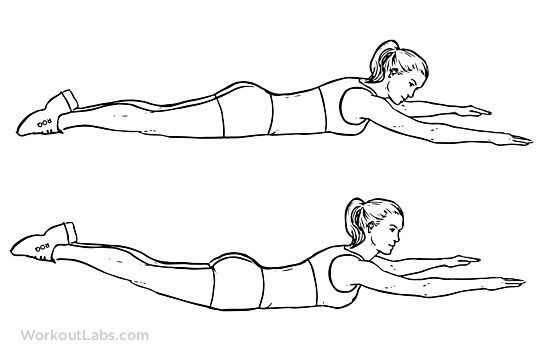
3. “Play superman” aka back extension exercises.
Hand-in-hand with the shoulder slump is the back curve. This usually presents as pain in the mid-back on either or both sides of the spine, in what’s called the erector spinae group (or ESGs in massage lingo). True to their Latin, the ESGs hold us upright–but when we’re slumping forward all the time they, like the rhomboids, get stretched out and weakened. Then when we go to lift something too heavy and bend over instead of using our legs, we get that eeeeeeak feeling in our back that is the ESGs informing us that this shit is not on.
What do? Lie on your front with your arms out to the sides. The picture above is kind of advanced: feel free to not have your arms out so far above your head, I only have my arms at a ninety-degree angle with my shoulders, frankly. Start off with maybe 20 reps of that motion and work your way up to 50 and arms straight out. Don’t overwork the muscles, but get them going.
4. “Cobra pose” aka psoas stretch.
You ever get that pain in your low back from sitting in a chair for a long time? That’s your psoas being a bitch. This stretch is a natural transition from the superman exercises. Really, it stretches a whole lot of things that need it, but especially the psoas muscles. The psoas attaches to the fronts of the vertebrae in the small of your back and run down through the pelvis to end up on the insides of your legs. It’s a waist flexor, which means that all that time you spend sitting down is teaching it to be short. Then when you go to stand up, it wants to STAY short instead of stretching, and the result is a sharp, powerful tug on your lumbar vertebrae and a helluva lot of low back pain.
What do? Lie on your front and rise up onto your elbows. You should feel a stretch in your abdomen. If you don’t, go up further onto your hands. If you still don’t, do this shit. Then get the fuck away from me. Jesus, what’s wrong with you? Do you not have a spine?
5. “Foam rolling your IT band” aka WHY GOD WHY DOES IT HURT??
I don’t know who made that picture but it is 100% accurate. See, there’s this swath of connective tissue (think tendons and ligaments) that runs down the sides of your thighs from your hips to your knees, called the Iliotibial Band, or IT band or ITB for short. The ITB, being sticky-wicky connective tissue, loves to get tangled up in everything around it, which is primarily the hamstrings and the quads. The adhesions that form along the whole length of the ITB prevent both these muscles groups from relaxing, and leads to all sorts of painful things, from torn hamstrings to kneecaps getting out of alignment and wearing down cartilage (thus necessitating knee replacements) to hip issues (gluteus maximus aka “the butt” feeds into the ITB). Basically it wants to fuck up your entire lower body.
What do? Well, if you’ve got a high pain threshold like the lady with the rictus grin in the picture, you can buy a foam roller and plop down on it like she is, then roll back and forth to your heart’s screaming, agonized content. If, however, your IT band is as sensitive as most people’s, I recommend getting a hard plastic water bottle (one that won’t crack and has a tight lid!!), filling it up with warm water, and using that instead. You can either assume the same position as above, or simply sit in a chair and rub it up and down your legs from hip to knee. Do it for about five minutes each day and that will relax the IT band as well as loosen the adhesions to the hamstrings and quadricep muscles. Stretch both those muscles afterwards for maximum benefit!
Again: caveat. I am by no means an expert at this. These are just the things that I’ve found to be most helpful for my clients. I take no responsibility if you injure yourselves actually doing these things, and especially no responsibility if you actually decide to foam roll your IT band. Seriously, that shit hurts.
Also hypermobile people in particular should be cautious of foam rollers. A physical therapist hecked me up once by having me use one on my upper back when my core muscles weren’t strong enough to deal with it safely.
lower-income people tend to be “hoarders” and richer people are able to do more “minimalist” living spaces. if u don’t have much, you will hold onto any little thing that comes across your way. you got a new tv, but you still keep the old tv because you know things can break. you keep extra boxes of macaroni and cheese lying around because there will be a week when you don’t have money for groceries. you hold onto your stacks of books and clothes for dear life. those are your assets. physical evidence of where your money’s gone. it’s hard to get rid of it. the bare wall is terrifying when you don’t have much.
Fuck. This makes so much sense and explains so much about me. I must have inherited this from my mum.
so I’d normally put this in the tags but it’s kind of a lot so just reblog this from OP to skip my commentary. But I dogsit for a family who is clearly LOADED. Their house is immaculate. High, vaulted ceilings, wood flooring, two chandeliers in one room. These things are fancy, right ?? I really don’t know, anything that isn’t tile or 30 year old carpet seems fancy to me. It also so… bare. Everything is organized perfectly, they have no excess. Their decor is extravagant and yet minimal – it is carefully and precisely executed. Nothing that doesn’t match the aesthetic sits in their living room. I tried to replicate some of it, but it’s just not possible. I have every book I’ve ever owned, my mom keeps papers upon papers, VHSs in a dresser, how do you just get rid of these things when you know you may not have the opportunity to buy them again? How must it feel to live in such orderly quarters where everything is replaceable?
This really locked into my brain when I was reading one of the declutter your space things and it suggested getting rid of duplicate highlighters and pens. /Pens/. It suggested that you needed one or two working pens, so if you had extra you should get rid of them. That was when I realized minimalist living was /innately/ tied to having spare money, because the idea was, of course you just went out and bought the single replacement thing whenever the first thing broke. You obv. Had the time and money to only ever hold what you needed that moment, because you could always buy more later.
aka the only possible appropriate character for talking about angels
серафими многоꙮчитїи
Multiocular O (ꙮ) is a rare glyph variant of the Cyrillic letter O. This glyph variant can be found in certain manuscripts in the phrase «серафими многоꙮчитїи» (“many-eyed seraphim”). It was documented by Yefim Karsky[1] from a copy of Psalms[2] from around 1429, now found in the collection[3]of the Trinity Lavra of St. Sergius, and subsequently incorporated[4] into Unicode as character U+A66E.
o.O seems to me like a monk meme rather than a proper letter, but hey
From the article for the Cyrillic O:
Historical typefaces (like poluustav (semi-uncial), a standard font style for the Church Slavonic typography) and old manuscripts represent several additional glyph variants of Cyrillic O, both for decorative and orthographic (sometimes also “hieroglyphic”[1]) purposes, namely:
broad variant (Ѻ/ѻ), used mostly as a word initial letter (see Broad On for more details);
narrow variant, being used now in Synodal Church Slavonic editions as the first element of digraph Oy/oy (see Uk (Cyrillic) for more details), and in the editions of Old Believers for unstressed “o” as well;
variant with a cross inside, used in certain manuscripts as the initial letter of words окрестъ ‘around, nearby’ (the root of this Slavonic word, крест, means ‘cross’) and округъ ‘district, neighbourhood’ with their derivatives;
“eyed” variant (Monocular O) with a dot inside (Ꙩ/ꙩ), used in certain manuscripts in spelling of word око ‘eye’ and its derivatives. In many other texts, including the birchbark letters, the monocular O was not used as a hieroglyph but largely as a synonym of Broad On signalling the word-initial position;
“two-eyed” variants with two dots inside (Ꙫ/ꙫ or Ꙭ/ꙭ), also double “O” without dots inside were used in certain manuscripts in spelling of dual/plural forms of the words with the same root ‘eye’;
“many-eyed” variant (ꙮ), used in certain manuscripts in spelling of the same root when embedded into word многоочитый ‘many-eyed’ (an attribute of seraphs).
This is the year 2017 and I’m still having to yell about how ridiculous Maya extinction myths are and tell people we are ‘Maya’ not ‘Mayan’. I’m not saying shame shame if anyone reads this and didn’t know. I’m so angry concerning how slowly these issues are being picked up by educational institutions, at how often I have to bring these things up to higher education professors.
We are a massive massive group of peoples. One of the largest Indigenous groups in the Americas. Wikipedia cites 7 million or so of us total but honestly that’s way off because that’s about how many Maya folks there are in Guatemala alone.
We’re not dead. The Maya did not ‘mysteriously disappear’. We did not ‘fall’. We did not fade into obscurity. We’ve led revolts and rebellions against colonial powers for hundreds of years. We’ve had a big hand in shaping legislative definitions and protections for Indigenous Peoples in Mexico, Belize, Guatemala, and El Salvador.
We haven’t lost our cultures. We’re constantly threatened and experience a lot of violence and have our resources stolen but we are still very much alive and our cultures have persisted.
And don’t even try me with the whole “Oh well we mean your CIVILIZATION disappeared, not you.” The structure of our societies and layout of our network changed and decentralized in many areas. That didn’t make us turn invisible. That didn’t make us not still be large in numbers with a relationship with our lands and lose influence in the areas we live. We still held power in large cities way after what people like to cite as “the fall of the Maya Civilization” (around 600-900 A.D. when we still had cities that we held power of until nearly 1700 when the last was “conquered” by Spain.)
Which brings me to the next issue. Being “conquered” or having a colonial government installed does not erase Indigenous societies or civilizations. That’s an extremely eurocentric way of thinking. We didn’t suddenly turn into Spaniards. We still had massive amounts of towns and villages with leaders. We still had our cultures, our trade, our networks, our influence, while Spain focused on putting up flags in our cities.
So yeah. All your history books have you all convinced that an extremely large group of people, with a greater population than more than half of the countries in Europe, all died out 1100 years ago.
Now try to imagine what kind of shit Indigenous Peoples with much less numbers and much lower access to resources go through.
The other thing about the word “queer” is that almost everyone I’ve seen opposed to it have been cis, binary gays and lesbians. Not wanting it applied to yourself is fine, but I think people underestimate the appeal of vague, inclusive terminology when they already have language to easily and non-invasively describe themselves.
Saying “I’m gay/lesbian/bi” is pretty simple. Just about everyone knows what you mean, and you quickly establish yourself as a member of a community. Saying “I’m a trans nonbinary bi woman who’s celibate due to dysphoria and possibly on the ace spectrum”… not so much. You’re lucky to find anyone who understands even half of that, and explaining it requires revealing a ton of personal information. The appeal of “queer” is being able to identify yourself without profiling yourself. It’s welcoming and functional terminology to those who do not have the luxury of simplified language and occupy complicated identities. *That’s* why people use it – there are currently not alternatives to express the same sentiment.
It’s not people “oppressing themselves” or naively and irresponsibly using a word with loaded history. It’s easy to dismiss it as bad or unnecessary if you already have the luxury of language to comfortably describe yourself.
There’s another dimension that always, always gets overlooked in contemporary discussions about the word “queer:” class. The last paragraph here reminds me of a old quote: “rich lesbians are ‘sapphic,’ poor lesbians are ‘dykes’.”
The reclaiming of the slur “queer” was an intensely political process, and people who came up during the 90s, or who came up mostly around people who did so, were divided on class and political lines on questions of assimilation into straight capitalist society.
Bourgeois gays and lesbians already had “the luxury of language” to describe themselves – normalized through struggle, thanks to groups like the Gay Liberation Front.
Everyone else, from poor gays and lesbians to bi and trans people and so on, had no such language. These people were the ones for whom social/economic assimilation was not an option.
The only language left, the only word which united this particular underclass, was “queer.” “Queer” came to mean an opposition to assimilation – to straight culture, capitalism, patriarchy, and to upper class gays and lesbians who wanted to throw the rest of us under the bus for a seat at that table – and a solidarity among those marginalized for their sexuality/gender id/presentation.
(Groups which reclaimed “queer,” like Queer Patrol (armed against homophobic violence), (Queers) Bash Back! (action and theory against fascism, homophobia, and transphobia), and Queerbomb (in response to corporate/state co-optation of mainstream Gay Pride), were “ultraleft,” working-class, anti-capitalist, and functioned around solidarity and direct action.)
The contemporary discourse around “queer” as a reclaimed-or-not slur both ignores and reproduces this history. The most marginalized among us, as OP notes, need this language. The ones who have problems with it are, generally, among those who have language – or “community,” or social/economic/political support – of their own.
a friend of mine is a science educator. not a classroom teacher – he does the kind of programs you see in museums, fun experiments with lasers and dry ice and shit.
yesterday, a young girl asked him why he was allowed to pour liquid nitrogen all over his own arm but he didn’t want her doing it. I braced myself for some dumb “well I’m an adult so I’m allowed” non-answer, but instead he surprised me by giving some of the best science (and life) advice I think you can give a young person:
“well, it’s one of those rules designed to keep you safe. and following the rules really can help you stay safe, but they’re not perfect. sometimes, usually because they’re too simple, the rules let you do things that aren’t safe, or don’t let you do things that are safe if you know how to do them. one of the reasons I’m good at what I do as a scientist is I try to understand how things work so I can figure out my own rules for keeping myself safe. and sometimes my rules are little more complicated than what I might hear from other people, but they work better for me. like, I let myself play with liquid nitrogen, but only in really specific ways that I’ve spent time practicing. you should follow the rules you’re given at first, but if you take the time to understand how things work, maybe you can make your own, better rules.”
I loved this response. it’s a great encapsulation of two really important things I think people need to learn and re-learn all the time: on the one hand, listen to genuine authority figures; when someone knows more than you about a subject, don’t treat their expertise as “just another opinion” and act like your ignorance is just as good as their knowledge. but on the other hand, don’t obey anything or anyone blindly. recognize that rules and systems and established ideas are never perfect. question things, educate yourself, question things more.
and then, of course, a parent had to butt in and spoil this wonderful lesson by saying:
“but not the rules mom comes up with!”
everyone in the room laughed. except me. I gave her a death glare I’m pretty sure she didn’t notice.
because no. no. your rules are not above reproach if you’re a parent. the thing about the dictates of genuine authority figures – people who deserve to have power, and to have their positions respected – is that they are open to question. genuine authority figures are accountable. governments can be petitioned and protested and recalled. doctors must respect patients’ right to a second opinion. journalists have jobs terminated and credentials revoked if they fail to meet standards of integrity and diligence. scientists, to bring us back full circle, spend their entire careers trying to disprove their own hypotheses! you know who insists on being treated as infallible? megalomaniacal dictators, that’s who. oh, and parents.
I’m beyond sick and tired of this “my house my rules, this family is not a democracy, I want my child to think critically and stand up for themselves except to me ha ha” bullshit. my friend gave this kid the kind of advice that doesn’t just help people become good scientists – if enough people adopt the mentality he put forth to that girl, that’s the kind of advice that helps societies value knowledge and resist totalitarianism. and her mother shut it down because, what, she didn’t want to deal with the inconvenience of having someone question her edicts about whose job it is to wash the dishes on Mondays?
we already know you’re more likely to be a Trump supporter if you’re an authoritarian parent – and that this is a stronger predictor of your views on the current president than age, religiosity, gender, or race. I’ll say this another way in case you didn’t catch the full meaning: people who believe in the absolute, unquestionable authority of parents are more than two and a half times as likely to support Trump as people who don’t, and that’s just among Republicans. we can’t afford to treat the oppressive treatment of children or the injustice of ageist power structures in our society as a sideshow issue any longer. the mentality that parents should be treated by their children as beyond reproach and above dispute is a social cancer that has metastasized into the man currently trying to destroy the foundations of democracy in this country.
in short: parents, get the hell over yourselves before you get us all killed. and kids, learn as much as you can, and then make your own rules.
My mother is fond of quoting something that happened once at work (she’s the director of tourism for the neighboring county).
She was on the phone with my brother, who wanted to do something (I forget what, I think he wanted to go camping with some friends and she was worried it was going to be too cold that weekend or whatever)
And finally she got off the phone and sighed and said, joking, “When I taught them to question authority I must have laid it on thick, because now they’re questioning mine.”
And it got really quiet in the office. And then her secretary pipes up with “You taught your kids to question authority???”
And mom says that right there in that moment she realized what was wrong with a huge part of the world.
Teach your kids to question, people.
For a short while as a child I had sanctuary from an abusive home in a lovely home with good parents. One of the things that completely shocked my taraumatized little soul was how deeply the adults respected children’s thoughts, feelings, needs and wants.
Whenever a kid thought something was unfair, the adult would ask why it felt unfair and talk to them about it. Sometimes the reason for the rule or decision was immovable, like, “this isn’t safe” or “this isn’t possible with the time we have and the responsibilities that fill it”, or “homework has to be done even if it’s boring, because it helps you practice skills you will need later on.”
In those cases, the rule wouldn’t change but the child would understand why it was a rule, and feel listened to and respected. And best of all, sometimes even if the rule didn’t change, an adult might help the child brainstorm ways to make it easier to follow the rule, or find alternatives to the thing they couldn’t have.
Sometimes, the rule or decision was for more flexible reasons, like “We can’t do this because you need supervision, and I have work to do which means I can’t supervise”, in which case a child’s suggestions, like, “What if I call a grandparent and see if they’re interested in supervising?” were encouraged and listened to.
This taught the kids, me included, so much more than we ever could have learnt by being shut down by, “I’m an adult and I said so.” The system was designed to teach us to make good decisions and to give us as much information as possible about how to do that before we went out into the world. Teaching us the reasons for certain rules helped us respect them and to understand how to make good rules for ourselves going forward.
In my original household, the central rule was “Do whatever will keep you from getting hurt by the person with the most power.” From this we learned to make choices based solely on fear of consequences, no innate ethical system, so we learned to misbehave without getting caught.
We learned that if you can force someone to do something they don’t want to, you’re allowed to, because that’s how rules are decided, the most powerful person always gets their way.
We learned that asking questions of someone with power over you is dangerous and you have to figure everything out on your own. We learned to keep secrets about how badly we were hurt. There was no oppenness, no conversation, no negotiation or questions or teaching, just fear and hatred and a lot of pain.
Which household do you think taught me the best lessons, the ones I can use to build a healthy and responsible life for myself?
I know multiple adults whose abusive parents totally failed to teach them how to do things.
My parents were great. I learned the word “autonomous” by the time I was five, because it was an explicitly stated goal of their parenting that I should be autonomous. Somewhere around then, I asked them to make my bedtime later, and they said no. And I said “but how can i be autonomous if i don’t get to argue things?”
By first grade, teachers wouldn’t let me argue because they knew they would lose. My parents, being smart and competent, did not usually lose. But they did accept the basic premise: Argumentation is about learning what is true, not about winning or losing.
And here I am in my 40s, and when I run into people who want arguments to be “fair” in that both parties concede equal numbers of points, I am completely unable to understand them. Like, even if I understand that this is what’s happening, I’m pretty much blind to the thing. People often form the idea that I only listen to my friends, or that you have to have “social status” to make me listen to you. But that’s not true. Random anons have sent in one-sentence claims that were possible for me to evaluate, and gotten me to rethink significant positions because, well. They were right. And that’s what matters. It’s all that matters.
So when I’m dealing with abused people, I try extra hard to recognize their autonomy and talk to them about things. To such an extent that people on my forum periodically lose their shit because they are sure there are hidden rules I’m not disclosing that I’m secretly enforcing. But no, I actually just want people to be making their own calls as much as possible. It works so much better.
no wonder brits think we’re all junk-food-snarfing morons
not a big enough pop-tarts choice
the only things there i actually buy, btw, are peanut butter cups and arizona iced tea. and even those are very occasional, cuz they’re so sweet.
just in case anyone was wondering what americans actually eat.
answer: not this.
non-snarky answer: i gather brits use something called ‘salad cream’ in tuna salad and egg salad and the like? we use mayonnaise or miracle whip, never seen salad cream for sale. miracle whip is spiced mayo, btw, it’s not a different substance, it’s just got a bit of onion, mustard, and paprika flavoring.
we don’t eat hamburgers at home much, except for cookouts. they’re mostly convenience food or backyard picnic party food. same with hot dogs. cold sandwiches are a lunch staple – deli meat and cheese, or pbj – but hot sandwiches are too much work for a quick lunch and not nutritious enough for a sit-down supper.
one thing i think is particularly american is the amount of ethnic foods we eat. even the whitest of families has some chinese, mexican, and japanese dishes in their menu rotation. italian’s hardly considered ethnic anymore, everyone eats lots of italian. more recent immigrant waves like vietnamese and somali haven’t quite sunk in to the common cuisine yet, but it’s still not at all unusual for random suburbanites to be fond enough of pho or sambusas to learn how to make them.
those huge airplane-hangar grocery stores you see on tv? yes, we really shop at those, and it’s not because we need fifty flavors of pop tarts. it’s because we cook fifty regional cuisines.
although… gotta fess up… everyone likes pop tarts. my favorite are raspberry. un-frosted so i can put butter on them when they’re hot.
one thing i notice is how most of these things are kid treats. i’d never eat them now, but when i was nine? hell yeah.
maybe this is one of those childhood nostalgia things–grown up food you can make on your own, for the most part, or get at a restauraunt. only a foul little twinkie tastes like a twinkie, god save us all.



 just moving along like everyone else