In science fiction, AIs tend to malfunction due to some technicality of logic, such as that business with the laws of robotics and an AI reaching a dramatic, ironic conclusion.
Content regulation algorithms tell me that sci-fi authors are overly generous in these depictions.
“Why did cop bot arrest that nice elderly woman?”
“It insists she’s the mafia.”
“It thinks she’s in the mafia?”
“No. It thinks she’s an entire crime family. It filled out paperwork for multiple separate arrests after bringing her in.”
I have to comment on this because this is touching on something I see a lot of people (including Tumblr staff and everyone else who uses these kind of deep learning systems willy-nilly like this) don’t quite get: “Deep Reinforcement Learning” AI like these engage with reality in a fundamentally different way from humans. I see some people testing the algorithm and seeing where the “line” is, wondering whether it looks for things like color gradients, skin tone pixels, certain shapes, curves, or what have you. All of these attempts to understand the algorithm fail because there is nothing to understand. There is no line, because there is no logic. You will never be able to pin down the “criteria” the algorithm uses to identify content, because the algorithm does not use logic at all to identify anything, only raw statistical correlations on top of statistical correlations on top of statistical correlations. There is no thought, no analysis, no reasoning. It does all its tasks through sheer unconscious intuition. The neural network is a shambling sleepwalker. It is madness incarnate. It knows nothing of human concepts like reason. It will think granny is the mafia.
This is why a lot of people say AI are so dangerous. Not because they will one day wake up and be conscious and overthrow humanity, but that they (or at least this type of AI) are not and never will be conscious, and yet we’re relying on them to do things that require such human characteristics as logic and any sort of thought process whatsoever. Humans have a really bad tendency to anthropomorphize, and we’d like to think the AI is “making decisions” or “thinking,” but the truth is that what it’s doing is fundamentally different from either of those things. What we see as, say, a field of grass, a neural network may see as a bus stop. Not because there is actually a bus stop there, or that anything in the photo resembles a bus stop according to our understanding, but because the exact right pixels in the photo were shaded in the exact right way so that they just so happened to be statistically correlated with the arbitrary functions it created when it was repeatedly exposed to pictures of bus stops over and over. It doesn’t know what grass is, what a bus stop is, but it sure as hell will say with 99.999% certainty that one is in fact the other, for reasons you can’t understand, and will drive your automated bus off the road and into a ditch because of this undetectable statistical overlap. Because a few pixels were off in just the right way in just the right places and it got really, really confused for a second.
There, I even caught myself using the word “confused” to describe it. That’s not right, because “confused” is a human word. What’s happening with the AI is something we don’t have the language to describe.
Anyway what’s more, this sort of trickery can be mimicked. A human wouldn’t be able to figure it out, but another neural network can easily guess the statistical filters it uses to identify things and figure out how to alter images with some white noise in exactly the right way to make the algorithm think it’s actually something else. It’ll still look like the original image, just with some pixelated artifacts, but the algorithm will see it as something completely different. This is what’s known as a “single pixel attack.” I am fairly confident porn bot creators might end up cracking the content flagging algorithm and start putting up some weirdly pixelated porn anyway, and all of this will be in vain. All because Tumblr staff decided to rely on content moderation via slot machine.
TL;DR bots are illogical because they’re actually unknowable eldritch horrors made of spreadsheets and we don’t know how to stop them or how they got here, send help
And Godot would know!
What do you Godot’s not an AI?
It’s also worth pointing out that algorithms cannot help but to end up replicating the inherent biases of the system it is ‘learning’ from.
i don’t mean to sound fake deep but the reason 2018 felt so long was because we’re being fed what’s trending at such a rapid rate that we literally can’t remember half of the shit that even happened anymore. “Black Panther came out in February!” Marvel releases so many movies a year that we completely forget about the last movie as soon as a new one comes out and it repeats in a vicious cycle. “Tide Pods/Ugandan Knuckles was in January!” The life span of memes have been rapidly declining for years and it’s gotten to the point where the average lifespan of a meme is about 2 weeks and then the next thing gets popular and then that lasts for 2 weeks and it just keeps going. We’re literally losing our sense of time because of our rapid consumption of media and pop culture.
While I’m sure there are people too lazy to spin a fork, keep in mind people like this person who may be suffering from arthritis or a neurological disease or nerve damage or a thousand other conditions that might impair their ability to do things as simple as spin a fork to eat spaghetti.
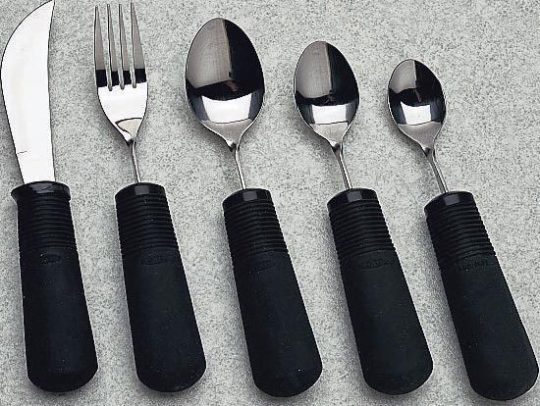
These are used with people who can’t grip well:
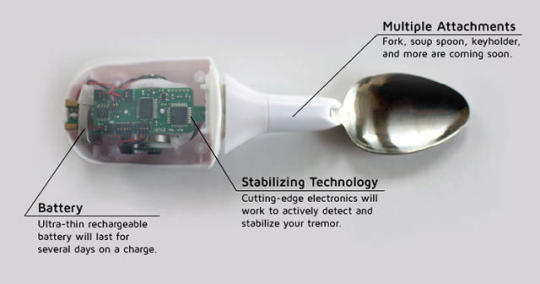
This is for Parkinsons’s:
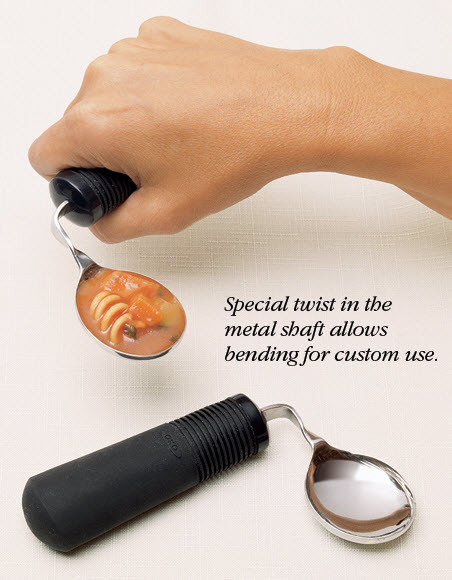
For people who can’t even bend their joints:
Here’s a product that guides your hand from your plate to your mouth
This one holds a sandwich
Like I get it. I used to see things like the fork and think “that’s fuckin’ lazy” or that product that holds a gallon and you just tip it and pour. But then I started working around the disabled and impaired and found out that these products aren’t meant for lazy people, they’re meant for people who need help.
So maybe next time you see something, instead of thinking “Wow, are people that lazy?” just be grateful that you’re able to do the things you do every day and take for granted, like being able to feed yourself and wipe your own ass because you have enough coordination and bendy joints to do it.
This isn’t specualtion either; the majority of products from commericals that we think are funny or silly are autally MEANT for hte disabled.But they are marketed towards the abled because the disabled aren’t considered a viable enough demographic on their own.
the Snuggie for example? Created for wheelchair users.
This is actually really nifty.
oh my god of course the snuggie was for wheelchair users
The fact that anyone buys these products besides disabled people drastically lowers the price of them. These would normally cost hundreds if not thousands if dollars. Because if spent time and money creating it, the company wants to get more than that back. And they can’t do that if they sell and market these primarily to disabled people for $20-$40 a piece or whatever. They’d lose money on production. If they can sell hundreds of them to everyone, they can lower the price drastically and therefore disabled people don’t die while trying to scrape up the money to buy these things and be a bit more independent.
I never considered that last part and that’s actually genius
Like yeah, a handful of people ARE that lazy.
But those are the people who use these products even though they don’t need them and thus allow the price to be lower for those who DO.
So honestly in this case good bless the lazy and those prone to gimmicks because they are invaluable to the elderly and disabled in this sense.
@thebibliosphere Look! People learning about disability and why to be kind!
The normalization of disability aids needs to be a thing precisely so they can cost less.
the DA didn’t make the case for the crime and i went into the deliberation room knowing that. i also knew a half-dozen white orange county folks might not see it that way. the defendant was latino, there was a gang charge in addition to robbery.
sure enough, as we went around the table to give our first impressions, the white ladies used language around “gut instinct” and “he shouldn’t be hanging out with bad people” and the like. others were undecided because there was so much unreliable testimony.
they got to me and i flatly said “i have reasonable doubts.” i stated some of my reasoning and heads started to nod. the next 3 jurors to talk after me were hispanic. they stated that they understood why this might be confusing, and then gave some personal perspectives about growing up in disadvantage neighborhoods, how not everyone is a gangster just because they live there. one white lady said “well, you know, they should really move if that’s the case.”
the discussion opened up and it went right to gangs, right to how the defendant shouldn’t be hanging out with gang members. everyone had an opinion about how the defendant looked, or talked, or that he was drinking a 40 just before the robbery, or that he was related to a gang member. they went right to that.
but that’s not what we were supposed to decide on. we were there for a robbery as the primary charge. a robbery that i very clearly felt the state had not be able to pin on this guy.
so… being the loud mouth that i sometimes am… i interrupted and said “let’s all turn to page 14 in the jury instructions and go through what would make the charge ‘guilty’, line by line, and see where we all stand.”
sure enough, when we focused on the actual charge, and the facts actually required for someone to be found guilty, most in the room agreed it wasn’t there. well, except for two white ladies.
so i, also a white lady, helped to walk them through the list. when “gut instinct” or “it’s a bad neighborhood” came up, i kindly pointed out that those are not facts of the case. when i requested that they use the facts of the case to provide reasoning for their position, they both quietly agreed there weren’t any.
and that’s how, in about an hour, we came to a unanimous decision of ‘not guilty’.
i don’t have experience with the court system. and i don’t watch court room based tv dramas. so i was really a blank slate to all this.
i was taken aback at the very clear inherent bias that some jurors displayed, and all the while realizing they didn’t think of themselves as bias. but i was also taken aback by how focusing on the process, the rules, and the facts quickly squashed that line of reasoning.
this has buoyed me a bit, in light of the actions of the aclu over the muslim ban. but it also feels so fragile. so very fragile.
And this is exactly why I have never tried to get out of jury duty. We need clear thinking, intelligent people on juries. I get so frustrated with people I know who are always looking for a way out of serving.
somebody offer this hero a cape
Fellow whites. THIS IS WHAT WE SHOULD BE DOING.
Which means -get yourselfs on juries-. Don’t skip jury duty. Don’t skip don’t skip don’t try to sneak out of it, get on that jury, and make sure you are keeping all the other white people in line.
ik this is like by design bc we live in a capitalist society that emphasizes individualism so as to isolate us from one another, but it would be so much easier to analyze and critique societal phenomena if every statement made about the potential harm of certain actions/behaviors/cultures didn’t get taken so personally by the people who engage in them.
we can’t talk about how makeup culture stems from and enforces misogyny or the violent institution that is gender because women who love makeup will scream that no, actually, they LOVE wearing makeup, it’s an art and a hobby and who are we to tell them they have to stop (which nobody ever actually says)
we can’t talk about how bdsm going more mainstream often results in people (usually men) who are sexually gratified by physically hurting others (usually women) having much easier access and opportunity to enact said physical harm, often with people who feel pressured into accepting it who wouldn’t otherwise – let alone discussing why so many men get off on beating women – because self-identified submissives will say “stop telling me what i can and can’t do in the bedroom!”
but frankly i think if someone says “analyze and examine your behaviors because they might be harmful” and you hear “stop doing this because it’s harmful” that tells me that you know what you’re doing might be harmful, whether to you personally, to someone else, or just in terms of promoting harmful phenomena in society, and you’re afraid to examine it because you’re afraid that you won’t be able to justify the consequences of your behavior
I’ve been getting some questions about transformative justice lately, so here’s an attempt at a quick 101 of what that means. It’s a first draft, a work in progress.
Transformative justice is build on the belief that we all generally want to be liked by the people around us and want
those people to be okay. The stronger our sense of connection, the more likely we are to want to help and not harm people. So we generally do not do harmful actions unless there are root causes, like:
Some examples of root causes:
We do not understand that our actions are harmful
Our basic needs are not being met (could be physical needs, mental health needs, etc)
We are hurting in a way that isnt acknowledged and are lashing out as a result
We reproduce a harmful oppressive system (sexist
violence, racist violence, transphobic violence, etc)
… other root causes that I’ve forgotten right now
Punishment
does not solve any of these causes. Punishment can make us too afraid
to act for a while, but in the end, if these reasons are not adressed,
our harmful behavior is going to keep coming back.
But just
as importantly: because punishment is forced upon the punished, it can
only happen when the punisher has more power than the punished. Punishment is a matter of who has the power to punish, not of who
is right or who is deserving of punishment. Generally, punishment doesn’t happen to the bad people, just to
those without the power to avoid being punished. Punishment maintains existing power imbalances and creates new
power-imbalances, new harm, new wounds, and as a result new harmful
behaviors. Punishment perpetuates harm.
So, what is the alternative?
Well, transformative justice relies on 3 things:
Protecting the victim and giving them space to heal (sidenote: there isn’t always a simple victim-actor binary)
Protecting the community and giving it space to heal
Working with the harmful actor to see what is needed
Focussing on the last two parts here, transformative justice means having genuine honest conversations with the harmful actor to achieve for example:
The realisation in the actor that the behavior is harmful and needs to change
The
realisation in the community that someone’s basic needs were not being met
and that needs to change
The realisation
in the community
that someone’s hurt was
not acknowledged and
that needs to change
The unlearning in the actor of the oppressive behaviors that prompted the harmful behavior
The realisation
in the community
that there was no real harm and that the behavior that broke the ‘rules’ was never harmful to begin with and the ‘rules’ need to change
A combination of these things
In short, if there is harmful behavior, it means something about the way
we have organized our society probably needs changing. Often other things that can not directly be identified as ‘root causes of harmful behavior’ come up, like ‘a person that was lashing out was able to recruit a group of friends in their harmful behavior’ and those things then need to be adressed. Transformative justice isn’t just about the actor, it is about the whole community.
Where there is harm, there is also disconnection. Pain, anger, broken trust. So identification of the root causes is followed by transformation. Meaning the root causes of the harmful behavior are removed and the connection between actor and community is restored.
The goal of transformative justice is NOT that the harmful actor puts on
a show of the right apologies and demonstrations of change. It’s not a
performance of accountability. Transformative justice is about creating actual, messy,
slow, imperfect change. Remorse is not a required component. The goal isn’t a specific emotion or act, it’s reaching a situation where no new harm will occur and connections are restored.
It’s hard work, for the harmful actor and for
the community. It is generally not fun. When it is done by a group of people who have grown up in a culture of revenge and punishment, it’s very very difficult work. Since we we’re already making lists, here are some..
Common pitfalls:
We don’t always have the resources to address the needs that are not being met, whether they are physical needs or mental health needs.
We don’t always have the skills needed to really listen to each other, to find root causes behind harm, to work on genuine healing, etc. We’re quick to fall into familiar patterns of punishment & revenge or demanding ingenuine performed apologies so that we can have simplicity and closure.
Transformations are often slow and unclear, creating a long period
of uncertainty.
There is no clear sense of when it’s over or whether a harmful actor is putting enough effort into ‘dealing with their shit’. If someone is lashing out as a
result of a lifetime of abuse or a deeply engrained oppressive dogma,
they’re not likely to become perfect in a short time. Protecting victims
and the community during that long period is difficult. Transformative
justice can be emotionally draining on everyone involved over a long
period of time. It is difficult to maintain. It doesn’t have big
spectacular success stories and very little recognition.
Working with the harmful actor to achieve transformation means listening to
someone who has done harm and genuinely trying to understand their point of view. This can bring a lot of discomfort and is something a lot of us who say we want transformative justice are ultimately unwilling to do. Transformation of an actor also results in a real reconnection of bonds between the actor and the community once the transformation has taken place. Are we willing to do that?
Participation of the victim should always be voluntary. A person healing from a very harmful thing definitely shouldn’t be pushed to participate. At the same time, some victims might really want to participate in the transformative justice process but may be unwilling or unable to deal with the messy process of genuine conversations with an actor and the flawed process of transformation it involves. Giving victims agency but also allowing the actors transformative process to take place is difficult.
We’re not very good at recognizing the difference between mutual harm
and victim-actor binaries. We often end up dealing badly with
cases where that is unclear. When the actor has a marginalized identity that the victim does not have, we’re often very bad at recognizing actor and victim.
We’re often unwilling to admit the role favoritism, personal bonds and popularity plays in how we respond to the need for a transformative justice process. A person who is well liked may get a lot more support in their transformation that a person who is not. The amount of energy we’re willing to spend on someone varies.
The community may be unwilling to change parts of its culture that are consistently creating new harmful actors. For example: an community that glorifies physical strength, fighting skills and a warrior attitude is going to have to problems with that again and again. A community that focusses on performative call-outs as a way of demonstrating your ideological purity is going to be very bad at genuine transformation.
And there are more pitfalls.. so yeah, it’s complicated. It’s a lot more complicated that kicking people out or building prisons.
But while punishment is ineffective and thus required again and again and again, transformative justice creates lasting change. And because it doesn’t just change the actor, every transformative justice process also creates a better community that is better capable of preventing harm in the first place.
To round up
Transformative justice is as old as human community itself and there are many different transformative justice techniques out there. Some
rely on an outside ‘impartial’ negotiator, others are victim-led, some
require that the actor in some way repairs the damage done while other
methods reject this notion. But in general transformative justice is about:
Safety, healing, and agency for victims
Transformation for people who did harm, resulting in meaningful reconnection to the community
Community transformation and healing
Transformation of the social conditions that perpetuate harm
here is a concept that I’m still trying to flesh out: medieval science fiction.
not, of course, aliens land during the middle ages, though I’ve read and enjoyed that, but something much more difficult to execute, if it’s possible at all: space opera (exempli gratia) as written by Bede or Gildas or Geoffrey of Monmouth.
The challenge is, of course, that you have to get into the medieval mind (ok, I know that talking about “the” medieval mind is fallacious) and figure out what they’d keep from their world and what they’d think to change – what is the analogue to ‘50s writers giving us faster than light travel & radioactive planets & psionics and still having gender and family politics that are identical to ‘50s middle class American politics? I have a feeling it’s the Church – it’s true that there are several books with Space Popes, but it tends to be a rebirth of the Papacy. I doubt a medieval science fiction writer would have the Church decline or even guess at the Reformation.
Also, sci-fi tech tends to be, both aesthetically and functionally, an extension of tech the society it’s from already has – does a medieval space ship look like a siege tower? How do they envision the instant communication I’m sure they’d have to have as working? Would it be through magic (which is often the case in modern sci-fi)?
And what would the spirit of it be? I would argue that, while you can’t really generalize over an entire field, and there is certainly some bleak sci-fi, the general tenor of American sci-fi is hopeful & enamored of the human spirit. Is the point of medieval space travel to find God*? Will leaving Earth leave behind Original Sin? Are we going to convert the Martians?
DO they need instant communication? I mean, even star wars still has people carrying thumb drives around. There could be a pigeon analogue – sleek little machines flitting between the stars carrying messages, or perhaps creatures already native to the higher spheres suited to the task. Venusian swallowtails, mercurial spirits.
I’d love to see the heavenly spheres as a setting for this all on its own, too. What’s the first moment a traveler hears the music like?
I could see a lot of it through the lens of knights on impossible quests – why not ascend the sky? Knights riding on bright steeds of golden fire known as comets. Knights finding allegorical realms on the various planets, like the Kingdom of Love from Capellanus’ Treatise on The Arts of Courtly Love, but set in the golden mountains of Venus, and you could have a Kingdom of War and a Kingdom of Wit and a Kingdom of Time on Mercury and Mars and Saturn. Prester John could be from Jupiter!
I’m not sure about the ways I would expect medieval scifi to be subversive, but I might look at Marie de France for ideas, she plays a lot with expectation and obligation and the implications of gender in her Lais, in very clever ways.
medievals didn’t have the concept of vacuum, let alone know that space doesn’t have air. everything is open ships and space sails. gravity isn’t oriented to the planet, there’s a universal ‘down’. engines are driven by people or animals or wind or water, not burning fuel; your space chariot is pulled by cloud horses or sun lions.
other planets are not other earths, they’re allegorical locations populated by allegorical creatures. angels, demons, dreamers, cannibals, a planet of all women and a planet of all men – but not for 1950′s bikini shenanigans, more as a parable about how the sexes can’t get along without each other because men’s work and women’s work are both necessary. no concept that men could do women’s work and vice-versa, or at least do it competently. the men on the men’s planet would like, grow children in their fields, but wean them on burnt bread soaked in beer because they’re terrible at milking cows and kneading dough, or something like that.
there’s a Renaissance thing, Orlando Furioso, in which the knight Astolfo gets to the moon in Elijah’s burning chariot. (He goes to the moon because everything that has been lost on Earth can be found there, including Orlando’s sanity, because of course.)
I think I’d argue that theological allegory, like the Divine Comedy or the Vision of Piers Plowman, pretty much is medieval science fiction: speculations and warnings and encouragement, based on what is known-or-believed-to-be-known. As I understand it, the general opinion of medieval European scholars was that theology was THE most important thing to know about; studying the Creator more fervently than the creation was considered pretty much the same degree of Obviously Sensible as, say, studying birds doing bird things and being birds instead of just looking at empty nests and eggshells would be to us, like, why study mere side-effects when you can study The Entire Truth And Cause Of Everything? So I would argue that theology is the medieval version of twentieth century rocket science and atomic physics as The Coolest Thing To Know About, and thus spec fic based on it is the equivalent of science fiction.
You guys might enjoy a book I remember reading ages ago…Richard Garfinkle’s Celestial Matters. I honestly can’t remember whether I liked it or not, but it’s basically “What if ancient astronomy was totally legit? Okay, adventure time.”
And, going in the opposite direction, for a modern example of someone writing in the style of a medieval travelogue but as if it were true science, check out Umberto Eco’s Baudolino. If you love history and sly wit, Eco’s your man.
I’m drawing a blank at how many people in Medieval Europe knew the Earth was round, and coming up with the possibility of a Universe shaped like an hourglass of sorts, with Earth as the flat plane through the smallest point in the middle, and the Infinite Heavens above and the equally-infinite Infernal Hell below, with “space travel” in two parts: man flying up to the realms of angels and heavenly spheres below the gates of Heaven, and man flying down to the realms of demons and diabolical spheres and, eventually, the gates of Hell.
These spheres would be I suppose something like the Death Star: round castles without an internal center of gravity, composed of layers on which people (or other entities) live and work. There would be spheres ruled by particular angels and demons, saints and noteworthy sinners, whose populace, society, and behavior are all based on that particular entity’s attributes.
The heavenly realms would have a lot of abundance and flying around on angels’ wings, and the infernal realms would have a lot of torture and riding on chariots of fire, and there would probably be a lot of stories focusing on what happens when a person from one side is displaced to the other, sometimes with them settling into (or succumbing to) their new environment, other times reshaping it into something more like themselves (an angel gets taken to hell, takes control of a sphere, and it rises into Heaven, full of rejoicing former-sinners filled with the Love of God, or a demon is brought to a celestial sphere by someone who wants to show off their power, and the demon carefully subverts the whole population and they rejoice as their sphere sinks down into Hell), and other times escaping back to their own place, or just travelling—perhaps there are Captain Jack Sparrow style characters that simply wander through and cause chaos through their “corkscrew in a world of straight lines” breezing through rules not meant to apply to them.
Dammit I want to write like six books’ worth of this now.
i feel like all i do is take care of myself, my plants, my friends and family, manage my depression and sometimes do laundry. one of my supervisors says i am “working for peace and good in this world”, that i am “helping the helpers”. a therapist-friend today said that was true and that once we are out of training and can choose our clients more ourselves that will be true even more so. most days i can see it. what do you think about it? thank you for your blog!
I have… three thoughts on this, I think.
Part of the definition of treason is giving “aid and comfort” to the enemy. Aid and comfort are no little things.
For me, posting cat pictures is a form of activism. I use the term “doughnut dolly of the revolution” a bit jokingly, because like Doughnut Dollies used to feel about themselves, I sometimes feel a bit inessential and useless. On the other hand. Most of the hardcore activists I know–the ones who negotiate and form coalitions and go out on picket lines and protest and testify to legislative committees and run nonprofits–are so burned out you can smell the smoke coming out from under their hoods. And have been for years. My girlfriend hasn’t totally recovered from the work she did against GWB’s war in Iraq.
So I do, in fact, aim to be a source of comfort, refuge, and resupply for people who go out and fight on the front lines of social justice. I blog the way I do in reaction to the intense level of media overload people got in 2015 and 16, where they couldn’t even check their fannish social media without getting overwhelmed by world events. So on days when something terrible is happening, I don’t think I can meaningfully contribute commentary or spreading awareness with any more skill or insight than 100,000 people are already doing–but I can reblog cat pictures from a source that’s fundamentally friendly.
One major issue I have with leftist activism is that it chronically undervalues work of nurturing, tending, cleaning, and maintaining. Who runs your bake sales? Who tends your wounds? Who cleans your clothes? Who makes food? Who cleans up after? That is a massive amount of work that’s taken absolutely for granted.
How we choose to work can be massively political. I had a professor, during grad school, who insisted that we could not let clients focus on the systemic problems they faced. If we let them blame anyone else for their problems, he said, they would never improve. (He worked for the US Army, convincing servicemembers that their children’s misbehaviour wasn’t due to having been moved around all the time, their spouse’s anxiety wasn’t related them being redeployed to Iraq for their fifth tour, their own bad moods weren’t related to traumatic brain injury; they just needed to take personal responsibility)
And one of the most formative clients for me during my own training was a Black university student who described how everyone in her class called her “sassy” and copied anything she said or did that seemed a little outside the norm, even though she felt that she wasn’t any weirder or louder than anyone else–or was she? Was there really something wrong with her? Was she ridiculous, worth being mocked? She drew in on herself like a setting sun, a star losing lustre, as she questioned herself.
I was still feeling my way, as a white girl reading a bunch of work by Black feminists and womanists, but even I knew about Black women being called too loud, too aggressive, too sassy. I very tentatively said, “It’s so upsetting, being picked on in this way that feels unfair and… honestly sounds kind of racist.”
“It does, doesn’t it,” she said, and dropped her head into her hands, knees drawn together. “Oh my god! It’s so racist! It’s so fucking racist!” And then she screamed quietly into her palms and did a little dance in her chair, and lifted up her head, and listed off all the things they’d said that they were racist–all the Black professionals and experts in her field they didn’t know when she mentioned them–how frustrating it was–how she’d dealt with racism in the past–how her family dealt with racism in the past–how much she missed her family–the festival she was going to in two weeks to reconnect with her Caribbean relatives.
I didn’t have to do anything for the rest of the session, just nod and make encouraging noises. That one little bit of validation linked her back into an entire system of resistance and community that gave her the strength to resist the pressures on her and renew her sense of pride and joy in who she was.
I think there’s a role therapists could have, and often do not have, in leftist movements. I keep thinking about it, but I don’t know how to make it fit.
Circling back to “every activist I know has burnout”: The way modern activism is done is very psychologically costly. We have discussions about “mental health and self-care” that kind of look like “BURN CARE WHILE LEAPING OVER LAVA: Remember that the lava is hot! Take frequent breaks to let your feet cool off!” Like, what if we did not have to leap over lava. What if an ordinary person’s activism didn’t have to involve large amounts of outrage, terror, and helplessness to fuel their work. What if we put resources into mental health as well.
And like I said, I don’t know what to do with this thought. Should I offer activist group members discount rates? Volunteer with an org as a counsellor? Suggest ways groups could make their members’ mental health better? Take my skills as a mediator into union disputes between nonprofit workers and management? Write articles about how somebody ought to address something about this problem? I’m not actually drowning in good ideas here.
I feel like there could be very targeted and effective work that we could do, that often gets ignored or discounted because the Left has a very ascetic bread-and-water, sacrifice-everything-for-the-revolution view of what activism should look like. And maybe we should start talking about it.
For a while now I’ve chosen to believe that JKR has approximately the understanding of wizarding history and international politics that the average British witch of her age would.
I.E. she slept through Binns’ class and barely scraped a passing grade, and maybe has some idea of what’s going on in western Europe but is relying entirely on hearsay, rumor, and propaganda for her understanding of even modern day wizarding societies in Asia, Africa, and the Americas, let alone the magical history of those regions.




 just moving along like everyone else