Idk why every person on this site doesn’t stan Sean Dhooghe aka the shortest player in NTDP history he’s literally 5’2 and committed to Wisconsin so basically he’s unreal at hockey and is just the cutest thing in the world
I’ve been reading a lot of Check Please fic lately, and while they tend to be well researched on the actual hockey gameplay, they are not always accurate when it comes to some specific college hockey conventions. So since I go to a school that plays ECAC hockey, and happen to know a good bit about the team from being in the band (side note – where are my Samwell Pep Band headcanons? Come on guys), I figured I would share.
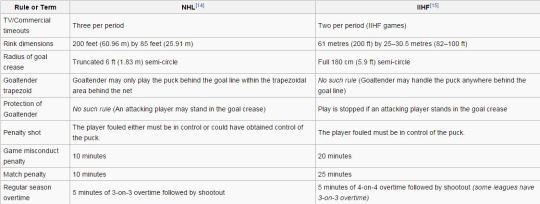
The size of an international rink is 200 ft by 100 ft (61m by 30.5m)
The size of an international rink is 200 ft by 85 ft (61m by 26m)
There are three periods in a game
Each period lasts for 20 minutes with a 17 minute period break in between
“In the National Hockey League, between stoppages of play, teams have 18 seconds (five seconds for the visiting team, eight seconds for the home team, five seconds to line up at the faceoff location) to substitute their players, except during TV timeouts.” [x]
TV Time outs are 2 minutes long and occur 3 times per period (In the NHL)
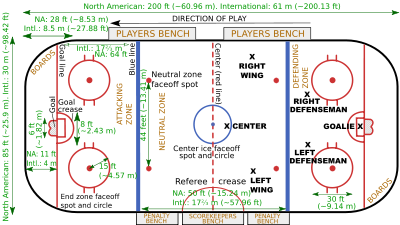
There are 6 players allowed on the ice per team at one time (1 LW, 1 Center, 1 RW, 2 D-men and 1 goalie)
A shutout is when a goalie doesn’t allow any goals in during a game. For example the score could be 3-0
A shootout is a way to break the tie after 5 minutes of overtime.
Each team names three shooters. If the game remains tied after the three shooters are done, teams continue shooting in “sudden death” mode. The game cannot end until each team has taken the same number of shots. [x]
Too Many Men on the Ice (this video gives a good visual of what this penalty looks like. There are 6 players plus the goalie on the ice for one team which is against the rules.)
G =Goals. A goal is awarded to the last player on the scoring team to touch the puck prior to the puck entering the net. Note: Goals scored during a shootout do not count towards a player’s goal total.
A =Assists. An assist is awarded to the player or players (maximum of two) who touch the puck prior to the goal, provided no defender plays or possesses the puck in between.
P or PTS =Points. The sum total of goals and assists.
GW = Game-winning goals. After the final score has been determined, the goal which leaves the winning team one goal ahead of its opponent is the game-winning goal (example: if Team A beats Team B 8-3, the player scoring the fourth goal for Team A receives credit for the game-winning goal). Note: Goals scored during a shootout are not credited as game-winning goals.
W = Wins.A goaltender receives a win if he is on the ice when his team scores the game-winning goal.
L = Losses. A goaltender receives a loss if he is on the ice when the opposing team scores the game-winning goal.
OT = Overtime or shootout losses. As of the 2005-06 NHL season, a goalie is credited with an “OT” if he is on the ice when the opposing team scores the game-winning goal in overtime or during a shootout.
GA = Goals against. Empty net goals do not count towards a goaltender’s goals against. Goals scored during a shootout do not count towards a goaltender’s goals against.
SO =Shutouts. If two goaltenders combine for a shutout, neither receives credit for the shutout. Instead it is recorded as a team shutout. If a regular season game is tied 0-0 at the end of overtime, both goaltenders are credited with a shutout, regardless of how many goals are scored in the shootout.
Team/League Stats:
A team’s stats are determined by their Win-Loss-Loss in Overtime record. For example: a team could be 12-5-4. That team would have 12 wins, 5 losses and 4 losses in overtime.
A team’s points are determined by their Win-Loss-Loss in Overtime record. Continuing on with the previous example, the team would have 28 points. Multiply the team’s winning record by 2 and add it to their OT loss record. (one point awarded for a loss in overtime) 24+4=28
An empty net goal occurs when a team scores a goal into a net with no goaltender present. This usually occurs in one of two different occasions:Usually in about the last two minutes of a game, if a team is within two goals, they will often pull the goalie, leaving the net defenseless, for an extra attacker, in order to have a better chance of scoring to either tie or get within one goal. If the team with the lead gets control of the puck they will often shoot at the net after clearing center ice. It is less common for a team to shoot from their own zone at an empty net because icing could occur if the shooter misses the net. Sometimes a team will pull their goalie when they are on a two-man advantage, even if not nearing the end of the game. With the team then gaining an advantage of six skaters to three, this will increase even further the chances of the team scoring. [x]
A goal is scored when the puck passes entirely across the red line painted between the goal posts and below the crossbar. A goal may be disallowed under the following circumstances:
the scoring team takes a penalty (except if the other team accidentally puts the puck into its own net untouched by the team to be penalized);
the puck is directed in by an attacker’s high stick (above the crossbar), or when the puck has been directed, batted, thrown or kicked into the net by an attacking player other than with a stick (angling one’s skate so the puck deflects off it into the goal is allowed).
goaltender interference (which can also result in a penalty)
the puck goes in after the Referee intends to stop play (e.g. the net has been dislodged)
the puck deflects off a referee or linesman and goes directly into the goal (exception to the rule that a puck hitting a referee or a linesman is still live)
a goal was allowed at the other end (this can happen if a video review clarifies a goal scored prior)
DO NOT EVER PARTICIPATE IN MEAN GOALIE CHANTS IT IS VERY RUDE (remember: love thy goalie)
The maximum number of players on an NHL roster is 23.
The diameter of a hockey puck is three inches (ooh fun fact 😀 )
Regulation hockey nets are six feet wide and four feet tall.
82 games are played per team in one season (NHL)
There are 30 teams in the NHL and they are divided into two divisions: The Eastern and Western Conferences
There are 16 teams in the Eastern Conference
There are 14 teams in the Western Conference
The NHL regular season starts in October and ends in early April
DON’T EVER CALL SOMEONE A PUCK SLUT/PUCK BUNNY. RESPECT ALL FANS!!
I know it’s a lot to take in, but hopefully you learned a little something about the sport. Remember: everyone has to start somewhere, you’ll catch on soon! Please feel free to add on to this list as I might have forgotten something!
i know a lot of us would like to see Holster playing in the NHL one day, but consider this:
adam “holster” birkholtz, the sassiest goddamn referee in the NHL (after mike leggo, of course)
here is some evidence:
he knows the rules, is an excellent skater, and likes to judge people
he is a Giant who can break up any and all fights
all the danger of an NHL game without the constant fear of being traded
his terrible fashion sense can still be represented in this ugly-ass uniform
still gets to wear a helmet so no one can see his awful hair cut
he still gets to curse, fine, and maintain control over the Sin Bin
he would 100% do this:
it would be really funny if this happened:
in summation, please make Holster a ref in your next fic because it’s A. hilarious and B. probs more realistic and C. DID I MENTION HOW FUCKING FUNNY IT IS
holy. fucking. shit. holy shit. THI S IS TOO PERFECT HOW IS IT SO PERFECT?????? A+ good job 100% gold star. I loveit. also now I have something I can use this pic as a reference for.
hockey sucks. your favorite players aren’t safe, your favorite teams aren’t safe, nothing you love is sacred, and this clusterfuck of a league will do whatever it can to ruin things for you and everyone else.
doughnut shop named after and founded by a hockey player in the 1960s
for all you non-canadian’s who think I’m exaggerating:
“Tim Hortons holds 62% of the Canadian coffee market (compared to Starbucks, in the number two position, at 7%)
“Canadians eat more doughnuts per capita and have more doughnut outlets per capita than any other nation“
“The company [Tim Hortons] opened twice as many Canadian outlets as McDonald’s and system-wide sales also surpassed those of McDonald’s Canadian operations as of 2002”
“The chain accounted for 22.6% of all fast food industry revenues in Canada in 2005.”
there is more to this story and it actually gets better
tim horton the hockey player’s signature move was literally picking opposing players up and hugging them. the guy was like 6′5 on skates, built like a tank, would have come out on top in every hockey fight except that he absolutely refused to punch. someone would hit him and he’d just pick them up in a giant, angry bear hug.
this one time he broke his jaw and leg in a collision and was off the ice for years, and this freaked him tf out, because dude bro do i like…….have value behind all this muscle? what if this like……happens again, bro? what if i can’t play hockey, bro? huh? bro. basically he broke his face and had an existential crisis. happens to the best of us.
so he started a donut shop because he figured he’d need something to do when the next injury rolled around, seeing as oblivion lurks around every corner and none of us have a purpose. he started it in hamilton, ontario.coffee was ten cents.
anyways, when his face got better, he invited a police officer to come run his company so he could go play more hockey. which he did.
so: canada’s pride and joy is a donut shop named after and founded by a touch-starved hockey player in the midst of an existential crisis, that was later run by a cop when the aforementioned hockey player left to play more hockey, that then somehow ate up 62% of the canadian coffee biz. god bless.
A hockey player who hugs his way out of fights is perhaps the most Canadian thing I can imagine.




 just moving along like everyone else