Shout-out to my fellow Fandom Olds who lived through Strikethrough/Boldthrough on LJ and knew this day would eventually come here on Tumblr.com also
Especial shout-out to the heroes at AO3 who designed their whole operation knowing that every other platform fandom used would pull this bullshit sooner or later
What I think is really interesting about the papyrus account of the workers building the tomb of Rameses III going on strike to demand better wages is really fascinating to me because if you look at the description given by the royal scribe you see that there was an attempt to satisfy the workers by bringing a large amount of food at once but that was rebuffed by the workers who declared that it wasn’t just that they were hungry at the moment but had serious charges to bring that “something bad had been done in this place of Pharoah” (is poor wages and mistreatment). They understood themselves as having long term economic interests as a -class- and organized together knowing that by doing so they could put forward their demands collectively. It so strongly flies in the face of narratives that are like “in this Time and Place people were happy to be serve because they believed in the God-King and maybe you get some intellectual outliers but certainly no common person questioned that”. If historical sources might paint that sorta picture of cultural homogeneity it is because those sources sought not to describe something true but invent a myth for the stability of a regime.
Since this is getting notes here’s a link to a translation of the papyrus scroll and here’s an article that gets further into the economic situation surrounding the strike and giving an explanation of the events. The workers didnt just refuse to construct Rameses III’s future tomb, they actually occupied the Valley of the Kings and were preventing anyone from entering to perform rituals or funerals. Basically they set up the first ever recorded picket line
Again the workers went on strike, this time taking over and blocking all access to the Valley of the Kings. The significance of this act was that no priests or family members of the deceased were able to enter with food and drink offerings for the dead and this was considered a serious offense to the memory of those who had passed on to the afterlife. When officials appeared with armed guards and threatened to remove the men by force, a striker responded that he would damage the royal tombs before they could move against him and so the two sides were stalemated.
Eventually the tomb workers were able to win the day and acquire their demands and actually set a precedent for organized labor and strikes in Egyptian society that continued for a long time
The jubilee in 1156 BCE was a great success and, as at all festivals, the participants forgot about their daily troubles with dancing and drink. The problem did not go away, however, and the workers continued their strikes and their struggle for fair payment in the following months. At last some sort of resolution seems to have been reached whereby officials were able to make payments to the workers on time but the dynamic of the relationship between temple officials and workers had changed – as had the practical application of the concept of ma’at – and these would never really revert to their former understandings again. Ma’at was the responsibility of the pharaoh to oversee and maintain, not the workers; and yet the men of Deir el-Medina had taken it upon themselves to correct what they saw as a breach in the policies which helped to maintain essential harmony and balance. The common people had been forced to assume the responsibilities of the king.
[…]
The success of the tomb-worker/artisan strikes inspired others to do the same. Just as the official records of the battle with the Sea Peoples never recorded the Egyptian losses in the land battle, neither do they record any mention of the strikes. The record of the strike comes from a papyrus scroll discovered at Deir el-Medina and most probably written by the scribe Amennakht. The precedent of workers walking away from their jobs was set by these events and, although there are no extant official reports of other similar events, workers now understood they had more power than previously thought. Strikes are mentioned in the latter part of the New Kingdom and Late Period and there is no doubt the practice began with the workers at Deir el-Medina in the time of Ramesses III.
There was also a strike at one point where construction workers refused to continue until they were given sufficient “cosmetics.”
This was thought a highly strange thing until somebody deciphered the recipe for the “cosmetics” the workers were demanding and recreated it.
It was sunscreen. Sunscreen.
Making that the first recorded strike over occupational safety.
SO. IF YOU KNOW YOUR FANDOM HISTORY, YOU CAN SEE THE WRITING ON THE WALL RIGHT NOW.
AND IN CASE YOU DON’T, I will tell you a story.
I don’t know if Yahoo as a corporate entity hates fandom, or if it LOVES fandom in the way a flame longs to wrap its embrace around a forest. Or maybe it’s just that fandom is an enticingly big and active userbase; but just by the nature of our enterprise, we are extremely difficult to monetize.
It doesn’t matter.
Once upon a time – in the era before anyone had heard of google – if you wanted to post fandom (or really, ANY) content, you made your own webpage out of nested frames and midi files. And you hosted it on GeoCities.
GeoCities was free and… there. If the internet of today is facebook and tumblr and twitter, the internet of the late 90s WAS GeoCities.
And then Yahoo bought GeoCities for way too much money and immediately made some, let’s say, User Outreach Errors. And anyway, the internet was getting more varied all the time, fandom mostly moved on – it wasn’t painful. GeoCities was free hosting, not a community space – but the 90s/early 00s internet was still there, preserved as if in amber, at GeoCities.com.
Until 2009, when Yahoo killed it. 15 years of early-internet history – a monument to humanity’s masses first testing the potential of the internet, and realizing they could build anything they wanted… And what they wanted to build was shines to Angel from BtVS with 20 pages of pictures that were too big to wait for on a 56k modem, interspersed with MS Word clipart and paragraphs of REALLY BIG flashing fushia letters that scrolled L to R across the page. And also your cursor would become a different MS Word clipart, with sparkles.
(So basically nothing has changed, except you don’t have to personally hardcode every entry in your tumblr anymore. Progress!)
And it was all wiped out, just like that. Gone. (except on the wayback machine, an important project, but they didn’t get everything) The weight of that loss still hurts. The sheer magnitude…
Imagine a library stocked with hundreds of thousands of personal journals, letters, family photographs, eulogies, novels, etc. dated from a revolutionary period in history, and each one its only copy. And then one day, its librarians become tired of maintaining it, so they set the library and all its contents on fire.
And watch as the flames take everything.
Brush the ash from their hands.
Walk away.
Once upon a time – in the era after everyone had heard of google, but still mostly believed them about “Don’t be evil” – fandom had a pretty great collective memory. If someone posted a good fic, or meta, or art, or conversation relevant to your interests? Anywhere? (This was before the AO3, after all.) You could know p much as soon – or as many years late – as you wanted to.
Because there was a tagging site – del.icio.us – that fandom-as-a-whole used; it was simple, functional, free, and there. Yahoo bought it in 2005. Yahoo announced they were closing it in 2010.
They ended up selling it instead, but not all the data went with it – many users didn’t opt to the migration. And even then, the new version was busted. Basically unusable for fannish searching or tagging purposes. This is the lure and the danger of centralization, I guess.
It is like fandom suffered – collectively – a brain injury. Memories are irrevocably lost, or else they are not retrievable without struggle. New ones aren’t getting formed. There is no consensus replacement.
We have never yet recovered.
Once upon a time… Yahoo bought tumblr.
I don’t know how you celebrated the event, but I spent it backing up as much as I could, because Yahoo’s hobby is collecting the platforms that fandom relies on and destroying them.
I do not think Yahoo is “bad” – I am criticizing them on their own site, after all, and I don’t expect any retribution. I genuinely hope they sort out their difficulties.
But they are, historically, bad for US.
And right now is a good time to look at what you’ve accumulated during your career on this platform, and start deciding what you want to pack and what can be left behind to become ruins. And ash.
…On a cheerier note, wherever we settle next will probably be much better! This was never a good place to build a city.
i forgot that yahoo was the one that destroyed both de.li.cious and geocities too, dang. But yes – tumblr is a loss and the writing is on the wall. Yahoo won’t run this site purely for charity reasons, so unless something wildly changes, tumblr’s days are numbered.
(Maybe now is a good time to check out pillowfort.io …)
I have been involved in online fandom since AOL was new, and yes, I witnessed the destruction when Geocities went dark. It was a real loss. The Wayback Machine saved some pages, but not all.
But I think it’s wrong to blame Yahoo. They weren’t the only ones. And they won’t be the last. It might seem like Facebook, Tumblr, and Twitter are here to stay, but that once seemed true of AOL, Geocities, MySpace, etc. If it stops being profitable, it goes away…or becomes a useless shadow of what it used to be.
AOL still exists as a company, but the fannish message boards, filled with discussion and fanfic, are gone forever. So are all the personal webpages where fans used to archive their stories. Free mailing lists at Yahoogroups, Onelist, and Egroups were once the heart of fandom – where people posted discussion and fanfic, and expected them to be archived forever. Yahoogroups ended up absorbing the rest, then put Draconian limits on posting and archiving that basically made the mailing lists useless for fannish purposes.
Usenet is still around, but the archiving services (Remarq, DejaNews, etc.) mostly went away. Because of the nature of Usenet, it was pretty useless without multiple archives (posts tended to get lost, they were only available for a couple of weeks, and you couldn’t depend on one ISP or one archive to get them all – a pain if you were trying to read a 30-part story).
So, I am wondering how long Tumblr will be a viable platform for fandom. Yahoo recently sold off Flickr, and the new owner is making huge changes. You used to get 1 terabyte of space for photos; now you only get 1,000 photos, no matter what size they are. If you don’t buy a membership for $50/year, they will start deleting your photos until you are under the limit, oldest first. If they decide to sell Tumblr as well, who knows what the new rules will be.
Many Flickr users are upset at the changes. They expected their photos to be archived there forever. Now that won’t be the case, even if they pay – since once you die and stop paying the fee, your photos will be deleted.
I fear that applies to fannish works as well. Switching to Pillowfort.io or Dreamwidth isn’t really a solution. They are likely to face the same pressures Yahoo, etc. faced. Any commercial service can’t be relied on.
I’m reminded of something a biographer of Steve Jobs said. He writes a lot of biographies, and said Jobs was difficult, because his early journals were on magnetic tape and other obsolete media, written with software that is no longer readily available. Leonardo da Vinci was easier, because his handwritten notebooks can still be read. I guess there’s something to be said for dead-tree fanzines.
A good post to revive!
I don’t think it’s the commercial nature of a site by itself that’s the issue. DW never really took off like a lot of us hoped and never created that second era of LJ-style fandom, but it has been chugging happily along ever since. Its ambitions were modest and its business plan sound.
The problem is that most commercial sites are venture capital startup nonsense that does not have a clear business plan that will be sustainable in the long run. The aim is to drive users to the site in such numbers that they feel unable to abandon it, then inflict advertising or new fees on them after they’re stuck. “We’ll figure it out later” is a key feature of all of these, but the assumption that lots of users mean lots of ways to monetize isn’t always valid.
Squidge-style sites also don’t usually have good long-term plans. (IDK about Squidge in particular though.) The ones that last are the ones run by fans with deep pockets and good offline fannish support networks. Many others die when the owner forgets to renew the domain name or gets tired of paying or can’t pay any longer.
Look at the Smallville Slash Archive: it was one of many fannish sites that Minotaur hosted. When he died unexpectedly, his many fannish friends stepped in to save his work. SSA ultimately got imported to AO3 to preserve it. This worked because he had plenty of actual friends in fandom–people he saw offline at cons too–and not just casual acquaintances who followed him on social media. It’s true that donation drives can be signal boosted on social media, but all of the liking and goodwill in the world won’t do jack if nobody has access to the hosting/business side of a site to use those donations to keep it open.
This is one reason a lot of older fans I know have started talking about fannish estate planning. All those paper zines are a better archival format than any computer drive, but they also often get thrown in the trash by clueless relatives. Out of an original print run of a couple hundred, how many are extant?
AO3 is distinctive in that it has an entire organization in place to make sure it continues. (So while nothing is forever, AO3 is about as solid as it gets.) But I’d probably trust DW second most, and I’d trust it over many single-owner not-for-profit fannish spaces.
Not to hijack the thread, but this is Walter from Squidge.org. Yes, we’re still out here, though we’re such a small part of fandom now as opposed to the early 90s when we started. Squidge has a future, I think, and I’m looking at replacing several of current sites (Peja’s WWOMB, NCISFiction.com, and a couple more eFiction sites) with a single AO3-based archive.
And as for the future, yes, we’re all getting older. I have a will that bequeaths Squidge.org fandom sites to the OTW (the folks that run AO3). My husband has instructions, and OTW has been told of my wishes.
Great to hear you’re around! I used to read WWOMB so often–and again whenever I get into a new-to-me old fandom. There are so many fics on older archives that aren’t crossposted anywhere else.
I’ve seen a lot of people on my dash who are justifiably upset with some of Tumblr’s recent changes (argh, reply function gone, argh argh) and talking about moving to another site. This is a good thing (and also more or less inevitable at some point; fandom activity never stays in one place forever, or else we’d all still be on like, Usenet*).
But one thing I will say, for those of you who have not lived through a fannish migration or six, is that fandoms don’t jump in an organized or coherent way. It tends to be a trickle, not a dam burst. So for instance, almost ten years ago now (yikes, can it really have been that long?) there was Strikethrough on Livejournal, which is a long story that doesn’t bear getting into right now but the short form is that LJ made enemies of a lot of fans. And there were various attempts to jump to InsaneJournal and GreatestJournal and a bunch of other LJ clones, but they mostly didn’t ‘take.’ Dreamwidth, when it came along a couple of years later, did better at attracting people (and does have a comparatively small but active user base–and specific communities, like certain RP comms, did make an organized jump, but they were actual communities and not an amorphous blob the way ‘Dragon Age fandom,’ say, is an amorphous blob), but the thing that actually finally dragged a ton of fannish activity away from LJ seems to have been Tumblr–not any of the “like LJ but different/better” alternatives that people were floating and promoting, but something entirely different.
The main thing is that communities or groups of friends may coordinate a move together, but fandoms in a larger sense are about as coordinate-able as a bunch of cats. And also, the place they end up going generally isn’t “like X but better” but a whole new Y (mailing lists to bboards to LJ to Tumblr, just to name a few–and each of those changed the “shape” of the fandoms within it quite a bit).
The reason I am saying this is not to discourage people from seeking out alternatives, but to say: fandom is going to move, if not now then at some point, but it ain’t going to happen in a way that necessarily makes a lot of sense from the outside. Like a bunch of cats, we’re going to wander around for a bit and then land somewhere and pretend we did it on purpose. And it’s easy to lose track of people when that happens. So my advice is: let people who you care about not losing track of know where to find you and how to keep up with you, whether it’s a new site or even just “hey, here’s my email, let’s stay in touch.” I have friends from old, old fannish days, who never ended up on Tumblr, but we still occasionally send each other a silly link or something… and who knows, maybe when fandom saunters catlike over to something new, we’ll reconnect there.
* – Inevitably when I say something like this someone feels obliged to note that they are still on, e.g., Usenet. And it’s true that Usenet still sees activity. But I think it’s safe to say that fannish activity is not there in the way that it was in, for instance, the early 90s.
This post was from 3 years ago, but it’s still holds true. I’ve managed to find many muturals after my old account was deleted, but not everyone, like smaller blogs in fandoms I don’t frequent often or ones with long, hard to pronounce names.
Get emails. Signal boost posts with people’s contact info so if the original blog goes dark that others can find them. There’s a good account called @find-me-at-x that’s doing the Good Fandom Lord’s work of boosting announcement posts and asks for missing blogs. I’d recommend following them if there’s someone you’re trying to find.
we need to go back to oppressing gilgamesh fans. I say this as someone who likes gilgamesh: we as a people, as a society, absolutely must oppress gilgamesh and his fans.
chapter babylon looms on the horizon and it is of the utmost importance that we don’t let anyone believe gilgamesh is meant for anything other than relentless bullying
I won’t deny this was about the overrated little twink from fate but you lot know as well as I do that the actual historical king gilgamesh from the epic of gilgamesh needs to be bullied too. that’s literally why they made enkidu
i know absolutely nothing about whatever game or anime they’re talking about so i continue to parse this as an unearthed clay tablet along the lines of the one complaining about the copper wholesaler ripping them off
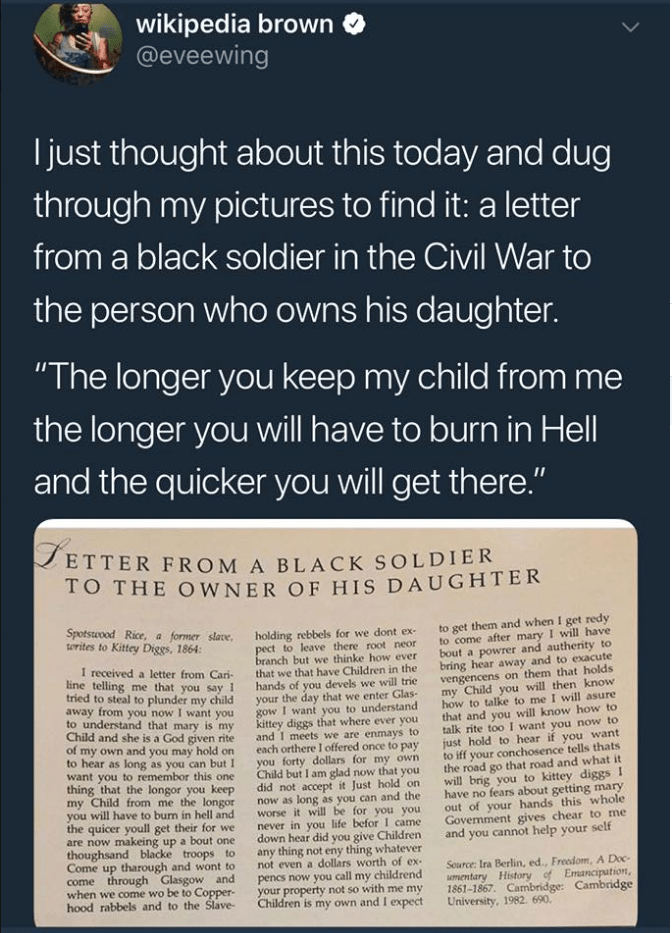
I just thought about this today and dug through my pictures to find it: a letter from a black soldier in the Civil War to the person who owns his daughter. “The longer you keep my child from me the longer you will have to burn in Hell and the quicker you will get there.“
photo text (with corrected spelling and broken into sentences, paragraphs):
Letter from a Black Soldier to the Owner of His Daughter
Spotswood Ric, a former slave, writes to Kittey Diggs, 1864:
I received a letter from Cariline telling me that you say I tried to steal, to plunder, my child away from you. Not I want you to understand that Mary is my Child and she is a God given rite of my own.
And you may hold on to her as long as you can. But I want you to remember this one thing, that the longer you keep my Child from me the longer you will have to burn in hell and the quicker you’ll get there.
For we are now making up about one thousand black troops to come up thorough, and want to come through, Glasgow. And when we come woe be to Copperhood rebels and to the Slaveholding rebels. For we don’t expect to leave them there. Root nor branch. But we think however that we (that have children in the hands of you devils), we will try your the day that we enter Glasgow.
I want you to understand Kittey Diggs that where ever you and I meet we are enemies to each other. I offered once to pay you forty dollars for my own Child but I am glad now that you did not accept it. Just hold on now as long as you can and the worse it will be for you.
You never in you life before I came down hear did you give children anything, not anything whatever, not even a dollars worth of expenses. Now you call my children your property. Not so with me.
My children is my own and I expect to get them. And when I get ready to come after Mary I will have both a power and authority to bring her away and to exact vengeances on them that holds my Child.
You will then know how to talk to me. I will assure that. And you will know how to talk right too. I want you now to just hold on; to hear if you want to. If your conscience tells that’s the road, go that road and what it will bring you to Kittey Diggs.
I have no fears about getting Mary out of your hands. This whole Government gives cheer to me and you cannot help yourself.
Source: Ira Berlin, ed. Freedom, A Documentary History of Emancipation, 1861-1867. Cambridge: Cambridge University, 1982, 690.
I wanted to find out what happened (DID HE GET HIS DAUGHTER BACK?) and the answer is that not only was he reunited with his family, but went on to be a successful minister and his daughter was interviewed in the 30s for the Slave Narratives Project.
I always get so fucking mad when I remember that it’s actually a 16-year-old Algerian girl who influenced BOTH Picasso and Matisse. and. No one gives a rat’s ass about her work which was very focused on women and nature. History -or people dare I say- didn’t bother to remember her name because she was a young Algerian woman and no one cares about Maghrebi/Arab women. unlike P*casso & M*tisse who both became legends, almost gods both during their lives and after their deaths, no one knows her.
What annoys the FUCK out of me about the ‘all historians are out there to erase queerness from history’ thing on Tumblr is that it’s just one of those many attitudes that flagrantly mischaracterises an entire academic field and has a complete amateur thinking they know more than people who’ve spent fucking years studying said field.
Like someone will offer a very obvious example of – say – two men writing each other passionate love letters, and then quip about how Historians will just try to say that affection was just different ‘back then’. Um…no. If one man writes to another about how he wants to give him 10 000 kisses and suck his cock, most historians – surprise surprise! – say it’s definitely romantic, sexual love. We aren’t Victorians anymore.
It also completely dismisses the fact of how many cases of possible queerness are much more ambiguous that two men writing to each other about banging merrily in a field. The boundaries of platonic affection are hugely variable depending on the time and place you’re looking at. What people mock us for saying is true. Nuance fucking exists in the world, unlike on this hellscape of a site.
It is a great discredit to the difficult work that historians do in interpreting the past to just assume we’re out there trying to straightwash the past. Queer historians exist. Open-minded allies exist.
I’m off to down a bottle of whisky and set something on fire.
It’s also vaguely problematic to ascribe our modern language
and ideas of sexuality to people living hundreds or even thousands of years
ago. Of course queer people existed then—don’t be fucking daft, literally any
researcher/historian/whatever worth their salt with acknowledge this. But as
noted above, there’s a lot of ambiguity as well—ESPECIALLY when dealing with a
translation of a translation of a copy of a damaged copy in some language that
isn’t spoken anymore. That being said, yes, queer erasure happens, and it
fucking sucks and hurts. I say that as a queer woman and a baby!researcher. But
this us (savvy internet historian) vs. them (dusty old actual historian)
mentality has got to stop.
You’re absolutely right.
I see the effect of applying modern labels to time periods when they didn’t have them come out in a bad way when people argue about whether some historical figure was transmasculine or a butch lesbian. There were some, of course, who were very obviously men and insisted on being treated as such, but with a lot of people…we just don’t know and we never will. The divide wasn’t so strong back in the late 19th century, for example. Heck, the word ‘transmasculine’ didn’t exist yet. There was a big ambiguous grey area about what AFAB people being masculine meant, identity-wise.
Some people today still have a foot in each camp. Identity is complicated, and that’s probably been the case since humans began to conceptualise sexuality and gender.
That’s why the word ‘queer’ is such a usefully broad and inclusive umbrella term for historians.
Also, one more thing and I will stop (sorry it’s just been so long since I’ve gotten to rant). Towards the beginning of last semester, I was translating “Wulf and Eadwacer” from Old English. This is a notoriously ambiguous poem, a p p a r e n t l y, and most of the other students and I were having a lot of trouble translating it because the nouns and their genders were all over the place (though this could be because my memory is slipping here) which made it hella difficult to figure out word order and syntax and (key) the fucking gender of everything. In class, though, my professor told us that the gender and identity of the speaker were actually the object of some debate in the Anglo-Saxonist community. For the most part, it was assumed that the principal speaker of the poem is a woman (there is one very clear female translation amongst all that ambiguity) mourning the exile of her lover/something along those lines. But there’s also some who say that she’s speaking of her child. And some people think the speaker of the poem is male and talking abut his lover. And finally, there’s some people who think that the speaker of the poem is a fucking BADGER, which is fucking wild and possibly my favorite interpretation in the history of interpretations.
TL;DR—If we can’t figure out beyond the shadow of a doubt whether the speaker is a human or a fucking badger, then we certainly can’t solidly say whether a speaker is queer or not. This isn’t narrowmindedness, this is fucking what-the-hell-is-this-language-and-culture (and also maybe most of the manuscripts are pretty fucked which further lessens knowledge and ergo certainty).
Also, if there’s nothing to debate, what’s even the fun in being an historian?
All of this.
I had a student once try to tell me that I was erasing queer history by claiming that a poem was ambiguous. I was trying to make the point that a poem was ambiguous and that for the time period we were working with, the identities of “queer” and “straight” weren’t so distinctive. Thus, it was possible that the poem was either about lovers or about friends because the language itself was in that grey area where the sentiment could be romantic or just an expression of affection that is different from how we display affection towards friends today.
And hoo boy. The student didn’t want to hear that.
It’s ok to admit ambiguity and nuance. Past sexualities aren’t the same as our modern ones, and our understanding of culture today can’t be transferred onto past cultures. It just doesn’t work. The past is essentially a foreign culture that doesn’t match up perfectly with current ones – even if we’re looking at familiar ones, like ancient or medieval Europe. That means our understanding of queerness also has to account for the passage of time. I think we need to ask “What did queerness look like in the past?” as opposed to “How did queerness as we understand it today exist in the past?” As long as we examine the past with an understanding that not all cultures thought same-sex romance/affection/sexual practice was sinful, we’re not being homophobic by admitting there can be nuance in a particular historical product.
I know a lot of very smart people who are working on queerness in medieval literature and history. And yes, there are traditions of scholars erasing queer history because they themselves are guided by their own ideologies. We all are. It’s impossible to be 100% objective about history and its interpretation. But that doesn’t mean there isn’t good work being done by current scholars, including work that corrects the bad methodologies of the past.
also yeah, the key thing that’s helped me as a student of history is learning that using language outside of modern labels shouldnt erase queerness, but should complicate it.
Jesus Christ all of this
i think a lot of kids of tumblr have this vague grudge against ‘straightwashing academics’ that they actually picked up from their highschool curriculum, which is kind of a completely different thing. like, it’s not ‘academics’ that’s the problem when it comes to american teenagers being fed an extremely white, straight, patriarchical version of history; it’s your fucking government.
A conversation on the fluidity of terms, and how to understand and have a productive conversation with a shifting generational gap in trans terminology.




 just moving along like everyone else