i generally say i don’t like ‘downer’ media, and that includes tragedies, but i quite like hamlet, and i think moby dick is the shit. recently i got to thinking what it is about the few tragedies i like that makes them different from the merely-depressing rest. best i can figure, here it is:
our protagonist has agency. he’s not a victim or a dupe. he could get out of the shit if that was his priority. of course, the way he could get out is not going to be easy or fun – ishmael’s options, for instance, were ‘mutiny’ or ‘swim’ – or else it wouldn’t be a tragedy, but he has choices he can make, is the point.
once he is in the shit, he struggles like a motherfucker. he doesn’t just sit down and go “oh well, suffering is good for the soul.” he fights. he plots revenge against his uncle. he clings to his boyfriend’s coffin in the freezing sea. he’s not a quitter.
when it all goes to hell, he doesn’t waste his last hours on futile scrambling to escape. he puts the pedal down and accelerates into that brick wall, screaming WITNESS ME with his last breath.
these, i think, are the criteria for a story i’ll like even though it ends with tombstones instead of medals. because even though our protagonist is dead, or bobbing amongst the corpses alone, or what have you, he remained himself and did what he thought was the thing he needed to do. which is the victory that really matters: remaining yourself and holding onto your will in the face of whatever the world throws at you.
@sphealrical your tags are a good addition, thanks
that’s absolutely worth thinking about, yeah – othello is a soldier, swift to violence, and he’s also accustomed to being betrayed and lied to. he’s been treated badly not just because of his skin color, but because he’s a moor – representative of muslim invaders who took over spain and so forth – and therefore an outsider. he’s always been treated as an enemy in europe. desdemona seems too good to be true. so when he hears she’s NOT true, he goes full tumblr callout drama and ruins everything.
but in a situation where the accusations were legit? if it had been his father’s ghost saying ‘avenge my murder’? SNICKTY SNICK wolverine style, play over.
and hamlet, he’s practically the opposite of othello in every way. he’s a dreamy danish goth who’s dating a weird girl who likes flowers, he loved his daddy and he’s being a big sulky poop about his mom remarrying too fast, everything is emotions and emo music and writing in his diary with purple gel pen. along comes his dad’s ghost going “hamlet you must do a violence!” and hamlet’s like… no? what? how about i just take a xanax and hide in the graveyard? once he realizes he really will have to do something awful, he tries to drive ophelia away so he won’t drag her down with him, and i’m pretty sure her suicide is when he switches over from acting crazy to actually being crazy.
but if someone had instead come along at the beginning and gone “yo ophelia’s the town bike, thought you should know” he probably would’ve replied “hey fuck you, stop spreading rumors about the sweetest girl in denmark” and there would’ve been no plot at all.
That said, I think it’s also worth bringing up that Hamlet is, essentially, an extended riff on the then-popular genre of revenge tragedies. In some ways, they were kind of filling a similar niche to slasher movies, in that the plot was largely about killing most of the characters in a chain reaction of spectacularly gruesome murders. People get revenge, and people get revenge for the revenge, and other people want revenge for that, and by the end of the play everyone is messily dead. (Shakespeare had actually earlier written a straight revenge tragedy in Titus Andronicus; to take someone’s summary that Wikipedia quoted,
“it has 14 killings, 9 of them on stage, 6 severed members, 1 rape (or 2
or 3 depending on how you count), 1 live burial, 1 case of insanity,
and 1 of cannibalism – an average of 5.2 atrocities per act, or one for
every 97 lines.”)
Many of Hamlet’s plot points are genre cliches or references to The Spanish Tragedy (the play that more or less launched the genre), including the play-within-a-play and the ghost. The thing is, though, a standard revenge tragedy protagonist would probably have done the Othello thing. But instead we’ve got Hamlet, and he… acts like someone who’s seen a lot of revenge tragedies might, if they were trying to avoid the spiral.
He makes absolutely sure he has the right guy before he does anything. He tries to get Ophelia out of the line of fire (and for all that his dickishness to her works out horribly long-term, he does succeed in convincing Claudius that he doesn’t care about her). He figures out he shouldn’t trust Rosencrantz and Guildenstern and proceeds to not trust them. …And then he stabs the wrong guy, and all the plot tropes his actions were calculated to avoid come crashing down on his head because he was trying to avoid them.
Hamlet is basically like the vampires from Carpe Jugulum, but for revenge tragedy tropes.
ooh, interesting point! yeah, he is disturbingly genre-savvy, isn’t he?
(titus andronicus is the one shakespeare play i’ve never read. i do not need that kind of nightmare fuel thanks will ol buddy i’m just gonna give that one a miss.)
i love that pair of comics and i know i’ve seen them before but i had forgotten them completely.
You know what they say! One man’s tragic flaw is another man’s pretty reasonable personality asset under the circumstances, I guess. Do…do they say that?
So let’s discuss the last scene of Hamlet, shall we? (Caution: long post.)
It starts out with just Hamlet and Horatio, discussing the deceit of Rosencrantz and Guildenstern. Horatio is explicitly made aware that King Claudius was at the root of the plot to kill Hamlet. Then Osric enters and informs them that Claudius has made a wager on Hamlet beating Laertes in a swordfight.
A swordfight. You know, with those sharp, pointy, potentially lethal things?
Come on, it’s obvious that this just the next attempt to get Hamlet killed. But it’s also fairly obvious that Laertes is not going to just come out and stab Hamlet to death – that would be better done in private and not in the most public situation imaginable at court, implicating the king. So, another plot is rather obviously afoot. Yet Hamlet hardly seems worried; instead he proceeds to make fun of Osric.
Why so? Well, the only rational explanation would be that Hamlet and Horatio have a plan of their own. Horatio’s offer to forestall the king’s arrival and “say you are not fit” could be read as a final test of resolve: “Do you really want to go ahead with this?” – And Hamlet replies with “We defy augury.” Given that the scene is replete with references to fate (e.g. the famous “divinity that shapes our ends”), this is hardly a throwaway comment. It is Hamlet answering: “Yes, let’s do it. Let’s play fate.”
Claudius and his party promptly enter. Hamlet, rather unsurprisingly, goes off on one of his hotch-potch rants. Its contents actually make sense – denial of responsibility due to insanity – but the phrasing is still rather more complicated than necessary, half mocking, half confused. You can just picture him waving his arms around wildly and drawing attention to himself. Meanwhile, no mention at all is made of what Horatio is up to.
So, what if he used the distraction provided by Hamlet to manipulate the rapiers? Being Horatio, he is of course well prepared. Romeo and Juliet teaches us that there is a non-lethal potion that can be used to fake death. What if Hamlet and Horatio, given the ominous circumstances, had already discussed its use in situations like this. What if Horatio, ever since then, carried a clean cloth and a flask of the potion. What if Horatio picked out the rapier which was anointed which that rather suspicious-looking liquid, wiped it clean, and dosed it instead with the non-lethal potion. What if Horatio thereby saved Hamlet using Juliet’s potion.
It explains why they went with the rapier fight at all – it gave them an opportunity to resolve things in a way that would get Hamlet out of the spotlight and allow them to start a new life in peace and quiet elsewhere. It explains why Hamlet isn’t bothered about which rapier he chooses – he knows that Laertes will choose the one carefully prepared by Horatio and actually wants to be hit. It explains why, after stabbing Claudius, Hamlet also forces him to drink from the poisoned cup – neither Gertrude’s nor Claudius’s death were intended, but the poisoned drink was not part of the plan. The fact that Claudius just lets Gertrude die gives Hamlet the final kick to actually kill him too, though, and he knows that the stab wound alone would do no harm.
It also explains all the references to playing fate – by successfully using the make-me-seem-dead potion that Shakespeare was so fond of, Hamlet and Horatio shaped their own ends in a way that would seem like fate to anyone else. All they had to do was act out the rest of the scene for the remaining courtiers (rather dramatically, one might add) and then sneak off sometime the next day. “Goodnight, sweet prince” literally means “sleep well, darling, and see you tomorrow morning”.
tl;dr: Headcanon that Hamlet and Horatio are happily living on a desert island together (just like Mercutio and Benvolio).
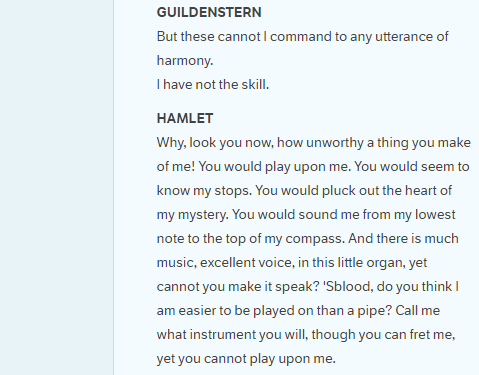
I read Hamlet back in high school and to this day my absolute favorite thing about it was when Guildenstern was trying to fool Hamlet into doing something or other and Hamlet’s savvy to it but rather than saying “you’re lying and trying to trick me” instead Hamlet outta nowhere whips out this flute and tells Guildenstern to play it.
And Guildenstern is all “I dont know how to play a flute, my lord”
And Hamlet takes a dramatic pause before he absolutely ruins Guildenstern with, “Well thats funny considering you thought you could play me”
this post sounds like im exaggerating but im not it’s straight up canon


 just moving along like everyone else