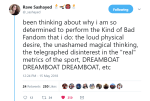
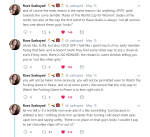
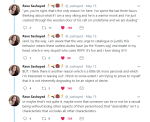
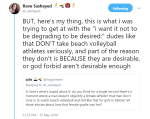
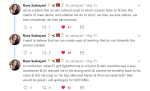
that dumb “Rules of the World Cup for Women” list made me livid and @sashayed had some good thoughts about it. I screencapped her tweetstorm so I can refer back to it when I feel anxious about my own way of caring about sports.
people in fanfiction are so good at identifying v specific smells. I literally struggle to identify vanilla when I’m sniffing a candle labelled “VANILLA” how are these kids getting woodsmoke, rain, mint, and a whiff of byronic despair from a fuckin tshirt
Once I read a fic where they were like “he tasted like” and I’m expecting the typical formula (1 cooking ingredient + 1 natural phenomenon + “something uniquely [character name]”) but instead they said “he tasted like mouth” and it was one of the greatest fic moments of my life
click and drag to find out what your shitty fanfiction kiss tastes like
Unsourced screencap making the rounds on Facebook.
yeah, pretty much this. there is no such thing as ‘white culture’.
the one ethnic pride fest i wish existed that doesn’t is “dude i have no idea what all is up in there” pride. both for the many white americans who have no idea where their ancestors came from (not all families were literate, some folks are adopted, etc), and for people like me who have an ancestry from “sort of all around that general vicinity over there.” i mean, i go to the czech heritage festival and that’s pretty great, but there’s no kazakh or mongolian or “idk some uyghur guys in northern china we think probably” festival. anyway, we could call it Mutt Fest and it could be a lot of fun. we could have fusion food and dance to afro-celts. 😀
Back when I thought I was straight I would go on dates with boys. The boys would usually want to kiss me. I disliked kissing, but I thought that their preferences deserved to count as much as mine, and I reasoned that they probably liked kissing more than I disliked kissing. So kissing was a morally good thing to do. I also reasoned that if I told them I disliked the kissing then they’d feel guilty and enjoy it less. So I did not tell them.
I am certain I was making some kind of critical error but it has taken me a long time to figure out what it might be.
ii.
I like cuddling. I know some straight girls who like cuddling with their straight female friends but don’t want to cuddle with people who might be attracted to them because it makes them uncomfortable. But they don’t want to explicitly tell me this preference because they’re worried it’s homophobic. Ever since I learned that this dynamic was present in at least one friendship of mine I have not cuddled with any straight girls because there’s a plausible scenario in which I’d be making them uncomfortable and they wouldn’t tell me.
Are you familiar with affective vs. cognitive empathy? I ask because these kinds of sentiments often come from confusing the two. Affective empathy is the visceral “I feel your pain” kind of empathy, and policing that is really – to use the dreaded word – problematic. If you aren’t familiar with cognitive empathy, “empathize with a murderer” can feel like a demand that you internalize and excuse their murderous urges. And that definitely isn’t what I’m going for.
When I talk about empathy, I’m talking about cognitive empathy, which is the ability to intellectually understand someone’s emotional state. Which is so, so important. On the practical level, it’s absolutely crucial to curtailing violent crime and seeing that its perpetrators get the rehabilitation they need. You can’t fight something you don’t understand. We’ve wasted money, time, and human lives waging wars on drugs and on terrorism, and we’re hilariously ineffective precisely because we aren’t addressing the causes. These issues are systemic, and we’re throwing riot police at the symptoms while ignoring the core dysfunctions.
Empathizing with a person or a group is crucial in avoiding othering them. Othering isn’t just cruel – it’s ineffective. Treating someone like they’re no longer a real person or a valued part of society is a terrible way to improve their behavior. If you’re just a rapist, just a murderer, just a drug dealer, where’s your incentive to become anything else? Humans have this nasty habit of sinking to the level that’s expected of them. Sometimes the thing you need to hear is “you did a bad thing, yes, but you are more than this, and you can make amends and move past it.”
Someone linked me to this, and I think this is a really excellent post.
If you want to solve problems, you have to think about what people are experiencing and why they are doing the things that they’re doing. Otherwise your “solutions” won’t be relevant.
also, if you can’t empathize with your villains, you will be a lousy writer. so there’s also that.
I’m on board for most of this, but do not ever ask me to refrain from Othering a rapist. The act of rape is deliberate, vicious and premeditated every time–or if not premeditated, it at least stems from an ingrained and irreversible pattern of predatory behavior. Rapists deserve to be othered and cast out entirely (personally I advocate execution but I know that’s a contested subject).
OP isn’t talking about what they deserve. it’s about understanding them well enough to change or prevent their behavior.
i am so tired of people being too squicked by crime to make it stop. y’all would rather let it proliferate and punish it after the fact than keep it from happening in the first place, if keeping it from happening would require you to think of criminals as human beings who do the wrong things, rather than as alien monsters whose motives and behavior are a total mystery.
not to mention how the monster hunter mentality causes people to assume suspicion = guilt. surely you can think of some problems with that reflex. possibly related to current events? if you think hard maybe?
“Y’all would rather let it proliferate and punish it after the fact than keep it from happening in the first place, if keeping it from happening would require you to think of criminals as human beings who do the wrong things, rather than as alien monsters whose motives and behavior are a total mystery.”
Having cognitive empathy doesn’t mean excusing the bad behavior.
But it becomes excusing the behavior as soon as people start saying “it was understandable because the victim was so difficult” and you usually see that when it’s an autistic or disabled person who was murdered by caregivers.
Yes! exactly!
It’s the difference between “I understand thar” and “that’s understandable.”
People often say things are understandable to excuse them.
Maybe it’s because that phrasing is so common, but a lot of people immediately assume that if you talk about understanding how this stuff happens, or how to prevent it, you’re excusing it.
Maybe it’s just the need to “other” people who do horrifying things. We need to believe that we could never do that, that they’re basically inhuman, that we can eradicate the problem by killing everyone who does it or identifying something about them that we can consider inhuman.
There are a ton of mental illnesses that people reach for to try to find the thing they can eradicate. This mindset is a huge, huge part of the reason that people with mental illnesses, and with disabilities in general, are vastly more likely to be the victims of violence/rape/murder than to be violent/rapists/murderers.
I see a lot of autistic people who get demonized for trying to understand why somebody would do terrible things, and what could make them stop.
Which often comes from having worked very hard on cognitive empathy. Because we want to understand how all the bizarre allistic people around us work and how all this weird social stuff works. Because being autistic often means you don’t understand how that stuff works, but you are good at trying to analyze systems and figure out their rules.
And I see a lot of allistic people who respond to this by insisting that we are excusing terrible acts. Maybe not only allistic people? but to me it seems like largely an allistic cultural thing.
I don’t think it’s a uniquely allistic thing, but I think you’re getting at something important here. People who are called monstrous tend to want to understand monsters. People doing the calling use that as proof that we were monstrous all along.
OH. MY. FUCKING.GOD. YES!!! I’ve been saying shit like this FOREVER. I am SO GLAD to find others who agree with me!
Other than disagreeing that we shouldn’t have affective empathy because my feelings about, well, feelings, seem to be different from most (i.e. it’s okay to feel/want/desire whatever… as long as you don’t ACT on the bad ones. Which isn’t that different from what psychotherapy already teaches. (Esp. see: validation in DBT… you can’t validate without having affective empathy, and validation does NOT mean saying something is okay, it means taking a neutral standpoint on the FEELINGS)), and the idea that reaching for mental illness to explain why people do bad things is bad (although that might not have been the point of “There are a ton of mental illnesses that people reach for to try to find the thing they can eradicate.”) (I’d rather people be seen as mentally ill, something human and treatable, than ‘evil’, something alien and irrevocable. Illness means hope for change. Evil means no hope for change.), I am on board with ALL of this. LIKE SO HARD.
But, honestly, I don’t understand why people think it would be so bad to have affective empathy. (or as someone else says “That’s understandable.” I think saying there’s a difference between the 2 is splitting hairs, and we need the following solution.) Feeling the feelings that someone would feel that drove them to do really bad things, to admit that there’s some part in all of us that wants to do those things too, even if it’s just the occasional impulse… just because everyone feels that way doesn’t mean we’re saying it’s okay to act on those feelings, and it totally boggles my mind that most seem to imply that.
But to feel those things, it means that we have to confront that part of ourselves that says “there but for whatever goes I” and people do NOT like to admit that it’s part of the human condition, as stated above. But if we could do that, it would REALLY help people who have mental illnesses (inc. personality disorders) that cause these urges feel less alone.
Like, frankly, sometimes I really feel like I’m the ONLY one who feels certain urges, but I’d love to see general people admit that they have them too. (Okay, ppl in general, but esp. SJ folks, because the whole community acts like they could NEVER EVER HAVE THOSE FEELINGS EVER GOD FORBID and I have this sneaking suspicion that not everyone is as they want to project. That plenty have various feelings and urges to do wrong/commit the wrongs they decry that they just don’t act on. Just like the general public.) Because I’m pretty damn sure they have them, even if it’s just some folks and/or every now and then, but no one is willing to step up to the plate and admit it. No one is willing to normalize HAVING the urges, while it desperately needs to be normalized.
Normalization doesn’t mean endorsement. It doesn’t mean that it’ll be okay to DO those things. It just means you’re not some freak or monster for feeling that way, for having those urges. It means MANY people have those feelings. They’re not outside of the human experience. But ya still can’t do them, or express them in harmful ways.
But, yes, the more we don’t just chalk things up to “they’re monsters, they’re not like us, we couldn’t POSSIBLY be like that”, the more we can actually come up with real solutions for this.
Plus, I’m saying this one more time for the folks in the back:
“Y’all would rather let it proliferate and punish it after the fact than keep it from happening in the first place, if keeping it from happening would require you to think of criminals as human beings who do the wrong things, rather than as alien monsters whose motives and behavior are a total mystery.”
Also, you can totally replace “criminals” and “do the wrong things” with “pedophiles” and “are attracted to the wrong people”. (And, yes, you could also replace it with “child molesters” and “have sex with the wrong people”, but that would be under “criminals”.)
This is SUCH an important addition. I would have included this stuff if I’d had any idea how viral the initial post would go. When I differentiated between affective and cognitive empathy, I was thinking of how no one should be *demanding* that you empathize with murderous feelings, which I still stand by – policing people’s feelings, in any direction, is cruel and futile. But you’re so, so right: these things exist on a continuum. There’s no distinct at which a thought becomes something only a Bad person would think. The difference between me and a murderer isn’t that I’ve never had murderous thoughts. Everyone likes to think *they* wouldn’t have just followed orders, but statistically speaking, we all probably would’ve.
(I also really *really* like the idea of “better sick than evil”. Reminding myself that I’m not a lost cause because of some of the things my mental illnesses have made me do has gotten me through Some Shit.)
There’s a lot of really good additions since the last time I saw this.
On the topic of empathy:
I know at least two people with clinically-diagnosed ASPD. People who specifically enjoy hurting people as an end in itself because it feels really good, and who don’t feel bad about this.
I also know dozens of people who think anyone who feels that way is a horrible monster.
The people I know with actual clinical ASPD are less likely to hurt people (non-consensually, anyway) than the people who think they’re monsters.




 just moving along like everyone else