folks are REALLY pitching a fit over 17776 being compared to homestuck but uhh heres the thing: homestuck is the biggest (and, as far as i am aware, the first – definitely the first of its scale) longform multimedia internet narrative. and 17776 is doing a lot of the same things homestuck did, particularly wrt how it handles dialogue and establishes character voice. its also following multiple groups of characters each pursuing their own seemingly-unrelated plot threads that you can expect will eventually intertwine, which is absolutely not a structure that homestuck invented but its interesting that the two works have it in common
finding commonalities in works from the same time period and especially when those two works are feeling their way around an entirely new medium and way of storytelling is to be expected. i have no idea if jon bois is familiar w homestuck but if he isnt thats even more reason to talk about those overlaps – these are tropes already being established in a genre that barely exists!
anyway 17776 is very good and made me laugh in real life and i am eagerly looking forward to seeing how it unfolds
i’ve been calling it post-homestuck, since while—as you’ve covered—it’s very similar to homestuck both thematically and tonally, from a structural perspective it goes places homestuck was only barely touching at the very end.
For example, the “text chat” conceit from homestuck has been turned into an actual, living breathing real-time chat in 17776—you can see characters hesitate, delete what they were typing, and pause in ways that homestuck never could express in the pesterlogs.
Or take the very first chapter, with the calendar sequence. in 17776, jon bois, designer tyson whiting and developer graham macaree have taken the infinite scrolling website and turned it into an entirely new art form—one that for sure takes tons of cues from homestuck, but is also about discarding some of the limitations homestuck set for itself and really breaking new ground in what is possible with web-based storytelling.
I mean, comparing a work to its predecessors and contemporaries within its medium is one of the foundations of critique? Whether 17776 is directly or intentionally referencing Homestuck or not is important to analyzing it and being upset that people are making the comparison is beyond silly. 17776 shares a deep cultural DNA with Homestuck even if its just in how it is constructed and being presented in a way that I haven’t seen almost any other piece of work on the internet. Even most currently running web comics are deeply rooted in the conventions of conventional comic forms, both news print and comic books. They are structured with discrete panels, linework, dialogue bubbles and a fairly strict left to right (in western comics) reading progression. Even comics that make use of animated panels and gifs are just taking the implied motion of a standard comic and making it literal.
The only other comic I have seen that approaches comics in a similar multi-media way is Prequel (now on a two year+ hiatus). There is a reason that 17776 and Homestuck have been so quickly and deeply embraced by people who have grown up on the internet and I think there is a ton to be learned by looking at how each one has been tailored to internet culture and the conventions, expectations, tools, and opportunities they have utilized as somewhat freeform narrative works.
For what its worth, reading 17776 yesterday, I was struck with the same kind of feeling I got in early Homestuck when Hussie started throwing flash games and videos into it, or the first time I clicked the ==> button and the entire RSS of his website changed to match the sudden shift in narrative perspective, including retooling the ad bars to be extra panels to the comic. For better or worse, Homestuck radically expanded the way people thought an online narrative could be told and conveyed and 17776 has handily picked up that particular torch and run with it, perhaps even places that I don’t think Hussie would have. Which is great! I can’t think of a better thing for a new medium than people willing to push it beyond its current constraints and see how far they can take it. There is a reason people compare Homestuck to Ulysses and at least part of that was Hussie’s willingness to use his readers’ expectations of narrative norms and subvert them as a way of creating metatextual tension that then fed back into the internal narrative arc of the comic. 17776 does a lot of the same and I am super excited to see where it goes.
in case u were under the misconception that they were all the same size: 9 is 0.8 meters tall (the size of a chair), 10 is nearly 3 meters in diameter (the size of a small car), and juice is 100 meters long (the size of a football field).
okay 17776 is really fucking delightful? it’s got exactly the thing i love, like, the attitude, the quality, the perspective? which is, humans are put in a completely insane situation that calls into question the very nature of humanity itself… and then the humans just act like total maniacs for fun, anyway. like when faced with immortality, they just keep playing football. they play football for thousands of years. one single football game lasts 800 years and winds up with 22 players stuck at the bottom of a canyon, still playing a football game that is now explicitly impossible for anyone to win. later, some other guys with a podcast joyfully make fun of them for it.
i really like stories that have this much affection for what enormous goddamn dinguses humans are.
you know there’s gotta be football on the moon. you know for a fact people are up there with two craters as the end zones, tackling each other in low gravity. and you know know, beyond any shadow of a doubt, that the fucking football has a speaker inside that is constantly blasting the Super Mario Bros 2 overworld theme. maybe they’ve terraformed the place enough that its atmosphere can support sound waves. maybe they haven’t, and the speaker is useless, and no one can hear each other. that’s not going to stop people from ineffectually shouting “JOHN MADDEN” every time they take possession. if a meme ball’s on the moon and no one hears it, it still makes a sound.
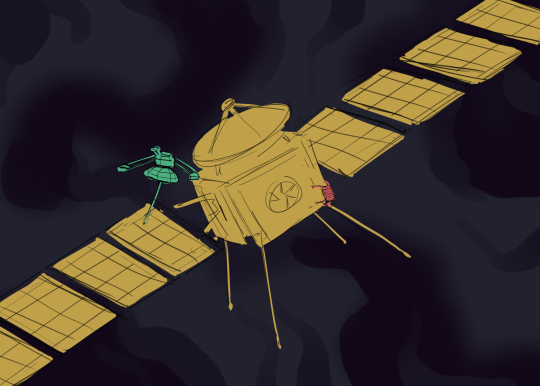

 just moving along like everyone else