Ho boy Anon this is a doozy of a prompt, very full of long fic potential. Also tragic as hell. I mean, I’m not gonna go for broke with the angst but I’m not going to shy away from it either. Hopefully this is something like what you were looking for. I’m sorry about this, by the way. It kinda meanders about and reads like a prologue.
Todoroki Shouto met Midoriya Izuku at the tail end of spring during the heart of the decade where magic became a myth. When they first met Shouto was older than Izuku. Not by a lot, just by a few years. That didn’t stop Shouto from falling for Izuku, for his smile and his bravery and his selflessness. For Shouto, Izuku is the brightest star.
Time, though, has no hold on witches. Izuku had understood from the beginning. The world of magic was dying out from public memory but Izuku accepted it as part of Shouto anyway. For a while, life was wonderful. Shouto would make sculptures of living ice in the summer for Izuku to marvel at and in the winter the fires would dance at his word. In their house the dishes do themselves, mirrors double as secret passageways, and the basement gives you whatever you ask for as long as you’re polite. Izuku never lost his childlike wonder at all things magical, at all things Shouto, even as his hair streaked gray and his freckles became harder to see thought the wrinkles.
Izuku grows old and Shouto stays a young man, forever twenty-three. Izuku calls him a miracle.
Magic is still as thick in the air as ever but with few and fewer people attuned to it Shouto finds himself unique where he was once one of many. Izuku’s right knee becomes weak, sometimes giving Izuku so much trouble he struggles to walk. Shouto watches Izuku deteriorate and he wishes that he had the skills to fix it, to make it painless. Shouto is not that kind of witch and once upon a time he knew someone who was but they were burned away. Izuku starts to age, starts to say things like “when I die you should get a pet so you’re not lonely”, and Shouto is gripped by fear. He starts looking for a witch that can turn back time on Izuku, that can make him young again.
He finds no such witch. He keeps looking away.
“Have you talked to your mortal about this?” Asks Nedzu when Shouto finds him. He’s an old man, tiny and wrinkled, but Shouto knows better. As old as he looks Nedzu is actually much older and much more powerful.
“I did,” Shouto admits.
“And what did he say?”
Shouto wrings his hands. “He said that he doesn’t want to live forever, that cheating death will do more harm than good to him in the long run.”
Nedzu chuckles. “He’s right, you know. Mortal bodies can’t take the strain.”
“Then what am I supposed to do?” Shouto demands.
Nedzu eyes him, tiny black eyes under large white eyebrows. “You could try letting him go.”
Shouto looks away. “That’s not possible.”
Nedzu sighs. “Young love is so earth-shattering. What are you, two hundred years old? You’ll fall in love many more times, young Todoroki.”
“I’d burn myself away without Izuku,” Shouto says and Nedzu falls quiet enough that Shouto looks back at him. The old man looks serious.
“There is a way. It’s not very wise, though, and completely irreversible.”
“Anything,” Shouto says.
“You’d even kill your mortal?” Nedzu asks and Shouto is taken aback.
“What?”
“The process will kill him,” Nedzu says, “but I can help you link his soul to yours. He will always return to you, across time and space and death itself. I cannot guarantee that he will love you, only that you will share your fate with him.”
Shouto hesitates, but only for a second. Killing Izuku once pales in comparison to the horror of existing in a universe without him. Shouto imagines Izuku, strong and passionate and kind, disappearing for good from the world and finds the strength to say, “Okay.”
Nedzu sighs. “Young love is so earth-shattering. Let me draw up a list of supplies and you can return to me when you’ve gathered them all, but you must return before your mortal dies. If he dies on his own there’s nothing I can do.”
Shouto nods, Nedzu grows a list from the bamboo plant in his living room, and then it’s a race against the clock. Some ingredients are easy, Shouto is a witch after all. His garden already has a lot of the herbs and his basement can conjure up some of the creature parts. Other things, though, are hard. Izuku’s blood is probably the hardest, not because it’s hard to get but because it’s hard to get without Izuku asking any questions. Shouto doesn’t want to tell him what he’s doing, doesn’t want to hear Izuku’s objections. He doesn’t want Izuku to change his mind.
Finally Shouto brings the ingredients to Nedzu and the old witch gets to work. Shouto hovers anxiously, doing everything he’s asked promptly. In the end, Shouto sits in Nedzu’s back yard in front of a dish of water, still and reflective as glass, within which Izuku sleeps. His hair is nearly white now and his chest rattles with snores he didn’t used to make. Shouto watches him, perfectly still as Nedzu paints a script on Shouto’s chest in Izuku’s blood and runs the herb mixture down from it to the wedding ring on Shouto’s finger. Shouto breathes slowly and Nedzu pulls a spike made of moonstone and jade from the earth. He positions the point of it carefully over Shouto’s heart.
“Ready?” Nedzu asks. “Once this is done we can’t take it back.”
Shouto breathes out and watches Izuku sleep in their bed through the scry. “Yeah.”
Nedzu starts the chant. Izuku blinks awake as though he can hear it.
“Forgive me,” Shouto whispers to him and Nedzu drives the spike into his heart.
It hurts, of course it hurts. It burns through his blood vessels, curling around inside him until he thinks he might die from it, and someone screams. It might be Shouto, it might be Izuku, and the sound of it knocks Shouto out.
He comes to only a few minutes later, slumped over on the grass. Nedzu drinks tea under the setting moon ten feet away, completely unconcerned.
“Did it work?” Shouto croaks.
“I would call it a success, yes,” Nedzu says, eyes falling to Shouto’s left hand.
Shouto looks down to his ring to see it sparkling unnaturally in the moonlight, as if it’s been dusted in a very fine glitter.
“Izuku?”
“Is being born again somewhere as we speak,” Nedzu says. “Congratulations.”
goes to her knees in the mud of Pelennor Fields, and rises up a Queen—split lip and still reeling, blinking up at
Eldwyn
as though it will somehow change what she has become.
He touches the crown of her head with his hands, and says, “I am sorry. I pray it is enough.”
It is. It isn’t. It is both. Théoden is dead and Éomer lost, never to wake from the feverish sleep of a Black blade, there is only her. She is all Rohan has left, and Éowyn wonders if they are glad of it, her decision to ride for Minas Tirith instead of throwing in her lot with the other women.
(At the very least, it makes the coronation easier. She is there, in the mud, already. No need to send for a man, her hair falls over her shoulders in a cascade of Rohirric
gold.)
Still—Aragorn looks at her oddly when she strides into the Merethrond wearing the shield and helm of
Eorl, the Horse-lords’ sigil painted in flaking gold on her breast.
“You called,” she says, taking her place at the Council-table without so much as a by-your-leave. “And the Oath of Eorl is fulfilled in me.”
In Gondor, they call her names after some creature of their mythological past—Health, or something like. They have a tendency to do that, she’s learned, Gondor is so in love with its own stories.
In Rohan she is only Éowyn, Queen,
daughter of Éomund.
(It also keeps her from becoming too proud, the knowledge that most of Edoras remembers her running shiftless through the Meduseld, shrieking at Éomer to give her back her poppet.)
She becomes close with Faramir, son of Denethor, in wake of Pelennor—they are both thrust, an ill-prepared, into a role they had not expected to play. After all, she was three persons removed from Rohan’s crown, and he was the younger brother of the immortal, burning Warden of the White Tower; neither of them had ever imagined being here.
“I will miss you most,” she says stiffly, once it all has calmed, and the Men of Rohan are free to return to their plains and stables. Faramir, son of Denethor, smiles in a way that makes the light of him shine through. Her chest aches. “I as well,” he says, and she is grateful for the pace Winfrith sets as they ride for the border after, the wind dashing her tears away.
They greet her with—only slightly less joy than they might have greeted her uncle, and Éowyn rides through the streets she knows well, touching hands and murmuring thanks and thinking, you are Rohan’s now, you are King of the Mark, earn it. Deserve it.
Being King is slightly less tedious than being the King’s niece, if only because they must listen to her now. She holds counsel, so when they mutter to one another and complain about her unwomanliness, she is already there. She may glare at them, pointedly, until they stop.
The news from Minas Tirith comes late, and piecemeal—she doesn’t hear about Aragorn riding for the North until they are on her doorstep.
“King Dernhelm,” Aragorn says, embracing her like a king instead of bowing to a queen. Éowyn laughs and kisses his hands, calling him Royal Elf-fucker in Rohirric. (She’s not sure he understands, but more than one of her men suddenly erupt into coughing fits, so that’s enough.)
“Why are you riding north, Aragorn?” she asks. The welcome feast is burning itself out, and Meduseld is almost dark; only
Éowyn and Aragorn remain. Two kings—alike in dignity, and equally conflicted about who they are to be now. (Aragorn is a Ranger-king, and she is a Shieldmaiden-queen, they understand one another, this way.)
“My people have suffered,” he said, sounding morose—she could have guessed he’d be graven, once the drink got to him. “The darkness in the East is only one enemy, there is—old darkness, that lingers still in the North. I must protect my people.” “All of Gondor are your people now,”
Éowyn said quietly, murmuring mostly to the mug of beer she lifted to lips. (Aragorn is High King, but in a way she understands him—Rohan is her people, still, no matter how longingly she thinks of the warfront, of Minas Tirith where the news comes from.)
Afterwards, she foists him onto one of his second-lieutenants, or—something like it, a Gondorian soldier with soft grey eyes, who assures her he will get the High King back to his bed. “Take care,” Éowyn says, “he is my friend.”
(She is surprised—lying in bed, staring up at the plaster ceiling, chewing on her lower lip—to find it is true.)
“Do you ever regret it?” Aragorn asked as they departed, his head tipping forward heavily—it might have been the leftover of his drinking, if there hadn’t been so much shame in his eyes.
Regret, that was a better word. So much regret.
And Éowyn thought of Faramir, son of Denethor, who was dark and fair both, and she thought of Eomer, her brother, who might have been king in her place, and she thought of Aragorn, King to Come, who was more a story than anything else. More than a person.
Except where he cared for Northmen above all else, despite himself. That was real, she suspected, if only because it was so inconvenient to his overall political goals.
The Director leans forward over her desk, her face drawn and intent. “So I suppose you’re wondering why I called you three in h–”
“Actually, Madam Director,” Taako interrupts, “I’m wondering how you got this lavender tea so right.”
The Director blinks. “I simmer the lavender blossoms in a saucepan with water and honey, because I’m not a fucking barbarian. Twenty minutes, dash of vanilla, the whole thing. Anyway–”
“It’s good tea,” Merle pipes up.
“Thanks, Merle. So–”
“Hold up, hold up. Holllld up.” Taako actually raises his hand. “How– okay, I mean, what the hell, that’s exactly how I make lavender tea, how’d you know?”
“I know everything, I’m the Director.”
“Are you spying on us?” Magnus says, suddenly interested.
“I can, uh, no, I can’t confirm that, or, deny, that horrific breach of employer-employee confidentiality. I probably just know that stuff because of all the cool superpowers you get when you’re in charge of a secret moon-based operation.”
Merle waves his hand enthusiastically. “Hey, what’s tattooed on my butt!”
“Kenny Chesney, which I know on account of you came into my actual office with your whole entire ass hanging out.”
“It was like three quarters, max,” Magnus says. “Hey, what’s my favorite tea?”
“You think tea is for chumps.”
“I do,” Magnus says, earnestly pleased.
“Does anyone have any non-tea related questions?”
Merle waves his hand again. “Do you know about our secret st—“
“Taped under Magnus’s bed. Yes.”
“Aw,” Magnus says to his tea.
“For someone with such extensive woodworking proficiency, I really thought you’d have, like, a secret drawer somewhere,” the Director says thoughtfully.
“Hey, taped under the mattress is a classic,” Taako says.
“It’s very, mm, very college hijinks, reminiscent, very Animal House.”
“Bullshit, you never watched Animal House,” Merle says.
“I may— I might have. You don’t know.”
“Name one— name one scene! Just one! Gimme a quote!”
“I don’t have to, because I’m your boss. Can I get back to telling you about your new incredibly important mission to save the whole— basically the whole entire world, already, or do you want to waste more time playing Fantasy fucking Trivia?”
The three Reclaimers look at each other, and then Taako uses mage hand to pour himself more lavender tea.
“What’s Merle’s favorite tea?” he asks, grinning, and the Director drops her face into her hands.
“Chamomile,” she says, in the grave, sorrowing tones of one who must bear the unbearable, year after thankless fucking year. “He thinks it’s sexy.”
You got it, my friend! (I hope this is okay… Iida is hard to write. XD)
7. “How long has it been?”
When Midoriya finally comes clean about his Quirk – about One For All, about All Might, about his life before Yuuei in general – his classmates had asked the obvious questions, such as ‘what was it like’, ‘how long did it take to master’, and ‘why didn’t you tell us sooner, you dummy, we could’ve helped you’ (that last one came from Uraraka, and was accompanied by a light karate chop to the head).
Only a few people deviated from the questions Midoriya had anticipated.
Asui had asked, “What do you intend to do now that All Might no longer has his powers?”, to which Midoriya had squirmed for an answer before giving up and shrugging helplessly.
Hatsume had asked, “Can I try to modify your costume so that you can turn the energy from your Quirk into laser beams?”, which Midoriya – as well as a very disgruntled Aoyama – immediately told her was not going to happen.
Bakugou had asked (well, ‘screamed’, really), “Deku, you fucking fuck, you better not be looking down on me,” which had been followed by a series of creative insults, death threats, and Bakugou getting dragged out of the room courtesy of Uraraka and Kirishima while the other students laughed wildly.
Iida had asked, “How long has it been?”, and that had gotten the attention of everyone still in the room. Midoriya had given him a grateful smile – most likely a ‘thank you for not asking me something stupid like Kaminari was about to’ – and had simply said:
“I got it on the day of the Entrance Exams.”
For some reason, that sticks in Iida’s head. The very first day they had met, Izuku had destroyed the robot threatening Uraraka – something no one else had even tried to do – and that was the first time he had ever used his Quirk.
A sense of wonder blossoms within Iida, because suddenly so many things make sense. Of course Midoriya relies more on his brains than his brawn – he’s had the former for much longer. Of course Midoriya had had absolutely no control over his powers – he’d only just received them.
Despite the awe he feels at his classmate’s accomplishments, Iida can’t help but feel a little bit envious. Midoriya had worked hard to get where he was; he had earned his power. Iida had simply been born with it. Iida had gotten into Yuuei because he had been fortunate enough to get a Quirk that allowed him to be a hero, but Midoriya had received his Quirk solely because All Might had realized that he already was a hero.
A tiny, nasty voice in the back of his head tells him that he should feel ashamed, but he doesn’t. He feels inspired. Midoriya makes him want to become more, makes him want to become even better than the best he can be.
Go beyond, he thinks to himself.
Plus Ultra. Everyone has their own, and Iida’s takes the form of a small yet muscular boy with a mop of black and green hair, hopeful green eyes, and the light of the sun shining in his smile.
Practice was just as grueling as it’d always been.
Regardless that Midorima had just been in an important match
against Jabberwock, Coach Nakatani didn’t take it easy on him. Even as he used
his selfish requests (now cut down to merely two a day), the coach would find
ways around it. Even compared to Teikou and their training last year, it felt
particularly brutal.
It was strange, Midorima thought, how much had changed when
their third-years graduated. The whole team had to be changed, plays rethought
and strengths reestablished and trust reformed. He expected it the moment he
attended Shuutoku, but being the complete cornerstone for the team and having
everyone depend on him until they sorted things was difficult.
And yet, he mused as he shot from the half-court line,
nothing had changed. From how Coach Nakatani ran them until it felt like they’d
break. From how Takao still joined him for every after hours practice. From how
Miyaji Yuuya threatened him with all kinds of bodily harm for bringing another
gigantic tanuki and keeping it on the bench.
Of course, their thirst for victory—clawing for wins like it
was life and death because it was—hadn’t changed at all.
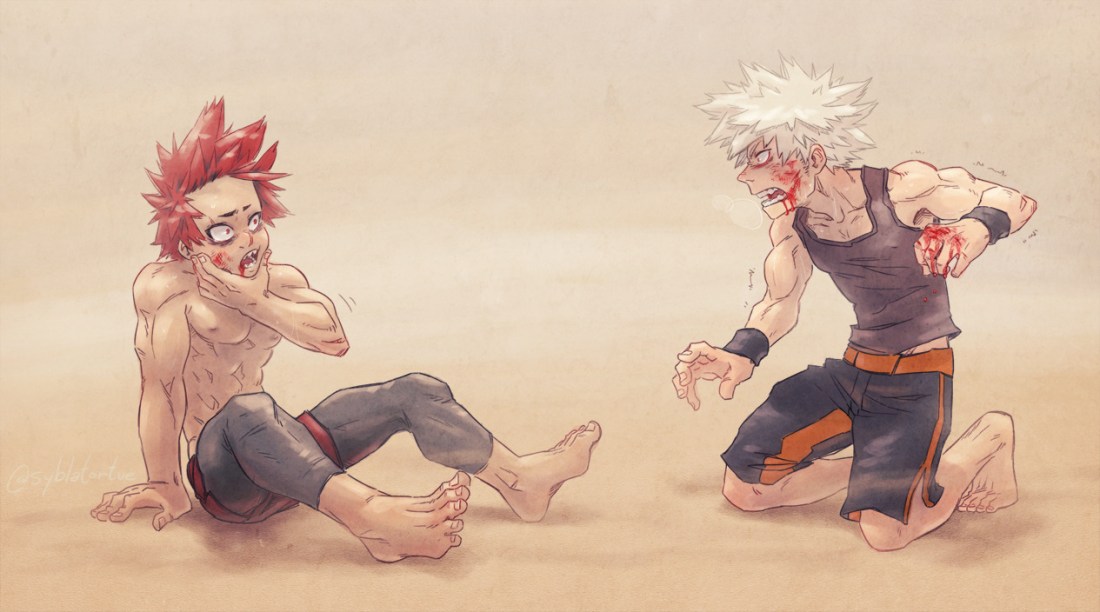
When he finally came to awareness, he was sitting on his ass on the floor holding a hand to his jaw. Bakugo was on his knees a few feet in front of him, bloody-knuckled fist still raised as if he was preparing to strike. His eyes were wide and wild. His teeth were bared. He looked furious and so incredibly worried as he breathed hard. The left side of his face was red, and blood smeared from the corner of his mouth.
PART ONE OF TWO || Where Johnny goes, the Devil follows; where Johnny goes, the Devil is already there.
He does try to play the thing
once or twice.
But a fiddle of gold is heavy as
shit, and the sound’s all wrong—loveless, and cold as Hell, with vicious
strings that split Johnny’s fingers when he plays. (There’s never any blood
when he looks, and Johnny wonders if it’s drinking him up, dry; leaving scars
at his fingertips and an ache in his hand that won’t quite ease. Then again,
it’s the Devil’s instrument; it can probably do any evil thing it likes.)
In the end, he loosens the
bow-hair and puts the thing away in a battered, borrowed case, goes back to
playing his box maple. Wood is living, it breathes and breaks; swells like your
best girl’s clit under your tongue, shivers like a warm wind through leaves.
Wood remembers the sun, wants to sing about it.
There’s nothing gold wants to sing
about, except being dead.
Johnny’s playing the maple that
night at the Bellows Club—well, used to be ‘Club’ until the owner’s second wife
decided they were destined for better things, had it rechristened ‘Café’. The
Tuesday-night regulars are the same, though, and they whistle or lazily applaud
when he finishes his set, greet him by name after he’s put the fiddle away and
come down off that high-as-Heaven stage. Johnny wades out among them to make a
little small talk, then wanders his way to the bar.
……..also while I firmly believe that T’Challa, Nakia, and W’Kabi went to the same schools that all children in the capital city attend (because Wakanda isn’t about to socially stratify its educational system—rich or poor, royalty or no, all children from all tribes attend the Wakandan schools) they also had a whole bunch of additional lessons. As royalty and de facto nobility, they were being raised with the expectation that they would one day rule, so they were stuck in lots of boring English/French/Mandarin lessons; lessons on the laws of Wakanda and the intricacies of the Council’s etiquette, etc.
And then, when they’re a little older they have combat and warcraft; statecraft lessons with the Dora-in-training, and this is when they meet Okoye. She’s a gawky teenager—taller than all of them, she had her growth spurt first—who scowls whenever they whisper or giggle in class. (She is not from the capital city, her Wakandan still accented; later they learn she traveled hundred of miles with nothing but her pack, just to come before the head of the Dora and throw herself on her knees, begging to be considered. She has sweat and bled for it, and she thinks they are not taking their duty to Wakanda seriously enough.)
Still, despite being stiff and disapproving, she’s smart, and fierce; the other Dora-in-training seem to look up to her and like her. (They also have gone disapproving and haughty when it comes to the Trio.) However, maybe a year into their lessons, the Dora-hopefuls play a hilarious prank on their Modern Politics instructor. It involved a jackfruit, a pun on the Wakandan word for colonialism, and their teacher’s inability to remember anyone’s names; it was extremely funny.
And T’Challa, Nakia and W’Kabi are floored when they discover it was Okoye who planned it—they didn’t think she had a sense of humor, or was capable of something like a prank, even if it was a hilarious and generally harmless.
They decide they like Okoye immensely, and she should be their friend. They put their heads together, and carefully plan charm offensive—behaving in class so she doesn’t glare at them, asking to sit with them and eat with them; inviting her to the market with them and encouraging her to tell stories. The Dora-hopefuls live in the barracks, so they cannot invite her to sleep in T’Challa’s rooms, the way W’Kabi and Nakia often do, but they would have her study with them there.
This, they think, is a good plan.
She looks spooked, the first time Nakia asks her to sit and eat with them in the gardens beyond the Dora training building. Okoye sits cross-legged and stiff, barely touches her food, her eyes darting around as though she is a trapped animal. When Nakia reaches out—just to indicate the tattoo on her shoulder, ask about its meaning, she was not going to touch her—Okoye flinches.
Title: The Miskatonic Project Rating: PG-13 for horror themes, death Summary: Abraham Erskine may have invented something new with the Serum – or maybe he re-created something very old. Something…Elder. Notes: I should be working on like three other fanfics but I had a TERRIBLE DREAM this afternoon and anyway this only took about half an hour to write.
***
Steve came out of the Vita-Ray machine…different.
Of course he looked different – taller, thickly muscled, skin gleaming. But it wasn’t the change in his appearance so much as the…sensation people felt around him. Howard claimed not to feel it, and Erskine died before he could weigh in. Peggy felt it, but not in the way others did. To her, he seemed otherworldly, but like an angel or a religious vision – comforting under a layer of unreality. She even liked the strange black pupils he’d developed, so big and dark you could hardly see the whites of his eyes at all.
Others, however….
She didn’t see him pull the Hydra agent out of the submarine after Erskine’s assassination. Only three people did – a cab driver, a little boy, and the boy’s mother. The cab driver wouldn’t say a word, and the boy’s mother stuttered and stammered so badly they finally gave up. The little boy just said, “Well, he got him,” and looked admiringly at Steve.
Steve wasn’t wet, but the submarine lay on the deck of the pier, and the man next to it was dead, a rictus of horror on his face.
Short, I said. Easy, I said. Definitely won’t take long, I said….
Aaaand here we go with part two…
***
On the first night they made camp, Peggy found herself surrounded by men – not in the sense that she was the only women, but in the sense that they actively, intently surrounded her. They weren’t impolite, exactly, but they had just come from a place of desperation and fear, and were happy to be alive, and all that…entailed. Their presence, their willingness to bring her tins of food or start a fire for her, the warring exhaustion and relief and want, pressed in on her insistently.
And then suddenly it was like the sun rose and the air cleared – and she saw why.
“Gentlemen,” Steve Rogers said, appearing from the darkness, lit by the fire and with Sergeant Barnes at one elbow, Sergeant Dugan at the other. The men all took a sort of spiritual step back. “How about you tired soldiers find places to bed down for the night.”
They cleared out fast. Steve looked at her, a question in his bright face, and she nodded. He settled in, others joining him – Dugan, Jones, Morita, Dernier and Falsworth, names she’d learn later. Steve sat on a fallen log one of the men had dragged over earlier; James Barnes sat at his feet. These men were calmer, and she sensed that they, like her, saw angels rather than devils when they looked at Steve and Barnes. They were here with her, not because of her.
“I was capable of looking after myself,” Peggy felt obliged to point out.
“Sure, but why should you have to?” Barnes said. Steve’s eyes still looked, at least in some lights, mostly normal. Barnes, you couldn’t see the whites at all.




 just moving along like everyone else