



This is his Jokers first day on the job, and he’s being such a good boy.
Donald W. Cook is a Los Angeles attorney with decades of experience bringing lawsuits over police dog bites — and mostly losing. He blames what he calls “The Rin Tin Tin Effect” — juries think of police dogs as noble, and have trouble visualizing how violent they can be during an arrest.
“[Police] use terms like ‘apprehend’ and ‘restrain,’ to try to portray it as a very antiseptic event,” Cook says. “But you look at the video and the dog is chewing away on his leg and mutilating him.”
Cook says the proliferation of smart phones and body cameras is capturing a reality that used to be lost on juries. “If it’s a good video,” he says, “it makes a case much easier to prevail on.”
The new generation of videos is capturing scenes of K9 arrests that are bloodier and more violent than imagined by the public. An NPR examination of police videos shows some officers using biting dogs against people who show minimal threat to officers, and a degree of violence that would be unacceptable if inflicted directly by the officers.
…
In fact, in many videos, the release of a dog appears to escalate the violence of an arrest.
“You just look at the dog as the source of pain and you do everything you can to address that pain,” says Seth Stoughton. He’s a former police officer, now an Assistant Professor of Law at the University of South Carolina who studies police use of force. “Those shouted commands — you’ll deal with that later, when the pain stops.”
And yet suspects who kick and try to shake the dog off are often accused of resisting arrest.
i don’t care what this dog in particular is being trained to do. furthering the idea that police dogs are somehow cute or good directly contributes to injustice and the perceived acceptability of police violence
My aunt rescues and rehabilitates german shepherds, and the vast majority are failed police dogs. The rehab process for these dogs is intense. They are trained to be hyper vigilant and to resort to violence. They are often is worse condition than formerly abused animals.
I spent a summer training one of these balls of anxiety. She was too fast and strong for my aunt to train her, so I did it. The biggest hurdle was getting her out of the mindset that biting someone gets her a treat. I had to let her bite my arm, forcible break the hold, and kennel her all without giving her a response because these dogs are trained to equate someone screaming at them as Go Time.
By letting her attack me and showing her that I was stronger than her and then not allowing her to play with the other dogs was what finally got her to stop attacking whenever she heard a loud noise or was surprised or just felt like it.
She still had to be homed in a gun-free, pet-free, child-free home because of the sheer anxiety she was bred for. These dogs are not cute, they are horribly mistreated.
Do you think regular dogs see police dogs and think “oh shit, it’s a cop”
My service dog avoids them b/c their trained to be aggressive and look threatening at all times which means their body language is a warning when non aggressive dogs look at them. If ur dog avoids confrontation like mine, then they will generally avoid police dogs.
Scientists invented a pill that enables dogs to fully speak and understand English. It lasts for ten minutes, and will only work one time. You give a pill to your 12 year-old Border Collie, whom you’ve had since they were a pup. Your dog immediately says “Alright, listen very carefully…”
“…you have always been the good boy. You get down on yourself but the good boy was you all a long.”
“Lie close,” Laura said, Pricking up her golden head: “We must not look at goblin men, We must not buy their fruits: Who knows upon what soil they fed Their hungry thirsty roots?”
A wolf goes for a walk in the woods and meets a dog for the first time
that wolf-meets-dog-horror comic got me thinking about werewolves and how different kinds of werewolves must have very different feelings about dogs. like, my erskin was born a wolf and remains very staunchly a wolf in terms of his self identity. his boyfriend bel just got turned into a werewolf a couple months back. and they stand at totally polar ends of like… the werewolf opinion spectrum on dogs.
like, erskin finds dogs to be kind of pathetic, mutated idiots— part alien child and part alien toy. he’ll go to a dog park sometimes for funsies, like you might go to the circus and laugh at the clowns, but he doesn’t respect dogs or want to interact with any of them on an ongoing basis. he would probably eat a dog if he was hungry enough and got the drop on one. he might actually have already eaten a dog. he’s definitely eaten foxes. in contrast, he thinks of wild wolves as people, just people who aren’t as smart as his relatives. they look and sound like people.
bel is like overwhelmed with delight and joy that as a werewolf he can communicate with other canids and is busy disney princessing it up with every fox and coyote and chihuahua he comes across. humans and dogs are just predisposed to like each other: being able to communicate even more clearly with each other due to lycanthropy just tightens and reaffirms that bond.
so i bet wolfish werewolf families have no dogs whatsoever, and humanish werewolf families have two to three times as many dogs as werewolves. mixed families have… a lot of friction.
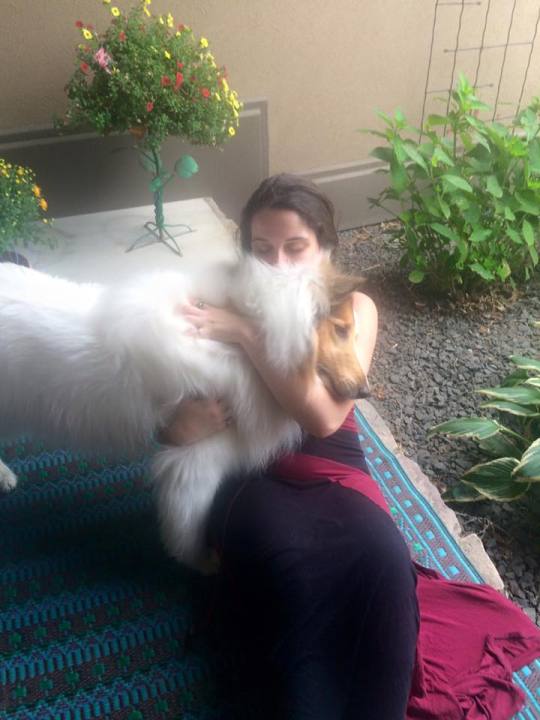
As a dog trainer, I can tell you that probably 50% of dogs really don’t like hugs and at least another 48% pretty much just tolerate them. Very few dogs I know genuinely like hugs the way humans tend to give them. What’s funny is that the picture that Fox used with this headline is one of the more common ways dogs do enjoy contact that humans would consider a hug.
Stanley Coren – the dude who wrote the article that is pissing everyone off about this – really does know what he’s talking about. He wrote one o my favorite books, called how to speak dog, which has some absolutely beautiful diagrams of dog behavior and body language along the gamut of extreme situations.
The way humans hug dogs is often really uncomfortable for them. We lean over them and trap them (think how many dogs we already know are spooky when you loom over them, but are fine if you get down to their level), and then we restrict their ability to move and shove our faces close to theirs. That’s not fun. Keep in mind that most dogs have personal space bubbles that are larger than we tend to think, and now you’re not only invading it, you’re making it so they can’t move or defend themselves if something happens.
Look at this photo from a couple years ago. Avalanche is probably the most tolerant dog I know of things that press his physical boundaries – he lets little kids do things to him that make me cringe and doesn’t even seem to notice half the time. This was right before I had to head back to college and I knew I wouldn’t see him for another 6 months, so I hugged him because sappy human emotions. I have an amazing relationship with this dog, and look at his body language. He’s kinda stiff, his face is a little tense, and the corners of his mouth are pulled back a little. All in all, he’s supremely un-enthused but he’s letting me do it. After about five seconds, he huffed out the sigh he uses to let me know when he’s done with the hug, and then pulled back and shook off.
Most dogs learn to tolerate hugs because we do it to them so often. It’s pretty much a kind of learned helplessness, plus, they like us and so they put up with our stupid human behavior. When you hug most dogs, you’ll notice they get kinda stiff, they look away or at other humans for help, you’ll see side-eyes or look-aways (not whale eye). Often they’ll distract you by doing something else like pawing at you, or licking your face as an appeasement signal. They’re all signs of discomfort that we already routinely ignore when we deal with our dogs, so it makes sense that people think their dogs are fine with it – they’re just still not listening.
More often, you’ll get dogs that will crawl up your chest when you sit and put their paws on your shoulders. Sometimes their face is close to yours, sometimes it’s on your shoulder. In that position – which they often initiate – they ca easily withdraw and get away if necessary and they’re not trapped or being leaned over. It’s not really a hug, just close contact, but I think it’s about as close as humans are going to get to one that a dog will enjoy.