thebibliosphere:

alwaysatomicconniseur:

ruffboijuliaburnsides:

mistersaturn123:

a-can-of-mountain-jew:

dragonenby:

tabbitcha:

lemonade-cat:

talkearlietome:

cartel:

hotboysofficial:

the future is now

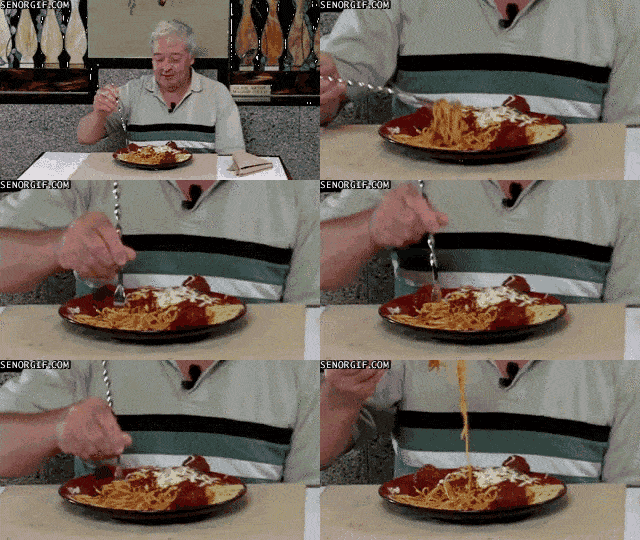
are people that lazy to need this

While I’m sure there are people too lazy to spin a fork, keep in mind people like this person who may be suffering from arthritis or a neurological disease or nerve damage or a thousand other conditions that might impair their ability to do things as simple as spin a fork to eat spaghetti. 

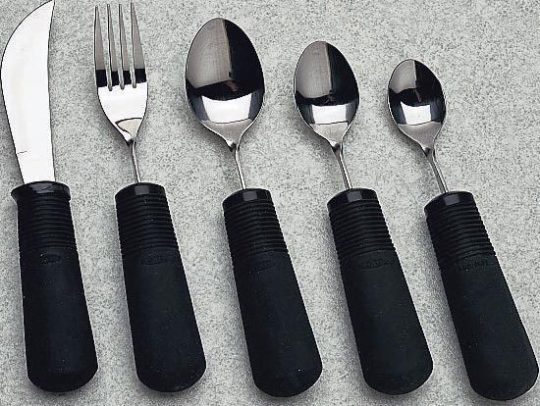
These are used with people who can’t grip well: 

image

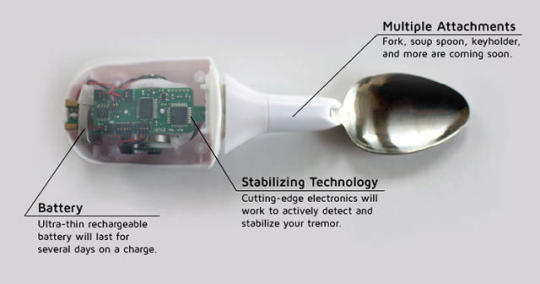
This is for Parkinsons’s: 

image

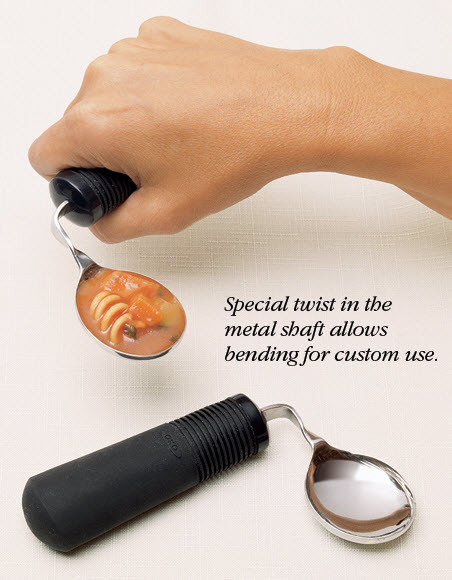
For people who can’t even bend their joints: 

image

Here’s a product that guides your hand from your plate to your mouth 

image

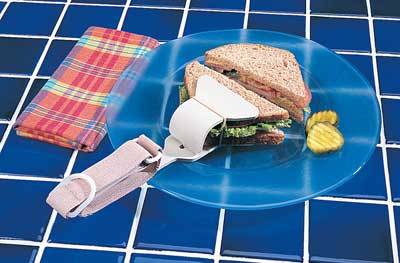
This one holds a sandwich 

image

Like I get it. I used to see things like the fork and think “that’s fuckin’ lazy” or that product that holds a gallon and you just tip it and pour. But then I started working around the disabled and impaired and found out that these products aren’t meant for lazy people, they’re meant for people who need help. 

So maybe next time you see something, instead of thinking “Wow, are people that lazy?” just be grateful that you’re able to do the things you do every day and take for granted, like being able to feed yourself and wipe your own ass because you have enough coordination and bendy joints to do it. 

This isn’t specualtion either; the majority of products from commericals that we think are funny or silly are autally MEANT for hte disabled.But they are marketed towards the abled because the disabled aren’t considered a viable enough demographic on their own.

the Snuggie for example? Created for wheelchair users.

This is actually really nifty.

oh my god of course the snuggie was for wheelchair users

The fact that anyone buys these products besides disabled people drastically lowers the price of them. These would normally cost hundreds if not thousands if dollars. Because if spent time and money creating it, the company wants to get more than that back. And they can’t do that if they sell and market these primarily to disabled people for $20-$40 a piece or whatever. They’d lose money on production. If they can sell hundreds of them to everyone, they can lower the price drastically and therefore disabled people don’t die while trying to scrape up the money to buy these things and be a bit more independent.

I never considered that last part and that’s actually genius

Like yeah, a handful of people ARE that lazy.

But those are the people who use these products even though they don’t need them and thus allow the price to be lower for those who DO.

So honestly in this case good bless the lazy and those prone to gimmicks because they are invaluable to the elderly and disabled in this sense.

@thebibliosphere Look! People learning about disability and why to be kind!

The normalization of disability aids needs to be a thing precisely so they can cost less.

oockitty:

coldalbion:

grace-and-ace:

neddythestylish:

memelordrevan:

rosslynpaladin:

iamthethunder:

s8yrboy:

“If autism isn’t caused by environmental factors and is natural why didn’t we ever see it in the past?”

We did, except it wasn’t called autism it was called “Little Jonathan is a r*tarded halfwit who bangs his head on things and can’t speak so we’re taking him into the middle of the cold dark forest and leaving him there to die.”

Or “little Jonathan doesn’t talk but does a good job herding the sheep, contributes to the community in his own way, and is, all around, a decent guy.” That happened a lot, too, especially before the 19th century.

Or, backing up FURTHER

and lots of people think this very likely,

“Oh little Sionnat has obviously been taken by the fairies and they’ve left us a Changeling Child who knows too much, and asks strange questions, and uses words she shouldn’t know, and watches everything with her big dark eyes, clearly a Fairy Child and not a Human Like Us.”

The Myth of the Changeling child, a human baby apparently replaced at a young age by a toddler who “suddenly” acts “strange and fey” is an almost textbook depiction of autistic children.

To this day, “autism warrior mommies” talk about autism “stealing” their “sweet normal child” and have this idea of “getting their real baby back” which (in the face of modern science)  indicates how the human psyche actually does deal with finding out their kid acts unlike what they expected.

Given this evidence, and how common we now know autism actually is, the Changeling myth is almost definitely the result of people’s confusion at the development of autistic children.

Weirdly enough, that legend is now comforting to me.

I think it’s worth noting that many like me, who are diagnosed with ASD now, would probably have been seen as just a bit odd in centuries past. I’m only a little bit autistic; I can pass for neurotypical for short periods if I work really hard at it. I have a lack of talent in social situations, and I’m prone to sensory overload or you might notice me stimming.

But here’s the thing: life is louder, brighter and more intense and confusing than it has ever been. I live on the edge of London and I rarely go into the centre of town because it’s too overwhelming. If I went back in time and lived on a farm somewhere, would anyone even notice there was anything odd about me? No police sirens, no crowded streets that go on for miles and miles, no flickery electric lights. Working on a farm has a clear routine. I’d be a badass at spinning cloth or churning butter because I find endless repetition soothing rather than boring.

I’m not trying to romanticise the past because I know it was hard, dirty work with a constant risk of premature death. I don’t actually want to be a 16th century farmer! What I’m saying is that disability exists in the context of the environment. Our environment isn’t making people autistic in the sense of some chemical causing brain damage. But we have created a modern environment which is hostile to autistic people in many ways, which effectively makes us more disabled. When you make people more disabled, you start to see more people struggling, failing at school because they’re overwhelmed, freaking out at the sound of electric hand dryers and so on. And suddenly it looks like there’s millions more autistic people than existed before.

“…disability exists in the context of the environment.”

Reblog for disability commentary.

That last paragraph is absolutely important.

unlimitedtrashworks:

the-daughters-of-eve:

atalantapendrag:

squidsqueen:

ladydrace:

Has anyone else noticed how, when you have a chronic condition of some kind, that there’s always the basic assumption from people around you that you’re not already doing everything you can?

It’s all about the illusion of control. People who are healthy like to believe they can always keep being healthy if they do the right things. They don’t want to think about how good people get struck with terrible circumstances for no reason.
So they keep assuming that if they got sick, they could do something to make it better.
And if you’re still sick, that must mean you’ve done something wrong or not done enough.

Nail. Head. The same attitude can be seen in how a lot of people talk about poverty.

And sexual assault. All they have to do is not go there not drink that not wear that not date them and they’ll be fine, right?

The Just World theory – that as long as I do everything right, I’m safe, and everybody who isn’t safe is at fault for not doing everything right – is perhaps the most harmful and widespread mindset today

if you ever see a conservative and wonder just how in the world they have so little compassion?  they are genuinely convinced that most – not all, but most – bad things that happen are the fault of the person affected, because then they don’t have to feel bad

somebody explaining this to me as a young adult was, quite literally, the start of me seeing the world in a new way and moving considerably to the left politically. by letting go of the just world mindset my conception of reality shifted considerably

What is the curb cutter effect

tatterdemalionamberite:

Here’s a post talking about it WRT interaction badges at cons:

“The Curb-Cutter Effect is when something to fit a specific need is found to create convenience in a broader area than intended.  Curb cuts allowing for wheelchair accessibility to sidewalks proved to also be convenient to anyone who may have trouble with steps or even simply a mother with a baby stroller or maybe a child with a wagon.  This is a desirable outcome with disability rights advocacy as creating convenience for non-disabled people often makes the assistive technology easier to advocate for.”

Or, in a series of examples: 

When moms with strollers use curb cuts, they also start demanding them and supporting them, and the sidewalks become easier to traverse for people in wheelchairs.

When neurotypical people use badges to indicate their interactional boundaries, curb-cutter effect makes it easier for neurodivergent people to do the same.

When a bunch of folks who can tolerate wheat decide they like gluten-free bread, it becomes easier for people with celiac disease to find it at the grocery store.

When asking people to tag their content becomes normalized, it means that people with severe triggers are less likely to encounter confusion or disdain when they ask. 

When able-bodied people understand spoon theory, it becomes easier for those of us who need it to talk about it. 

When people with mild mental health problems see a therapist, it makes it easier for that therapist to stay in practice and see their more vulnerable clients.

When people who aren’t direly affected by dysphoria access trans health care, the increased demand familiarizes more primary care doctors with an area of medicine they should all be able to practice, so that when people with severe dysphoria seek care, it’s less likely to require moving to another city or state.

TL;DR convenience users of any service or assistive technology are the shock troops of accessibility and I love them. 

pilferingapples:

marauders4evr:

See, the problem with people who aren’t in wheelchairs writing about and/or drawing people who are in (manual) wheelchairs is that the people who aren’t in wheelchairs tend to think that there’s only like four movements that you do in a wheelchair. You can either push forward, push backwards, turn left, or turn right. And the characters do it all while sitting up straight or bending forward so that their noses touch their knees.

But the amount of motions that I go through on a daily basis are actually amazing. And the body language…you could write an entire book on the body language of someone in a wheelchair.

Like right now, I’m more relaxed, so I’m slouching slightly. I’ve got my right foot on its footrest and the left foot on the ground. Every so often, as I stop to think of something to say, I’ll push with my left foot to rock the chair slightly.

But usually, I sit mostly upright with my upper-half slightly leaned forward. When I’m wheeling across the campus, especially if I have somewhere that I need to be, I’ll lean and shift my weight in whichever direction it is that I’m going. It helps make the wheelchair glide that much more smoothly. How far/dramatically I lean depends on how fast I’m going, the terrain, if there’s a turn, etc.

Plus people who don’t use wheelchairs don’t understand the relationship between grabbing the wheels, pushing, and the chair moving. Like I’ve seen things written or have seen people try to use a chair where the character/that person grabs the wheel every single second and never lets go to save their lives. Which isn’t right. The key is to do long, strong, pushes that allow you to move several feet before repeating. I can usually get about ten feet in before I have to push again. It’s kind of like riding a scooter. You don’t always need to push. You push, then ride, then push, then ride, etc.

And because of this, despite what many people think, people in wheelchairs can actually multitask. I’ve carried Starbucks drinks across the campus without spilling a single drop. Because it’s possible to wheel one-handed (despite what most people think), especially when you shift your weight. And if I need to alternate between pushing both wheels, I’ll just swap hands during the ‘glide’ time.

I’ve also noticed that people who don’t use wheelchairs, for some reason, have no idea how to turn a wheelchair. It’s the funniest thing. Like I see it written or, again, have seen people ‘try’ a wheelchair where they’re reaching across their bodies to try to grab one wheel and push or they try to push both wheels at the same time and don’t understand. (For the record, you pull back a wheel and push a wheel. The direction that you’re going is the side that you pull back.)

Back to body language. Again, no idea why most people think that we always sit upright and nothing else. Maybe when I’m in meetings or other formal settings, but most of the time, I do slightly slouch/lean. As for the hands…A lot of writers put the wheelchair user’s hands on the armrests but the truth is, most armrests sit too far back to actually put your hands on. There are times when I’ll put my elbows on the edges of the armrests and will put my hands between my legs. Note: Not on my lap. That’s another thing that writers do but putting your hands in your lap is actually not a natural thing to do when you’re in a wheelchair, due to the angle that you’re sitting and the armrests. Most of the time, I’ll just sort of let my arms loosely fall on either side of the chair, so that my hands are next to my wheels but not grabbing them. That’s another form of body language. I’ve talked to a few people who have done it and I do it myself. If I’m ever anxious or in a situation where I want to leave for one reason or another, I will usually grip my handrims – one hand near the front , one hand near the back. And if I’m really nervous, you’ll find me leaning further and further into the chair, running my hands along the handrims.

Also, on a related subject – a character’s legs should usually be at 90 degree angles, the cushion should come to about their knees, and the armrests should come to about their elbows. You can always tell that an actor is not a wheelchair user when their wheelchair isn’t designed to their dimensions. (Their knees are usually inches away from the seats and are up at an angle, the armrests are too high, etc.) Plus they don’t know how to drive the chair.

Let’s see, what else? Only certain bags can go on the back of the chair without scraping against the wheels, so, no, your teenagers in wheelchairs can’t put their big, stylish, purses on the back. We don’t always use gloves since most gloves actually aren’t that helpful (as stated above, wheeling is a very fluid motion and gloves tend to constrict movements). Height differences are always a thing to remember. If you’re going for the “oh no, my wheelchair is broken” trope, nobody really has ‘flat’ tires anymore thanks to the new material for the wheels but it is possible to have things break off. We use the environment a lot. I always push off of walls or grab onto corners or kick off of the floor etc. Wheelchair parkour should really become a thing. 

This is all of the physical things to think about. I could write a thesis on the emotional treatment of your characters with disabilities. But for now, I think that I’ll stop here. For my followers in wheelchairs, is there anything that I left out?

Also why isn’t wheelchair parkour a thing? Somebody make wheelchair parkour a thing.

This is all REALLY GOOD and I wish something like this would be in more art guidebooks and classes. 

One thing I’d add is that some of the posture stuff here is specific to wheelchair users who have the right chair; a lot of people (hi, past me) have to use chairs that aren’t at all the correct size, and that’s going to change posture, ease of use, etc.  That’s such a broad variable that it’s probably useless to try and cover here, but it’s something to be aware of and research if it seems relevant to a character. 
If You’re Gonna Make Something Wheelchair Accessible, Don’t Make it a Thing

urbancripple:

Here’s some examples awkward accessibility being a thing:

Your at a hotel that has a lift to get you from one sub-floor to another, but the lift can only be unlocked and operated by one specific person that the hotel now has to go find. Sure, they’ve made the entrance to the sub-floor is accessible, but now it’s a thing.

The buses are wheelchair accessible but the driver has to stop the bus, take 30 seconds to lower the goddamn ramp, move passengers out of their seats, hook up the straps and then secure you in the bus. Sure, they’ve made the busses accessible but now it’s a thing.

The restaurant has an accessible entrance, but it’s past the trash room and through the kitchen. Sure, the restaurant is accessible, but now it’s an insulting thing.

Here’s some great examples of accessibility not being a thing:

The train to the airport pulls up flush with the platform. I board with everyone else and sit wherever the fuck I want. Riding the train is accessible and not a thing.

In Portland, I press a button the side of the streetcar and a ramp automatically extends at the same time the door opens. I board in the same amount of time as everyone else. This is not a thing.

I get that it is difficult to design for wheelchair accessibility, but folks need to start considering the overall quality of the experience versus just thinking about meeting the minimum requirements.

ladyshinga:

fullyarticulatedgoldskeleton:

When people ask, “How can I tell if someone is disabled or just lazy?” I think about my parents.

My parents have known me my whole life. When they’re not actively contemptuous of me, they do seem to be somewhat aware of my general personality and character. In one of his nicer moments, my dad has called me “sweet-natured.” They can tell that when I make them a surprise breakfast or lunch that I enjoy being helpful and doing nice things for people.

They know from watching me grow up that I have always had trouble keeping my room clean, getting homework done, and keeping my desk tidy at school.

The longest I can push myself past my limits is about nine months. Then I collapse and end up less functional than I was before I pushed myself. This has been a pattern throughout my middle and high school years. I would go to public school for about a year, and then collapse and have to do the rest of my education at home. My work history follows this pattern, too.

I once sat in a therapy session with my dad to talk about the constant struggle we were having at home because he wanted me to help out more and do better in school. When he asked me why I didn’t do things, I broke down in tears, because I couldn’t explain it. “I just CAN’T. I want to, and I CAN’T.” Nobody listened.

My mom asked me why I don’t do things, and I said, “I just can’t. I sit there for hours trying to convince myself to do things, and I can’t. Move.”

And she said, “Don’t think about it, just do it,” completely missing the point.

When I got older I found words for the things I was dealing with. I got professionally diagnosed, and I’d look up information about my diagnosis and e-mail articles to my parents explaining what my disability is and why I can’t do things.

My parents have firsthand information about my character (helpful, likes doing things for others) and my history with disability (can’t consistently keep things clean, can’t manage a daily schedule). I’ve talked to them extensively about my diagnosis and given them information about it. They have known me my whole life, and I’ve always been this way. And they still, STILL choose to believe I’m just a bad person who doesn’t try and doesn’t care.

My disability isn’t invisible, people refuse to look at it.

People like problems they can yell at. They like having a target for their frustration. They don’t want to admit disability is real, because they want problems that they can either solve, or blame someone else for. And the disabled person themself is  their scapegoat, someone who can’t ever opt out of their role because the disability is never going to go away.

My disability isn’t invisible, people refuse to look at it.

My disability isn’t invisible, people refuse to look at it.

My disability isn’t invisible, people refuse to look at it.