when eric bittle is 8 years old his aunt judy marries a Northeasterner named jacob birkholtz and suddenly he’s not the weirdest cousin anymore, it’s this gangly 12 year old named adam who Did Not Want to move to georgia and now they’re stuck in the same town together
yeah, aunt judy is holster’s step mom
this is random but holster’s dad is a pilot and aunt judy is a flight attendant and they have like the cutest dating stories ever
their first date was in paris (at the charles de gaulle airport which is actually hell but they tell people it was at a little cafe and don’t mention it happened to be in in terminal 3)
so holster and his dad move down to georgia and it’s Awkward because everyone is welcoming but distant because they’re so clearly Different (northern accents, don’t know the family history, Jewish, really don’t care that much about jam [but they learn. oh, do they learn]).
suzanne is like so heckin jazzed to have her sister back in the same city so she and judy get together all the time and holster and bitty are forced to hang
bitty thinks holster is snarky and obnoxious and holster thinks bitty is too peppy and weird and they’re sitting at the kids table together at thanksgiving and holster is grumpily shoving mashed potatoes in his mouth and bitty can’t believe he’s not even putting GRAVY on them like WHAT is WRONG WITH HIM
meanwhile holster’s just trying to figure out why everyone keeps saying “bless your pea-pickin heart”
coach and holster form a football-based bond where they just sit on the couch next to each other and mumble stats back and forth while they watch the game
bitty is jealous because it’s not fair that this stranger relates to his dad better than he does but holster is jealous because bitty’s dad is home every night while his dad is off flying around the world
do they bond over their daddy issues?? you fuckin bet
holster joins a hockey team and he sees the tail end of bitty’s training with katya because there’s like one ice rink in their town and he’s like so impressed that his tiny strange cousin does ice magic
holster becomes peak Team Bitty. he begs to be taught jumps and ice skating moves, he starts doing the mixes for bitty’s routines, they go skating together and race even though bitty always wins
bitty starts doing drills with holster and that’s how he initially gets into hockey
he uses holster’s old gear and stick and stuff and it’s all way too big but so so so cute
like, tiny baby bitty with his loud cousin watching hockey for the first time and holster’s actually like patiently taking the time to explain everything because bitty is so impressed by the game
holster refers to them a brousins (bruh – sinz, brother cousins)
they’re the bittle-birkholtz-brousins there’s a lot of alliteration ok
they’re both outsiders in their family and they end up spending half their family gatherings eating a secret pie bitty stashed, listening to one of holster’s playlists on his first generation ipod, gossiping about their entire town
bitty is one of the few people holster likes
holster is one of the few people who like bitty
BITTY AT HOLSTER’S BAR MITZVAH
i have a billion more ideas for this verse so if you’re interested i’ll keep going with Bittle-Birkholtz-Brousins Part 2: puberty and beyond
i’m watching this documentary about halloween and there’s a part where they’re explaining that ghost stories got really popular around the civil war no one could really deal with how many people went off and died and
the narrator just said
“the first ghost stories were really about coming home”
IIRC, the Civil War also played a huge part in forming the modern American conception of heaven as this nice, domestic place where you’re reunited with your loved ones. People (particularly mothers) responded to the trauma of brother-killing-brother by imagining an afterlife in which families would once again be happy together.
(also not doing this in the correct tag-style, because I wanna KNOW— )What documentary is this? Or is there more than one? Any books on the subject? THIS IS FASCINATING.
cool (ghost) story, bro.
reblogging because, as a us history phd student, i want to say YAY for how much of this is totally on point. i also want to rec the book where a lot of this is covered very, very well, which is Drew Gilpin Faust’s “This Republic of Suffering: Death and the American Civil War.”
a lot of books on the Civil War are deadly dull because they’re about battles and shit, but as a transformative moment in mindset and ideology, it becomes *fascinating*
the other book I’d even more highly rec is David W. Blight’s “Race and Reunion,” which is about how the “(white) brother against (white) brother” image of the war was invented and how throwing African Americans to the merciless viciousness of post-Reconstruction racist whites was part of constructing this “oh everybody was white men and everybody was noble let’s celebrate them all” approach to Civil War remembrance
very good stuff
Thank you! This looks like exactly the sort of reading I’m after! *adds to wish list*
I ended up having a really interesting conversation with some people at the bus stop today. They were getting out of some sort of ‘clean and sober’ meeting and had starting saying how they were so bored because they didn’t have anything to do, and had to stay at home because all their old friends would pull them back. So I said something like, ‘So this is the time to do all the stuff your parents told you they didn’t have money/time for!’
“Whatcha mean?”
“You know, like when you were five and you REALLY wanted to have that toy or do that thing and you were like, ‘Please mom please I gotta have this I gotta go do this’ and they went ‘Hell no you think I’m paying for that do you want to goddamn EAT?’ “
And this light went on in their eyes. The lady is going to go check thrift stores for an Easybake Oven and I told her about Wilton cake decorating classes. The dude is going to Griffith Park and ride horses, because, ‘I always wanted to be a cowboy, and you can’t drink when you’re on a horse ‘cause you’ll fucking die!’
Fuck it. This is what being an adult is. Sure it’s bills and work and relationships, but damn it, it’s also time to do the things you LIKE.
I signed up for a free class/lecture on Water Gardens. I’m going. It’s time.
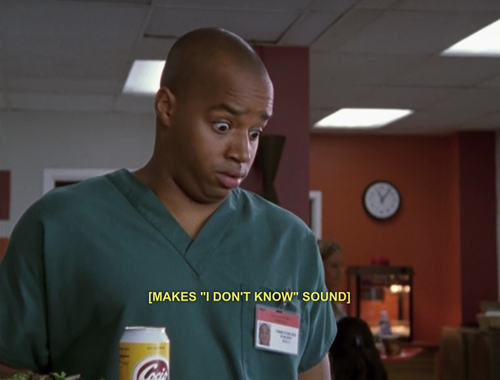
You know what I think is really cool about language (English in this case)? It’s the way you can express “I don’t know” without opening your mouth. All you have to do is hum a low note, a high note, then another lower note. The same goes for yes and no. Does anyone know what this is called?
These are called vocables, a form of non-lexical utterance – that is, wordlike sounds that aren’t strictly words, have flexible meaning depending on context, and reflect the speakers emotional reaction to the context rather than stating something specific. They also include uh-oh! (that’s not good!), uh-huh and mm-hmm (yes), uhn-uhn (no), huh? (what?), huh… (oh, I see…), hmmn… (I wonder… / maybe…), awww! (that’s cute!), aww… (darn it…), um? (excuse me; that doesn’t seem right?), ugh and guh (expressions of alarm, disgust, or sympathy toward somebody else’s displeasure or distress), etc.
Every natural human language has at least a few vocables in it, and filler words like “um” and “erm” are also part of this overall class of utterances. Technically “vocable” itself refers to a wider category of utterances, but these types of sounds are the ones most frequently being referred to, when the word is used.
Reblog if u just hummed all of these out loud as you read them
This country (the Roman Empire) has more than four hundred smaller cities and towns. It extends several thousand li in all directions. The king has his capital (that is, the city of Rome) close to the mouth of a river (the Tiber). The outer walls of the city are made of stone.
…The ruler of this country is not permanent. When disasters result from unusual phenomena, they unceremoniously replace him, installing a virtuous man as king, and release the old king, who does not dare show resentment.
The common people are tall and virtuous like the Chinese, but wear hu (‘Western’) clothes. They say they originally came from China, but left it.
They have always wanted to communicate with China but, Anxi (Parthia), jealous of their profits, would not allow them to pass (through to China).
from the the Weilüe, an account from the 200s CE of the interactions between the Romans and the Chinese. It was written by Yu Huan, a state historian for Cao Wei during the Three Kingdoms Period. (via historical-nonfiction)
oh wild, i didn’t know they had any direct interactions in that time period. i thought all trading was done through a string of intermediaries. i need to read up on this!
Hey all! This poem is part of my chapbook Miss Translated, which I produced in a limited run as Town Hall Seattle’s Spring 2017 artist-in-residence. The main conceit behind this work is that to accurately portray my relationship with Spanish, I have to explore the pain and ambiguity of not speaking the language of my grandparents and ancestors. As a result, these poems are bilingual … sort of. Each one is translated into English incorrectly.
The poems I produced have secrets, horrific twists, emotional rants, and confessions hiding in the Spanish. It’s my hope that people can appreciate them regardless of their level of Spanish proficiency.
oh shit. my spanish is pretty shaky, but i’m pretty sure “te perdono” is “i forgive you.” wow understanding just that much is pretty chilling.
and something about…blood? and transformation? oooh yikes. she didn’t want legs in the spanish version did she. and it was a painful process.
so this poem is about…misunderstandings leading to pain for the person misunderstood? whish is really effective with the way it’s written, wow. this is the most meta poem form i’ve ever seen. wow.
<— This right here is AMAZING. Look at the journey this person went on reading my poem! Secret fact, I have been stalking tags and reblogs of this because what I wanted more than anything was to provide an experience for people and LOOK AT YOU ALL GO. Your engagement and enthusiasm is amazing and so humbling for me.
Holy crap, this is incredible. As a natively bilingual Latina woman, allow me to dive into a full analysis.
First, I should tell you my experience of reading this. I didn’t even look at the English at first, because I didn’t know that the mistranslation was the point, and of course I didn’t need it. So I read the whole poem in Spanish and thought it was really sad and moving. Then I looked at the English and my eyebrows went right up to my hairline. Why the hell would you translate it this way, I thought.
Then I read the caption and realized that this is a genius way of demonstrating how translation into English can be an act of colonization and violence.
I would translate the first two lines as “The mermaid rose from the sea / To see the dry world.” They’re very neutral lines. She was curious about the dry world, so she went to check it out. That’s a very different connotation from the mistranslation, which tells you that the mermaid preferred the land to the sea.
The second two lines I would say mean “She found a fisherman on the beach / this beautiful fish without a net.” She’s the one with agency here, not the fisherman, and she thinks of herself as a free fish, unconstrained by a net, not as a fish without a home.
The next three lines by my lights read “She had a gleaming tail; scales / that covered her breasts, arms, and face / and a wake of lacy waves.” Again, it’s from her perspective, not the fisherman’s, and she thinks of herself as having a gleaming rather than oily tail, a lacy wake rather than a frothing one.
Next stanza: “The fisherman caught her by the tail / and cut it in half.” From her point of view, the fisherman has committed a sudden and senseless mutilation. Then he goes, “’Now,’ he said to her, ‘you have legs. / Why don’t you walk?’” It’s almost like an accusation. You have legs now, why don’t you just get up and walk?
My read on the next stanza is: “The mermaid began to sing to the sea / for aid, her blood transforming / the sand of the beach into rainbows.” The sea is her home, not the land, and she’s crying out to her home in pain as she bleeds.
Then the poem ends with “She sang to the fisherman, ‘I forgive you, I forgive you, I forgive you.’”
The reason this mistranslation is so brilliant is that it takes a story about a mermaid trying to forgive a man who’s committed senseless violence against her, and turns it into a story about a man who uplifts a woman to a better life out of the kindness of his heart. And the thing is, that’s exactly what happens to so many stories from colonized cultures when they’re adapted by the oppressor. Translation into English, and further the cultural language of the oppressor, can be an act of violence and erasure rather than one of respect.
This is why I have worked so hard to translate poetry from Spanish to English that has previously only been translated by white Americans who learned Spanish in college. I can bring something to the translation that they can’t. It’s usually not this extreme, but this exists to some degree in all translations by people who don’t truly understand the culture that produced the work they’re translating.
the level of pettiness, stubbornness and thriftiness
The video is just called “Polishing a Rusty Knife” as if watching this guy’s knife wizardry didn’t just clear my pores, cure my anxiety, and stock my fridge full of vegetarian sushi.
Here’s something I’d learned about before, but didn’t really understand until nursing school:
When you put your hand on a hot stove
(or any extremity on any major, unexpected source of pain), the decision to pull it away happens in your back. That’s what a spinal reflex means–not just that the action is automatic, but that your brain isn’t even consulted.
You will never remember it this way. You will always remember the event as “the stove felt hot so I pulled my hand away.” But “you” didn’t do anything. All you did was come up with a justification after your back had already acted. Even if you know this intellectually, it won’t change anything–you still won’t be able to remember your hand acting on its own. Your brain will not allow it.
There are more parts of the nervous system that work this way than you’d probably like to think about.
Alternate framing: your spinal cord (and indeed your whole body) is part of “you” just like your brain
Alternate, alternate framing: Almost none of your brain is “you” either.
The parts of your brain that consciously think “My name is [name]! I want to do good things and not do bad things! Here are some decisions I’m going to make!” are pretty much dwarfed by the ones that don’t. We usually frame them as acting in service to the consciousness–your non-conscious brain may help you balance when you walk, but you tell it where you want to go–but then again, you also think you decided to take your hand off the stove.
Have you ever walked into a room, and then wondered what you were supposed to do in there? You think you just forgot. But what if you really didn’t know?
–
(Please note: this is mostly me going “oooh, wouldn’t it be creepy if,” and at this point I have strayed pretty far from the amount of neuroscience I actually know.)
There’re a few sci-fi stories that play with this idea!
so you know this cool challenge dance maui does to get the lava demon’s attention? it’s called a haka, and it turns out new zealand sports teams do it before their matches.
 just moving along like everyone else