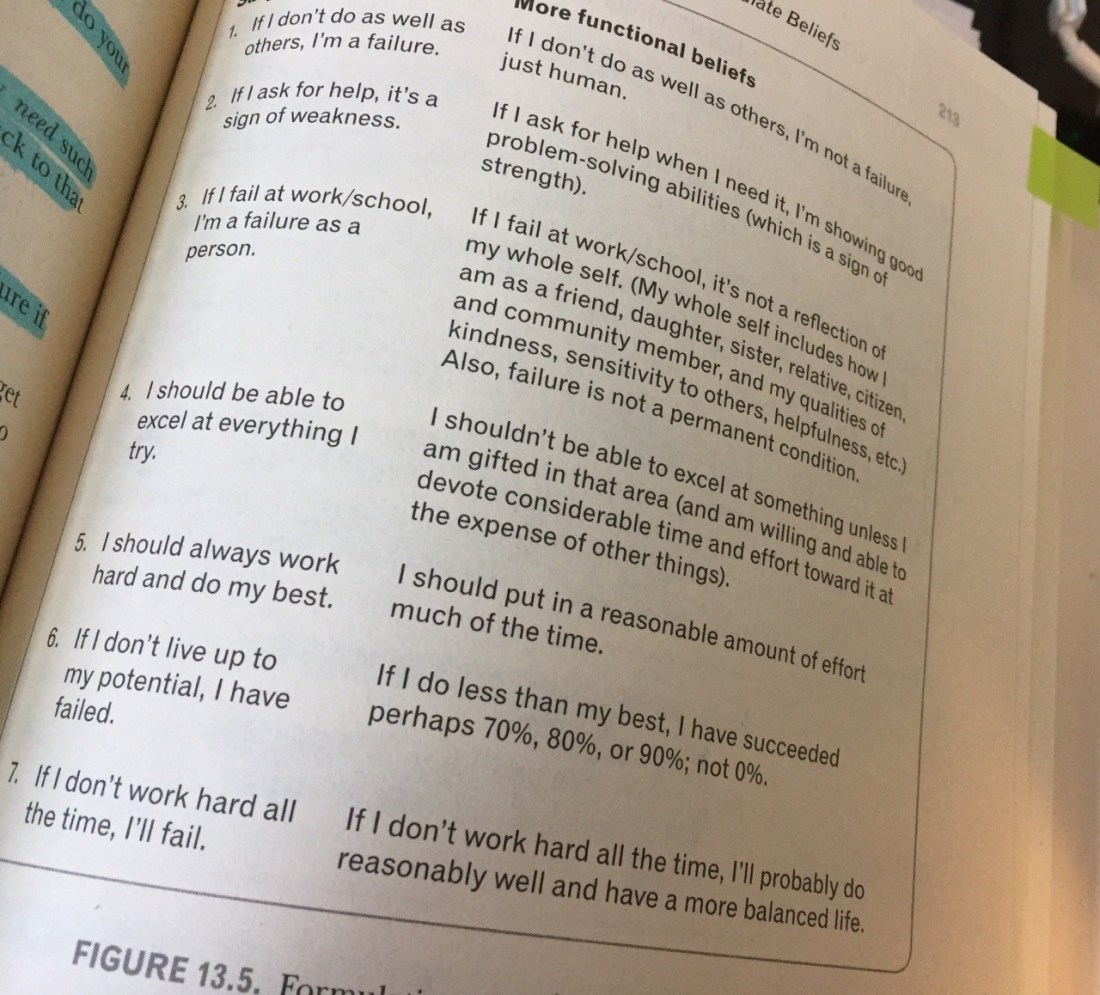
This is a really helpful page in my CBT textbook for tackling some of the maladaptive beliefs we often hold. The first column lists the rules and assumptions we often may tell ourselves, while the second column is a more functional belief. Just thought I would pass this along. Be kind to yourselves, friends❤
Oh my god, number 5. And 6, and 7.
I frigging needed that.
Failure is not a permanent condition.
The text on the image:
Maladaptive belief:
If I don’t do as well as others, I’m a failure. More functional belief:
If I don’t do as well as others, I’m not a failure, just human.
Maladaptive belief: If I ask for help, it’s a sign of weakness. More functional belief: If I ask for help when I need it, I’m showing good problem-solving abilities (which is a sign of strength).
Maladaptive belief: If I fail at work/school, I’m a failure as a person. More functional belief:
If I fail at work/school, it’s not a reflection of my whole self. (My whole self includes how I am as a friend, daughter, sister, relative, citizen, and community member, and my qualities of kindness, sensitivity to others, helpfulness, etc.) Also, failure is not a permanent condition.
Maladaptive belief: I should be able to excel at everything I try. More functional belief: I shouldn’t be able to excel at something unless I am gifted in that area (and am willing and able to devote considerable time and effort toward it at the expense of other things.
Maladaptive belief: I should always work hard and do my best. More functional belief: I should put in a reasonable amount of effort much of the time.
Maladaptive belief: If I don’t live up to my potential, I have failed. More functional belief: If I do less than my best, I have succeeded perhaps 70%, 80%, or 90%; not 0%.
Maladaptive belief: If I don’t work hard all the time, I’ll fail. More functional belief:
If I don’t work hard all the time, I’ll probably do reasonably well and have a more balanced life.
hahaha jfc sorry i was just remembering a corporate retail questionaire that was like trying to gauge your work ethic and like, whether you thought it was okay to shoplift, and tbh most of the items on the maladaptive side would not have been out of place for things they wanted you to select
Okay, but like, holy shit put these in perspective of ADHD or ASD and the whole 2G bullshit and I swear to god half of these maladaptave thoughts were burned into my by the very people who couldn’t recognize that there was a disability there to begin with.
If I fail at school I am not a bad person? If I don’t live up to my potential I have failed? I should be able to excel at everything I tried?
Like, no – these actually where the expectations put on me and I couldn’t meet them probably because they are maladaptave.
Is it any wonder that RSD busted through wall and shouted, “OH, YEAH!”
I actually literally cannot convince myself that most of these aren’t true. (For me only. I can cut other people slack, but not myself.)
it goes something like this:
Me: This is a list of maladaptive thoughts. That means they’re wrong and it’s a bad idea to apply them to yourself.
My brain: Yes, but they’re obviously true.
Me: How can they be obviously true when they’re obviously false?
My brain: They’re intellectually false. In real life they’re true.
Me: That makes no sense. You’re coming up with rationalizations.
My brain: I’m good at that, aren’t I? Here we go: These are true because you’re female and working in a majority male profession so you have to live up to these standards!
Me: No, I don’t. I have three female employees and I don’t make any of them put up with this shit.
My brain: That’s because they’re not you. You’re special. That’s why you have to meet these standards.
Me: Oh, so you’re going to play to my ego, are you now?
My brain: Hey, you managed to make it through life with a mostly high opinion of yourself. Do you think that doesn’t cost anything? You have to be perfect, that’s the price of being special. If you’re not perfect then you’re not special, and if you’re not special then you’re not anything and every bad thing everyone ever said about you is true.
Me: I don’t think that logically follows…
My brain: Oh, who does logic around here? You or your brain? I think I’m more qualified to tell you what is logical than you are.
Me: Yeah, but these are still maladaptive and stupid.
My brain: LA LA LA LA I CANNOT HEAR YOU
The thing about beliefs like that is that changing them takes significant time. So you can sort of get to the point of recognizing that they must be true, but they don’t feel true, and then you sorta… keep poking it. Keep remembering that you’ve been told, by credible experts, that these things can’t be true. Keep pointing out that they’re not true of other people, and that it’s ridiculous to think they’re true only of you. And so on.
one of the most insidious things about depression is it doesn’t ‘feel’ like depression. even when you have it, you know you have it, you’ve been diagnosed—you still find yourself thinking, no, nope, this isn’t it, can’t be. it’s like the mental illness equivalent of that knight in monty python that keeps going ‘it’s a flesh wound! i’m fine, really! this is just a scratch, i’ll be up in a moment!’ even after all his limbs have been hacked off and he’s lying there helpless.
one of the most common narratives around it is that no one realizes they have depression until they start checking off what they consider to be normal aspects of their lives—and personal character flaws— against the checklist for depression symptoms. really key symptoms include:
lack of motivation
constant tiredness, even exhaustion
finding no pleasure or satisfaction in activities they used to like, or that they know should feel good
not seeing the point of doing anything
increased and even unmanageable anxiety and fearfulness
any one of these symptoms drains away your ability to do work, cope with setbacks, overcome difficulties, or stop procrastinating. multiple symptoms create a pretty perfect storm of intertia and anxious self-loathing. you stop doing anything because it’s hard to get going, unpleasant while you’re at it, and afterwards there’s no reward. why bother, right? and when you’re always tired you get conservative of what little energy you can manage, and when you only feel emotions on the ‘empty to miserable’ spectrum you get really aversive to making mistakes. the whole mess very quickly and very insidiously loads every single thing in your life with toxic emotional baggage.
and then someone says to you— or you say to yourself, ‘stop being lazy’. and that haunts you forever. because you’re lazy! the work is so easy. everyone else does it. everyone but you, you lazy asshole, lying around all day not doing this totally easy thing that you should be able to but aren’t. you don’t have depression! of course not. mental illness is for victims, is for blameless innocent people who can’t be blamed for being so understandably sick. but you can be blamed. you have a character flaw, and it’s getting worse by the minute.
and that is how people who have been diagnosed, who have been medicated, who have been through therapy, can still spend all day hiding in bed and chewing themselves up over their failure to just somehow magically be a good, healthy, useful person, instead of treating themselves to a sick day and saying ‘yup! it’s depression. i need to be kind to myself.’
Fuck this is so important and relevant
Nope reblogging twice in a row because u want to scream this from the roof and plaster it over the walls and never shut up about it
One thing I think is useful to conceptualize when thinking about the severity of depression is figuring out what counts as a ‘task’ to your brain
for example, healthy people outlining the tasks they need to do that day might be something like
– class – work – homework
if a healthy person is having a low energy day, maybe it becomes
– make breakfast – go to class – class – go to work – work – come home from work – work on an essay – do 2 readings
a depressed person, on a high energy day will probably see that same day as
– make breakfast – eat breakfast – take meds – shower – get dressed – walk to bus – take bus … etc
a depressed person, on a low energy day will see that same day as
– wake up – get out of bed – walk to bathroom – use bathroom – stand back up – walk to kitchen – open fridge – take out juice – set on counter – go to cabinet – reach up arm – take down glass – unscrew lid of juice carton – pour juice – drink the juice – finish the juice …etc
the sort of chronic exhaustion manifests in how each ‘task’ takes a certain amount of energy and when you have depression, what begins to take that amount of energy- and thus, cognitively count as a ‘task’- are smaller and smaller subdivisions of what other people consider tasks.
And the more ‘tasks’ you do, the less energy you have, and the smaller the subdivisions must be to take equivalent amounts of energy. And the longer that “to do” list of tasks is, the more exhausting and overwhelming and hopeless it feels, which creates a feedback loop of dysfunction.
So say our depressed person on a low energy day gets all the way to finishing their glass of juice. They’ve actually gotten through a lot of tasks! They’ve tried really hard.
But to a healthy person, even on a low energy day, that probably looks like not having done anything- not having gotten through any tasks. And when our depressed person is surrounded by healthy people, they will likely internalize that they haven’t done anything, and further that they can’t complete any tasks no matter how hard they try. And that feeds worthlessness and suicidal ideation
That, I think, is why it’s so important to encourage your depressed and chronically low-energy friends when they accomplish tasks, even if they’re operating at a level of subdivision that you don’t recognize. It is an accomplishment to get water and actually drink it for some folks. It is an accomplishment to get to class or to work.
And acknowledging how hard someone is trying and how much energy they’re putting towards accomplishing those tasks can make a huge difference in whether they feel worthless and hopeless or whether they feel like it’s worth it to keep doing what they can.
i hate feeling guilty and tbh it’s really easy for me to feel that way and for a long time too


 just moving along like everyone else