My complete and total inability to keep anything clean or tidy for any amount of time is a symptom of my depression. I may never be able to do this. It’s important that I remember that and forgive myself when I clean something out (like my car) and it ends up trashed within a week.
Depression IS A DISABILITY. Requiring accommodations is okay.
Medications don’t make you better, they don’t cure your depression. They serve as an aid. Their purpose is to help you get to everyone else’s minimal level of functioning.
Depression can cycle through periods of inactivity. This doesn’t mean it’s gone away.
The reason I don’t feel like other people understand me is because … well … other people DON’T understand me. They can’t. They don’t have my disability.
Paranoia is par for the course.
Depression can and will interfere with your physical mobility. Forgive yourself when you can’t physically do something.
It’s entirely possible that I may never be able to live by myself. I can’t take care of myself. I need help to do it. And that’s okay.
As someone who suffers from depression and who experiences all these things as well I think this is important and needs to be reblogged. Depression is a very difficult thing, not only for people who suffer from it, but for everyone who knows a depressed person. My family doesn’t know how to deal with it, my friends try their very best to support me and I have tried to pretend I was fine until I was in ninth grade.
Everything makes so much more sense
Depression is a disease of the brain. The brain is an organ. When organs are not functioning properly, you are advised to see a doctor and get help. So why is it so hard to understand that the brain can suffer as well, and that we need help for it?
The brain controls the body. A sick brain means a sick body.
…. Shit.
Don’t disregard it as just sadness. Depression is life threatening.
me, talking about my trauma: haha yeah it was no big deal tho i don’t really care it’s whatever honestly
somebody: validates my trauma and says i shouldn’t have had to go through that
me, suddenly crying: huh. weird
shoutout to depressed and anxious people who often isolate themselves because they don’t have the energy to socialize, they’re scared, don’t believe anyone genuinely wants them around, etc.
When you’re a little depressed and nobody takes it seriously or wants to help you, it’s really tempting to feel like if only you were MORE depressed, THEN people would realize you were in actual pain and actually get off their asses and help you.
As someone who’s been there: Nope, sorry. Our society is woefully inadequate at giving actual help and support to people with any level of depression. Like, when they realize you’re stuck in a really deep pit they might lower you a rope to pull yourself up with, but the rope’s still ten feet short. When you let other people decide how much help you need, they’ll probably always underestimate it.
The sucky part about depression is that the best way to get good help for it is to demand it. It’s to be, or have, a loud, active, pushy advocate for what you need. This disease is so deadly because right when you need to say, “That doesn’t sound like enough,” it pushes you to dully say, “Okay, I guess,” and stop bothering people.
Or they lower you enough rope and then pull you up …
… to that shallower pit you were in before.
And leave you there, except now you’re tireder and more messed up.
Yeah.
i feel like if i were more obviously suffering then i might be able to say i was Actually Depressed and seek help instead of, y know, just being unsociable, lazy, and lacking ambition. as it is, the last and only therapist i managed to drag my ass out to see seemed to be leaning towards "bereavement" and i cant scrape up the motivation to try another
It should be noted that a lot of therapists can’t actually diagnose (that’s a medical prerogative) and definitely can’t prescribe. Depending on where you are, but especially US and Canada, it’s worth going to your GP or even a walk-in, especially if you can bring one of the questionnaires and go “I self-scored X, I’d like a medical opinion.”
The thing is, from the inside, my own experience is that you’ll never be “suffering obviously enough”. Part of what depression itself will actually do is make it almost impossible to see “I am sick” rather than “I am unsociable, lazy and lacking ambition.”
I have had a medical diagnosis for over a decade, I have outright scared multiple health-care and mental health practitioners, my score on the screening tests is still scary, I have massive amounts of other actual evidence and, you know, suffering, including active suicidality … and my hindbrain still tries to go “but what if you’re just lazy and moody? what if you’re just looking for excuses?”
The disease literally does that. The chemical misfires in the brain trigger the “worthlessness” systems and they start attacking you. Guilt, shame, humiliation and the sense of Just Being Bad are literally symptoms of the disease. And it will always move the goalpost.
So you say to yourself “well if I were crying all the time, then I’d know I’m Actually Depressed, and seek help; but since I’m not, I’m just unhappy/grumpy, clearly I’m not Actually Depressed.”
Six months later when all it takes to burst into tears is knocking over a teacup, though, that doesn’t seem compelling. Instead, you think, “well if I wanted to kill myself, then I’d know I was Actually Depressed, and seek help.”
Six months later when every time you walk along the sidewalk you’re fantasizing about how easy it would be to step out in front of a high-speed car, or every time you’re driving you think how easy it would be to just … twist the wheel and ram headlong into the underpass, you think “If I knew I MEANT it, then I’d know I’m Actually Depressed and seek help.”
This can go on forever. I have known people actually in the hospital after surviving a suicide attempt who didn’t want to go see the psychiatrist after because, after all, this wasn’t Actual Depression, it was just them being a loser and doing something really stupid. If you make that kind of goalpost, the depression will move it. Constantly.
There’s different ways to address this. I personally do tend to self-score on the questionnaires on a regular basis. The most common score on the BDI is 0, and the vast majority of people, even in stressful situations, don’t score higher than 10. I know that’s hard to believe; I know a WHOLE BUNCH OF PEOPLE READING THIS who live with mood disorders just went “that’s impossible”. It’s not. It’s true.
That’s HOW BADLY our brains not only fuck us up, but then lie about how they’re fucking us up.
So I self-score. I have gone into my psychiatrist saying “so I don’t FEEL like things are that bad and mostly I just feel like I’m being whiny, but on the other hand I’m napping all the time and my BDI pushed over 30, so …”
Internally, that’s what our brains do.
Externally, the problem is that honestly there isn’t a lot of help that isn’t driven by you – as @star-anise notes in the OP – before someone’s calling 911 on you. And that’s not a lot of fun. Moreover, the help that you do get at that point is focused on getting you out of crisis: out of the point where you’re a danger to yourself and/or others. And once you are you’re …back where you were before.
It’s kind of a bugger.
the teal deer version is: go see your doctor. If you’re miserable, you’re Depressed Enough. Promise.
in the US, your GP can prescribe certain antidepressants. there is no reason not to give it a go. you can’t get high on lexapro or sell zoloft on the black market. if you have symptoms of depression, and there isn’t a VERY OBVIOUS outside cause like divorce, getting fired, death of a family member, etc QUITE RECENTLY, then ask your doctor. and if your first try doesn’t work out, ask for another.
it’s a well-known phenomenon that whether an antidepressant will work is pretty individual, and most people have to try several before finding the right one.
i was lucky in that my only false try was wellbutrin – it helped me quit smoking, but made me even more passive and unmotivated than before, and when i went off it i immediately started smoking again. then my gp gave me lexapro to try, and it worked beautifully.
about two weeks after my first dose, i was able to look back on my life and go, “holy shit. i have been severely, cripplingly, horrifyingly depressed since i was a very small child. i am AWESOME for surviving this long!”
when you’re in the shit, it looks normal. but it’s not. and you can get out.
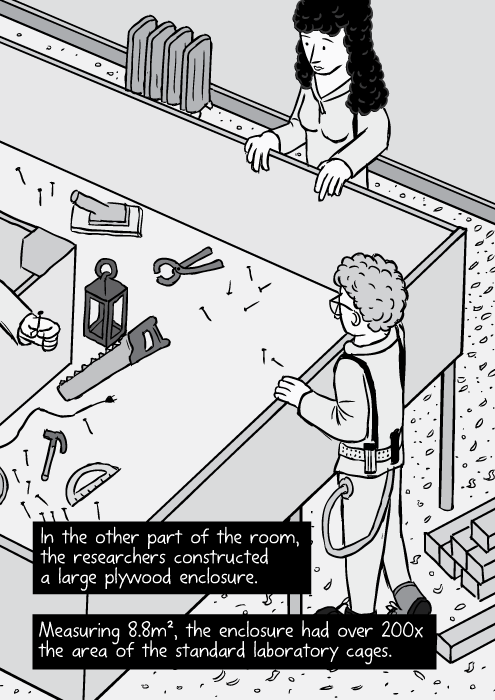
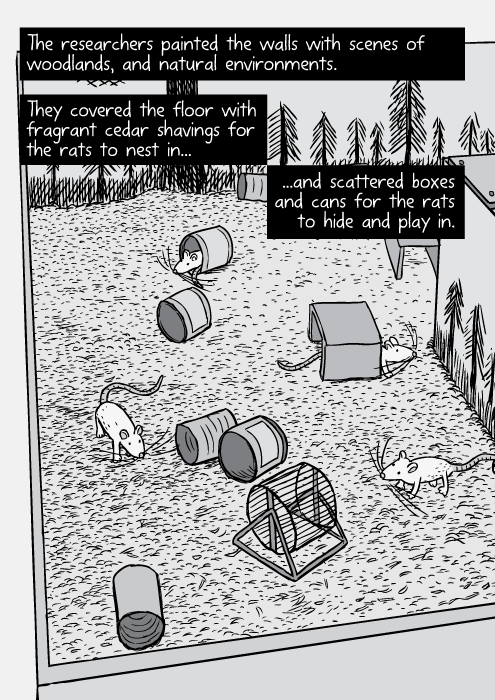
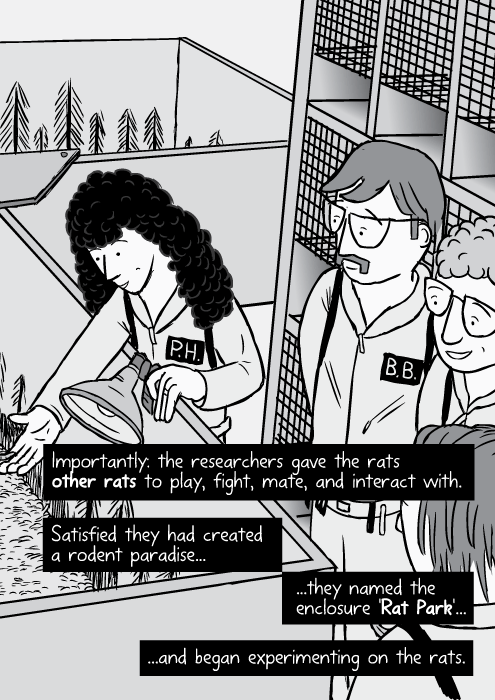
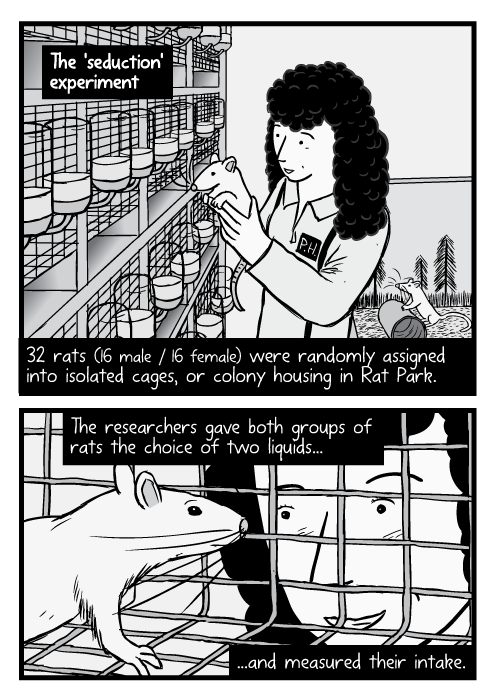
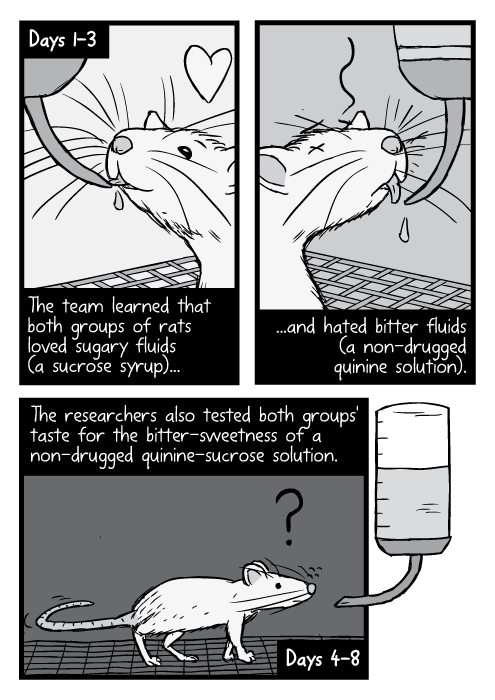
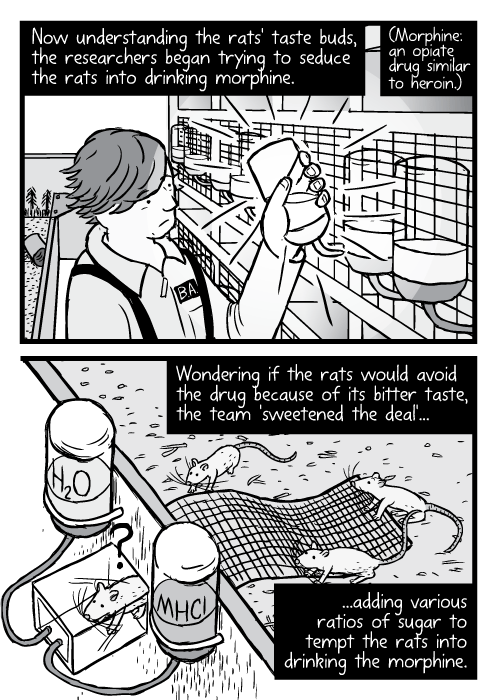
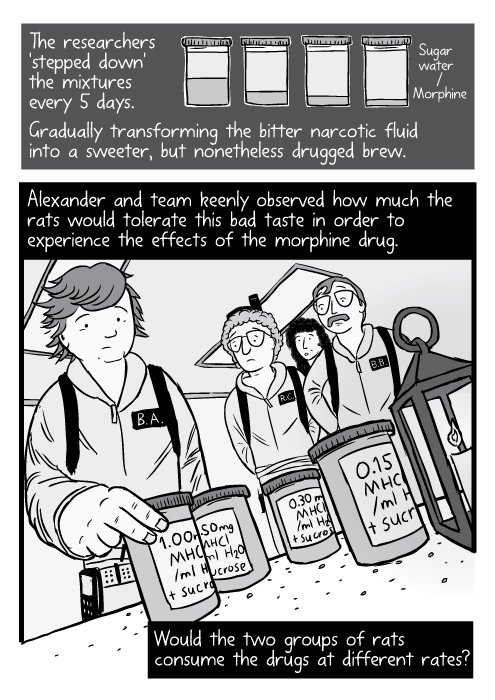
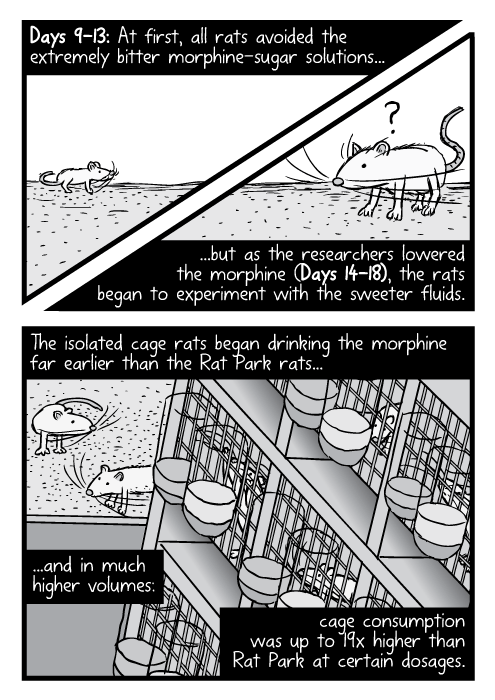
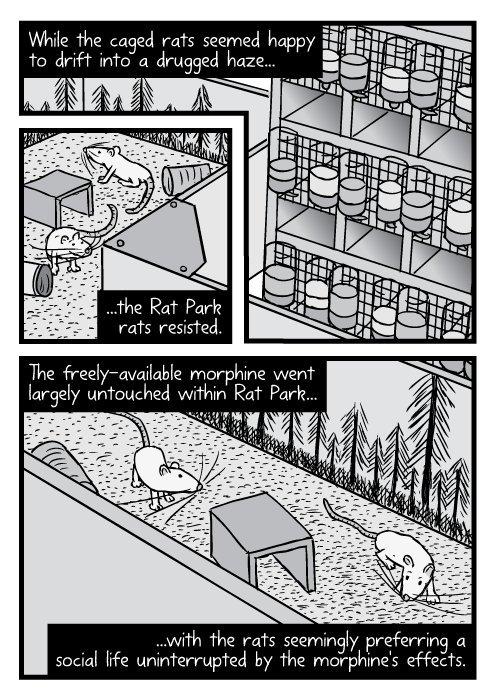
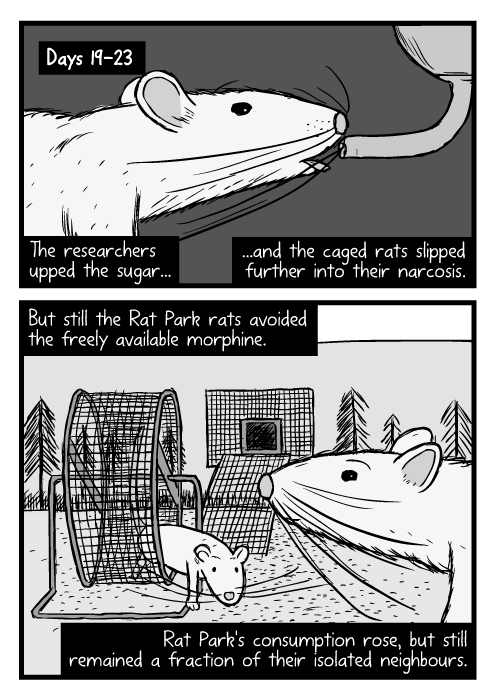
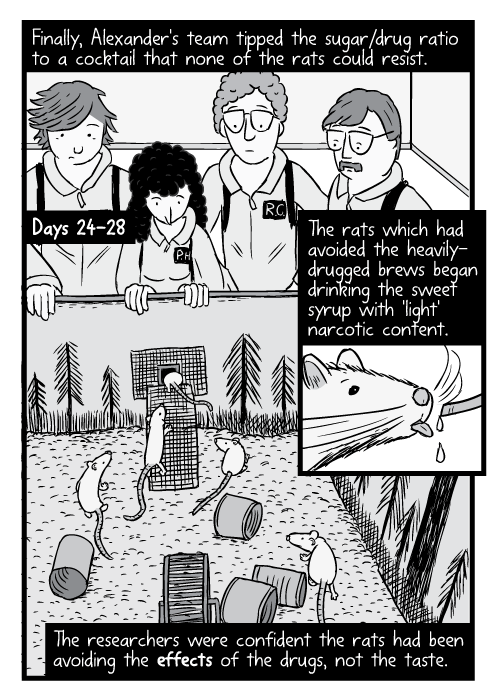
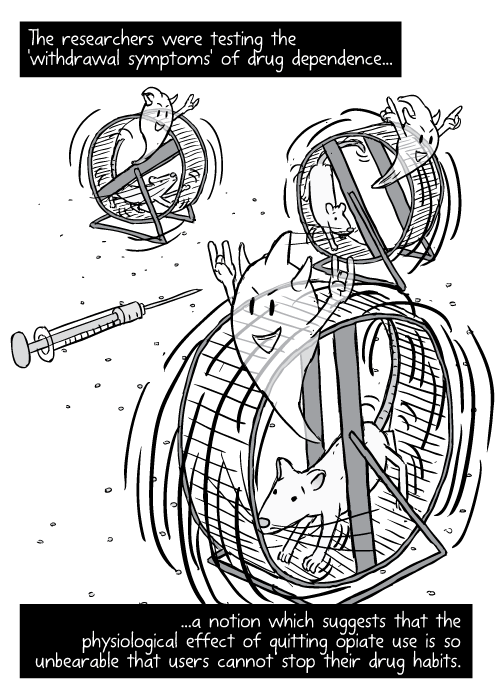
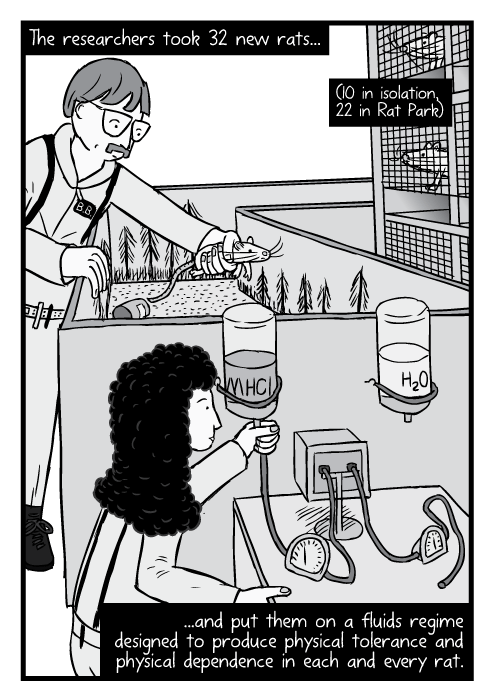
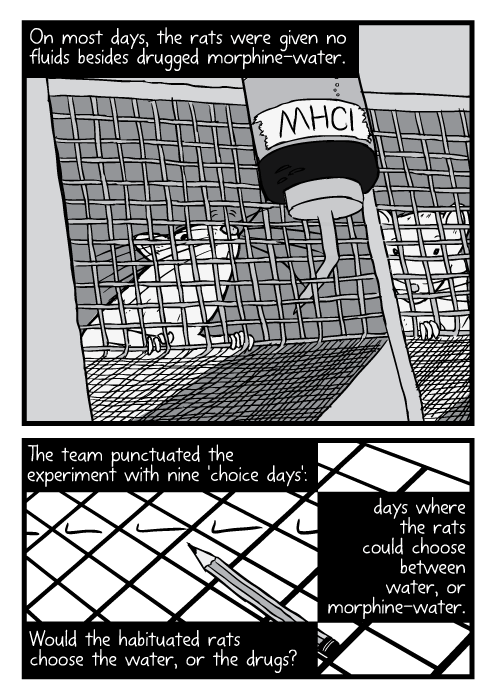
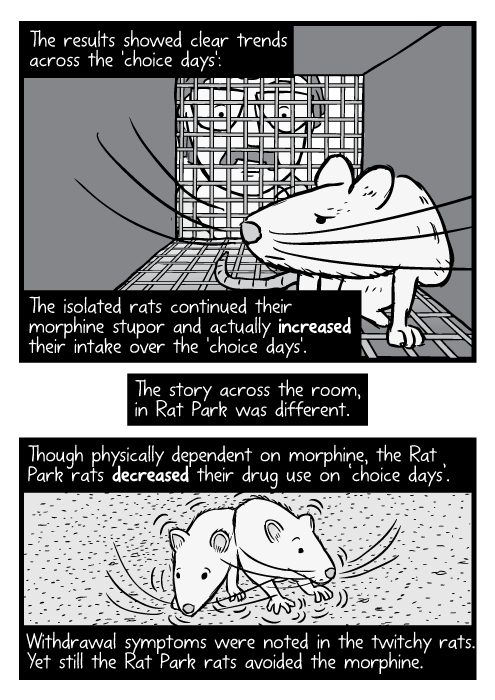
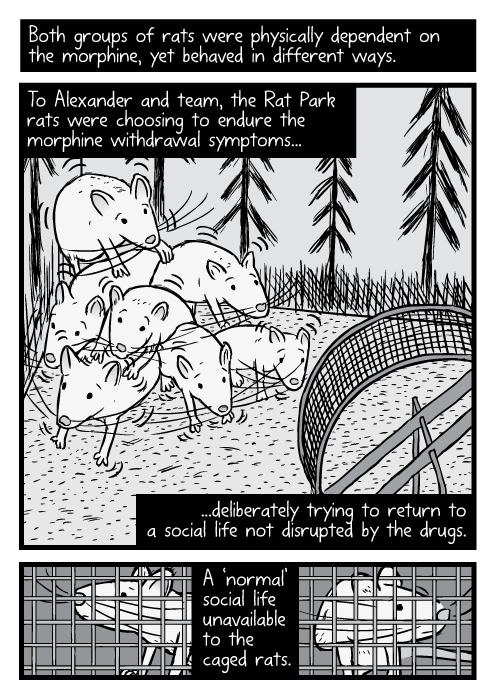
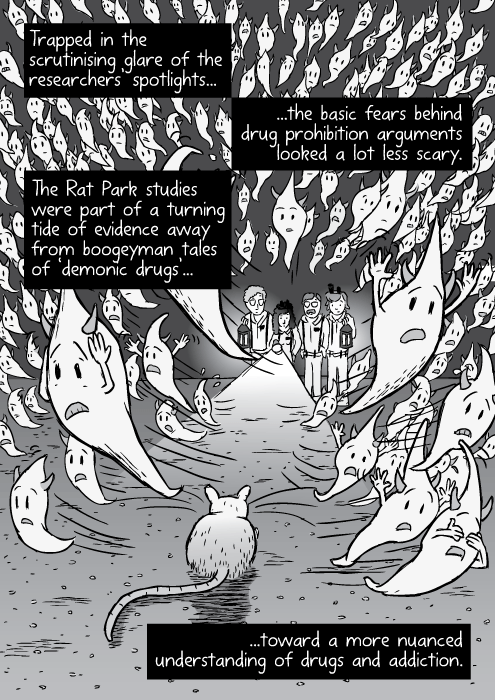
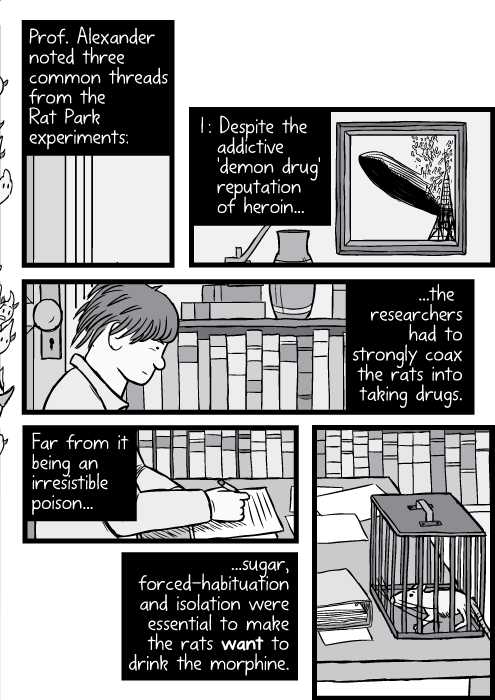
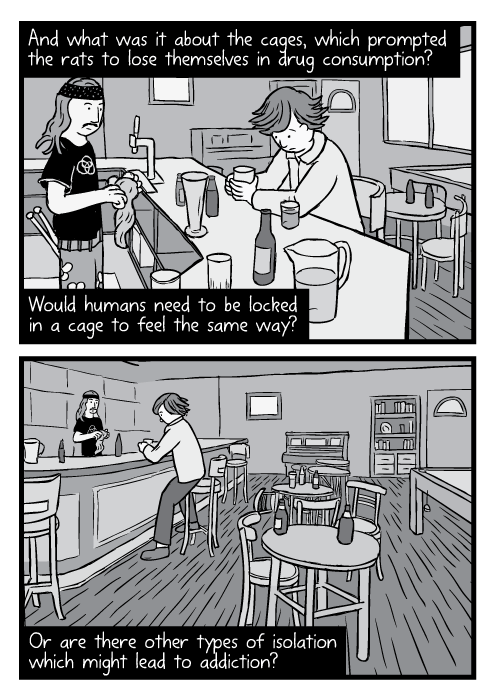
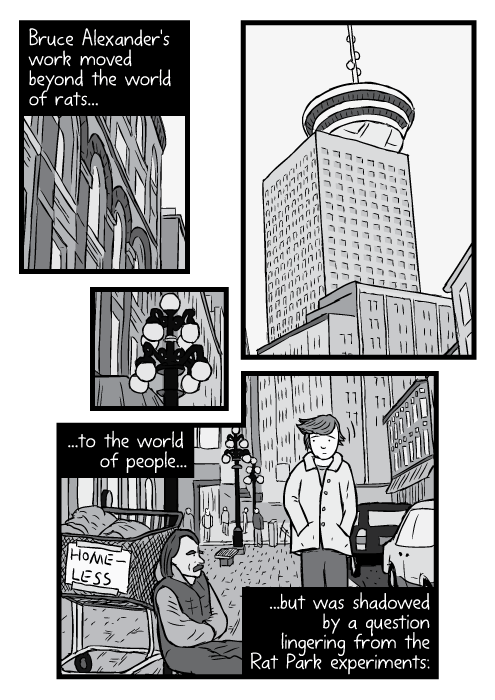
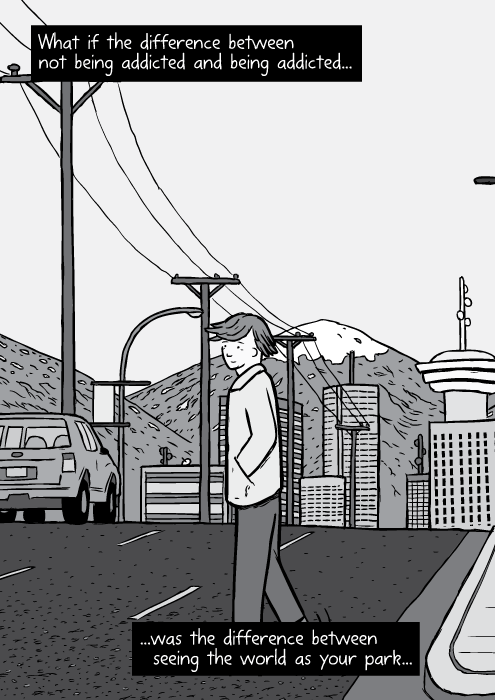
What I found absolutely impressive and stunning about this comic is the way the artist explained the identification and elimination of the confounding factors in the Rat Park study. This is one of the hardest parts of experiments to explain to the public, and I think it was just brilliantly done.
WHEN THE MONSTER UNDER THE BED TURNS OUT TO BE CLINICAL DEPRESSION
Me and the monster
wake up together.
Every morning,
he sits at the kitchen table
pouring salt into my coffee cup.
Emotions are not innately programmed into our brains, but, in fact,
are cognitive states resulting from the gathering of information, New
York University Professor Joseph LeDoux and Richard Brown, a professor
at the City University of New York, conclude in the latest issue of the
journal Proceedings of the National Academy of Sciences.
“We argue that conscious experiences, regardless of their content,
arise from one system in the brain,” explains LeDoux, a professor in New
York University’s Center for Neural Science. “Specifically, the
differences between emotional and non-emotional states are the kinds of
inputs that are processed by a general cortical network of cognition, a
network essential for conscious experiences.”
As a result, LeDoux and Brown observe, “the brain mechanisms that
give rise to conscious emotional feelings are not fundamentally
different from those that give rise to perceptual conscious
experiences.”
Their paper—“A Higher-Order Theory of Emotional
Consciousness”—addresses a notable gap in neuroscience theory. While
emotions, or feelings, are the most significant events in our lives,
there has been relatively little integration of theories of emotion and
emerging theories of consciousness in cognitive science.
Existing work posits that emotions are innately programmed in the
brain’s subcortical circuits. As a result, emotions are often treated as
different from cognitive states of consciousness, such as those related
to the perception of external stimuli. In other words, emotions aren’t a
response to what our brain takes in from our observations, but, rather,
are intrinsic to our makeup.
However, after taking into account existing scholarship on both
cognition and emotion, LeDoux and Brown see a quite different
architecture for emotions—one more centered on process than on
composition. They conclude that emotions are “higher-order states”
embedded in cortical circuits. Therefore, unlike present theories, they
see emotional states as similar to other states of consciousness.
interesting! kind of a slippery distinction, isn’t it? i mean from the end-user point of view. from the neurological point of view it’s pretty significant.
This is just a very short article based on an abstract, so it’s difficult to assess it. Typically emotions are thought of as a response; an event happens, your brain is hardwired to respond to it with a specific, autonomic biochemical and anatomical reaction, which we label “emotions”. But what they’re saying is that emotions are how particular inputs, particular sorts of experiences, are processed by the brain using a single cognitive system. I’m going to talk this through for myself under the cut.








 just moving along like everyone else