in case u were under the misconception that they were all the same size: 9 is 0.8 meters tall (the size of a chair), 10 is nearly 3 meters in diameter (the size of a small car), and juice is 100 meters long (the size of a football field).
17776 is about humanity, immortality, purpose, and football — told from the perspective of three sentient space probes wandering through outer space. but when you think about it, the space probes don’t… need to be there. i mean, why? it’s a story that uses football as a concrete way to dig into the issue of boredom in immortality. even if jon bois really, reeeaaally wanted to sneak in a subplot about a computer becoming sentient, it could have just been an abandoned laptop in a forgotten part of chicago or something. so… why pioneer nine? why space probes at all?
the answer is: narrative lens.
and yes, that’s a pun.
17776 is designed at the beginning (with the disintegrating article and then the calendar format of chapter 1) so that a reader could potentially feel nine’s distress as nine slips into sentience. after that, the story is designed so that the reader explores the far-future setting through nine’s questioning of their fellow space probes. if the author had simply immersed us in the dialogue of the durazos without any context, we might have eventually picked up on the setting and themes, but because nine is an outsider, nine’s perspective allows questions to be asked that would otherwise have gone unanswered. for example: “what is this?“ “football!” “don’t humans have better things to do?” “nope!”
(side note: yes, i’m aware that literature profs tell you you’re not supposed to make claims about what the reader feels, but i’m attempting to approach 17776 as a designed product bc that seems most appropriate right now. see also: me typing in lowercase.)
additionally, and this may be already obvious, but the predicament of nine, ten and juice serves as a useful parallel for the predicament of the humans. the july 8th upda7e makes this clear:
and just a few moments before this, nine says: “All these people seem so normal… But in some ways, it’s like they’re broken.” note the word choice; this is a word you use for machines, not people. since nine is a machine, it’s the only way nine knows how to process this experience, and it furthers the development of the immortality->purposelessness theme.
so 17776 has established the comparison that humans without suffering are like broken machines. but then, in the next chapter, we see nancy reflecting on the same issues that the space probes were discussing, and it doesn’t end on the same dissatisfied, negative note. she tells her companion about her inability to make a mark on the world, and she says: “There’s nowhere left to write. I think I’m just a bookmark.”
and he responds:
cool, huh?
this brings me to my last point. why a space probe, specifically? why not a time-traveler, or some other kind of computer, or an alien species?
it’s been argued that every work of fiction, whether it’s about suburban america or a far-off fantasy universe, whether it’s about the past, the present, or the future, all stories are nevertheless grounded in the here-and-now. we wouldn’t be interested in reading about nine and ten and juice if we couldn’t relate to them as humans in the early 21st century. so even though speculative fiction is ostensibly used to look outward, we inevitably end up looking inward instead, because it’s the only thing we know how to do.
that applies to 17776 as well. this may be a story about the far future, but it interests us because it asks questions about the here-and-now: why do we seek entertainment? what gives us purpose? does death make us human? 17776 is a narrative lens that aims into the fictional future in order to explore the real present, just as nine is a space probe — a lens made for looking outward — that finds themselves looking inward instead. nine isn’t just the main character or useful outsider POV. nine symbolizes the function of speculative fiction in our society.
and that’s my ridiculously long, severely lame, analysis-filled pun about 17776 and narrative lens.
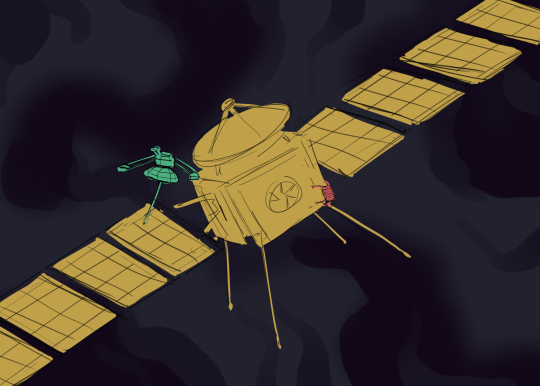


 just moving along like everyone else