This is demonstrating why you absolutely do not pour water on a grease fire.
holy shit
Okaaaay. If any of you actually have a grease fire in the kitchen put the lid on the pan. It will suffocate the flames. Don’t pour water on it, and don’t freak out. Cook safely!
Or throw flour on it to smother it.
/quick safety announcement
NO, DO NOT USE FLOUR, DO NOT USE FLOUR TO SMOTHER A FIRE.
YOU HAVE TO USE BAKING SODA.
Throwing flour into a fire can cause it to combust and make the fire worse because FLOUR/SUGAR IS FLAMMABLE. One cup of flour into a grease fire can have the explosive force of dynamite.
The reason you use baking soda is that it releases carbon dioxide when heated, and CO2 is a fire suppressant.
REBLOGGING FOR LAST COMMENT TO SAVE LIVES
Salt doesn’t release CO2 but will also work to smother a fire
It’s been 10 years since we first started taking the Hobbits to Isengard. I mean, it’s been way longer – the Hobbits could have fucking walked there, back again, managed to get served several times at the downstairs bar in Doggett’s and got a Southeastern train service all the way to Charing Cross since Tolkien put pen to page. But (and believe me, this is deeply unusual for me) let’s put J R R aside in this.
Peter Jackson’s Lord of the Rings trilogy is kind of… well, both too faithful (total lack of critical interrogation of Tolkien’s absolutely awful concepts around race, gender, etc.) and not faithful enough in that it appeared to miss all the points your correspondent’s teenage self managed to find in the series. Specifically, where Lord of the Rings is an obsessively detailed but ultimately quite modest and traumatised epic, a huge amount of which is two small, starving creatures crawling around in mud having moral dilemmas. The Jackson films take themselves as seriously and grandly as the books came to be and as I suspect their author probably never did.
Taking the Hobbits to Isengard, on the other hand, is a pure and perfect work and I will hear no ill spoken of it else ye never receive a pint in a round bought by me again.
It takes as its base the Hovis-theme-ripping-off music from The Shire – the small-worlded part of the films, before any grandeur is truly injected into the bloated beastie that is the trilogy. The Hobbiton theme is supposed to be homely, reassuring, quaint – like anything that succeeds at that, it sounds fucking amazing played on an airhorn.
The simplicity of the Shire’s theme is what allows it to so naturally accept the kitchen-sink style auditory ornamentation that is ‘a donk’. A classic staple of rave, it needs no introduction even in a world as apparently dislocated from two WKDs and a honk on some poppers as the miruvor-quaffing pipeweed fiends we see here.
As a lyrical piece, Taking The Hobbits is discursive – like many of the very best pieces of pop. One only has to consider the sweet, sweet tension of Fleetwood Mac’s The Chain or Brandy and Monica’s iconic The Boy Is Mine to recognise that dialogous pop is, when it works, a particularly sublime genre.
It doesn’t matter that the lines are, ostensibly, orphaned from their original place in the script – from the eponymous ejaculation to Gollum’s hissed What did u say??? they’re all perfectly addressing each other in the sort of gloriously confused cacophony usually reserved for a misunderstanding-based brawl outside a kebab shop at 3am.
I remember the first time I heard Taking The Hobbits To Isengard. It was quite a momentous occasion because I still had dial up, so it took roughly the length of a decent pop song to load and it was very difficult to tell if it was deliberate or a bandwidth-related glitch remix for at least 30 torturously disrupted seconds. I’d imagined it would be a fairly quick joke – most internet video based things were, at the time, but no; a fully fledged song. That just kept going.
The initial air horns! These are funny, yes because we remember them as the Shire theme, which isn’t even the music for this bit. The stuttering sample of the original line! Which sustains itself as Sheffield Dave-style shout out far better than it should, given it’s old seriousface Elf ears himself yelling off a horse.
(In retrospect, should have equated that with Sheffield Dave earlier)
Then there’s …polka bit. Few pop songs manage to maintain a polka interlude – Bohemian Rhapsody springs to mind but Taking the Hobbits To Isengard manages to repeatedly insert it without losing coherency around its original rave premise. If you don’t think ‘Tell me where is Gandalf, for I much desire to speak with him’ delivered over a little eurodance handbag bit is not both extremely funny and excellent pop, I can’t help you.
Taking The Hobbits To Isengard would score reasonably at Eurovision. Not because Eurovision is actually the home of comedy trash but because if France (and it would probably have to be France in order for the Elven analogues to take themselves seriously enough) scooted in on an artpop platform and wanged loads of fucking airhorns round the stadium it would be entirely in keeping with European sensibilities of solemnly considering the totally whimsical due to our inherent reservedness about experiencing joy.
(The slightly older and wiser part of me has to question the repeated use of Gollum’s ‘stupid, fat, Hobbits’ which makes sense in the context of what he is but isn’t inherently funny, unlike a context-dislocated, bass-intoned ‘A Balrog of Morgoth’)
The great thing about Taking The Hobbits To Isengard is it actually gets funnier the more it goes on. Like Star Trekkin it not only sets out to commit to a fairly one-note premise but to hammer that note until it falls out through the piano and becomes a transcendent free agent, cascading through the strings.
It takes a premise; that the Lord of the Rings films, in their overblown format, are very, very silly and runs with it extremely, deadly seriously. This is the core of not all but a fairly substantial chunk of really good pop, as well as an excellent manual for life. All things are here – a manic sense of imminent implosion, troubling past associated with racist ideologies, handcarts, hell, what did u say???
Very seriously; Taking The Hobbits To Isengard is a superb piece of fan work and it has substantially enriched my life to listen to it on loop for the past 45 minutes whilst watching a parliamentary debate on mute. Creators of this piece: thank.
My friend Hazel wrote a Very Serious post about a Very Serious and Important fanwork and you should all read it immediately
This is literally the most bomb-ass D&D story I’ve ever read in my life oh my god.
Holy shit ._.
Some RP sessions have better stories than actual fiction. I mean, goddamn.
For those having trouble reading the text:
We had a campaign in D&D where we assembled a steampunk-ish time machine. After many sessions travelling through time, uncovering mysteries and learning harsh lessons about changing history, we had to stop a time-travelling cult from destroying the gods, and therefore the world. We failed.
Our machine crashed, we were stranded earlier than we had ever been able to travel. We found the Gods, but only a few of them were present – it was as if some had never existed. Then we realised – we had to become those Gods. Our party was entirely divine (Cleric, Paladin, Avenger, Invoker), and each of us was a worshipper of a god who had been unmade – and we were the only people in existence with enough knowledge of the forgotten deities to assume their roles.
But two of the players were worshippers of Io (in his twin forms of Tiamat and Bahamut, who would of course form later after Io’s ‘death’), and only one could become Io. The other would have to be the un-created Asmodeus.
So the most just, honourable and dedicated Lawful Good paladin I’ve ever seen roleplayed became the god of tyranny and evil. If he hadn’t, the gods would never have defeated the primordials, and the world would never have been completed.
In our setting, Asmodeus is every bit the epitome of evil you would expect him to be. Nobody but the gods who abide his presence know him as otherwise. He adheres to his role because he knows he has to – and that in doing so, the world can exist. He can never tell anyone his duty, and no-one who knows can ever discuss it.
In the farthest recesses of the Nine Hells, in a chamber sealed tighter than any other in existence is a pocketwatch of finest gnome craft with a photo of his family in it – his wife, son, and little baby girl.
They were killed by an orc army marching under the orders and banner of Asmodeus. Their deaths are what drove him to become an adventurer.
aka the only possible appropriate character for talking about angels
серафими многоꙮчитїи
Multiocular O (ꙮ) is a rare glyph variant of the Cyrillic letter O. This glyph variant can be found in certain manuscripts in the phrase «серафими многоꙮчитїи» (“many-eyed seraphim”). It was documented by Yefim Karsky[1] from a copy of Psalms[2] from around 1429, now found in the collection[3]of the Trinity Lavra of St. Sergius, and subsequently incorporated[4] into Unicode as character U+A66E.
o.O seems to me like a monk meme rather than a proper letter, but hey
From the article for the Cyrillic O:
Historical typefaces (like poluustav (semi-uncial), a standard font style for the Church Slavonic typography) and old manuscripts represent several additional glyph variants of Cyrillic O, both for decorative and orthographic (sometimes also “hieroglyphic”[1]) purposes, namely:
broad variant (Ѻ/ѻ), used mostly as a word initial letter (see Broad On for more details);
narrow variant, being used now in Synodal Church Slavonic editions as the first element of digraph Oy/oy (see Uk (Cyrillic) for more details), and in the editions of Old Believers for unstressed “o” as well;
variant with a cross inside, used in certain manuscripts as the initial letter of words окрестъ ‘around, nearby’ (the root of this Slavonic word, крест, means ‘cross’) and округъ ‘district, neighbourhood’ with their derivatives;
“eyed” variant (Monocular O) with a dot inside (Ꙩ/ꙩ), used in certain manuscripts in spelling of word око ‘eye’ and its derivatives. In many other texts, including the birchbark letters, the monocular O was not used as a hieroglyph but largely as a synonym of Broad On signalling the word-initial position;
“two-eyed” variants with two dots inside (Ꙫ/ꙫ or Ꙭ/ꙭ), also double “O” without dots inside were used in certain manuscripts in spelling of dual/plural forms of the words with the same root ‘eye’;
“many-eyed” variant (ꙮ), used in certain manuscripts in spelling of the same root when embedded into word многоочитый ‘many-eyed’ (an attribute of seraphs).
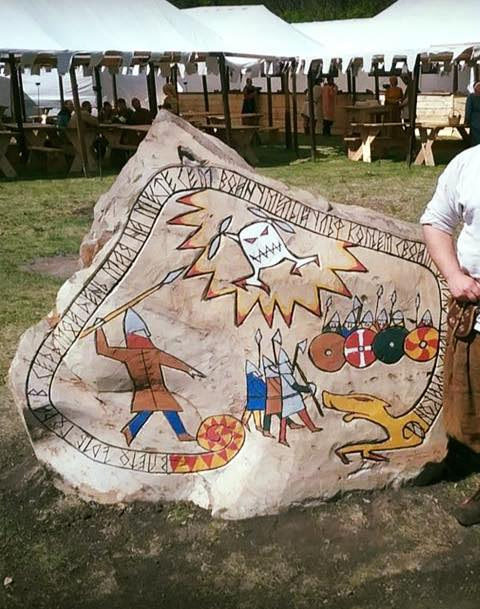
“The medieval warrior, realizing the consequences of his impulsive act, immediately approached the owner of the drone and offered to pay for the damage.
The owner of the drone was so impressed by the brilliant attack that he suggested organizing a competition for bringing down “dragons” with short spears next year.
Drone owners have another year to develop a unique “dragon-like” design for their flying machines.” (x)
I am 100% cooler with this knowing that the spear-thrower realized “oops maybe I shouldn’t have done that” and tried to make it right, and that the guy who the drone belonged to was cool with it
just so everyone knows, this has already been memorialized in a runestone
This is the year 2017 and I’m still having to yell about how ridiculous Maya extinction myths are and tell people we are ‘Maya’ not ‘Mayan’. I’m not saying shame shame if anyone reads this and didn’t know. I’m so angry concerning how slowly these issues are being picked up by educational institutions, at how often I have to bring these things up to higher education professors.
We are a massive massive group of peoples. One of the largest Indigenous groups in the Americas. Wikipedia cites 7 million or so of us total but honestly that’s way off because that’s about how many Maya folks there are in Guatemala alone.
We’re not dead. The Maya did not ‘mysteriously disappear’. We did not ‘fall’. We did not fade into obscurity. We’ve led revolts and rebellions against colonial powers for hundreds of years. We’ve had a big hand in shaping legislative definitions and protections for Indigenous Peoples in Mexico, Belize, Guatemala, and El Salvador.
We haven’t lost our cultures. We’re constantly threatened and experience a lot of violence and have our resources stolen but we are still very much alive and our cultures have persisted.
And don’t even try me with the whole “Oh well we mean your CIVILIZATION disappeared, not you.” The structure of our societies and layout of our network changed and decentralized in many areas. That didn’t make us turn invisible. That didn’t make us not still be large in numbers with a relationship with our lands and lose influence in the areas we live. We still held power in large cities way after what people like to cite as “the fall of the Maya Civilization” (around 600-900 A.D. when we still had cities that we held power of until nearly 1700 when the last was “conquered” by Spain.)
Which brings me to the next issue. Being “conquered” or having a colonial government installed does not erase Indigenous societies or civilizations. That’s an extremely eurocentric way of thinking. We didn’t suddenly turn into Spaniards. We still had massive amounts of towns and villages with leaders. We still had our cultures, our trade, our networks, our influence, while Spain focused on putting up flags in our cities.
So yeah. All your history books have you all convinced that an extremely large group of people, with a greater population than more than half of the countries in Europe, all died out 1100 years ago.
Now try to imagine what kind of shit Indigenous Peoples with much less numbers and much lower access to resources go through.


 just moving along like everyone else