The tenth anniversary of the OTW and all the AO3 discussion going around this week inspired me to go look at astolat’s original post about creating an An Archive Of Our Own, and found my comment on it:
“I think this is needed and long past needed.
There are of course huge fanfic archives out there like ff.net, but the bigger and more public the site, the more restrictive it is, the more stuff around the edges gets cut off. I don’t WANT the public face of fanfic to be only the most easily palatable stuff, with the smut and the kink and the controversial subjects marginalized and hidden under the table.
And I particularly don’t want to see us all sitting around feeling frustrated while this fabulous community is commodified out from underneath us.
I’m not fit to be a project manager, but I’m great with details and general organizational work. If someone takes this and runs with it, I’d love to help.“
Eleven years and rather a lot of volunteer-hours later, I stand by every single word.
And then I found my original post on the idea that became the OTW/AO3, which says in part:
“However, as I was reading the comments over there, I noticed a frustrating, but not surprising number of comments along the lines of “well, it’s a good idea, but it’s way too ambitious”
I’m not talking about the really useful and practical comments bringing up pitfalls and difficulties to be aware of from the get go with something this massive and complex, I’m talking about all the comments that go something like this:
Taken separately, these comments don’t seem like much, but every time a new one showed up I couldn’t help but be reminded of
this post by commodorified, and her oh so brilliant and beautiful rant therein:
“WOMEN NEED TO LEARN TO ASK FOR EVERY DAMN THING THEY WANT.
And here are some notes:
Yes, you. Yes, everything. Yes, even that.
All of it. Because it’s true. We’re mostly raised to live on table scraps, to wait and see what’s going when everyone else has been served and then choose from what’s left. And that’s crap, and it’ll get you crap.
Forget the limited menu of things that you automatically assume is all that’s available given your (gender, looks, social class, education, financial position, reputation, family, damage level, etc etc etc), and start reading the whole menu instead.
Then figure out what you want. Then check what you’ve got and figure out how to get it. And then go after it baldheaded till either you make it happen or you decide that its real cost is more than it’s worth to you.”
And THAT is what Astolat’s post is about. It’s about saying “THIS is what we want, let’s make it happen.” It’s about aiming for the ideal, not for some artificially imposed, more “realistic” option.
And I think that’s fabulous. And I think we CAN do this, we CAN make this amazing, complicated idea happen. But in order to do so we’re going to have to be careful about those little voices inside our heads saying “well, it’s a nice idea, but” and “there’s no point in trying for that impossible thing, let’s aim for this ‘more realistic’ goal instead.”
Because, damn it, why shouldn’t we ask for every damn thing we want. And why shouldn’t we go out there and get it?”
I am so pleased to have been proved correct.
(And also, in the category of “women need to ask for every damn thing they want”? I took those words to heart, which is one of many reasons Marna/commodorified and I have been married for going on eight years.)
ETA: I know some of the links are broken, they copied over from my original post and I didn’t have the energy to either delete them or track them down elsewhere.
Asking for it and doing it!!!
So inspiring. And yes – at the time this seemed such a pipedream, but look at it now!
Yup. I remember saying I’d support it regardless, but it would only really be useful to me as a poster if it allowed every kind of content. Heh.
God this brings it back. People saying we couldn’t do it, that we would never be able to do it, etc. And then there was the sort of six months later moment where people were like, but where is it? (!) Dudes, we had to found a nonprofit company first! so we could be legal and raise money and pay taxes and have a bank account and enter contracts – and moreover, the archive was written from scratch: from a single blinking cursor on the screen, custom-designed from the ground up. I remember that I had the job of tracking wireframes in the early days as the real designers figured out how the flow of pages in the archive were going to go. Amazing.
Anyway, I want to say that the group that came together around the OTW /AO3 in those first years had a track record like WHOA: so many of those people had been archivists, web-admins, fannish fest-runners, newsletter compilers, community moderators, listmoms (kiddies, you won’t know what this is) or had other fannish roles that gave them enormous experience in working collaboratively in fandom and keeping something great going year after year. And OTW continues to attract great people–and so also, while I’m blathering, let me say that volunteering for the OTW also provides great, real world experience that you can put on your resume, because AO3 is one of the top sites in the world and TWC has been publishing on time for ten years and Fanlore is cited in books and journalism all the time and Open Doors has relationships with many meatspace university libraries and archives etc. so if you think you have something to bring to the table, please do think about volunteering somewhere. It’s work, believe me, but it’s also pretty g-d awesome.
And THAT is what Astolat’s post is about. It’s about saying “THIS is what we want, let’s make it happen.” It’s about aiming for the ideal, not for some artificially imposed, more “realistic” option.
I want to pull this out for a second because I have in fact generally spent much of my life aiming for big unrealistic goals, very few of which I’ve actually achieved, and many of which I didn’t actually want by the time I got close to them.
The thing about aiming for “unrealistic” goals is that the work you do to achieve those goals doesn’t disappear even if you don’t achieve the goal. We still haven’t accomplished everything on our giant AO3 wishlist. There remains plenty of work to be done (and the OTW and the amazing current team working on the AO3 can always use more help, as Cesperanza says!)
But because we collectively threw ourselves at this project, there is an archive, and it’s not just good, it’s better than anything else out there. ❤
An incomplete list of descriptive paradigms for physical immortality – a resource for tabletop RPGs and other situations where you might find yourself playing or writing a character who can’t be hurt through conventional means.
Superman: The standard option – physical dangers just bounce off of you. If something does manage to injure you, you’ll display signs of pain or discomfort, and may exhibit light bruising, a thin trickle of blood, or some other cosmetic damage, but nothing short of complete destruction can violate your bodily integrity.
G-Rated: A series of unlikely coincidences arranges for injuries that you suffer to be much less severe than they should be. Fatal plummets become embarrassing pratfalls, and plunging into a fire merely leaves you artfully singed. Should you have enemies, they likely find you extremely frustrating to deal with.
Looney Tunes: You stretch and squash like a cartoon character, or else your body is simply amorphous. The effects of injuries tend to be exaggerated, but inflict no long-term impairment; for example, you might be cut in half, burnt to ash, or shattered like glass by trauma that wouldn’t ordinarily produce such extreme results, but quickly recover.
Zombie: You’re no more resistant to injury than an ordinary person, but being injured simply doesn’t particularly impair your ability to act. You’ll just keep going through anything short of complete bodily dismemberment, and even in that situation, your severed limbs may continue to act with far greater effectiveness than they really should.
Jekyll & Hyde: Trauma that should incapacitate or kill you instead causes you to transform into or be replaced by something else, typically an entity that can more effectively remove or escape the threat. The process later reverses itself, leaving you unharmed; you may or may not remember what your replacement did in your absence.
Skinsuit: Your human form is something you wear like a suit. Damaging it doesn’t meaningfully injure you, though it may impair your ability to act in a human fashion; in essence, injuries are recontextualised so that they change your ability to interact with the world rather than reducing it. Tentacles are traditional but not mandatory.
Puppet Strings: Your body is something that you have rather than something that you are. As you become progressively more damaged, it becomes progressively more apparent to onlookers that your body is being driven or dragged about by some outside force. You may or may not be able to replace it in the event of complete destruction.
Reset Button: You can be hurt or killed in the usual fashion, but no matter what happens to you, you just show up again later as though nothing happened. This may involve time manipulation, literal reincarnation, or some sort of metatextual contrivance. If killed, you may or may not remember dying.
Disposable: You’re actually one of a large number of essentially identical entities, typically a hive mind (if biological) or part of a product line (if mechanical). Destroyed instances are simply replaced. There may be a fixed number of you; if not, you may depend on some sort of external facility to produce more of you.
Outside Context: Your nature is sufficiently weird that it’s unclear what would qualify as an injury for you. The archetypal example is an intangible ghost, though there are many other possibilities. This usually involves a set of concomitant limitations on how you can interact with the world – it’s as alien to you as you are to it!
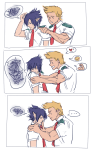
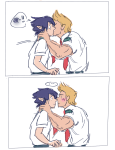
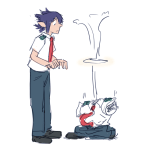
in honor of kiri’s birthday, here’s my piece for @takemyhandzine in which i drew kiri and baku taking each other’s hand (in marriage)… because that’s the title… of the zine……..




 just moving along like everyone else