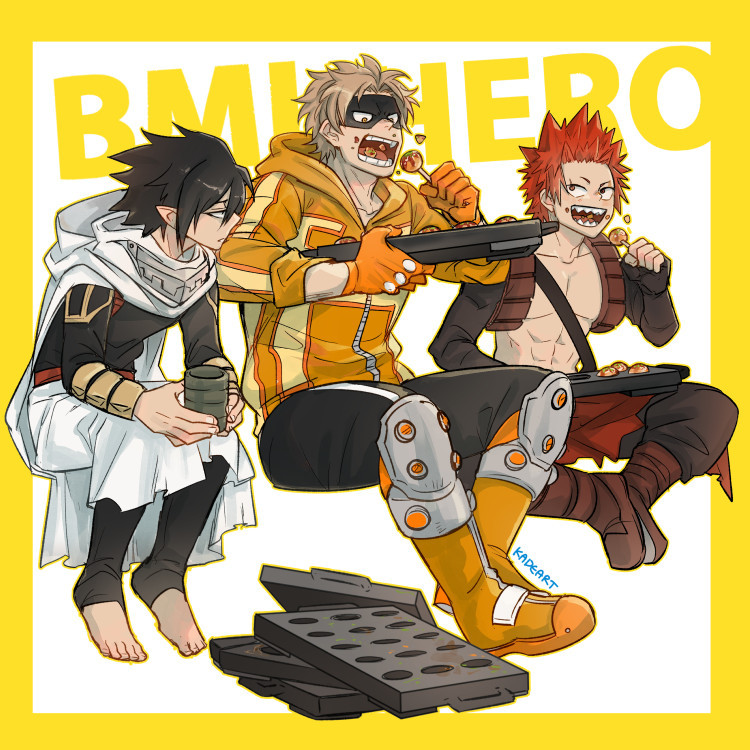
As much as I like to explore Kirishima’s softer side, I think a lot of people tend to forget that he’s actually very intense. He has convictions and boy is he not afraid to stand up for them, he’s loud and abrasive and he loves smashing things. He’s not just uwu soft boy, because he loves strength and manliness and to him that’s about being loud and brash and unafraid to stand up for what he believes in. Just, don’t take that intensity away from him?
Yeah, thank you for this.
I’ve been looking through the Kirishima Eijirou tag, trying to look for some badass posts of him, but the tag is just mostly about his soft side or of him acting like a dork or an idiot. It’s like people have forgotten the amazing badass he is.
How many of you have been banned from playing a bard in campaigns? I need to know for science.
For anyone that might ask- I had to sign a legally binding contract to not play bard characters if I wanted to join a campaign in my old group.
this is an outrage.
here’s what you do:
be a half-elf. the skill versatility trait is similar to the bard’s starting skill proficiencies
play a warlock. again, similar starting proficiencies. charisma is your spellcasting ability. very bardy
your otherworldly patron is the great old one. or the archfey. except call them your “otherworldly muse” or “otherworldly patron of the arts”
pick spells on the bard spell list, such as minor illusion, mage hand, dissonant whispers, or Tasha’s hideous laughter
take the entertainer background. much bard. wow.
choose pact of the blade if you’re a valor bard or pact of the tome if you’re a lore bard. i recommend the latter. pick the vicious mockery cantrip (because bard), as well as guidance and resistance (to emulate bardic inspiration)
for eldritch invocations, take beguiling influence for more skill proficiencies and book of ancient secrets to ape the bard’s magical secrets feature
if you miss having expertise, splash in a level or six of rogue, perhaps at fifth level
voila! you’re a bard in all but name. that’ll show ‘em
Software Creations: *in the middle of development for Solstice* Okay so we need an intro theme to set the mood. Something folky, like medieval times. Think you can try your hand at that?
Tim Fucking Follin: Yeah I got ya, check this out.
Software Creations: *barely seconds in*Ohhh yes finally, something that isn’t an overwhelming banger. You done good, Mr. Follin.
I’m perfectly capable of enjoying the idea of “person A, a hero, ‘saves’ person b, a villain, with the power of love” in a fictional context, and all the different ways it can play out, while also recognizing that it’s a bad idea to try to save someone from themselves if they’re dangerous in real life. I’m an adult and I understand the difference. My enjoyment if hero/villain ships in fiction does not inform my real life relationship choices. On the contrary, they allow a safe outlet me to explore and live out these ideas without suffering negative consequences in my real life.
This continued insistence by self-described feminists that I actually don’t know the difference, and am potentially endangering myself by consuming fiction featuring that trope, is not helpful. It’s not progressive or radical. It’s not liberating or empowering. It’s not “smashing the patriarchy.”
On the contrary, it’s nothing but a rehash of old misogynistic stand-bys: that women can’t be trusted to understand their own thoughts and emotions, that they have to be told what they feel and think and why, that women are blinded by innate naivety and compassion, or by sexual desire, that women need a guiding hand to protect them from their own bad judgment.
The fact that it’s women applying this to other women this time around. does not magically make it okay, does not make it less condescending, less patronizing, less violating. Women have been enforcing misogynistic social norms for other women for ages; this is nothing new. It’s no different than when my female Sunday school teachers told me that my body is inherently a temptation to sin, and I must take counter-measures to prevent others from falling from grace by covering it at the expense of my own comfort. It’s no different than when they told me that women who aren’t virgins are equivalent to chewed up gum or licked cupcakes. Sexism doesn’t stop being sexism because it’s enforced laterally.
It’s funny that these people keep implying that women who enjoy this fictional trope have a savior complex. From where I’m sitting, we aren’t the ones trying to save people who don’t need or want to be saved.
Honestly I think we need a name for this kind of condescending “it’s for their own good” themarysue-style fauxminism and I’m formally submitting “helicopter feminism” as that name.
if thanos wanted to kill off half of the population because there weren’t enough resources……..but then snapped half of the vegetation and animals (according to the russos)……..then isn’t he back at square one……………and there aren’t enough resources for the population……………
what about……..all of the empty and abandoned planets……..he couldn’t have restributed populations there? or like………..what about endangered species they’re pretty much gone now thanks to T Hanos…………..he really didn’t think this through………….
this is deadass what part 4 is gonna be. like he’s gonna realize “huh…. maybe this wasn’t a good idea” and reverse time.
Or he literally could have just doubled the resources
Maybe I’m wrong but all he would need is the Space Stone to teleport and redistribute resources + life. But I guess killing half of all life made more sense.
Or he could’ve just created more planets and teleported the halfs but a bitch is too dumb
He can throw a moon for a fight but teleporting some resources is too much work?
He can change reality but he uses it to fake his death and do a power point presentation?
He has the time stone, in which he could literally go back in time and save his home planet ….not by killing half of them …but by using these new powers?
The best way I can explain it, is that talent is something you have a particular natural aptitude for and skill is something you can acquire.
I’ve met plenty of talented and even gifted writers in my time, but a lot of them actually lack the skill to do anything with that talent. So they might churn out a golden phrase and an absolutely soul shaking concept here and there, but when it comes down to putting it on paper, they lack for fortitude to persevere with it.
Talent, after all, can make things feel like second nature, so when something doesn’t flow easily or is not perfect on the first or even second try, they lose interest because well, if they were talented this would be working out for them, but it’s not, so clearly there’s no point in trying. They’re just not Talented Enough.
This is a mindset I labored under for a lot of my teens and my early 20s. I am a talented writer, I was made aware of this by my elders using words like “gifted” and “extraordinary” a lot, right up until I hit college age and suddenly talent counted for absolute shit compared to those able to sit down and methodically work their way through something without having to wait for the lightning strike of genius to occur.
Which is when I had to go back and learn the actual skill of writing, and I’ve been honing it ever since, both through my work and through my personal meanderings in the written word.
By contrast, skill is something that is acquired, it’s a tool that you will spend years fiddling with to get it working the way you want it to. It takes whatever small aptitude you have for something, and provided you keep nurturing it and learning from your experiences, you will eventually improve. You can also, with significant mastery, make it look effortless like talent.
Combining the two should be a goal of any writer, however small or large their inherent talent is. Cause I’m telling you from experience, talent alone does not a success make. I’ve watched careers be built on talent and discovery, only for it to melt away in the wake of realizing they don’t actually know how to sustain what they’re doing. They burn out and fizzle before they really get a chance to shine. While on the other hand, I’ve seen plenty of skilled writers become absolute powerhouses of fiction because they found the formula that works for them, and they’re going at it like a dynamo.
Talent might get you noticed amidst the sea of voices all vying for attention, but it’ll be your skill that keeps you afloat.
Talent’s nice and all, I guess, but skill builds careers.






 just moving along like everyone else