Yeah, that is a good question – why do some scifi twist endings fail?
As a teenager obsessed with Rod Serling and the Twilight Zone, I bought every single one of Rod Serling’s guides to writing. I wanted to know what he knew.
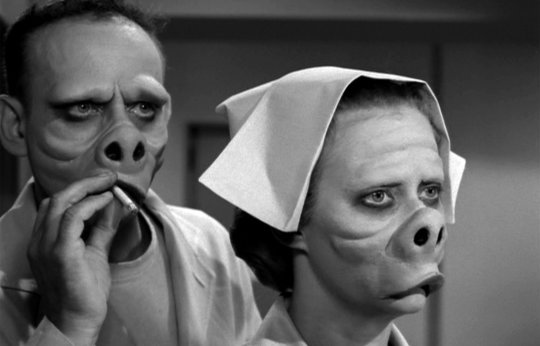
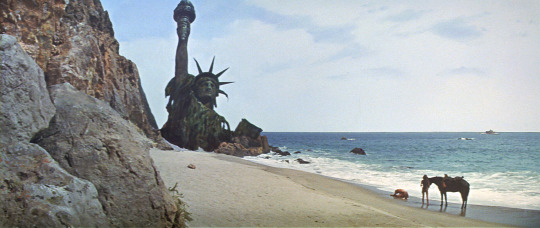
The reason that Rod Serling’s twist endings work is because they “answer the question” that the story raised in the first place. They are connected to the very clear reason to even tell the story at all. Rod’s story structures were all about starting off with a question, the way he did in his script for Planet of the Apes (yes, Rod Serling wrote the script for Planet of the Apes, which makes sense, since it feels like a Twilight Zone episode): “is mankind inherently violent and self-destructive?” The plot of Planet of the Apes argues the point back and forth, and finally, we get an answer to the question: the Planet of the Apes was earth, after we destroyed ourselves. The reason the ending has “oomph” is because it answers the question that the story asked.
According to Rod Serling, every story has three parts: proposal, argument, and conclusion. Proposal is where you express the idea the story will go over, like, “are humans violent and self destructive?” Argument is where the characters go back and forth on this, and conclusion is where you answer the question the story raised in a definitive and clear fashion.
The reason that a lot of twist endings like those of M. Night Shyamalan’s and a lot of the 1950s horror comics fail is that they’re just a thing that happens instead of being connected to the theme of the story.
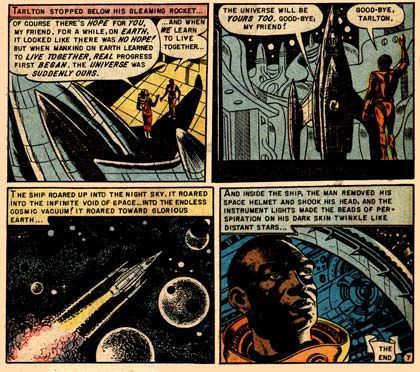
One of the most effective and memorable “final panels” in old scifi comics is EC Comics’ “Judgment Day,” where an astronaut from an enlightened earth visits a backward planet divided between orange and blue robots, where one group has more rights than the other. The point of the story is “is prejudice permanent, and will things ever get better?” And in the final panel, the astronaut from earth takes his helmet off and reveals he is a black man, answering the question the story raised.
IIRC “Judgment Day” was part of the inspiration for the excellent Star Trek: Deep Space Nine episode “Far Beyond the Stars.”
Mary was a beautiful baby, sweet and affectionate, but by the time she’s three she’s turned difficult and strange, with fey moods and a stubborn mouth that screams and bites but never says mama. But her mother’s well-used to hard work with little thanks, and when the village gossips wag their tongues she just shrugs, and pulls her difficult child away from their precious, perfect blossoms, before the bites draw blood. Mary’s mother doesn’t drown her in a bucket of saltwater, and she doesn’t take up the silver knife the wife of the village priest leaves out for her one Sunday brunch.
She gives her daughter yarn, instead, and instead of a rowan stake through her inhuman heart she gives her a child’s first loom, oak and ash. She lets her vicious, uncooperative fairy daughter entertain herself with games of her own devising, in as much peace and comfort as either of them can manage.
Mary grows up strangely, as a strange child would, learning everything in all the wrong order, and biting a great deal more than she should. But she also learns to weave, and takes to it with a grand passion. Soon enough she knows more than her mother–which isn’t all that much–and is striking out into unknown territory, turning out odd new knots and weaves, patterns as complex as spiderwebs and spellrings.
“Aren’t you clever,” her mother says, of her work, and leaves her to her wool and flax and whatnot. Mary’s not biting anymore, and she smiles more than she frowns, and that’s about as much, her mother figures, as anyone should hope for from their child.
Mary still cries sometimes, when the other girls reject her for her strange graces, her odd slow way of talking, her restless reaching fluttering hands that have learned to spin but never to settle. The other girls call her freak, witchblood, hobgoblin.
“I don’t remember girls being quite so stupid when I was that age,” her mother says, brushing Mary’s hair smooth and steady like they’ve both learned to enjoy, smooth as a skein of silk. “Time was, you knew not to insult anyone you might need to flatter later. ‘Specially when you don’t know if they’re going to grow wings or horns or whatnot. Serve ‘em all right if you ever figure out curses.”
“I want to go back,” Mary says. “I want to go home, to where I came from, where there’s people like me. If I’m a fairy’s child I should be in fairyland, and no one would call me a freak.”
“Aye, well, I’d miss you though,” her mother says. “And I expect there’s stupid folk everywhere, even in fairyland. Cruel folk, too. You just have to make the best of things where you are, being my child instead.”
Mary learns to read well enough, in between the weaving, especially when her mother tracks down the traveling booktraders and comes home with slim, precious manuals on dyes and stains and mordants, on pigments and patterns, diagrams too arcane for her own eyes but which make her daughter’s eyes shine.
“We need an herb garden,” her daughter says, hands busy, flipping from page to page, pulling on her hair, twisting in her skirt, itching for a project. “Yarrow, and madder, and woad and weld…”
“Well, start digging,” her mother says. “Won’t do you a harm to get out of the house now’n then.”
Mary doesn’t like dirt but she’s learned determination well enough from her mother. She digs and digs, and plants what she’s given, and the first year doesn’t turn out so well but the second’s better, and by the third a cauldron’s always simmering something over the fire, and Mary’s taking in orders from girls five years older or more, turning out vivid bolts and spools and skeins of red and gold and blue, restless fingers dancing like they’ve summoned down the rainbow. Her mother figures she probably has.
“Just as well you never got the hang of curses,” she says, admiring her bright new skirts. “I like this sort of trick a lot better.”
Mary smiles, rocking back and forth on her heels, fingers already fluttering to find the next project.
She finally grows up tall and fair, if a bit stooped and squinty, and time and age seem to calm her unhappy mouth about as well as it does for human children. Word gets around she never lies or breaks a bargain, and if the first seems odd for a fairy’s child then the second one seems fit enough. The undyed stacks of taken orders grow taller, the dyed lots of filled orders grow brighter, the loom in the corner for Mary’s own creations grows stranger and more complex. Mary’s hands callus just like her mother’s, become as strong and tough and smooth as the oak and ash of her needles and frames, though they never fall still.
“Do you ever wonder what your real daughter would be like?” the priest’s wife asks, once.
Mary’s mother snorts. “She wouldn’t be worth a damn at weaving,” she says. “Lord knows I never was. No, I’ll keep what I’ve been given and thank the givers kindly. It was a fair enough trade for me. Good day, ma’am.”
Mary brings her mother sweet chamomile tea, that night, and a warm shawl in all the colors of a garden, and a hairbrush. In the morning, the priest’s son comes round, with payment for his mother’s pretty new dress and a shy smile just for Mary. He thinks her hair is nice, and her hands are even nicer, vibrant in their strength and skill and endless motion.
people who encourage calling the cops in case of domestic violence situations have obv never had the cops called in domestically violent situations.
they’ll arrest & endanger the victim’s ass too. especially if they’re nonwhite & undocumented, and almost always is detrimental. so NO don’t encourage people to call 911 n ask for pepperoni pizza.
it’s better to document instances of abuse, HAVE A SAFETY PLAN, then leave and take legal action that you have control over.



 just moving along like everyone else