Mistake 1: Growing from seed. When you first start out trying to grow fresh herbs, I recommend you begin by trying to grow from seedlings rather than planting your own seeds. These great little starter plants are widely available in grocery stores in the late spring. For the same price as a packet of fresh herbs from the produce section, you can buy your own little starter plant. Lots can go wrong in the seed to seedling transition (including not thinning out plants properly), so its probably best to begin by skipping that complicated task or you are in danger of washing out before you really begin.
Mistake 2: Starting with the wrong varieties. I recommend you start by trying to grow fresh basil. It is the perfect trainer herb. First, basil grows quickly, allowing you to observe the effects of your care more easily. Second, basil leaves wilt visibly when not watered enough, but recovers well if you water the wilted plant. This makes basil a great ‘canary in the mineshaft’ to help you figure out how much water is enough.
Mistake 3: Watering herbs like houseplants. Instead, water herbs a moderate amount every day. While some houseplants flourish with one solid watering per week, most delicate herbs require moderate and regular watering. This is particularly true during hot summer months. If you have good drainage at the bottom of your pot (at least a drainage hole, possibly rocks beneath the soil), it will be difficult to water herbs too much.
Mistake 4: Not cutting early and often. As a novice gardener, it may seem like your puny little plant just isn’t ready for a trip to the barber, but then you will find yourself sitting there wishing for leaves without much success. Again, basil is a great herb to practice pruning. As with all herbs, you want to cut the herb just above a set of growing leaves. With basil, when you cut the plant that way, the originally trimmed stem will no longer grow. However, two new stems will grow around the original cutting, creating a “V” shape (see the photo above, can you spot the Vs?). If you don’t trim basil aggressively, it will continue to grow straight up, and become too tall and top-heavy. Making your first trim approximately 3-4” above the soil produces a nice sturdy plant. Of course you want to be sure you are always leaving a few good sturdy leaves on the plant (see below). As it continues to grow, continue to prune it approximately every 3-4" for a nice solid plant. I like to let it grow for some time and then cut back to within 2-3 inches of the original cut. After only a few early trial cuts, this usually makes for a nice clipping with plenty of basil to use for a pizza.
Mistake 5: Taking the leaves from the wrong place. When you are just starting out it seems to make so much sense to pick off a few big leaves around the bottom of the plant, and let those tender little guys at the top keep growing. Wrong. Leave those large tough old guys at the bottom alone. They are the solar panels that power your herb’s growth. Once your plant is big enough to sustain a decent harvest, keep on taking from the top, as you have been when you were pruning. That way you get all those tender new herbs that are so tasty, and your plant gets to keep its well developed solar power system in place. Plus, if you pluck from the base and leave the top intact, you get a tall skinny plant that will flop over from its own weight (and yes, I know this from experience). When you pluck from the top, instead of clipping off just below a pair of leaves, you want to clip off just above a pair of leaves. It is a bit counter-intuitive as a novice, but trust me it works. The place where the leaf joins the stem is where new growth will occur when your plant sends off new stems in a V.
Mistake 6: Letting your plants get too randy. If you are pruning regularly, this may never become an issue, but unless you are growing something for its edible flowers, be sure to cut back herbs before they start growing flowers. My friend once brought me to her backyard garden and pointed, frustrated, at her wimpy, small basil plants. “I just keep tending them, but they don’t even produce enough leaves to put on a salad!” she lamented. I pointed to the glorious stalk of flowers at the top of each plant, “That’s your problem” I explained. Because herbs are kind of like college boys: if you give them half a chance, they will focus all their energy on procreation and neglect growth. If you want leaves, keep cutting off the little flower buds whenever you find them (see photo above), and it will encourage your plant to focus on growing more leaves.
Mistake 7: Using tired soil with no nutrients. Tired soil that has been sitting in your garden or lawn for ages often looks grey and a little depressing. Would you want to grow in that stuff? Give your plants a dose of the good stuff and they’ll thank you for it. I grow my herbs in a combination of potting soil, used coffee grounds (with a near-neutral PH, available for free at Starbucks), and organic compost. If I have some on hand, I also throw in crushed egg shells. Those without access to compost (and no deep commitment to organic growing) may find Miracle grow useful. My momma swears by it for tomatoes. A diluted solution of Miracle grow occasionally can help many herbs flourish.
Mistake 8: Getting in a rut. There is an element to passion about herb gardening. In order to be good at it, you need to feel rewarded. So don’t stick too long with one or two herbs just because they work. Branch out to a few other basic herbs that you will use regularly in your kitchen. There are few things more rewarding as an urban foodie than being able to pop out to the fire escape to clip fresh herbs to use in my cooking. Once you have become comfortable with basil, I recommend moving on to try growing oregano, mint, rosemary and thyme. All are regularly useful herbs in the kitchen, and all are relatively easy to grow. You will notice that rosemary cleaves after cutting in a somewhat similar way to basil, but grows much more slowly, so the effect is difficult to notice. Some plants also respond to clipping by throwing out more full leaves at their base. I have long wanted to grow cilantro but have not had much luck with it.
Mistake 9: You mean there’s more than one kind of mint?When choosing herbs, read the label carefully. For example, there are two main varieties of oregano: Mediterranean and Mexican. Mediterranean oregano is the more common variety, and what you likely own if you have conventional dried oregano in your cupboard. I have Mexican oregano growing on my back fire escape. I love Mexican oregano in spicy dishes, for making beans from scratch, and often use it in tomato dishes where I don’t want the flavor to seem too much like marinara. Similarly, there are many different kinds of mint. You don’t want to be thinking of the pungent spearmint plant and accidentally take home the much more subtle (and not mojito savvy) applemint by mistake.
Mistake 10: Feed me Seymour! If you are planting in soil instead of pots, take care that your cute little herb seedling doesn’t become a giant plant that takes over your garden. A word of warning for oregano and mint: both can be voracious growers. If you are planting outside in a garden, rather than in pots, you may want to consider potting these herbs and then burying the pots in the ground. This will add a measure of control to the root systems of these herbs, which can otherwise take over a garden and strangle nearby neighbors. When in doubt, check out wikipedia, they usually are careful to point out which herbs are in danger of overwhelming your garden.
Some really useful info here if you’re new to herb gardening.
What if the horrible answer is I don’t think elves have casual sex and I’m fine with them all being insectile monogamists? …………. nooooo uhhhhhh hhhhhh I… still pretty much stand by “all sex is casual if it’s not telepathic” …. I guess I should pick a specific elf to talk about, it’s just, my answers for that are horrible too. I suspect Nerdanel and Fëanor managed to have a LOT of premarital sex through innovative, like, psychic blindfolds, and also that Nerdanel wanted to keep doing kinky willpower-based contraception while Fëanor was begging her for kids. It’s like orgasm denial but instead Fëanor is sitting there TRYING to push half a soul out and Nerdanel is jamming it back up the spout
“Listen!” cried the bard. “Listen, good folk and I shall tell a tale such as never you have heard before.”
The taproom of the Prancing Pony stilled and quieted, which said much for the skill of his voice, or of the mannish want for new stories.
“The Dark Lord is thrown down and a king crowned in the West!” the bard went on, leaping up onto a table and drawing out his harp. “But Sauron – yes! I shall speak his name! – is not the first nor the greatest foe of the free peoples, and there are kings that sit e’en now in a West more distant than Gondor. A flagon of ale and a warm bed for the night, and I shall tell you of the fall of Morgoth, and the fall, too, of the great Elvenkings of old. I shall sing to you the Noldolantë, as was first sung by Maglor Fëanorian, the greatest bard to ever walk this earth.”
Barliman Butterbur looked around at the crowded taproom and the folk squeezing in from the stables as the news spread and decided he knew a good deal when he heard it. He filled the requested flagon and handed it up.
The bard drained it in one long gulp, wiped his mouth upon his sleeve and struck another cord. “There was a man – a prince! The greatest of all princes! – and he had seven sons-”
It was a long story, but a good one. Barliman liked the clever maiden in the vampire fell even if he couldn’t quite keep up with all the Fins – what kind of names were those, he asked you? – and much of it was sadder than he liked. But it kept the patrons in and kept them drinking, which was more than enough to recommend it to him.
The young bard told the story well, slipping into the characters like they were well-worn boots and a favourite jacket. He was a handsome fellow, bright-eyed with hair as raven-dark as the plumes in his fine hat, and the flames licking in the hearth threw shadows across his features that made him seem now fair and merry, now old and fell as a grizzled wolf in keeping with the characters in his tale.
When he was done with his tale, had accepted another flagon of ale and refused, despite much pleading, to do an encore, the room started to empty out, the patrons wending their way home or upstairs to their beds.
“Here now, though,” said Barliman, pausing with his hands full of empty jugs and greasy plates. “What about that last fellow? You never said what happened to the second son.” He was an innkeep after all and every innkeep has a sense for when he’s been cheated.
“Faded from grief,” said the bard, wearily for it had been a long performance. “Or drowned with Beleriand. Returned to the West when the weight of his sins grew too great for even his proud shoulders to bear up under. Or perhaps,” – he leant in closer and Barliman was not sure why he’d thought this old man young. “Perhaps he lingers still upon these shores. Haunting the woods, and singing sad songs beside forgotten pools. Perhaps he steals away Mannish children to raise as his own, scions of his dead house.”
“Not around here, I shouldn’t think,” Barliman huffed indignantly. “That may have gone over in that drowned country but we have a proper king now and he wouldn’t hold with stolen children.”
The bard laughed merrily. “Of course, of course. The poor fellow’s surely dead, but I’ve long found a neat ending, all tied up in a bow, makes for a poorer story. A more forgettable one, certainly, and I would not have poor Maglor fade from history altogether. Now if you’ll excuse me, I am for my bed.” His hard heeled boots rang on the stairs as he picked his way up them.
His words rang on in Barliman’s mind a good while longer. After the tables were wiped down and Barliman was in his nightshirt blowing out the candle, he thought about that wanderer, weeping upon the cold sand of a distant shore.
All innkeeps have a sense for when they’ve been cheated and a new thought tickled at the back of Barliman’s mind.
But the bed was soft, the hour was late and Barliman never had had much luck in recognising kings.
someone created a random generator that creates randomized inspirational quotes overlaid on random images in a soothing fashion and each and every image is comic gold
it’s pretty much the best thing ever and here are some of my favorites so far
so good
I’m getting this one made into a motivational poster for my home office
See, you were trying to sneak around it with that start on muscle mass but this is about the idea that women can fight and or fight as well as a man. We get these questions a lot, and the answer is always the same. However, the question itself always displays the asker’s ignorance on the subject matter and about combat in general. You aren’t the first to go, “but boxing!!!” as if it means something or is a winning point. Usually, “muscles” is a go to standard because that’s what so many have been led to believe makes men superior.
When I get these questions, I can always tell this person who asked has never been to a martial arts competition of any kind. If they had, they would know Women’s Divisions are a standard practice. They would also know that with an exception of major tournaments where there are enough participants to justify it, the girls and the boys spar each other at the ranks below black belt. Sometimes, the boys win. Sometimes, the girls win. The breakdown is by age (adults/kids) and belt rank, not by gender.
I’ll tell you though, none of the boy’s in the black belt division
wanted to jump in with the girls. Those girls were vicious. Men’s
sparring was much more laid back, and slower. Women’s TKD… yeesh.
Again, in most martial arts tournaments there are no weight classes. The breakdown is by age and rank, with gender as a secondary when there are enough participants to justify multiple divisions. Weight classes are a boxing tradition and other, similar bloodsports which rears it’s head when they have enough participants to justify one. In many Taekwondo tournaments, you can easily end up with a 150 pound black belt sparring one weighing in at 250. And you won’t know what they weigh anyway because there is no “weighing in”.
I’ve explained before why there are weight classes in boxing. The moment you stop and realize that it’s a sport with a purpose to make money, the reasoning behind the weight classes will become fairly clear. (Hint: it’s entertainment and aesthetics.)
That said, the “boxing champions are generally men” crap is, well, crap. They don’t let women box men professionally, or at the collegiate level. It’s hard to make a case for muscle mass when citing professional sports where women are barred from competing. Now, there was a time when there were women boxers who boxed with each other and against men. In the 1800s, it was called bareknuckle boxing. This is the granddaddy version of modern boxing, when it was all back alleys without gloves or handwraps.
That said, women’s boxing is making a comeback at the collegiate level. There’s a National Champion in Women’s Collegiate Boxing walking around somewhere in the US right now. There are multiple female martial arts champions from a variety of disciplines wandering around all over the world. The UFC has opened a division for female fighters. This is like asking why there aren’t female wrestlers (there are) or female quarterbacks (there are).
One of the greatest snipers in history is a woman.
You just don’t hear about them or the women who did the hard work pushing back to fight for the categories to be re-added.
That said, comparing the restrictions applied in sports to a person’s “fighting ability” is a mistake. You’re not asking an honest question so much as floundering for a popular misconception. It’s essentially the same as saying, “it’s ridiculous for there to be female fighters in this historical fiction because there were no female warriors”.
1) That assertion is patently false.
2) When one gender is barred from participating by the established rules of a modern sport whose history you don’t understand, you can’t then turn around and ask why most of the champions are men.
History makes a case for a lot of female combatants throughout history, but you’re not going to know they’re there if you don’t go looking for them. Their accomplishments tend to get wiped out.
a safer way to overshare: project onto a fictional character so hard that sharing your headcanons is basically exposing your deepest secrets, but it’s fine, because no one has to Know
The answer is apparently “because we’re actually able to eat it”
Fun fact: white people (specifically Northern European white people) have a genetic mutation that allows them to digest lactose even after weaning, which is abnormal for all mammals and also most humans. It’s theorized that because Northern Europe doesn’t get a lot of sun, an alternative source of vitamin D (like milk) would be a useful trait. It’s a very recent mutation that would only have happened after humans started domesticating animals like cows and goats.
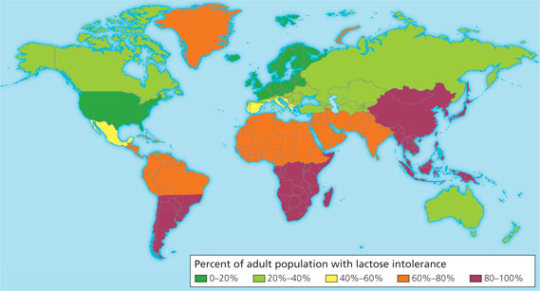
oh no, my bizarre moment has come, cause lactose tolerance is actually A Thing I Know About because it’s played a fascinating role in human evolution for thousands of years. This chart displays some of the broad trends, but it’s giving near continental averages, which doesn’t showcase how this kind of thing really breaks down and some of the surprising exceptions.
Lactose tolerance is the majority trait for only a very few population groups: North Europeans (and therefore populations that draw heavily from that stock, such as America,) nomadic central Eurasians, and sub-Saharan pastoralist Africans, but that latter group is often overlooked. The vast majority of Africans cannot process lactose, but certain people groups whose lifestyles have revolved around cattle for thousands of years will have 80% and even approaching 100% lactose tolerance rates. They’d be spots of dark green amidst a sea of orange and burgundy on the above chart.
Our hunter-gatherer ancestors were almost entirely lactose intolerant, that is definitely the biological norm (and people groups who maintained that lifestyle, such as Native Americans, remained as such – along with groups who transitioned to sedentary agricultural lifestyles, but I’ll get into that). As such, lactose tolerance is an adaptive trait that only became prevalent in environments that exerted strong selective pressure for it. So, cows were domesticated some 10,000 odd years ago in the Middle East (and some have contended for an independent domestication event in Africa as well). In either case, cattle quickly spread across the continent and we know there was milking and cheese production at least 6,000 years ago in both the Nile and Mesopotamia. While cow meat would have been enjoyed by all, in agricultural societies milk and cheese would have been options, but hardly staples as there were plenty of other things to eat as well, and therefore there would have been no selective pressure for processing lactose. Also, sedentary societies had ways of processing milk and cheese that allowed lactose intolerant people to drink/eat dairy products. Fermenting milk or aging cheese breaks down lactose, making it a non issue once ingested. This is why fermented milk may seem utterly foul to many Westerners, but is extremely common in other parts of the world. But, fermentation and aging requires time, and the ability to store things in a single location for weeks or even months. Sedentary societies adapted the milk to fit their biology, but nomadic societies did the reverse.
There are still mobile pastoralist societies in Africa today, and there have been for thousands and thousands of years. For many of them, cows are not one of many dietary options, they are the single dietary staple around which their lifestyle revolves. Biologically, this means you gotta get with the program if you wanna survive. For most mobile tribes, fermentation and aging weren’t options, so there would have been strong selective pressure favoring those who could drink milk straight outta the cow, as they would have had an additional, highly nutritious food source available to them. Milk also allowed for a marked shortening of the weaning process, transitioning children from breastmilk to cow’s milk, which would again be advantageous for groups where both the men and women work and are always on the move. Over generations these populations specialized into essentially cow-based lifestyles, creating a survival niche highly advantageous to them, and fast forward thousands of years and there are groups in Africa with near ubiquitous lactose tolerance, while the rest of the continent (and the world really) is nearly entirely intolerant.
Many of these same factors would have influenced the central Eurasian populations, which is why Mongolians and other descendants of nomadic steppe peoples are largely lactose tolerant, as mare’s milk would have been a dietary staple (though they also developed efficient ways to ferment it).
North Europeans developed lactose tolerance in response to deficiencies in certain nutrients. The northern climate limited Vitamin D production, and the agricultural products available to them were often low on calcium and protein, and so dairy farming developed alongside agriculture to create a more rounded diet (and this was limited to Northern Europeans, as Mediterranean peoples such as the Romans wrote about their great confusion at the northern barbarians’ ability to drink fresh milk)
And I promise all of this is fascinating because the ability to process lactose evolved independently in several different population groups and in response to different factors: lifestyles revolving around cows, lifestyles revolving around horses, deficiencies in climate and agriculture. Besides providing insight into human history and biology, lactose tolerance is also a great example of convergent evolution, where different genetic populations in different environments produce similar results.
And uh, that’s my rant about the role of milk and lactose tolerance in human evolution.
Beautifully written, very concise and informative. Good stuff. Interesting stuff. Thanks for your input.
This explains a lot about my family, actually.
as a descendent of nomadic central asians on my dad’s side, and celts and vikings on my mom’s, i am double plus dairy certified and should probably just buy a cow.






 just moving along like everyone else